The Central Plains War
The Central Plains War was a large-scale civil war in 1930 between Chiang Kai-shek’s Nanjing National Government and an anti-Chiang alliance led by Yan Xishan, Feng Yuxiang and Li Zongren. Yan assumed command against Chiang on 1 April, and from May fighting spread across Henan, Shandong and beyond, involving more than a million troops. The anti-Chiang factions also convened a Kuomintang “Enlarged Conference” in Beiping and in September proclaimed a rival National Government headed by Yan. On 18 September Zhang Xueliang, hitherto neutral, called for a ceasefire and sent the Northeastern Army south of the Great Wall, and the Beiping government dissolved. Government troops took Xi’an at the end of October, and on 4 November Yan and Feng announced their retirement. Zhang emerged dominant in North China, and Chiang soon turned his armies against the Communist base areas.
The Anti-Chiang Alliance and the War of Telegrams
After the Northern Expedition and the Northeast Flag Replacement, the Nanjing National Government had nominally unified China, but conflict among the major military groupings continued. According to the History of the Communist Party of China compiled by the CPC Central Party History Research Office, the Chiang–Guangxi War broke out in the spring of 1929, followed by fierce struggles among Chiang Kai-shek, Yan Xishan and Feng Yuxiang and by anti-Chiang moves involving Zhang Fakui, Tang Shengzhi, Shi Yousan and others; after these failed, Yan, Feng, Li Zongren and others began consultations in January 1930 and in March formed an anti-Chiang alliance headed by Yan. A 2014 investigation report of the Control Yuan of the Republic of China says that “measures to reduce and reorganise the armed forces set off the Central Plains War.”
From February 1930 Yan Xishan and Chiang Kai-shek fought a war of circular telegrams. According to reports by the U.S. minister in China, Nelson T. Johnson, Yan telegraphed Chiang on 10 February that “force cannot be depended upon as an ultimate arbiter” and recommended “that we both retire for the benefit of the country”; Chiang replied on the 12th that he too wished to retire but could not do so until the revolt in Guangxi had been suppressed. On the 15th Zhang Xueliang urged both men to settle their differences peacefully. On the 21st Chiang accused Yan of mobilising his army to fight the Central Government and told him to demobilise and to release Feng Yuxiang, whom Yan had in effect been holding near Taiyuan. On the 24th Yan sent another telegram said to bear, besides his own, the names of Feng, Li Zongren and 42 other generals, though some of the generals later denied having signed it. On 28 February Feng left for Taiyuan escorted by Yan.
Yan Xishan Takes Command
The U.S. legation’s report on March said the break was now clean, with China divided into two camps, North and South, although the leaders on both sides emphasised that no geographical or political issue was at stake, “it being a question of personalities.” Yan took over the railways, telegraphs and all revenue-producing administrations in Beiping and Tianjin, leaving only the Maritime Customs in Nanjing’s hands, while Feng, with Yan’s acquiescence, went to Tongguan to take command of the Guominjun. On 1 April Yan assumed office as Commander-in-Chief of the Army, Navy and Air Forces of the Republic of China, telling the foreign envoys that he had sworn to lead a punitive campaign against “a certain person” illegally occupying the Central Government; Feng and Li Zongren were his deputies.
According to an estimate of 21 April by the legation’s military attaché, the Nanjing government had some 715,000 troops and the anti-Chiang coalition some 872,000, while Zhang Xueliang’s Northeastern Frontier Defense Forces, about 409,000 strong, remained neutral. The legation remarked that neither side’s announced aim—Chiang’s maintenance of unity, Yan’s establishment of a “legal” government by removing the allegedly corrupt Chiang family—aroused any enthusiasm among the Chinese people.
The Longhai, Jinpu and Hunan Fronts
According to the History of the Communist Party of China, in early May Yan and Feng opened a large-scale war against Chiang on three fronts in the Central Plains and southwestern Shandong, while Li Zongren and Zhang Fakui attacked on the Hunan–Guangdong–Guangxi border; more than one million troops were engaged in all, at a cost of some 500 million yuan. The main front lay along the Longhai Railway. The U.S. legation reported severe fighting there at the end of May, with Nanjing’s forces at first successful but later suffering serious reverses and many casualties on both sides; by early June the front at Xuzhou was at a stalemate and Xuzhou was crowded with uncared-for wounded. Between 18 and 26 June Nanjing’s forces advanced to within a few miles of Kaifeng before Feng held them in check, and in July Feng’s Guominjun, about 200,000 strong, was still deadlocked with Nanjing’s troops on the Longhai line.
In the south, forces under Zhang Fakui, Li Zongren and Bai Chongxi entered Hunan and took Changsha on 5 June with scarcely any resistance; He Jian retook the city on the 17th and the Guangxi troops withdrew eastward. In Shandong, Shanxi troops captured Jinan on 25 June and Nanjing’s commander Han Fuju withdrew to the east. According to an article from Dangshi Bolan republished by rmzxw.com.cn, Chen Cheng’s 11th Division fired its first shot of the war at Mamuji on the Longhai line and later relieved the siege of Qufu; Chiang then expanded the division into the 18th Army with Chen as its commander. On 2 August Chiang launched an offensive on Jinan with some 100,000 of his best troops and retook the city on 15 August; the Shanxi forces were driven back across the Yellow River and Shandong largely returned to Nanjing’s control.
The Enlarged Conference and a Rival Government in Beiping
While the armies were deadlocked, the anti-Chiang camp set up a rival political centre. On 13 July the “Enlarged Plenary Session of the Central Headquarters of the Kuomintang” held its inaugural meeting in Beiping, bringing together the party’s Left Wing under Wang Jingwei and the Right Wing (the Western Hills group) represented by Xie Chi; according to the U.S. legation, one of its purposes was to invalidate the Third National Congress held in Nanjing in March 1929. Wang, who came to Beiping in July, told interviewers: “If we want to complete the national revolution, there is no alternative but to overthrow the personal dictatorship of Chiang Kai-shek.” The conference held its first formal meeting on 7 August; its manifesto called for a people’s conference as soon as possible and a provisional code (yuefa) for the period of political tutelage. On 1 September its fifth formal meeting promulgated a General Outline of Organization of the National Government, with Yan Xishan as chairman of the State Council and Tang Shaoyi, Wang Jingwei, Feng Yuxiang, Zhang Xueliang, Li Zongren and Xie Chi as members. Yan arrived in Beiping on 7 September and was sworn in early on the morning of 9 September.
Not everyone named accepted. The U.S. consul general at Mukden reported that Zhang Xueliang’s name had obviously been used without his consent, and in early September Zhang telegraphed Yan demanding an explanation; Wellington Koo, slated to become foreign minister, also declined, and Tang Shaoyi stayed in the south.
Zhang Xueliang Enters the Pass
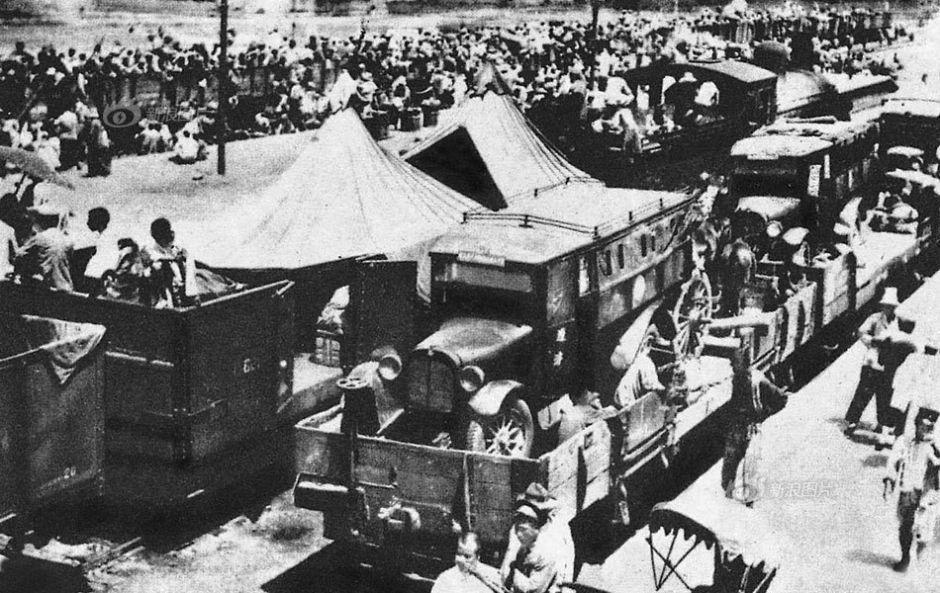
For most of the war Zhang Xueliang stayed neutral. In June the Nanjing government gazetted him as Vice Commander-in-Chief of the Army, Navy and Air Forces, an appointment he did not accept, and both sides kept sending emissaries to win him over. On 10 September the U.S. consul general at Mukden reported that Zhang was inclined to side with Chiang but did not want to see southern troops occupy Hebei. The Northeastern Political Council met in Mukden from 10 to 17 September. On 18 September Zhang issued a circular telegram (the “Qiao telegram”) appealing to all sides for an immediate cessation of hostilities and declaring that “in order to undertake the reconstruction of China the first essential is to eliminate warfare”; the mobilisation order had already been given, and on the 19th the first troops entrained for Tianjin. They reached the outskirts of Tianjin on the 20th, when the Beiping government dissolved and Wang Jingwei and his colleagues left for Shijiazhuang; on the 22nd the vanguard reached Beiping, and the Beiping–Tianjin area was taken over without bloodshed. Nanjing then appointed Wang Shuchang chairman of Hebei and Yu Xuezhong garrison commander of Beiping and Tianjin.
In late September Zhang told a Reuters correspondent that his intervention had been delayed by the need to arrange details with Nanjing first. The U.S. legation’s report on September listed several considerations that may have shaped his decision: the discovery in August of a mutiny plot in his army allegedly instigated by Nanjing, the fall of Jinan on 15 August, Manchurian anxiety about the spread of “communism” south of the Wall, and his determination to keep control of the Beiping–Mukden Railway. Once the Northeastern Army had entered the Pass, the Shanxi and Guominjun forces lost their outlet to the outside world through Tianjin.
The Retirement of Yan and Feng and the Postwar Settlement
In Henan Chiang concentrated some 27 divisions in the Kaifeng–Zhengzhou area by early September and launched an offensive, and there was severe fighting from 7 to 16 September; on the 25th Feng was forced to give up Lanfeng, one of his strongest positions on the Longhai line, and then fell back toward Shaanxi. According to the U.S. legation, the civil war may be said to have ended when government troops occupied Xi’an on 27 October. On 3 October Chiang telegraphed Nanjing from the front proposing an amnesty for all rebel leaders except Yan Xishan, Chen Jiongming and the communists, saying, “I am not free from reproach and should, therefore, not be hard on others.” On 9 October Zhang Xueliang was sworn in as Vice Commander-in-Chief.
Using Chiang’s and Yan’s papers held by the Academia Historica in Taipei, the Taiwanese researcher Huang Yu-fang shows that the Shanxi side asked that Yan be allowed simply to retire to Wutai and that Shanxi generals keep Shanxi, Chahar and Suiyuan; Chiang judged these demands excessive, ordered He Yingqin to bomb Taiyuan, Jincheng, Tongguan and other places daily from 28 October, and warned that unless Yan left Shanxi to go abroad the centre would not discuss the rehabilitation of Shanxi and the Shanxi army would get no funds; on 30 October Yan agreed to step down and leave. The U.S. legation reported that the people of Shanxi suffered casualties for the first time only when Nanjing bombers attacked Taiyuan and other cities in October and November. On 4 November Yan and Feng jointly announced their retirement. In his circular Yan said he had tried to persuade Chiang, Feng and Wang Jingwei all to resign so as to create democratic party politics, but because of opposition in Nanjing he “was forced to meet them in the battlefield,” and that he had now “lost nearly all of my military strength.”
On 12 November Zhang Xueliang arrived in Nanjing and held repeated talks with Chiang. The U.S. legation understood that Zhang agreed to let Nanjing collect the salt and tobacco revenues in Manchuria and to limit his army to 150,000 men; Huang Yu-fang, citing Chiang’s papers, notes that Chiang in principle left northern affairs to Zhang and handed him the reorganisation of the Shanxi army, concluding that “Chiang forced Yan out, but Zhang became the greatest beneficiary.” In December Zhang conferred in Tianjin with Shanxi and Guominjun commanders about demobilisation; about 160,000 Shanxi troops and 80,000 Guominjun troops were estimated still to be under arms. On 22 December Yan left Tianjin for Dalian, declaring that he had “no intention whatever to return into China’s political life in future,” while Feng stayed in Shanxi. Huang notes that Yan did not go abroad as he had said and returned to Shanxi with Japanese help on 5 August 1931.
Differing Accounts
The belligerents each had their own account at the time. Nanjing’s foreign minister, C. T. Wang, told the American minister that this was a struggle between two ideas—Sun Yat-sen’s unified China against a confederation of a few autonomous areas under independent heads, which amounted to “a reversion to semi-feudalism”—and in October Chiang declared, “I am firmly convinced that the present war is the last one fought for the cause of unification in China.” The northern coalition presented its cause as the establishment of a “legal” government and the overthrow of Chiang’s “personal dictatorship.” The Communists at the time regarded the conflict as a “war over the division of spoils” among warlords; in May 1930 Wang Ming called in the party journal Bolshevik for “turning the warlord war into a revolutionary civil war.” According to the History of the Communist Party of China, Li Lisan and others concluded after the war broke out that the revolutionary situation had matured nationwide, and the Politburo’s resolution of 11 June put the “Left” adventurist line in control of the party centre. After the war ended, Chiang promptly massed troops for “encirclement campaigns” against the revolutionary base areas.
Later accounts differ in emphasis. CPC party history calls it the “Central Plains War between the Kuomintang new warlords,” describes the unification after the Northeast Flag Replacement as merely “superficial,” and says the warlord wars “objectively provided favourable conditions for the growth of revolutionary forces.” The Control Yuan report in Taiwan stresses Zhang Xueliang’s telegram and his willingness “to carry out an armed mediation in the Central Plains War.” The U.S. legation at the time judged that Zhang intervened only when the Shansi cause seemed hopeless, so that his intervention “may have saved the ‘rebel armies’ from complete destruction at the hands of Chiang,” and that the victory over Yan and Feng was “largely a personal triumph” for Chiang. On casualties, the legation said only that there had been “unusual losses on both sides”; no reliable figures were found for this entry.
Gallery
Narrative Comparison
| Source | Narrative |
|---|---|
| CPC Central Party History Research Office, History of the Communist Party of China, vol. 1 (Qiushi online, 2019) | CPC party history calls it a “Central Plains War between the Kuomintang new warlords,” arguing that the fall of the Beiyang warlords and the Northeast flag change had brought only a “superficial national unification.” Warlord politics was “based on the private ownership of armies, forming warlord separatism,” and the factions fought above all for “control of the Kuomintang central government.” The incessant wars deepened the people’s suffering and “objectively provided favourable conditions for the growth of revolutionary forces”; as soon as the war ended Chiang massed troops for “encirclement campaigns” against the base areas. |
| Control Yuan of the Republic of China, investigation report (2014); Huang Yu-fang, MA thesis, National Chengchi University (2004) | The Control Yuan report says that after formal unification “measures to reduce and reorganise the armed forces set off the Central Plains War”; judging Chiang “somewhat superior” to the northern warlords’ alliance, Zhang Xueliang issued his telegram of 18 September 1930 declaring himself “willing to carry out an armed mediation in the Central Plains War,” and became “the most sought-after figure of the day.” Drawing on Chiang’s and Yan’s papers in the Academia Historica, Huang Yu-fang describes how Chiang used air raids and the withholding of funds to force Yan out of Shanxi, and concludes that “Zhang became the greatest beneficiary.” |
| Monthly reports of Minister Nelson T. Johnson to the Secretary of State (FRUS 1930, vol. II) | The legation’s March report said that although China was split into northern and southern camps, the leaders insisted no geographical or political issue was at stake, “it being a question of personalities.” Its September report noted that Zhang Xueliang had stayed strictly neutral while the northern coalition was winning and Nanjing most needed help, intervening only when the Shansi cause seemed hopeless, so that his intervention “may have saved the ‘rebel armies’ from complete destruction at the hands of Chiang”; it predicted that if Chiang eliminated Yan and Feng, the Young Marshal’s turn to be suppressed would likely come next. The October report called the victory over Yan and Feng “largely a personal triumph” for Chiang, whose refusal to parley with the northern coalition “has been amply vindicated.” |
Key Milestones
- Yan proposes joint retirement
Yan telegraphs Chiang recommending that both retire, escalating the war of telegrams.
- Yan’s collective telegram
Yan’s telegram to Chiang is said to bear the names of Feng, Li Zongren and 42 other generals besides his own; some later deny signing.
- Feng goes to Taiyuan
Feng, in effect held by Yan until then, goes to Taiyuan escorted by Yan.
- Yan becomes commander-in-chief
Yan assumes office as Commander-in-Chief of the Army, Navy and Air Forces and announces a punitive campaign; Feng and Li are deputies.
- Changsha taken
Forces under Zhang Fakui and Li Zongren take Changsha; He Jian retakes it on the 17th.
- Shanxi army takes Jinan
Shanxi troops capture Jinan; Han Fuju withdraws east.
- Enlarged Conference opens
The Enlarged Plenary Session of the KMT Central Headquarters holds its inaugural meeting in Beiping.
- Nanjing retakes Jinan
Chiang’s forces retake Jinan and drive the Shanxi army back across the Yellow River.
- Rival government proclaimed
The conference promulgates an organic outline for a National Government with Yan as State Council chairman; Yan is sworn in on the 9th.
- Zhang Xueliang’s telegram
Zhang Xueliang calls for an immediate ceasefire; the Northeastern Army begins moving south of the Wall.
- Northeastern Army reaches Beiping
The Northeastern vanguard reaches Beiping and takes over Beiping and Tianjin without bloodshed; the Beiping government has already dissolved.
- Chiang proposes amnesty
Chiang proposes an amnesty for all rebel leaders except Yan, Chen Jiongming and the communists.
- Government troops occupy Xi’an
The U.S. legation regards this as the end of the civil war.
- Yan and Feng retire
Yan and Feng jointly announce their retirement.
- Zhang Xueliang in Nanjing
Zhang arrives in Nanjing for talks with Chiang on Manchurian revenues, the size of his army and the reorganisation of the Shanxi forces.
- Yan leaves for Dalian
Yan leaves Tianjin for Dalian, declaring his retirement from politics.
- Yan returns to Shanxi
According to Huang Yu-fang, Yan returns from Dalian to Shanxi with Japanese help.
Last verified:
Cite this page
Chronicles of Modern China. (2026, November 7). The Central Plains War. Retrieved November 7, 2026, from https://www.cmcarchive.org/events/central-plains-war-1930
“The Central Plains War.” Chronicles of Modern China. Last modified November 7, 2026. Accessed November 7, 2026. https://www.cmcarchive.org/events/central-plains-war-1930.
Chronicles of Modern China. The Central Plains War[EB/OL]. (2026-11-07)[2026-11-07]. https://www.cmcarchive.org/events/central-plains-war-1930.