Northern Expedition
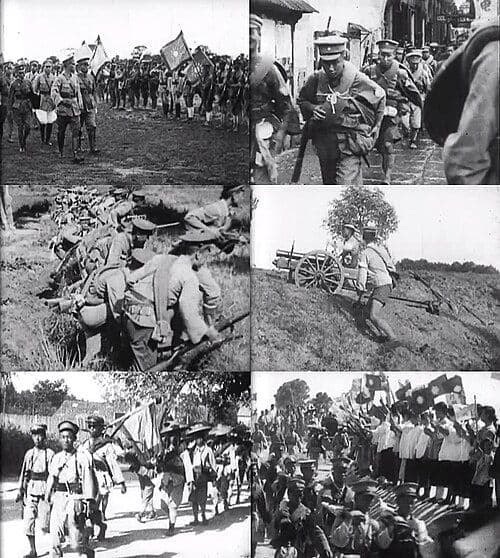
Launched from Guangzhou on 9 July 1926 under Chiang Kai-shek, the National Revolutionary Army's Northern Expedition aimed to reunify China by defeating the regional warlords. Within two years, the NRA swept north through Hunan, captured Wuhan and Shanghai, and — after violently purging its Communist allies in April 1927 — completed its advance to Beijing by 1928. China was nominally reunified under the Nationalist government, though the process entrenched the split between the KMT and CCP that would define the next two decades.
The Warlord Landscape
By 1926, China was divided among three major regional powers. In central China, Wu Peifu controlled Hunan and Hubei with the most professionally trained forces; in the lower Yangtze, Sun Chuanfang held five provinces — Jiangsu, Zhejiang, Fujian, Jiangxi, and Anhui; in the north, Zhang Zuolin's Fengtian clique dominated Manchuria and much of northern China. These three warlords were the primary targets of the Northern Expedition. None commanded genuine popular loyalty: their authority rested on military coercion and local tax extraction, making them structurally vulnerable to an army that combined military force with a political programme promising an end to foreign imperialism and internal fragmentation.
Origins: The Guangzhou Base and the First United Front
The Northern Expedition was the military culmination of the first KMT-CCP united front, brokered by the Soviet Comintern from 1923. Under Comintern adviser Mikhail Borodin, the KMT reorganised itself along Leninist lines and established the Whampoa Military Academy in 1924 to train a new officer corps. Chiang Kai-shek, as the academy's commandant, built the personal loyalties that would define the campaign. By mid-1926, the National Revolutionary Army numbered roughly 100,000 troops and controlled Guangdong province.
The NRA's advance benefited from political organisation as much as military force. Communist Party organisers mobilised peasant associations and urban labour unions ahead of the army's arrival, undermining warlord control from within. The Hunanese warlord Wu Peifu — one of the most formidable opponents — saw his forces collapse partly because Communist organisers had mobilised soldiers' families. By September 1926, Wuhan had fallen.
The Wuhan–Nanjing Split and the Shanghai Massacre
As the NRA reached the Yangtze valley, the united front fractured. The KMT's left wing, led by Wang Jingwei, and its Soviet advisers established a government in Wuhan; Chiang Kai-shek, advancing into the lower Yangtze, established a rival government in Nanjing. On 12 April 1927, working with Shanghai's Green Gang criminal networks and the city's foreign business community, Chiang turned on the Communist-led labour unions in a coordinated massacre. Thousands were killed across the city and in subsequent purges nationwide. The first united front was destroyed.
Completion and the Nanjing Decade
Despite the rupture, the Northern Expedition continued. The Wuhan left-KMT government collapsed and reconciled with Nanjing. By June 1928, NRA forces had entered Beijing — renamed Beiping. The last significant northern warlord, Zhang Zuolin, was assassinated by Japanese Kwantung Army officers as he fled the city. His son Zhang Xueliang pledged loyalty to Nanjing in December 1928, completing China's nominal reunification. The Nanjing Decade that followed (1928–1937) saw genuine modernisation efforts alongside persistent warlordism, incomplete land reform, and the unresolved CCP insurgency in rural base areas.
Narrative Comparison
| Source | Narrative |
|---|---|
| PRC Official Narrative | The Northern Expedition was a joint KMT-CCP effort in which Communist organisation of the peasant and labour movement was decisive to military success. The April 1927 massacre revealed the KMT's class character: when confronted with real popular power, the KMT turned on its allies to protect landlord and comprador interests. The revolution was betrayed from within. |
| ROC / Taiwan Narrative | The Northern Expedition realised Sun Yat-sen's vision of a nationally unified China. The purge of Communists in April 1927 was a necessary defensive measure against Soviet subversion of Chinese nationalism. The Nanjing Decade that followed was a period of genuine national reconstruction, cut short only by Japanese aggression. |
| Western Academic Perspective | The Northern Expedition's success owed as much to warlord defections and political deal-making as to military superiority. The KMT's Leninist organisational model, initially effective, became the template for single-party authoritarian rule. The April 1927 rupture initiated a twenty-two-year civil conflict. |
| PRC Official Narrative | The Northern Expedition succeeded because of the revolutionary mobilisation of the peasant and labour masses by Communist Party organisers, whose work won the broad popular support that warlord armies could never command. The NRA's political programme — opposing imperialism and warlordism — gave it a moral authority that transformed military operations into a genuine people's war. Warlord defections reflected not opportunism but the irresistible momentum of the revolutionary tide. The KMT's subsequent betrayal of this mass movement in April 1927 ultimately cost it the mandate of history. |
Key Milestones
- Northern Expedition launches
Chiang Kai-shek formally launches the Northern Expedition from Guangzhou, commanding a National Revolutionary Army of roughly 100,000 troops.
- Fall of Wuhan
NRA forces capture the Wuhan tri-cities, dealing a decisive blow to Wu Peifu's central China power base.
- Shanghai Massacre
Chiang Kai-shek, working with the Green Gang and Shanghai's foreign business interests, massacres Communist-led labour unions. Thousands are killed; the first united front collapses.
- Wuhan Government Also Purges Communists
Wang Jingwei's left-KMT Wuhan government breaks with the Communist Party, expelling CCP members and Soviet advisers. Both KMT factions have now destroyed the first united front — Chiang in April, Wang in July.
- Zhang Zuolin assassinated
Japanese Kwantung Army officers bomb Zhang Zuolin's train at Huanggutun, Mukden. The assassination — carried out without Tokyo's authorisation — removes the last major northern warlord opposing the NRA.
- Zhang Xueliang pledges loyalty to Nanjing
Zhang Zuolin's son Zhang Xueliang declares allegiance to the Nationalist government in Nanjing, completing China's nominal reunification under the Kuomintang.
Last verified: