Battle of Wuhan
From June to October 1938 Japanese forces advanced along both banks of the Yangtze and the northern foothills of the Dabie Mountains on Wuhan, then the seat of China's wartime military command. Chinese forces resisted across Anhui, Jiangxi, Henan and Hubei, encircling much of the Japanese 106th Division at Wanjialing. On 25 October the Military Affairs Commission announced the withdrawal from Wuhan, and Japanese forces entered Hankou the next day. Figures for forces and casualties differ widely; the war then settled into stalemate.
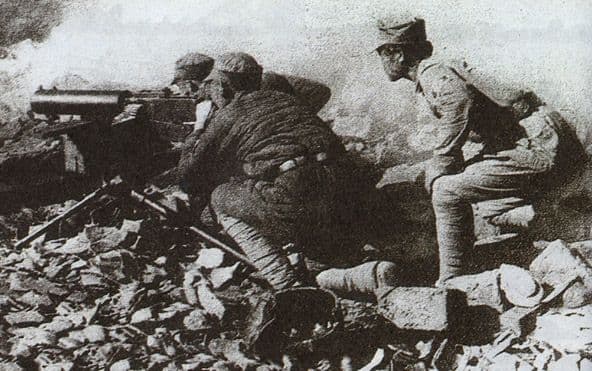
Wuhan Before the Battle
After Nanjing fell at the end of 1937 the Nationalist government announced its move to Chongqing, but the Military Affairs Commission and many party and government bodies remained in Wuhan, which for a time became the country's political, economic and military centre. According to the historian Stephen R. MacKinnon, large numbers of refugees displaced by the war poured into the three cities of Wuhan in the spring of 1938; he cites the contemporary description of Wuhan as "China's Madrid," a city visited by foreign writers and photographers including Robert Capa, W. H. Auden and Christopher Isherwood. Before the campaign began, Japanese aircraft repeatedly raided Wuhan and were met by the Chinese air force and Soviet volunteer airmen, including in an air battle on 29 April 1938, the Japanese emperor's birthday. According to Xinhua, the Soviet Union sent more than 2,000 pilots to China during the war.
Chiang Kai-shek described the purpose of the campaign, according to his collected speeches, as follows: "The main purpose of defending Wuhan was to hold up the enemy's westward advance, wear down his strength, prepare communications in the rear, transport and stockpile necessary weapons, and move the industries of the southeast and centre to build up the northwest and southwest." An article in Taiwan's Air Force Officer Bimonthly quotes Chiang telling the commanders charged with defending Wuhan that "senior commanders must be resolved to die and swear to live or die with Wuhan."
The Opposing Forces
On the Japanese side, Hata Shunroku, commander of the Central China Expeditionary Army, was in overall command. The 11th Army under Okamura Yasuji advanced west along both banks of the Yangtze, while the 2nd Army under Prince Higashikuni Naruhiko moved along the northern foothills of the Dabie Mountains through Lu'an, Gushi and Huangchuan towards Xinyang, to swing south on Wuhan. Figures for the forces involved vary: Xinhua says Japan used 350,000 troops against a Chinese army of a million; a 2015 article in The Paper says China committed 14 army groups with more than 50 armies, about a million men, against about 170,000 men of the Japanese 2nd Army and about 200,000 of the 11th, close to 400,000 in all. In the Chinese defences along the Yangtze, the Madang garrison area was under the direct command of Chen Cheng, commander of the Wuhan garrison.
Fighting Along the Yangtze
According to the Japanese 6th Division's unit history, on 6 June 1938 the division attacked Chinese outposts south of Luzhou; on 12 June the Japanese took Anqing, and the Madang fortress on the Yangtze became the front line. On 24 June more than 2,000 men of the Hata Detachment, covered by naval and air forces, landed at Xiangkou about 30 kilometres downstream of Madang. According to material compiled by the media centre of Pengze County, Jiangxi, at dawn on 26 June the Japanese released poison gas in front of the positions of the 7th Company of the Chinese Navy's 2nd Battalion at the western end of Changshan, and that afternoon the Madang fortress fell. The Japanese then pushed upriver, taking Hukou and Jiujiang.
In September Chinese forces held the Japanese at the Tianjiazhen fortress, where hills command the river about 150 kilometres below Wuhan. The Japanese 6th Division suffered heavy losses at Taihu, Huangmei, Guangji and Tianjiazhen; a regimental history records that from 1 August to 26 October the division lost 2,308 killed and 7,277 wounded.
Wanjialing
After Jiujiang fell, part of the Japanese 11th Army attacked through northern Jiangxi towards De'an and Nanchang. In the autumn of 1938 the 106th Division pushed deep into the Wanjialing area in De'an County, Jiangxi, and was surrounded by Chinese forces under Xue Yue. The Japanese soldier Nasu Ryosuke later wrote in Three Weeks in Hell Valley: "We marched into this valley, and only later learned that tens of thousands of enemy troops were waiting for us in the surrounding hills!" On 8 October he recorded close-quarters fighting, with "almost no food — we staved off hunger with rice husks," and supplies dropped by air. Xinhua says Chinese forces fought for more than ten days, killed more than 10,000 of the enemy and "nearly wiped out the main body of the Japanese 106th Division"; in mainland China the battle is counted with Pingxingguan and Taierzhuang as one of the "three great victories" of the war. According to the Japanese unit history, the 106th Division lost 3,321 killed, 4,085 wounded and 9,905 sick over the whole Wuhan campaign.
Leaving Wuhan
In October Japanese columns broke through the outer defences and closed on Wuhan. On 24 October the gunboat Zhongshan was bombed by six Japanese aircraft and sank in the Yangtze at Jinkou, with Captain Sa Shijun and 25 officers and men killed. According to Global People, that night Chiang Kai-shek and Soong Mei-ling flew out of Wuhan to Hengyang, travelling on through Changsha, Guangzhou and Guilin before arriving in Chongqing with the Military Affairs Commission on 9 December.
According to a telegram from the American Consul General at Hankou, Paul R. Josselyn, on 25 October a spokesman for the Military Affairs Commission announced that morning that Chinese forces had decided to withdraw from Wuhan, saying that "the real significance of defending the Wuhan area does not lie in the possession of the three cities but in the protection given to the transfer of man power and material resources from Southeast and Central China to China's northwest and southwest," and that after six months of resistance on the Yangtze front it was unnecessary to defend Wuhan further. On 26 October Josselyn reported that Japanese destroyers had arrived in the river at Hankou and Japanese army detachments had reached the Japanese Concession.
Casualty Figures
Casualty figures differ widely. According to a 2015 article in The Paper, the Military Operations Department of the Military Affairs Commission counted 256,000 Japanese casualties on the basis of unit combat reports; Japan's official war history, the Senshi Sosho published in 1975, records 9,600 casualties in the 2nd Army and 21,886 in the 11th Army, 31,486 in all, while a separate Japanese survey shows more than 100,000 cases of sickness in the 11th Army alone. The article's author, working from Japanese divisional and regimental histories, estimates Japanese killed and wounded at 55,000 to 70,000, plus more than 100,000 sick. An article in Taiwan's Air Force Officer Bimonthly gives Chinese casualties of more than 400,000 and Japanese casualties of more than 200,000.
After the Fall of Wuhan
Although the Japanese took Wuhan, they did not force the Nationalist government to submit. Xinhua says the campaign shattered Japan's hopes of a "quick victory" and moved the China theatre into strategic stalemate; the Taiwan Air Force Officer Bimonthly article says most of the Nationalist army's main force survived, and that Japan launched no operation on the scale of Wuhan until Operation Ichi-go in 1944. In December 1938 Wang Jingwei, deputy leader of the Nationalist Party, left Chongqing for Hanoi and went on to collaborate with Japan.
Gallery
Narrative Comparison
| Source | Narrative |
|---|---|
| Xinhua (2025) | A 2025 Xinhua report calls the Battle of Wuhan "a key turning point in China's War of Resistance" that "shattered the Japanese dream of a quick victory," and stresses that Wanjialing "nearly wiped out the main body of the Japanese 106th Division." It highlights the donation campaign launched "in response to the call of the Communist Party" and Nationalist–Communist cooperation, and quotes a scholar calling the campaign a "practical confirmation" of Mao's On Protracted War. |
| Chen Wei-kuan, Air Force Officer Bimonthly; Chiang Kai-shek's speeches (as quoted by Pengze County media) | An article in Taiwan's Air Force Officer Bimonthly calls the Battle of Wuhan "the decisive campaign that turned the tide," arguing that although the Japanese took Wuhan "most of the national army's main force survived while the Japanese were weakened," illustrating how "the national army, though weaker, won after eight years." Chiang Kai-shek himself summed up the aim of the campaign as "holding up the enemy's westward advance and wearing down his strength" and "moving the industries of the southeast and centre." |
| Telegrams from the U.S. Consul General at Hankow, Paul R. Josselyn (25–26 October 1938) | Telegrams from the U.S. Consul General at Hankow around the city's fall relay the Chinese Military Affairs Commission spokesman's explanation of the withdrawal — "the real significance of defending the Wuhan area does not lie in the possession of the three cities but in the protection given to the transfer of man power and material resources" to the interior — and the next day simply record the arrival of Japanese warships and troops: "Conditions quiet." |
| Stephen R. MacKinnon, Wuhan, 1938 (2008), and Daniel Little's review (2009) | MacKinnon's study focuses on refugees, society and culture. He writes that for "ten remarkable months" Wuhan held out against the Japanese "in what would become a turning point in the war," and that "Wuhan in 1938 became a laboratory for cultural experimentation," where intellectuals agreed that "their nation needed to turn culture into a potent weapon in the war against the Japanese." |
| Nasu Ryosuke, Japanese soldier, Three Weeks in Hell Valley (as quoted by China News Service) | Nasu Ryosuke, a soldier of the Japanese 106th Division, recalled Wanjialing: "We marched into this valley, and only later learned that tens of thousands of enemy troops were waiting for us in the surrounding hills!" On 8 October he wrote of "fighting at close quarters. We had almost no food and staved off hunger with rice husks." |
Key Milestones
- Air battle over Wuhan on the Emperor's birthday
Japanese aircraft raid Wuhan on the Emperor's birthday and are met by Chinese and Soviet volunteer airmen.
- Japanese 6th Division opens the offensive
According to its unit history, the Japanese 6th Division attacks Chinese outposts south of Luzhou.
- Japanese take Anqing
Anqing falls and the Madang fortress on the Yangtze becomes the front line.
- Madang fortress falls
After a dawn gas attack, the Madang garrison is ordered to break out that afternoon.
- Close fighting at Wanjialing
The encircled Japanese 106th Division fights at close quarters at Wanjialing, cut off and supplied by air.
- Zhongshan sunk; Chiang leaves Wuhan
The gunboat Zhongshan is sunk at Jinkou with 25 killed; that night Chiang and Soong Mei-ling fly out of Wuhan.
- Withdrawal from Wuhan announced
A Military Affairs Commission spokesman announces the decision to withdraw from Wuhan.
- Japanese forces enter Hankou
The U.S. Consul General reports Japanese warships at Hankou and army detachments in the Japanese Concession.
Last verified:
Cite this page
Chronicles of Modern China. (2026, November 3). Battle of Wuhan. Retrieved November 3, 2026, from https://www.cmcarchive.org/events/battle-of-wuhan-1938
“Battle of Wuhan.” Chronicles of Modern China. Last modified November 3, 2026. Accessed November 3, 2026. https://www.cmcarchive.org/events/battle-of-wuhan-1938.
Chronicles of Modern China. Battle of Wuhan[EB/OL]. (2026-11-03)[2026-11-03]. https://www.cmcarchive.org/events/battle-of-wuhan-1938.