Operation Ichi-go (Henan–Hunan–Guangxi Campaign)
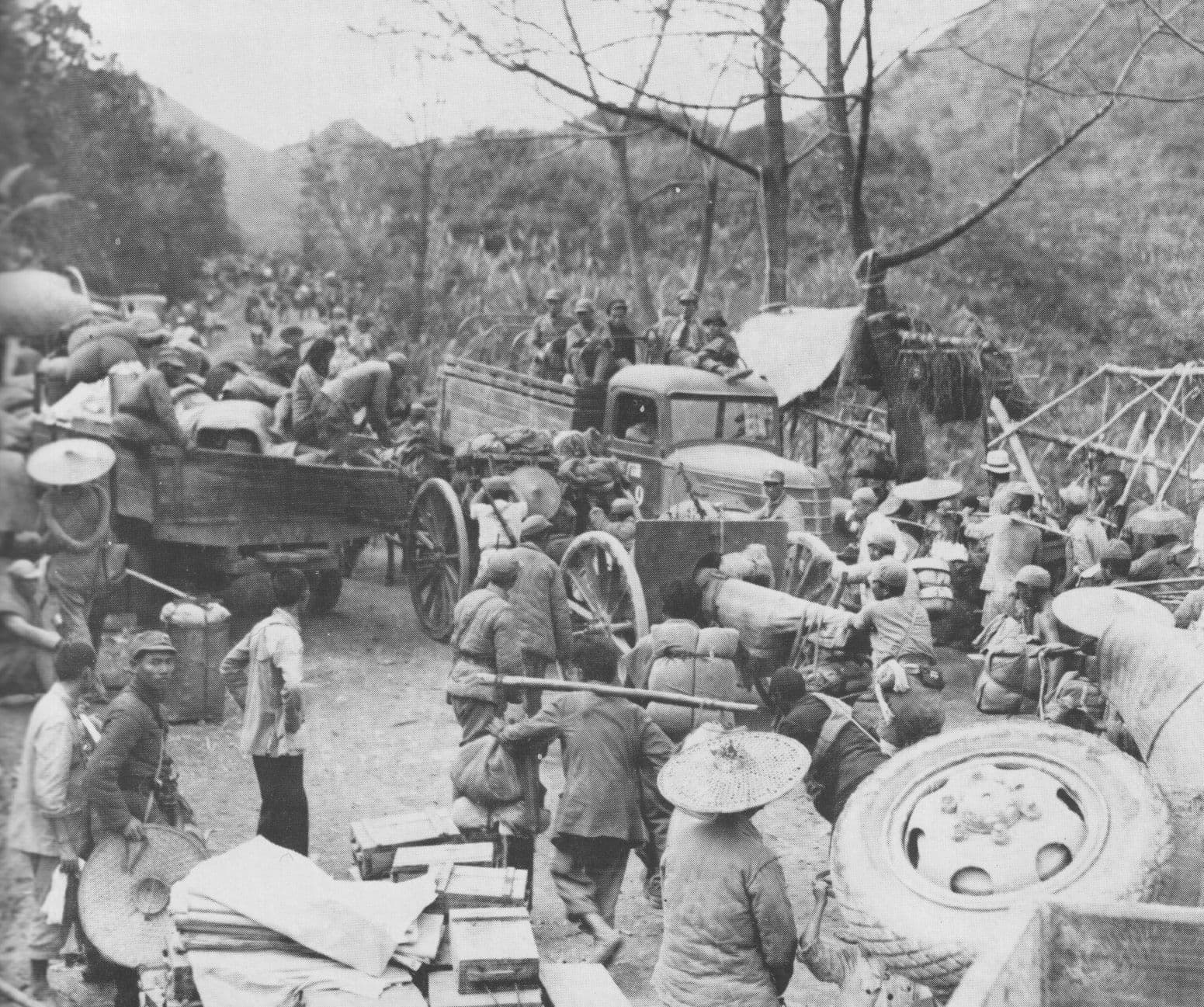
From April to December 1944 Japan's Operation Ichi-go sent over 500,000 troops south from Henan through Hunan into Guangxi to open an overland corridor and destroy Allied air bases. Nationalist forces collapsed in Henan, and Changsha, Hengyang, Guilin and Liuzhou fell in turn, though Hengyang held for 47 days. The military crisis triggered the Stilwell crisis in Sino-American relations. Nationalist forces lost nearly 600,000 men and vast territory.
Japan's Plan
On 24 January 1944 Japanese Imperial General Headquarters issued the order for Operation Ichi-go, calling for the army to "destroy the enemy army, occupy and secure key points along the Hunan–Guangxi, Guangdong–Hankou and southern Beijing–Hankou railways, in order to destroy the enemy's main air bases" — that is, to open an overland corridor from north China to the south and on to Southeast Asia, and to destroy the bases from which American and Chinese aircraft could bomb Japan. Because the fighting centred on Henan, Hunan and Guangxi, Chinese historians call it the Henan–Hunan–Guangxi (Yu-Xiang-Gui) campaign. According to Xinmin Evening News, Japan committed more than 500,000 troops, the largest mobilisation in the Imperial Army's history. A study in Taiwan's Whampoa Journal notes that China's best troops had by then been sent to Yunnan and Burma at the Allies' request, leaving too few to stop the offensive.
Henan: The Collapse of the First War Zone
The Japanese attacked in Henan on 17 April 1944. The U.S. consul at Xi'an reported on 14 May that some 60,000 to 70,000 Japanese troops had met "only token resistance" except at Hulaoguan and Longmen south of Luoyang; although the Chinese had not announced it, Luoyang appeared to have fallen on 12 or 13 May; the First War Zone was "shattered," its commanders Jiang Dingwen and Tang Enbo "discredited," and the year's fine wheat crop lost. A U.S. Embassy despatch of November reported that much of Henan had remained "in a state bordering on chaos," with homes along the roads looted by Chinese soldiers and many weapons having fallen into peasants' hands "when the latter turned against their own troops"; Chinese freely admitted that maladministration and indiscipline had contributed to the loss of the province.
Changsha and Hengyang
The Japanese attacked Changsha on 16 June and took it three days later. They then moved south on Hengyang, where Chiang Kai-shek ordered Fang Xianjue's 10th Army to prepare to hold for 10 to 14 days. The defence of Hengyang lasted 47 days, from 23 June to 8 August. The 10th Army numbered about 17,000 men, and according to press accounts the Japanese used large numbers of gas shells from 24 June. On 7 August Fang sent his "last telegram" to the Military Affairs Commission. Accounts of the city's fall differ: an article in The Paper says the 10th Army proposed seven conditions, the first being that it "would never surrender and would only agree to a conditional ceasefire"; Xinmin Evening News records that Fang attempted suicide on 8 August and was then captured by the Japanese. On 26 August Chiang ordered all servicemen to observe three minutes' silence for those killed at Hengyang.
Casualty figures for Hengyang vary. Xinmin Evening News gives more than 6,000 defenders killed and 7,000 wounded, more than 3,000 civilian volunteers killed, and 20,000 Japanese killed and over 60,000 wounded; the article in The Paper cites Japanese war histories as recording more than 29,000 Japanese casualties, and says 13,306 men of the 10th Army laid down their arms, about 9,000 of them wounded (one researcher puts the number at about 7,000).
Guilin, Liuzhou and the Threat to Guizhou
After Hengyang the Japanese advanced along the Hunan–Guangxi railway into Guangxi. According to CPPCC News, Guangxi commanders moved the two stronger of the city's four divisions outside the walls in the name of "mobile operations," leaving about 17,000 men to defend Guilin; the Japanese attacked on 31 October, and when the city fell in November the commander of the 131st Division, Kan Weiyong, shot himself. The air bases at Guilin, Liuzhou and elsewhere were lost. The Paper says the Japanese then threatened Guizhou and Chongqing itself.
The Stilwell Crisis
The military crisis sharpened Sino-American tensions. On 16 September 1944 Roosevelt cabled Chiang that he faced "in the near future … the disaster I have feared," and that "now, when you have not yet placed General Stilwell in command of all forces in China, we are faced with the loss of a critical area in east China." On 9 October, through Patrick Hurley, Chiang replied that he was willing to have an American officer command Chinese forces but insisted that Stilwell be relieved. According to the George C. Marshall Foundation, Stilwell was recalled on 19 October.
Outcome
According to The Paper, the campaign lasted from April to December 1944; Nationalist forces lost nearly 600,000 men, 146 cities, seven air bases and 36 airfields, and more than 200,000 square kilometres, leaving 60 million people under Japanese occupation, and Chiang lamented that 1944 was "the worst year for China in the long war." The Academia Sinica historian Chen Yung-fa notes that the defeat cost the Nationalist government most of Henan, Hunan and Guangxi, stirred centrifugal forces at home, turned intellectuals against the Nationalist Party, and allowed the Communists to expand and gain the propaganda advantage.
Gallery
Narrative Comparison
| Source | Narrative |
|---|---|
| The Paper; Xinmin Evening News; CPPCC News | Mainland media say that "the Chinese military authorities underestimated Japan's all-out gamble, leaving the front weak and ill-prepared," and stress the Nationalist army's loss of nearly 600,000 men; at the same time recent coverage praises the 47-day defence of Hengyang and the stand at Guilin, while criticising Guangxi commanders for withdrawing troops from Guilin "to preserve their strength." |
| Whampoa Journal (ROC National Defense University, 2022); Chen Yung-fa (Academia Sinica, 2013) | A study from Taiwan's National Defense University attributes the defeats chiefly to external factors — China's elite troops "diverted to Yunnan and Burma at the Allies' request" and Marshall and Stilwell "threatening to halt supplies" — while holding up Hengyang as a model of an outnumbered army holding out for dozens of days. Academia Sinica's Chen Yung-fa writes that the Nationalist army "suffered a crushing defeat," after which "intellectuals began to turn against the Nationalists and the Communists seized the chance to expand." |
| U.S. Embassy reports and Roosevelt–Chiang correspondence (1944) | U.S. Embassy reports said the Japanese in Henan "met with only token resistance," that the First War Zone was "shattered," and that peasants "turned against their own troops"; Roosevelt warned Chiang of "the disaster I have feared" and pressed him to give Stilwell command. |
| George C. Marshall Foundation | An article from the Marshall Foundation quotes Marshall — "Stilwell was getting very little. So he was having a hard time getting a fight out of his people" — and states that Chiang "was more concerned about using Lend-Lease aid to fight Chinese communists rather than their common enemy—the Japanese." |
Key Milestones
- Ichi-go order issued
The order calls for opening the continental corridor and destroying Allied air bases.
- Japanese offensive opens in Henan
Operation Ichi-go begins.
- U.S. Embassy reports First War Zone shattered
The report says Luoyang apparently fell on 12 or 13 May.
- Japanese attack Changsha
Changsha falls three days later.
- Defence of Hengyang begins
About 17,000 men of the 10th Army begin the defence.
- Hengyang falls
After 47 days the city falls and Fang Xianjue is captured.
- Roosevelt's message to Chiang
Roosevelt presses Chiang to give Stilwell command of all forces in China.
- Stilwell recalled
Stilwell is recalled after Chiang insists on his removal.
- Japanese attack Guilin
The city falls in November; division commander Kan Weiyong kills himself.
Last verified:
Cite this page
Chronicles of Modern China. (2026, November 3). Operation Ichi-go (Henan–Hunan–Guangxi Campaign). Retrieved November 3, 2026, from https://www.cmcarchive.org/events/operation-ichi-go-1944
“Operation Ichi-go (Henan–Hunan–Guangxi Campaign).” Chronicles of Modern China. Last modified November 3, 2026. Accessed November 3, 2026. https://www.cmcarchive.org/events/operation-ichi-go-1944.
Chronicles of Modern China. Operation Ichi-go (Henan–Hunan–Guangxi Campaign)[EB/OL]. (2026-11-03)[2026-11-03]. https://www.cmcarchive.org/events/operation-ichi-go-1944.