Huayuankou Yellow River Dike Breach
In June 1938, to stop the Japanese advancing west along the Longhai railway to Zhengzhou and south to Wuhan, Nationalist troops — after two failed attempts at Zhaokou — cut the Yellow River dike at Huayuankou north of Zhengzhou on 9 June. The flood held up the Japanese, but for nine years the river spread through the Huai system across Henan, Anhui and Jiangsu; estimates of the dead range from tens of thousands to nearly 900,000. During the war the government blamed Japanese bombing; the breach was closed in March 1947 and the river returned to its old course.
How the Idea of Breaching the Dike Took Shape
In 1935 and 1936 Alexander von Falkenhausen, the head of the German military advisory mission to the Nationalist government, twice drew up proposals for Chiang Kai-shek on preparing for war with Japan. They stated that "the last line of defence is the Yellow River; a planned artificial flood should be made to strengthen its defensive power." According to the Beijing Daily, Chiang underlined this passage in red and wrote "last line of resistance" at the top of the page. On 13 April 1938, shortly after the victory at Taierzhuang, Chen Guofu warned Chiang in a memorandum that "in the flood season the enemy may use a dike breach against us," and Chiang passed the memorandum to Cheng Qian, commander of the First War Zone, "for consideration and action."
In mid-May the Xuzhou campaign turned against China and Chinese forces withdrew from Xuzhou. The First War Zone then failed to destroy the Japanese 14th Division under Doihara Kenji in eastern Henan; Lanfeng and Shangqiu fell in turn, and Japanese forces closed on Kaifeng and on Zhengzhou, the junction of the Longhai and Pinghan railways. On 21 May Yao Cong, deputy director of the Military Affairs Commission's general office, cabled vice-minister of military operations Xiong Bin — the first explicit proposal to breach the Yellow River dike — and several senior staff officers followed with similar proposals. Citing research by Qu Changgen of Zhejiang Sci-Tech University, the Beijing Daily reports that Chiang chaired a supreme military conference in Wuhan on 1 June; the archives contain no direct record of its decision, and the final order to breach the dike was given by telephone. Yan Xunfu, then chief of staff of the First War Zone, recalled that the conference "at the same time decided on breaching the Yellow River." Chen Weiru, head of the Henan office of the Yellow River Conservancy Commission, recalled that Cheng Qian passed the order to him on 1 June. Chen argued against it, saying the river was low in the dry season and a breach would be hard to close once the flood season came; the next day Cheng told him: "Chairman Chiang says that as long as the enemy knows the Yellow River has been breached, they will not dare advance. Even if the water is low it must be breached — send the river workers to do it at once."
Two Failed Attempts at Zhaokou
The site first chosen was Zhaokou, directly north of Zhongmu County. According to the Beijing Daily, a regiment of the 53rd Army began digging on 3 June; an article by Lieutenant Colonel Dai Yanhua published on the website of Taiwan's Ministry of National Defense gives the start as 6 a.m. on 4 June. Local people called the Zhaokou dike the "golden dike" because it was so strong. The soldiers dug with picks and shovels, but the cut narrowed as it went down until it was only about a metre wide near the waterline; the engineers' explosives broke only the stone facing on the river side, and the cut soon collapsed and blocked. Shang Zhen, commander of the 20th Army Group and responsible for the operation, went to supervise in person and sent troops of the 39th Army to dig a second cut nearby, but still no water flowed. According to the Beijing Daily, Chiang in Wuhan "asked three or four times a day about the progress of the breach." By then the Japanese had taken Kaifeng and their vanguard was approaching Zhongmu.
The Breach at Huayuankou
On 6 June Jiang Zaizhen, commander of the New 8th Division, which was responsible for the Zhengxian sector, inspected Zhaokou and proposed a new breach site within his division's sector; Shang Zhen obtained Chiang's approval. That night Xiong Xianyu of the New 8th Division, with engineer battalion commander Huang Yingqing and Su Guanjun, head of the local dike section of the Yellow River Conservancy Commission, reconnoitred Huayuankou and chose a point about 300 metres west of a temple to Guan Yu. Learning from Zhaokou, the division cut an opening about 50 metres wide at the top of the dike and dug downward in steps, so that it would still be about 10 metres wide at river level.
On the morning of 9 June engineers used explosives to break the stone facing on the river side, and at 9 a.m. the water was released. The article on Taiwan's Ministry of National Defense website says Jiang Zaizhen also asked Xue Yue's artillery to shell the opening. Participants' accounts differ on whether the dike was dug or blasted: Xiong Xianyu's diary does not mention explosives or artillery, while the diary of the division's deputy commander Zhu Zhenmin records that "from 6 a.m. (on the 9th) explosives were used to destroy the stone base of the inner slope." The flow was gentle at first, then the river rose and the gap widened. That night Cheng Qian cabled Chiang that "as of 8 p.m. the water had widened the breach to 40 chi, the water more than a zhang deep and the waves three chi high." After several days of heavy rain, the cut at Zhaokou was also washed open.
On warnings to residents, an article in National Humanity History says that after Cheng Qian decided on 31 May to breach the dike at Zhaokou, he allocated 10,000 yuan, with which the Zhengzhou commissioner Luo Zhen and the Zhengxian county head Quan Baici paid five yuan in "flight money" to each resident who was to be moved, and Zhongmu County did the same. The historian Micah Muscolino writes, by contrast, that only minimal public warning was given lest the Japanese find out, and that only people living in the immediate vicinity received any sort of warning.
Blaming Japanese Aircraft
On the day of the breach Jiang Zaizhen sent a cable drafted in advance, reporting that "at 8 a.m. on the 9th three enemy aircraft bombed open the river dike at Huayuankou, and this division is rushing to close it." Cheng Qian's cable that night said that "a version for external publicity has been drafted here": that the Japanese had breached the dike north of Zhongmu to wash away the Chinese positions. On 11 June Chiang cabled Cheng with instructions that "the public must be told that enemy aircraft bombed the Yellow River dike," and the same day the Central News Agency reported from Zhengzhou that the Japanese had destroyed a section of the dike with aircraft and artillery. According to the Beijing Daily, Shang Zhen ordered the New 8th Division on 9 June to blow up a small Dragon King temple, houses and trees near the breach to stage a scene of Japanese bombing; when Chinese and foreign reporters visited Huayuankou on 22 June, they were shown soldiers and civilians apparently working to close the gap. The Japanese-controlled Shengjing Shibao reported on 16 June that the breach "was a planned act of the Nationalist army."
Muscolino notes that throughout the war the Nationalist government refused to take responsibility for the disaster, presenting it as another example of Japanese atrocities, while the Japanese denied the accusation and framed the flood as proof of China's disregard for human life. When the true cause came to light after 1945, the Nationalist government recast the flood as evidence of the sacrifices made by the Chinese people to save the nation. In 1967 Hollington Tong, a former deputy head of the Nationalist Party's propaganda department, disclosed in his biography of Chiang that "we blew up the Yellow River dike at Zhengzhou, setting its rushing waters against the invading enemy"; in 1982 Wei Rulin, formerly chief of staff of the 20th Army Group headquarters, published an account of the breach in Taiwan.
The Flood and the Course of the War
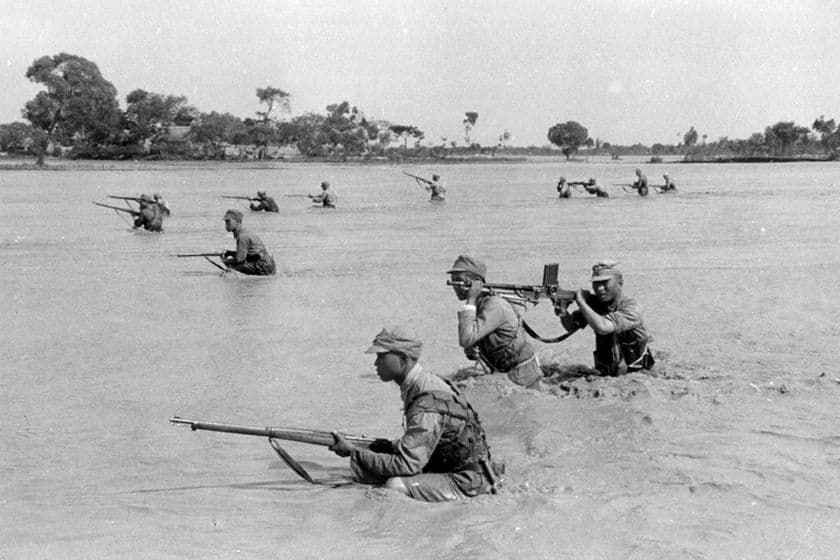
The flood trapped the Japanese forces that had pushed into eastern Henan. According to the article on Taiwan's Ministry of National Defense website, part of the Japanese 14th Division was cut off at Zhongmu and the main body of the 16th Division was surrounded by water around Weishi and Zhuxianzhen; the Japanese had to halt their advance on Zhengzhou, with more than 10,000 troops withdrawing east by rail and more than 7,000 crossing north of the Yellow River. The Beijing Daily says figures for Japanese losses released by the two sides range from 7,000 to 20,000. Azuma Shiro, a private first class in the 20th Regiment of the Japanese 16th Division, wrote in his diary that on the morning of 14 June his unit received the order "The enemy has destroyed the Yellow River dike; the battalion is to disperse at once," after which it lost contact with its supply lines.
The river's new course became the front line between the two armies, each building dikes along its bank, and the Japanese did not take Zhengzhou until 1944. Muscolino notes that the Japanese then shifted to a combined land and river advance along the Yangtze, and Wuhan still fell in October 1938; the article on Taiwan's Ministry of National Defense website argues that the breach, together with the Xuzhou campaign, won five months of preparation for the defence of Wuhan.
The Flooded Area and Casualty Figures
According to Muscolino, the floodwaters advanced southeast at about 16 kilometres a day, entered the upper Huai River in early July, and then poured into Hongze Lake and on into Jiangsu. For the next nine years the Yellow River flowed through the Huai system across Henan, Anhui and Jiangsu; its dikes broke repeatedly and the flooded area kept shifting until the river was returned to its old course in 1947. The region became known as the Huangfanqu, the Yellow River flooded area.
Casualty figures vary widely. Drawing on a 1948 study by Han Qitong and Nan Zhongwan, Damage and Relief in the Yellow River Flooded Area, Muscolino states that between 1938 and 1947 the flood killed more than 800,000 people in the three provinces and displaced nearly four million, including more than 400,000 deaths in Anhui and more than 325,000 in Henan. The Beijing Daily gives 893,000 dead and 12 million displaced in 44 counties of Henan, Anhui and Jiangsu; the stele erected in 1997 states that "in more than eight years 890,000 people died and 3.91 million fled." The article on Taiwan's Ministry of National Defense website says the breach left "millions homeless and hundreds of thousands dead." A 2020 Storm Media article cites Hong Xiaoxia, a professor at Shanghai Normal University, as concluding that 890,000 is the total of all deaths from disease, hunger and drowning in the three provinces between the breach in June 1938 and the river's return in March 1947, and that the breach itself caused about 30,000 deaths at the time.
Closing the Breach and Returning the River
After the war the Nationalist government decided to close the Huayuankou breach and return the Yellow River to its pre-1938 course. According to the Beijing Daily, a Yellow River closure bureau was set up in February 1946 and work began in March; the project received extensive aid from the United Nations Relief and Rehabilitation Administration (UNRRA). By then much of the old course was under Communist control, and local interests there opposed bringing the river back. The historian Kathryn Edgerton-Tarpley shows that the diversion project consequently became intensely politicized and entangled in the Chinese Civil War. In March 1947 the breach at Huayuankou was closed and the river returned to its old course.
The Nationalist government erected a stele at the closure site bearing four characters in Chiang Kai-shek's hand, "Jiguo anlan" (Save the nation and calm the waves). On 28 August 1997 the Henan Provincial People's Government and the Yellow River Conservancy Commission erected a second stele recording the cutting and closure of the dike. According to the Publicity and Education Center of the Ministry of Water Resources, the Republican-era stele speaks only of a "breach" and avoids the fact that the dike was deliberately cut, while the 1997 stele records the events from the cutting of the dike to its closure, including the negotiations and struggle between the Nationalists and Communists over the closure.
Gallery
Narrative Comparison
| Source | Narrative |
|---|---|
| Beijing Daily (2012); Publicity and Education Center, Ministry of Water Resources (2026) | A long 2012 Beijing Daily report calls the Nationalist army's breach at Huayuankou "undoubtedly a painful chapter in the history of the War of Resistance" and "a self-inflicted defensive strategy," while stating that "it must be acknowledged that the breach partly achieved its intended military purpose." It details how the Nationalists blamed Japanese aircraft and staged a false scene, and uses the figure of 893,000 dead. A 2026 introduction by the Ministry of Water Resources' publicity centre says the 1997 stele "truthfully states the historical fact that the Nationalist government cut the dike" and "reveals the Nationalists' military intention of flooding the liberated areas." |
| Dai Yanhua (Taiwan Ministry of National Defense website); Chia Chung-wei (Storm Media, 2020) | An article by Dai Yanhua on the website of Taiwan's Ministry of National Defense presents the breach as a "glorious chapter in Army engineer history," calls "using water in place of troops" "a measure taken when there was no other way," and argues that "without the Huayuankou breach, the national army could not have carried out a protracted war." It acknowledges that the breach left "millions homeless and hundreds of thousands dead," and says Huayuankou, "although not a battlefield of the War of Resistance, was the place that most affected the course of the war." A Storm Media commentary by Chia Chung-wei, citing Hong Xiaoxia, holds that the breach "was indeed an effective means of resisting the enemy" and that the figure of 890,000 dead "is a misattribution." |
| Micah Muscolino (DisasterHistory.org); Kathryn Edgerton-Tarpley (Social Science History, 2017) | Micah Muscolino calls the breach "perhaps the single most environmentally damaging act of warfare in world history" and argues that "in the eyes of Nationalist leaders, not unlike other modern regimes of the twentieth-century world, 'saving the nation' could justify unlimited sacrifice on the part of the civilian population." He notes that the Nationalists blamed the Japanese during the war and afterwards recast the flood as the people's sacrifice for the nation. Kathryn Edgerton-Tarpley, studying the postwar closure, finds that because the Communists controlled much of the old course, "the Yellow River diversion project thus became intensely politicized." |
| Recollections of Chen Weiru and Su Guanjun; diaries of Xiong Xianyu and Azuma Shiro (as quoted by the Beijing Daily) | Chen Weiru of the Yellow River Conservancy Commission recalled Cheng Qian relaying Chiang's words: "As long as the enemy knows the Yellow River has been breached, they will not dare advance; even if the water is low it must be breached." When the Huayuankou site was chosen, the local dike section chief Su Guanjun cried out: "How many people will die … how many people will die …" Xiong Xianyu, who chose the site, wrote in his diary that the action "was meant to stop the enemy and save the overall situation, so no sacrifice is too great in pursuit of final victory," yet seeing that "the houses and property of countless common people have been wiped out," his "heart aches." The Japanese soldier Azuma Shiro recorded the order his unit received: "The enemy has destroyed the Yellow River dike; the battalion is to disperse at once." |
Key Milestones
- Chen Guofu memorandum to Chiang
Chen Guofu warns that the enemy may use a dike breach against China; Chiang passes the memo to Cheng Qian for action.
- Yao Cong proposes breaching the dike
Yao Cong of the Military Affairs Commission cables Xiong Bin, the first explicit proposal to breach the Yellow River dike.
- Supreme military conference in Wuhan
Chiang chairs a supreme military conference; Yan Xunfu recalled it also decided on the breach. Cheng Qian passes the order to Chen Weiru the same day.
- Dike breached at Huayuankou
The New 8th Division breaks the inner stone facing at Huayuankou; water is released at 9 a.m. and the gap widens.
- Chiang orders blame on Japanese aircraft
Chiang instructs Cheng Qian to tell the public that enemy aircraft bombed the dike; the Central News Agency reports the same day.
- Reporters visit Huayuankou
Chinese and foreign reporters visit the site and are shown soldiers and civilians apparently closing the gap.
- Stele on the cutting and closure erected
The Henan provincial government and the Yellow River Conservancy Commission erect a stele recording the cutting and closure of the dike.
Last verified:
Cite this page
Chronicles of Modern China. (2026, November 3). Huayuankou Yellow River Dike Breach. Retrieved November 3, 2026, from https://www.cmcarchive.org/events/huayuankou-yellow-river-breach-1938
“Huayuankou Yellow River Dike Breach.” Chronicles of Modern China. Last modified November 3, 2026. Accessed November 3, 2026. https://www.cmcarchive.org/events/huayuankou-yellow-river-breach-1938.
Chronicles of Modern China. Huayuankou Yellow River Dike Breach[EB/OL]. (2026-11-03)[2026-11-03]. https://www.cmcarchive.org/events/huayuankou-yellow-river-breach-1938.