Establishment of the Wang Jingwei Regime in Nanjing
After leaving Chongqing for Hanoi at the end of 1938, Wang Jingwei negotiated with Japan to form a new government; the two sides signed the "Outline for Adjusting New Japan–China Relations" on 30 December 1939, which Gao Zongwu and Tao Xisheng made public in Hong Kong the following January. On 30 March 1940 Wang declared the "return of the capital to Nanjing" and set up a "National Government" under the Republic's name and flag. Japan backed it, the Chongqing government declared it null and void, and the United States continued to recognise Chongqing. Japan and the Wang regime signed a basic relations treaty in November 1940.
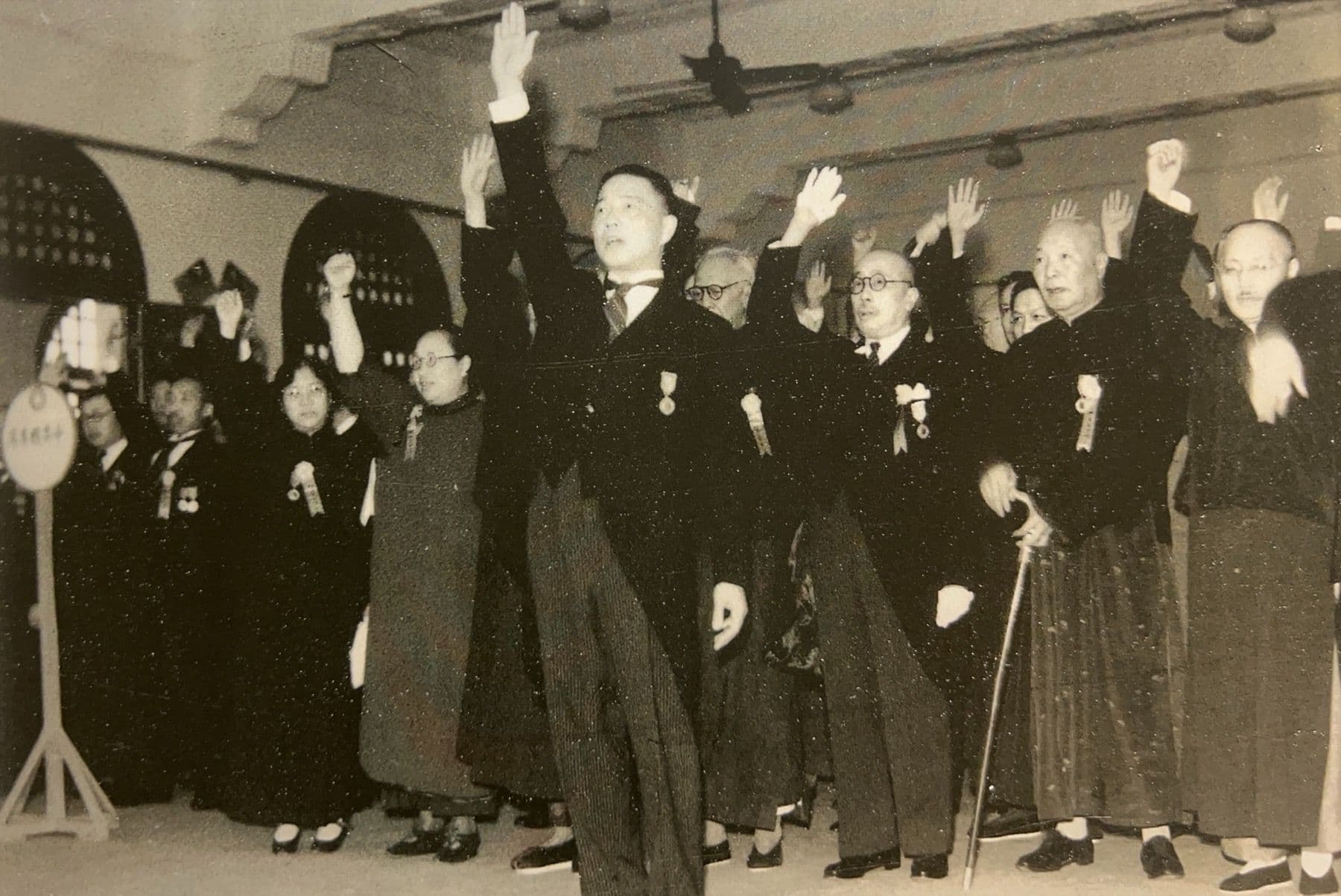
From Hanoi to a New Government
In December 1938 Wang Jingwei, then deputy leader of the Nationalist Party, left Chongqing and travelled via Kunming to Hanoi, and afterwards worked behind the scenes with Japan to set up a new administration. On 28–29 August 1939, with Japanese backing, Wang convened a so-called "Sixth National Congress of the Kuomintang" in Shanghai. According to Global People, the National Government in Chongqing issued arrest warrants for the participants and the party's Central Supervisory Committee expelled them, though Chiang Kai-shek personally struck Tao Xisheng's name from the warrant.
Japan had already set up the "Reformed Government of the Republic of China" under Liang Hongzhi in Nanjing. The historian Craig A. Smith notes that the Reformed Government was unpopular and struggled to win support even around Nanjing, but that it set the stage for Wang to establish a more significant regime in March 1940.
The Secret Agreement and the Gao–Tao Affair
In the second half of 1939 Wang's group negotiated with Japan over the new regime's relations with Japan. According to a note by Gao Zongwu, who took part in the talks, the "Outline for Adjusting New Japan–China Relations" and its annexes were handed by the Japanese representative Kagesa Sadaaki to Zhou Fohai and Mei Siping on 5 November, signed in Shanghai on 30 December, and taken to Tokyo by Inukai Takeru the next day. The documents provided that China would recognise "Manchukuo," that Japan would send advisers to the Chinese central government and station troops at key points in North China and Mengjiang for "joint anti-communist defence," and that North China, Mengjiang and the lower Yangtze would be zones of close Japan–China integration.
According to Global People, Tao Xisheng, who had taken part in the negotiations, stayed away from the signing on grounds of illness. On 3 January 1940 he and Gao Zongwu, secretly helped by Du Yuesheng and his follower Wan Molin, they left Shanghai by ship for Hong Kong, and on Chiang Kai-shek's instructions published photographs of the agreement and its annexes, with a joint letter, in the Hong Kong Ta Kung Pao and major Chinese newspapers. The diplomat Fu Bingchang in Chongqing noted in his diary on 23 January that Gao and Tao had written to the Ta Kung Pao "to denounce Wang Jingwei for accepting humiliating terms" from Japan. Tao's book Behind the Scenes of Wang's Stage, published soon afterwards, said the agreement used "the construction of a new East Asian order by Japan, Manchukuo and China as a smokescreen, to place China under Japanese servitude."
"Returning the Capital" to Nanjing
On 30 March 1940 Wang Jingwei declared the "return of the capital to Nanjing" and held an inauguration ceremony for the "National Government" in the former Examination Yuan at Jimingsi in Nanjing, taking the post of acting chairman. According to Guancha, the former National Government buildings had been wrecked by the Japanese, so Wang's government moved into the prewar Examination Yuan. Smith notes that Wang, in consultation with Zhou Fohai, kept the name, flag and formal ideology of the Republic and invoked Sun Yat-sen at every opportunity to shore up his legitimacy; the government served as a central authority over the various regimes the Japanese military had set up in occupied China.
Reactions
The Japanese government issued a statement the same day congratulating the "new Central Government" and promising "their wholehearted cooperation and support for its development," and calling on the powers to recognise this reality. A Foreign Ministry file published by the Japan Center for Asian Historical Records (JACAR) includes a booklet, "Outline of the Process to Establish a New Chinese Central Government," which says that establishing the Wang administration was "definitely an effective strategy for sowing the collapse of the government in Chongqing."
The National Government in Chongqing notified foreign envoys that the Nanjing organisation was null and void. U.S. Secretary of State Cordell Hull said the same day that "the setting up of a new regime at Nanking has the appearance of a further step in a program of one country by armed force to impose its will upon a neighboring country," that the United States had ample reason to believe that the government with its capital at Chongqing had the allegiance and support of the great majority of the Chinese people, and that it "of course continues to recognize that Government as the Government of China."
The Basic Relations Treaty
On 30 November 1940 Japan and the Wang regime signed the Treaty Concerning the Basic Relations Between Japan and China at Nanjing. It committed the two governments to joint defence "against all destructive operations of communistic nature," for which Japan would station forces in specified areas of Mengjiang and North China; the withdrawal of Japanese forces was to follow terms agreed separately.
How the Regime Worked and How It Ended
Smith notes that while many patriots refused to cooperate with the occupation and moved with the government to Chongqing, many others from all walks of life joined Wang's government or quietly accepted its authority. Led first by Wang and then by Chen Gongbo (1944–1945), the regime was marked by violence and political assassinations, and senior figures such as Zhou Fohai kept in contact with Chongqing or with the Communists. Wang died in Japan in 1944 and was buried near the Sun Yat-sen Mausoleum in Nanjing; when Nationalist troops re-entered Nanjing after the war they destroyed his tomb. From the moment of its founding, both the Nationalists in Chongqing and the Communist Party called it "Wang Jingwei's Phony Regime" (Wang wei zhengquan), a term still in official use.
Gallery
Narrative Comparison
| Source | Narrative |
|---|---|
| Global People (People's Daily, 2012); Guancha (2025) | Mainland Chinese media call the regime a "puppet regime." A Global People article says Gao Zongwu and Tao Xisheng realised during the talks that "Japan's ultimate aim was the complete conquest of China and Wang's so-called peace movement was outright capitulation," and that their exposure of the secret agreement "opened the eyes of China's soldiers and civilians with first-hand iron proof and strengthened their resolve to resist to the end." |
| Japanese government statement (30 March 1940); Japanese Foreign Ministry file (JACAR) | The Japanese government's statement on the day of the regime's founding congratulated the "new Central Government" and promised "wholehearted cooperation and support." An internal Foreign Ministry booklet described the establishment of the Wang administration as "definitely an effective strategy for sowing the collapse of the government in Chongqing." |
| Statement by Secretary of State Cordell Hull (30 March 1940) | Secretary of State Hull said that "the setting up of a new regime at Nanking has the appearance of a further step in a program of one country by armed force to impose its will upon a neighboring country," and that the United States "of course continues to recognize" the government at Chongqing "as the Government of China." |
| Craig A. Smith (China Heritage, 2018) | Introducing the Wang regime, Craig A. Smith notes that while many patriots refused to cooperate, "many others from all walks of life joined his government or quietly acquiesced to its authority," and that senior figures such as Zhou Fohai kept in contact with Chongqing or the Communists, "ever ready to abandon their unsteady ship of state." He observes that people on both sides of the Taiwan Strait remain outraged by the collaboration, and that the term "Wang Jingwei's Phony Regime" "is still in official use." |
| Tao Xisheng, Behind the Scenes of Wang's Stage (1940); diary of Fu Bingchang (23 January 1940) | Tao Xisheng, who had taken part in the negotiations, wrote after his escape that the agreement used "the construction of a new East Asian order by Japan, Manchukuo and China as a smokescreen, to place China under Japanese servitude." In Chongqing, the diplomat Fu Bingchang recorded in his diary that Gao and Tao had written to the Ta Kung Pao to denounce Wang "for accepting humiliating terms from Japs," adding: "Such rascals are bound to stab one another." |
Key Milestones
- So-called Sixth KMT Congress in Shanghai
Wang convenes a so-called Sixth National Congress of the Kuomintang with Japanese backing; Chongqing issues arrest warrants.
- Japan–Wang secret agreement signed
The "Outline for Adjusting New Japan–China Relations" and its annexes are signed in Shanghai and taken to Tokyo the next day.
- Gao Zongwu and Tao Xisheng leave Shanghai
With help from Du Yuesheng and Wan Molin, the two leave Shanghai and later publish the agreement in Hong Kong.
- Wang "returns the capital" to Nanjing
Wang inaugurates the "National Government" in Nanjing as acting chairman; Japan issues a supporting statement and Hull reaffirms U.S. recognition of Chongqing.
- Basic Relations Treaty signed
Japan and the Wang regime sign a treaty in Nanjing providing for joint anti-communist defence and Japanese garrisons in Mengjiang and North China.
Last verified:
Cite this page
Chronicles of Modern China. (2026, November 3). Establishment of the Wang Jingwei Regime in Nanjing. Retrieved November 3, 2026, from https://www.cmcarchive.org/events/wang-jingwei-nanjing-regime-1940
“Establishment of the Wang Jingwei Regime in Nanjing.” Chronicles of Modern China. Last modified November 3, 2026. Accessed November 3, 2026. https://www.cmcarchive.org/events/wang-jingwei-nanjing-regime-1940.
Chronicles of Modern China. Establishment of the Wang Jingwei Regime in Nanjing[EB/OL]. (2026-11-03)[2026-11-03]. https://www.cmcarchive.org/events/wang-jingwei-nanjing-regime-1940.