The Zhang Xun Restoration
In 1917 President Li Yuanhong and Premier Duan Qirui clashed over entering the First World War; after Li dismissed Duan, northern military governors threatened to break with Beijing. Zhang Xun, whose army was based at Xuzhou, came to the capital with his “pigtailed army” as mediator, forced Li to dissolve Parliament and on 1 July restored Puyi to the throne. Duan launched a punitive campaign from Machang on 3 July, his forces entered Beijing on 12 July and Zhang fled to the Dutch legation, ending a twelve-day restoration. Duan returned to power, the old Parliament was not restored, and a rival government formed in the south.
The Conflict between President and Cabinet
After Yuan Shikai’s death, President Li Yuanhong and Premier Duan Qirui clashed bitterly, above all over whether China should declare war on Germany. The American minister Paul Reinsch reported on 11 May 1917 that “the Prime Minister favors declaration of war but Parliament insists that Cabinet be first reorganized”; Duan planned to dissolve Parliament, Li resisted, and the day before “hired mob assailed halls of Parliament.” In late May, after nearly the whole cabinet resigned, Li dismissed Duan and appointed Wu Tingfang acting premier. The military governors of Henan, Shandong, Manchuria and Anhui then threatened to break with the central government unless Parliament was dissolved, and Zhang Xun, whose army was based at Xuzhou and who held the balance of power, was summoned to Beijing to mediate.
Zhang’s soldiers were not allowed to cut their queues and were known as the “pigtailed army.” In June he brought his troops to Beijing; on 13 June Li was prevailed upon to sign a mandate dissolving Parliament, countersigned by the new acting premier, the commander of the Peking gendarmerie. On 16 June Zhang, in Qing court dress, paid a ceremonial call on the eleven-year-old Puyi in the Hall of Mental Cultivation in the Forbidden City.
The Restoration of 1 July
At 2 a.m. on 1 July Zhang and his allies launched a coup, “calling upon the President to resign in favor of the Emperor”; Li replied that he would resign only in favour of the vice president. The same day Zhang and others submitted a memorial, dated the 13th day of the 5th month of the ninth year of Xuantong, declaring that the foundations of the state were shaken and that republican government did not suit the people, and asking Puyi to resume the throne; a circular telegram in the names of Zhang Xun, Wang Shizhen, Jiang Chaozong, Chen Guangyuan and others urged the provinces to replace an empty republic with a stable empire, adopt the imperial calendar and hoist the dragon flag. Puyi then issued an edict proclaiming constitutional monarchy and appointing a cabinet headed by Zhang; his edicts were dated by the Xuantong reign and the lunar calendar. Li Yuanhong refused to cooperate and took refuge in the Japanese legation, sending word that he hoped the United States would not recognise the restoration.
The Punitive Campaign
Opposition was almost immediate. On 2 July Reinsch reported that “the coup d’état was the personal act of Chang Hsun and that it is not approved of by other leaders even in the North, some of whose names were used in this connection without authorization.” On 3 July Duan Qirui assumed command of an “Army to Punish the Rebels” at Machang near Tianjin; the Ta Kung Pao reported his campaign under the headline “The Army to Punish the Traitor Rises,” and even Yang Du, who had supported Yuan Shikai’s monarchy, telegraphed his opposition. The Shanxi governor Yan Xishan issued a proclamation accusing Zhang of falsely using the provinces’ names and forging imperial edicts. Vice President Feng Guozhang assumed the duties of acting president in Nanjing on 6 July.
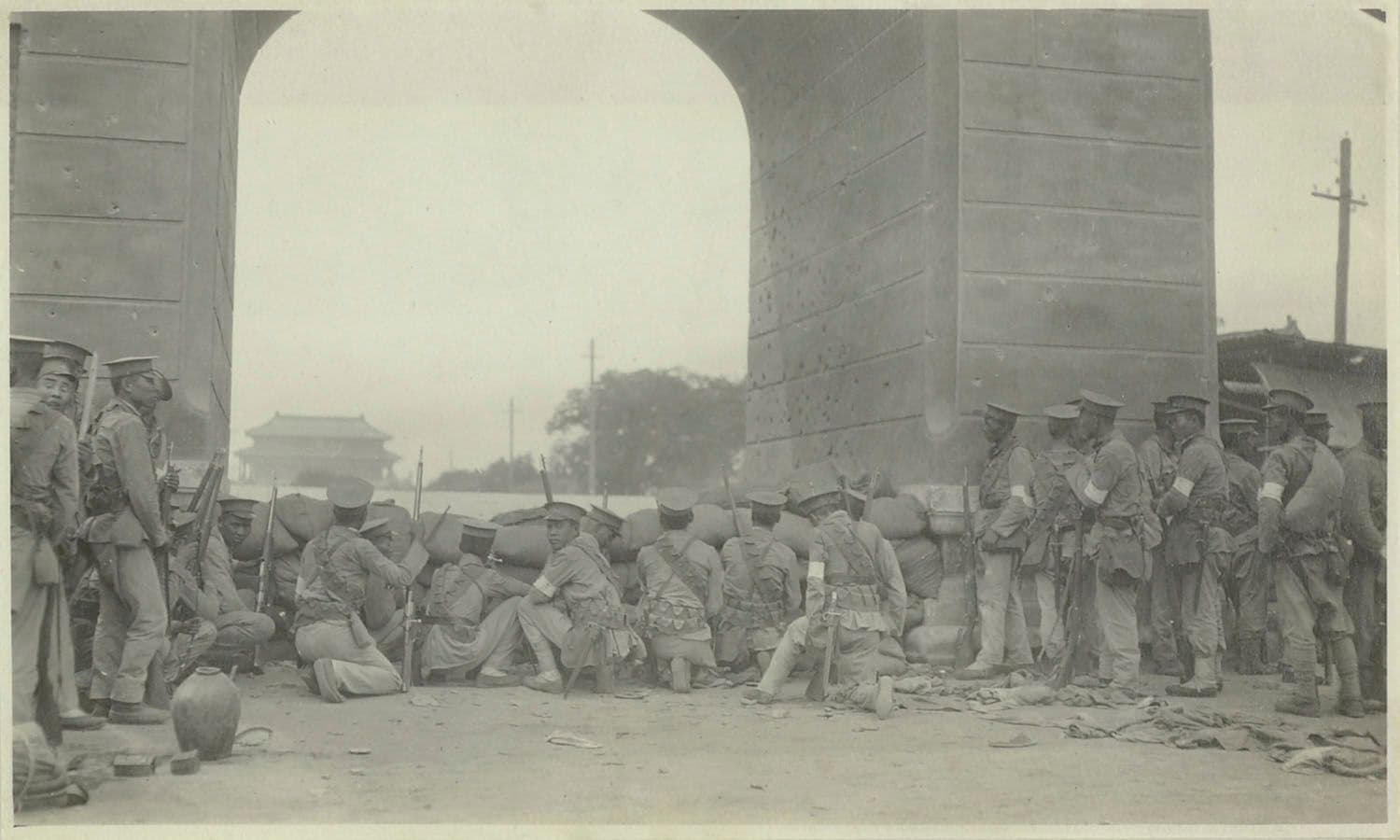
As the punitive army advanced, Zhang’s forces fell back. The Qing court had already drafted an abdication edict in which the emperor declared he would not cling to power and instructed Wang Shizhen and Xu Shichang to arrange a handover with Duan Qirui. On 12 July the punitive army entered Beijing in three columns; after about ten hours of fighting the imperialists capitulated. Zhang took refuge in the Dutch legation under the protection of the diplomatic corps, and Kang Youwei hid in the American legation. The restoration had lasted twelve days.
Aftermath
On 17 July the court issued an edict that, in Rhoads’s words, “put the blame entirely on Zhang Xun and portrayed the young emperor as utterly naive and helpless.” According to Rhoads, the restoration led many, for the first time since 1912, to demand abolition of the Articles of Favourable Treatment: Wu Tingfang, Tang Shaoyi, Wang Jingwei and others who had negotiated them declared that “since the Qing emperor has usurped power, the Articles of Favorable Treatment are obviously invalid,” and northern generals including Feng Yuxiang called for the articles to be abrogated and Puyi stripped of his title. Duan’s government nevertheless treated the court leniently and the articles remained in force. With Duan back as premier, the cabinet decided in early August to declare war on Germany; the old Parliament was not restored, and Duan’s southern opponents set up a rival government in Guangzhou.
Differing Interpretations
Mainland media commonly describe the restoration as a “farce” and count Duan’s campaign among his “three restorations of the Republic.” Rhoads argues that “Zhang Xun’s effort had been more an expression of Qing loyalism than of Manchu restorationism,” its participants overwhelmingly Han, with very few Manchus. The historian Zhang Ming questions the conventional explanation that republicanism had taken root in people’s hearts, arguing that the leaders of both monarchical restorations mostly sought constitutional monarchy rather than autocracy.
Gallery
Narrative Comparison
| Source | Narrative |
|---|---|
| China News Service (2010); CPPCC News (2015) | Official mainland media describe the restoration as a short-lived farce, note that Li Yuanhong refused to cooperate with the restorationists, and say that Duan Qirui rode the wave of nationwide opposition to launch his campaign; CPPCC News counts Duan’s swift defeat of Zhang among his “three restorations of the Republic.” |
| U.S. Minister Paul Reinsch’s telegrams (1917) | The day after the coup Reinsch concluded that “the coup d’état was the personal act of Chang Hsun and that it is not approved of by other leaders even in the North, some of whose names were used in this connection without authorization,” adding that Duan disapproved; Li Yuanhong had asked that the United States not recognise the restoration. |
| Edward J. M. Rhoads, Manchus and Han (University of Washington Press, 2000) | Rhoads argues that Zhang, like Yuan, “lacked the support of other military leaders,” and that his effort was “more an expression of Qing loyalism than of Manchu restorationism,” being “notably lacking in Manchu participation.” Duan’s government treated the court leniently, its 17 July edict placing the blame entirely on Zhang. |
Key Milestones
- Mob attacks Parliament
During the dispute over war with Germany, a hired mob attacked Parliament.
- Li forced to dissolve Parliament
The mandate was countersigned by the new acting premier, the commander of the Peking gendarmerie.
- Zhang Xun calls on Puyi
Zhang, in Qing court dress, paid a ceremonial call at the Hall of Mental Cultivation.
- Zhang Xun restores Puyi
A pre-dawn coup; the provinces were told to adopt the Xuantong calendar and fly the dragon flag.
- Duan Qirui launches the punitive campaign
Duan assumed command of the punitive army at Machang near Tianjin.
- Feng Guozhang becomes acting president
Vice President Feng assumed the duties of president in Nanjing.
- Punitive army enters Beijing; restoration collapses
After about ten hours of fighting the restorationists capitulated; Zhang fled to the Dutch legation.
- Qing court edict blames Zhang Xun
The edict placed the blame for the restoration entirely on Zhang.
Last verified:
Cite this page
Chronicles of Modern China. (2026, November 6). The Zhang Xun Restoration. Retrieved November 6, 2026, from https://www.cmcarchive.org/events/zhang-xun-restoration-1917
“The Zhang Xun Restoration.” Chronicles of Modern China. Last modified November 6, 2026. Accessed November 6, 2026. https://www.cmcarchive.org/events/zhang-xun-restoration-1917.
Chronicles of Modern China. The Zhang Xun Restoration[EB/OL]. (2026-11-06)[2026-11-06]. https://www.cmcarchive.org/events/zhang-xun-restoration-1917.