Xinhai Revolution
On 10 October 1911, New Army troops rose in Wuchang; by late November every province along and south of the Yangzi, as well as Shaanxi and Shanxi, had broken with the Qing. The court recalled Yuan Shikai, and the two sides opened peace talks in Shanghai; on 1 January 1912 Sun Yat-sen was inaugurated in Nanjing as provisional president of the Republic of China. On 12 February Empress Dowager Longyu issued the abdication edict in the name of the Xuantong Emperor, Puyi, together with the Articles of Favourable Treatment, ending Qing rule. Sun resigned, Yuan Shikai was inaugurated as provisional president in Beijing on 10 March, and the Provisional Constitution was promulgated the next day.
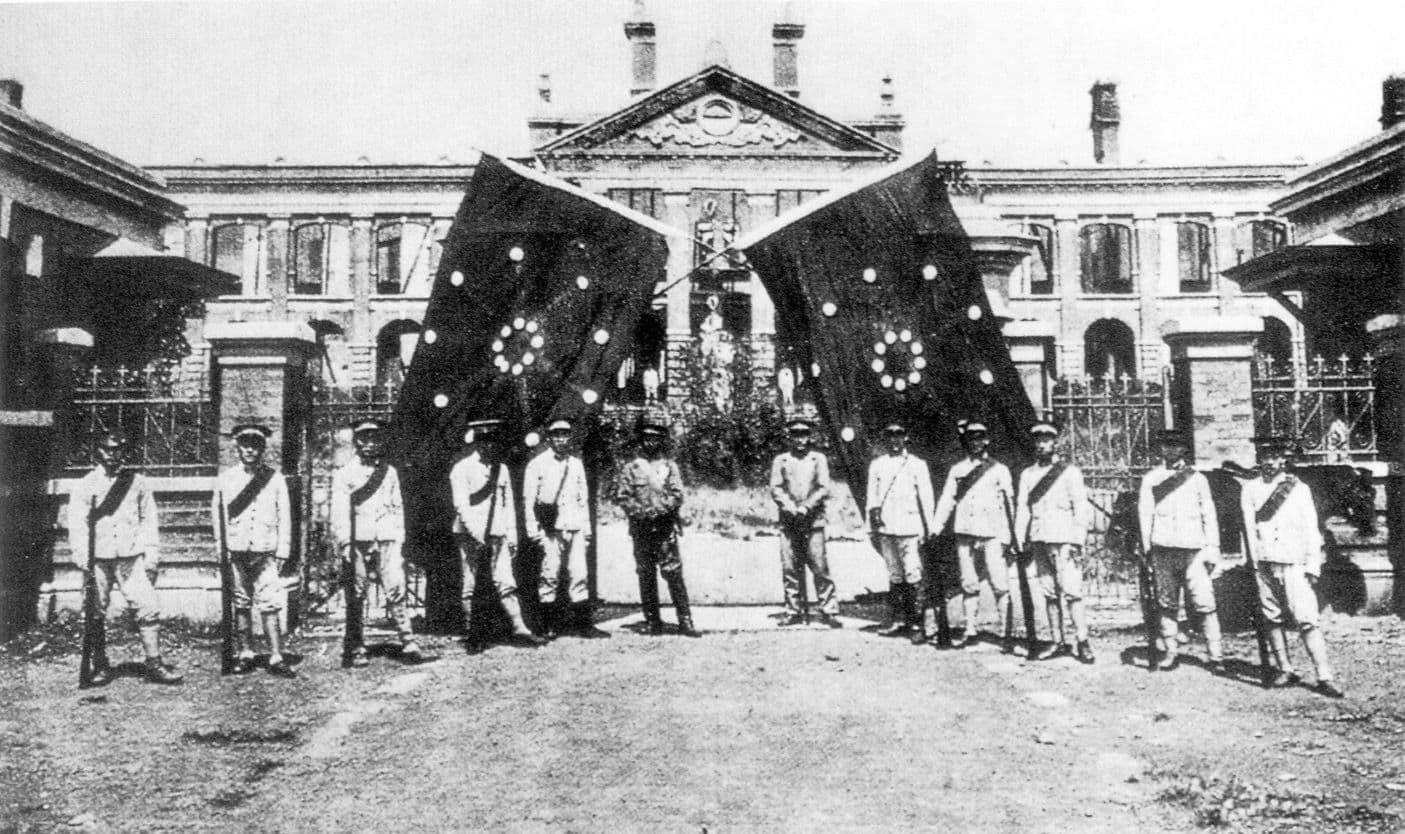
The Railway Protection Movement and the Wuchang Uprising
In the summer of 1911, Sichuan erupted in the Railway Protection Movement against the building of railways by foreigners. On 10 September the American chargé d’affaires, Williams, cabled Washington that after the viceroy at Chengdu arrested the ringleaders, his yamen was attacked by a mob and “the soldiers fired and killed some twenty rioters; some soldiers were killed also.” According to Chinese Communist Party history materials, much of the Wuhan New Army was transferred to Sichuan, weakening Qing forces in Hubei. On 24 September the Hubei revolutionary groups the Literary Society and the Progressive Association held a joint meeting in Wuchang, naming Jiang Yiwu provisional commander-in-chief and Sun Wu chief of staff, and drew up a plan for an uprising.
On 9 October, while Sun Wu was making bombs at the revolutionaries’ headquarters at Baoshanli in the Russian concession of Hankou, one exploded by accident; Russian police seized the documents and the headquarters was exposed. Jiang Yiwu ordered an uprising that night, but the order did not arrive in time. Governor-General Ruicheng began arresting suspects from the captured rolls and on the morning of the 10th executed three captured revolutionaries. After 7 p.m. on 10 October, Xiong Bingkun, a revolutionary in the New Army’s Eighth Engineer Battalion, rose first and led a dozen or so soldiers to the Chuwangtai arsenal, where guards fired in support; the insurgents took Chuwangtai and chose Wu Zhaolin, a company officer of the engineers, as acting commander. That night they attacked the governor-general’s yamen; Ruicheng escaped through a hole cut in its rear wall and took refuge on a gunboat in the Yangzi. The insurgents took the yamen before dawn on the 11th and by the early hours of the 12th had seized Hanyang and Hankou, putting all three cities of Wuhan in their hands.
On the 11th the Hubei Military Government was proclaimed in Wuchang, with the insurgents installing Li Yuanhong, commander of the New Army’s Twenty-first Mixed Brigade, as military governor. On the 13th Li wrote to the foreign consuls at Hankou that treaties already concluded would remain in force, indemnities and loans would be paid and foreign lives and property protected, but that treaties concluded with the Qing thereafter would not be recognised and powers assisting the Qing would be treated as enemies. Williams reported on the 12th that the whole New Army at Wuchang, about 15,000 men, had joined the revolution and that the rebellion was “undoubtedly the most serious since the Taiping.”
The Revolution Spreads and Yuan Shikai Returns
On 12 October the Qing court sent Army Minister Yinchang south with two New Army divisions, and on the 14th named Yuan Shikai, dismissed in 1909 and living in retirement at Zhangde in Henan, governor-general of Hubei and Hunan. Yuan declined, citing an unhealed foot ailment. Qing forces began a counteroffensive on 27 October and retook Hankou on 1 November. The same day Yikuang’s cabinet resigned and the court named Yuan prime minister; Yuan insisted that his appointment come from the parliament rather than the emperor, the National Assembly elected him on 8 November, the court ratified the choice the next day, and Yuan arrived in Beijing on the 13th.
Meanwhile the revolution spread rapidly. Changsha and Xi’an rose on 22 October, followed by cities such as Hangzhou, Zhenjiang and Fuzhou. By the count of historian Edward J. M. Rhoads, by late November every province along and south of the Yangzi, as well as Shaanxi and Shanxi in the north, had declared for the revolution; CCP history materials state that within little more than a month fourteen provinces had declared “restoration” and independence. On the battlefield, Huang Xing was made commander-in-chief of the revolutionary forces on 3 November and on the 16th led a failed counterattack on Hankou before falling back on Hanyang; Feng Guozhang’s First Corps attacked Hanyang on the 21st and took it on 27 November, the revolutionaries withdrawing to Wuchang, while revolutionary forces captured Nanjing on 2 December.
Violence against the Banner People
Rhoads notes that the revolution was “hardly bloodless” and that a disproportionate number of those killed and wounded were Manchus. The newly proclaimed Hubei Military Government declared its goal to be to “elevate the Han and exterminate the Manchus,” and soldiers stopped and killed banner people in the streets of Wuchang. A representative of the Military Government calculated that no fewer than four to five hundred banner people were killed in the first three days; a Reuters correspondent who visited Wuchang on the 14th estimated eight hundred. The worst of the killing ended after a proclamation of 13 October. When Xi’an’s Manchu City fell on 24 October its inhabitants were slaughtered indiscriminately, and Manchus were massacred after revolutionary troops entered the Manchu City of Nanjing on 3 December. Rhoads attributes this to the virulent racist rhetoric that had been a staple of revolutionary ideology for over a decade.
The North–South Peace Talks
After retaking Hankou, Yuan ordered his troops on 4 November to halt their advance on Hanyang and sent Liu Cheng’en and Cai Tinggan to Wuchang to approach Li Yuanhong. Wang Jingwei, a Revolutionary Alliance member released from prison on 6 November, stayed in Beijing and with Yuan’s adviser Yang Du formed the Society for the Joint Resolution of National Problems, working between the two sides; through his mediation Huang Xing replied on 9 December that if Yuan joined the revolutionaries in swiftly overthrowing the Qing, they would certainly elect him president of the Republic. A cease-fire was agreed in early December and repeatedly extended. On 7 December Empress Dowager Longyu gave Yuan full authority to appoint a representative to discuss the situation with the south; Yuan named Tang Shaoyi his plenipotentiary, Wu Tingfang led the southern delegation, and Wang Jingwei was made an adviser to the southern side on reaching Shanghai. Tang arrived in Shanghai on 17 December.
The formal talks opened on the afternoon of 18 December at the Town Hall of the International Settlement’s Municipal Council. At the second session on the 20th, Wu demanded a republic and the emperor’s abdication; Tang replied that “republican constitutionalism has the support of all; we Han people all approve of it,” but that a method must be found for a peaceful settlement so that the Qing court would not obstruct it, and proposed that a national convention decide between monarchy and republic. The same day the American, British, French, German, Japanese and Russian representatives in Beijing made a joint communication to both delegations. Outside the formal sessions, through Wang Jingwei’s mediation, the delegates met privately each night at the home of a mutual acquaintance; according to a 2012 Jiefang Daily report, this was Zhao Fengchang’s residence, Xiyintang, on Nanyang Road, where after daytime sessions conducted “with stern faces and in full official language” they discussed the terms of favourable treatment, who would govern, and how to win foreign recognition.
On 28 December the Qing court agreed to convene an assembly to decide the form of state. At the third session on the 29th the delegates agreed that a national convention would settle the question by majority decision, binding on both sides, and on the 30th that each province (with Inner and Outer Mongolia, and Front and Rear Tibet, each counted as one unit) would send three delegates. But on the 29th, delegates of seventeen provinces in Nanjing elected Sun Yat-sen, just back from abroad, provisional president. The American minister, W. J. Calhoun, cabled on the 31st that Sun “thus ignores the peace conference at Shanghai and the proposals to submit the form of government to a national convention.” Yuan refused to recognise the articles Tang had signed; Tang offered his resignation on the 31st, and on 2 January 1912 Yuan accepted it on the grounds that the articles had been signed without first being agreed with him. Yuan then negotiated with Wu directly by telegraph.
The Provisional Government of the Republic of China
On 1 January 1912 Sun Yat-sen was inaugurated in Nanjing as provisional president of the Republic of China, proclaiming the Republic and adopting the solar calendar. In his oath he declared that overthrowing the Manchu autocratic government, consolidating the Republic and planning for the people’s welfare was the common will of the nation, and pledged to resign once the autocracy had fallen, the country was free of disorder and the Republic was recognised by the nations. His inaugural proclamation stated that “the foundation of the state lies in its people,” and that uniting the lands of the Han, Manchus, Mongols, Hui and Tibetans into one country meant uniting these peoples as one.
On the day of his election Sun telegraphed Yuan explaining why a government had been formed, saying that he was filling the post only temporarily and was keeping it vacant for Yuan. Yuan replied on 2 January that “as for a provisional government, I dare not take part.” On 19 January the Republic’s foreign minister, Wang Chonghui, cabled the U.S. Secretary of State that the Qing government was negotiating to surrender its sovereignty and asked for recognition.
The Abdication of the Qing
According to Rhoads, by mid-January Yuan was pressing the court to abdicate without waiting for a national convention. At a court conference on 17 January, Prince Qing (Yikuang) and Pulun spoke in favour, and Calhoun reported on the 19th that the imperial clan had voted that day to accept an abdication edict drafted by Yuan. But opponents led by Puwei, Prince Gong, urged resistance at a conference on the 22nd, and on the 24th Empress Dowager Longyu issued an edict reverting to the plan of having a national convention decide the form of state.
On 26 January Duan Qirui, newly appointed commander of the First Corps, and more than forty generals and officers jointly telegraphed the cabinet and the princes, blaming the princes for the delay and urging the immediate establishment of a republic. That night Liangbi, who had stirred the Palace Guard against abdication, was attacked by a revolutionary and died of his wounds several days later. On the 27th Wu Tingfang warned Yuan that the southern offer of favourable treatment would be withdrawn unless the Qing announced its abdication before the cease-fire expired on the 29th. On 3 February Longyu formally gave Yuan full authority to settle with the revolutionaries the terms for the imperial household, the imperial lineage, the Eight Banners and the Manchus, Mongols, Hui and Tibetans. Negotiations followed: on 5 February the Nanjing Senate took Yuan’s draft as a basis but demanded revisions, and the two sides bargained over whether the emperor’s title would be hereditary, whether his allowance would be reckoned in taels or dollars, where he would live, who would control the Palace Guard and which word for “abdication” to use. Some revolutionaries, including Guangdong military governor Chen Jiongming, publicly objected that the terms were too generous, while Wang Jingwei defended them in reply.
On 12 February 1912 (the 25th day of the 12th month of the third year of Xuantong), Empress Dowager Longyu issued three edicts in the name of the six-year-old Xuantong Emperor, Puyi. The first, the abdication edict, stated that the people of the whole country now mostly inclined towards a republic, transferred the emperor’s sovereignty to the whole nation, established a constitutional republican form of state, charged Yuan Shikai with organising a provisional republican government with full powers in consultation with the revolutionary army, and expressed the hope that the territory of the five peoples—Manchu, Han, Mongol, Hui and Tibetan—would remain united as one great Republic of China. The second ordered officials to keep order; the third proclaimed the Articles of Favourable Treatment.
The Articles had three parts. The emperor would retain his title, and the Republic would treat him with the courtesy due to foreign monarchs; he would receive four million taels a year, to become four million dollars once a new currency was minted; he would live “temporarily” in the palace and later move to the Yiheyuan; palace staff could be retained, but no more eunuchs could be recruited; and the Palace Guard would come under the Republic’s Ministry of the Army with its strength and pay unchanged. Four further articles covered the imperial lineage and seven the Manchus, Mongols, Hui and Tibetans, providing among other things that princely and hereditary titles would continue and that former restrictions on the banner people’s occupation and residence were abolished.
Accounts of who drafted the edict differ. The version on Wikisource is annotated as drafted by Zhang Yuanqi, acting vice-minister of education, and revised by Xu Shichang, former associate prime minister; Rhoads writes that it was drafted by Zhang Jian for the Republicans and revised by Yuan Shikai, and the Jiefang Daily report likewise says Zhang Jian drafted the first version at Xiyintang. Rhoads adds that the clause giving Yuan full authority to organise a provisional republican government was inserted by Yuan without the revolutionaries’ prior consent, and that they were incensed, having always insisted that Yuan’s authority must derive from the Republic and not from the Qing. Forwarding the edicts on the 13th, Calhoun wrote that the documents were “of profound significance, marking the close of the Ta Ch’ing Dynasty and the rule of the Manchus,” and ushered in “a new era whose character is yet to be determined.”
Sun’s Resignation and Yuan’s Inauguration
On 13 February Sun submitted his resignation to the Nanjing Provisional Senate, saying that now that the emperor had abdicated and autocracy had been removed he would keep his oath and step down. He attached three conditions: the provisional government would remain in Nanjing, which could not be changed; he and his ministers would leave office only when the new president came to Nanjing in person to take office; and the new president must observe the provisional constitution drawn up by the Senate. In a separate letter he recommended Yuan, writing that Yuan’s efforts had counted for much in the abdication and the unification of north and south. On 15 February the Senate unanimously elected Yuan provisional president and fixed the provisional capital at Nanjing; the same day Sun led a large party to the tomb of the Ming founder outside Nanjing. Sun then sent envoys north to invite Yuan to Nanjing.
On the evening of 29 February troops in Beijing mutinied, shooting, burning and looting through the city until the evening of 2 March; similar disorders followed in Tianjin and Baoding. Calhoun reported that the mutineers told missionaries they opposed the republican movement and “condemned Yuan in severe terms for having gone over to the republicans,” while also complaining of unpaid and reduced wages; the foreign ministers agreed to bring more troops into the capital from Tianjin. The Nanjing Senate subsequently authorised Yuan to be inaugurated in Beijing, and he took the oath of office as provisional president there on 10 March. The Provisional Constitution, passed by the Senate on 8 March, was promulgated by Sun on 11 March; it declared that the sovereignty of the Republic of China was vested in the people as a whole. In Washington, the House of Representatives passed a joint resolution on 29 February congratulating the people of China “on their assumption of the powers, duties and responsibilities of self-government.”
Differing Accounts across the Strait and in Scholarship
Both the People’s Republic of China and the Republic of China on Taiwan commemorate the revolution, with different emphases. At the 2021 commemoration Xi Jinping said that it “ended the monarchical autocracy that had lasted in China for several thousand years,” but that it “did not accomplish the historic task of achieving national independence and the people’s liberation,” and called Chinese Communists “the most faithful successors” of Sun’s revolutionary cause. In Taiwan, Ma Ying-jeou in 2011 called the revolution “a memory and heritage shared by both sides of the Taiwan Strait,” stressing that the ROC’s existence “is referred to not in the past tense, but in the present”; in his 2024 National Day address Lai Ching-te said that the ROC “has taken root in Taiwan, Penghu, Kinmen and Matsu” and that the ROC and the PRC “are not subordinate to each other.” Among historians, Sang Bing argues that the main subject of the peace talks was not the merits of a republic versus a constitutional monarchy but the form in which a republic would be realised, while Rhoads concludes that the abdication terms were the product of over three months of genuine give-and-take rather than terms imposed by victors on a vanquished foe.
Gallery
Narrative Comparison
| Source | Narrative |
|---|---|
| Xi Jinping, speech marking the 110th anniversary (2021) | Beijing presents the revolution as having “overthrew the Qing government and ended the monarchical autocracy that had lasted in China for several thousand years,” while holding that it “did not change the semi-colonial, semi-feudal nature of old China” and “did not accomplish the historic task of achieving national independence and the people’s liberation”; it describes Chinese Communists as “the most steadfast supporters, the most loyal partners and the most faithful successors” of Sun Yat-sen’s revolutionary cause. |
| Ma Ying-jeou, National Day address (2011, via Taipei Times); Lai Ching-te, National Day address (2024) | At the centenary Ma Ying-jeou called the revolution “a memory and heritage shared by both sides of the Taiwan Strait,” urged Beijing to “face the existence of the Republic of China head-on,” and stressed that the ROC’s existence “is referred to not in the past tense, but in the present.” In 2024 Lai Ching-te said that revolutionaries had overthrown imperial rule 113 years earlier in pursuit of a democratic republic, but that “the dream of democracy was once swallowed by the flames of war, and the ideal of freedom was long eroded under authoritarian rule,” adding that the ROC “has taken root in Taiwan, Penghu, Kinmen and Matsu” and that the ROC and the PRC “are not subordinate to each other.” The two presidents framed the ROC’s relationship to the revolution with different emphases. |
| U.S. Minister W. J. Calhoun’s dispatches (1911–12); House joint resolution (1912) | U.S. legation reporting was at first guarded towards Nanjing: Calhoun wrote that Sun’s inauguration “ignores the peace conference at Shanghai and the proposals to submit the form of government to a national convention.” After the abdication he called the edicts “of profound significance, marking the close of the Ta Ch’ing Dynasty and the rule of the Manchus,” ushering in “a new era whose character is yet to be determined.” The House of Representatives then passed a joint resolution congratulating the people of China “on their assumption of the powers, duties and responsibilities of self-government.” |
| Edward J. M. Rhoads, Manchus and Han (University of Washington Press, 2000) | Rhoads stresses that “brief as it was, the revolution was hardly bloodless”: a disproportionate number of the dead and wounded were Manchus, victims of years of racist rhetoric. At the same time, the terms of the abdication agreement “were the product of genuine give-and-take between the Republicans and the Qing that lasted over three months; they were not imposed by the victorious revolutionaries upon a vanquished foe.” In his view the Republicans’ generosity was meant to avoid a prolonged war and the risk of foreign intervention. |
Key Milestones
- Clashes at Chengdu over railway protection
According to U.S. legation cables of 10 and 14 September, after the Sichuan viceroy arrested leaders of the movement at Chengdu, a crowd attacked his yamen and soldiers killed some twenty rioters; fighting continued at Chengdu from the 7th.
- Accidental bomb explosion at Baoshanli, Hankou
A bomb exploded while Sun Wu was making explosives at the revolutionaries’ headquarters in Hankou’s Russian concession; Russian police seized the documents and the Hubei revolutionary organisation was exposed.
- Wuchang Uprising
The Eighth Engineer Battalion rose that night; the insurgents took the governor-general’s yamen before dawn and on the 11th formed the Hubei Military Government under Li Yuanhong.
- Qing court names Yuan Shikai governor-general of Hubei and Hunan
Yuan declined at first, citing an unhealed foot ailment.
- Qing forces retake Hankou; Yuan named prime minister
Yikuang’s cabinet resigned the same day. The National Assembly elected Yuan prime minister on 8 November, and he reached Beijing on the 13th.
- Qing forces retake Hanyang
Feng Guozhang’s First Corps captured Hanyang, and the revolutionaries fell back on Wuchang.
- Revolutionary forces capture Nanjing
Manchus in the city’s banner quarter were massacred the next day. A cease-fire between north and south followed.
- North–South peace talks open in Shanghai
Tang Shaoyi and Wu Tingfang held their first session at the Town Hall of the International Settlement; five sessions were held by the 31st.
- Sun Yat-sen elected provisional president
Delegates of seventeen provinces in Nanjing elected Sun provisional president. The same day the Shanghai talks agreed that a national convention would decide the form of state.
- Provisional Government of the Republic of China founded
Sun was inaugurated in Nanjing, proclaiming the Republic and adopting the solar calendar.
- Duan Qirui and generals urge a republic; Liangbi attacked
Duan Qirui and more than forty officers telegraphed the cabinet and princes urging an immediate republic; that night Liangbi was attacked by a revolutionary and died days later.
- Abdication of the Qing emperor
Empress Dowager Longyu issued the abdication edict and two others in the Xuantong Emperor’s name, proclaiming the Articles of Favourable Treatment.
- Sun Yat-sen resigns and recommends Yuan
His resignation set three conditions: the government would stay in Nanjing, the new president would take office there in person, and he would observe the provisional constitution.
- Senate elects Yuan provisional president
The Nanjing Senate elected Yuan unanimously and fixed the provisional capital at Nanjing.
- Mutiny in Beijing
Mutinous troops shot, burned and looted in Beijing until the evening of 2 March; disorders followed in Tianjin and Baoding.
- Yuan inaugurated in Beijing
With the Nanjing Senate’s authorisation, Yuan took the oath of office in Beijing.
- Provisional Constitution promulgated
Passed by the Senate on 8 March and promulgated by Sun, it vested the sovereignty of the Republic in the people as a whole.
Last verified:
Cite this page
Chronicles of Modern China. (2026, November 6). Xinhai Revolution. Retrieved November 6, 2026, from https://www.cmcarchive.org/events/xinhai-revolution-1911
“Xinhai Revolution.” Chronicles of Modern China. Last modified November 6, 2026. Accessed November 6, 2026. https://www.cmcarchive.org/events/xinhai-revolution-1911.
Chronicles of Modern China. Xinhai Revolution[EB/OL]. (2026-11-06)[2026-11-06]. https://www.cmcarchive.org/events/xinhai-revolution-1911.