The Hongxian Monarchy and the National Protection War
In August 1915, after the American adviser Frank Goodnow’s memorandum was published, the Chou’an hui was formed to campaign for a return to monarchy; on 11 December the Council of State reported that all 1,993 national delegates favoured constitutional monarchy, and Yuan Shikai accepted the throne the next day, adopting the reign title Hongxian. Japan, with Britain and Russia, urged postponement, while the United States treated the matter as China’s internal affair. On 25 December Tang Jiyao, Cai E and others declared Yunnan independent, starting the National Protection War; Guangxi, Guangdong and other provinces followed, and Japan turned to supporting Yuan’s removal. Yuan cancelled the monarchy on 22 March 1916 and died on 6 June; the war ended in July.
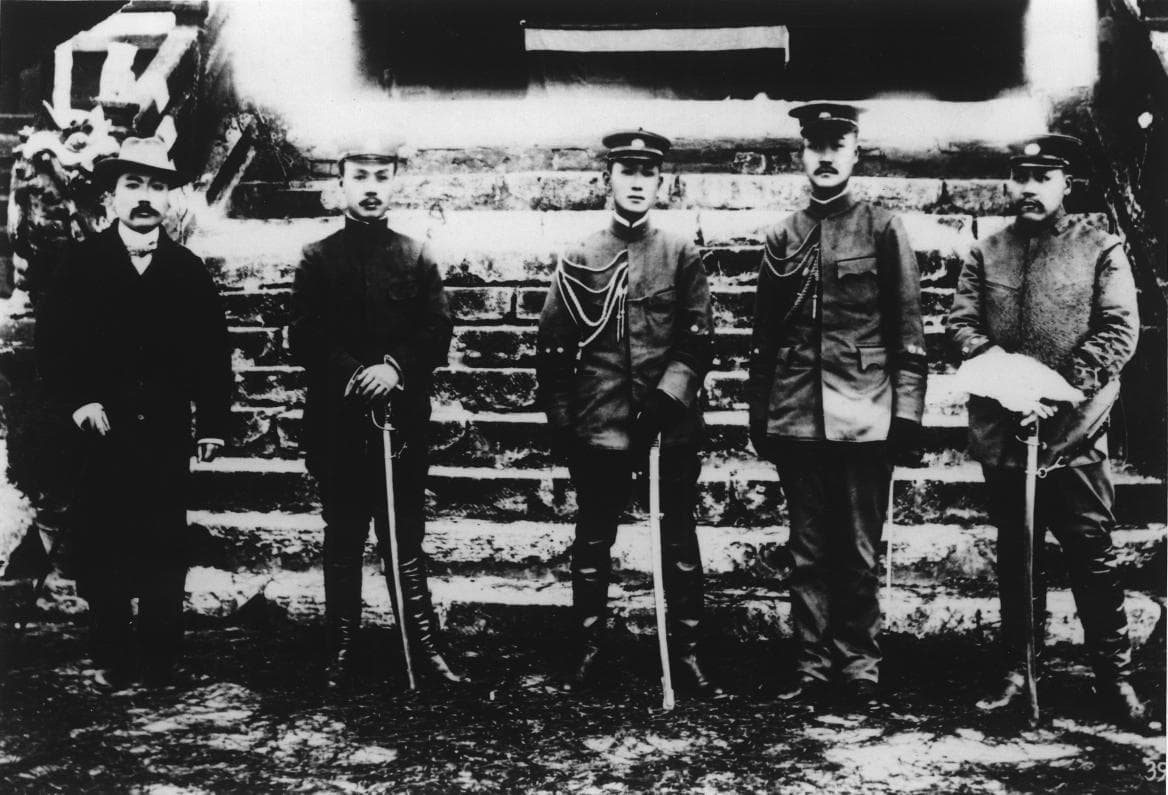
The Goodnow Memorandum and the Chou’an hui
In August 1915 Yuan Shikai published a memorandum written at his request by his American constitutional adviser, Frank J. Goodnow. According to the U.S. legation, it held that, theoretically and in the abstract, monarchy was better adapted to conditions in China, while reserving an opinion on whether a change should be made; the Chinese version declared that monarchy would be better suited to China than a republic. Days later Yang Du, Sun Yujun, Yan Fu, Liu Shipei, Li Xiehe and Hu Ying launched the Society to Plan for Stability (Chou’an hui), which announced its establishment on 19 August with Yang as president and campaigned for constitutional monarchy under the guise of studying which form of state suited China. The American chargé, John Van Antwerp MacMurray, reported that Yuan had declined to restrain the society and that “the great majority of provincial governors, both civil and military” had telegraphed their support—telegrams that “have in all probability been sent under official inspiration.”
The most influential opponent was Liang Qichao, whose essay of 31 August, How Strange This So-Called Question of the Form of State, declared that constitutionalist commentators should concern themselves only with the form of government and not the form of state, and opposed a change at that time.
The Vote on the Form of State and Acceptance of the Throne
The Council of State referred the question to a national convention of delegates. Delegates were elected from 25 October and voting on the form of state took place from 28 October. On 11 December the Council reported that all 1,993 delegates had voted unanimously for constitutional monarchy and, as their general representative, petitioned Yuan to become emperor. Yuan first declined, saying that suddenly assuming the throne would shame him before the former emperor and his own oath; after a second petition that evening he accepted the throne on 12 December and adopted the reign title Hongxian. The enthronement, first planned for New Year’s Day, was postponed by decree on 26 December, and later dates were never carried out. Foreign legations returned any correspondence dated by the Hongxian era, forcing the government to use the Western calendar. According to an article in The Paper, Yuan’s eldest son Yuan Keding forged copies of the Japanese-controlled Shuntian Times to persuade his father that Japan supported his enthronement.
The Powers’ Response
On 28 October the Japanese chargé d’affaires, together with the British and Russian ministers, called on the Chinese foreign minister and, “by way of friendly counsel,” suggested “stopping the movement for a change in the form of government, in order that disturbances might be avoided.” Japanese Foreign Minister Ishii Kikujirō informed the United States that opposition to the monarchy in China was “very much stronger than at first suspected,” especially in the Yangzi valley and the south. The British minister later told Yuan’s representatives that Britain had simply followed Japan’s suggestion and was not hostile to the monarchy. The United States declined to join: a State Department memorandum of 4 November said that although the American government was “naturally in sympathy with republican institutions,” any change in China’s form of government was “wholly a domestic question” and interference would be “an invasion of China’s sovereignty.” On 21 December Secretary of State Robert Lansing authorised Minister Paul Reinsch to recognise the empire if “no serious organized opposition exists,” but after the Yunnan rising Reinsch did not intimate recognition to Beijing.
The National Protection Army Rises
Cai E, a former military governor of Yunnan, had been transferred to Beijing by Yuan in 1913 with a nominal generalship. Zeng Yeying of the Institute of Modern History at the Chinese Academy of Social Sciences argues that Cai, while outwardly supporting the monarchy, was in danger and not fully trusted by Yuan. In 1915 Cai left Beijing and made his way back to Yunnan via Japan and Vietnam. Li Liejun reached Kunming on 17 December, and Cai and Dai Kan arrived on the 22nd. On the 23rd the Yunnan general Tang Jiyao and civil governor Ren Kecheng telegraphed Yuan demanding that he cancel the monarchy and punish its instigators, setting a deadline of 10 a.m. on the 25th; when no reply came, Yunnan declared independence on 25 December, beginning the National Protection War. Cai commanded the First Army and Li Liejun the Second, and in January 1916 Yunnan forces advanced into southern Sichuan.
On 19 January Reinsch still judged that “the Yunnan revolt has not spread but retains the character of a local opposition of a few military leaders against Yuan personally.” But on 15 March Guangxi declared independence, demanding cancellation of the monarchy and threatening joint action with Yunnan, and the situation turned sharply against Yuan.
The Monarchy Cancelled
On 21 March Yuan convened a meeting at the presidential palace that resolved to cancel the monarchy, and on the 22nd he issued an order revoking his acceptance of the throne, returning the provincial petitions for destruction and halting all preparations, declaring that whatever fault there was lay with him alone. On the 23rd the Hongxian reign title was abolished and Duan Qirui was appointed chief of the general staff. The cancellation did not end the opposition: Long Jiguang declared Guangdong independent on 6 April, Zhejiang and other provinces followed, and Reinsch reported that the rebels had “no policy but to oust Yuan.”
Japanese Intervention
Japan moved from urging postponement to working for Yuan’s removal. According to the historian Cheng Honglei, drawing on Japanese archives, the Japanese Army General Staff began planning intervention after Beijing ignored the October advice, and in early March 1916 the Japanese cabinet concluded that Yuan was an obstacle to Japan’s ascendancy in China and that it would be best to remove him from power, preferably through a situation created by the Chinese themselves. The General Staff’s envoy Aoki Nobuzumi liaised with the anti-Yuan factions from Shanghai, supported Liang Qichao’s journey south and the National Protection Army, and tried to win over Feng Guozhang and Zhang Zuolin, though the Beiyang generals did not openly defect. Reinsch reported at the time that action by a Japanese bank had cut off Beijing’s salt revenue and that “Japanese are actively encouraging revolution”; on 4 May a force of a thousand armed men, “including many Japanese,” arrived by special train from Qingdao and attacked Weixian in Shandong.
Yuan’s Death and the End of the War
Yuan Shikai died in Beijing at 10 a.m. on 6 June 1916, and Vice President Li Yuanhong took the oath as president the next day. Reinsch wrote in his memoirs that Yuan suffered from Bright’s disease, which worsened under the strain, and that, according to those present, he declared on his deathbed “that it had not been his wish to become Emperor; he had been deceived into believing that the step was demanded by the public, and was necessary to the country.” On 14 July the Military Affairs Council formed by the anti-Yuan provinces was dissolved, ending the National Protection War.
Gallery
Narrative Comparison
| Source | Narrative |
|---|---|
| China News Service (2011) | China News Service, an official mainland outlet, presents the war as Cai E’s campaign against Yuan after seeing through his imperial ambitions, stating that “in 1916 the usurper Yuan Shikai died amid the curses of the nation, and the war ended in victory,” and cites Zeng Yeying of the Chinese Academy of Social Sciences on how Cai pretended to support Yuan while in danger. |
| Foreign Minister Ishii’s telegram (1915, FRUS); Japanese cabinet decision (March 1916, as cited by Cheng Honglei) | In October 1915 the Japanese government urged postponement in the name of peace, Ishii stating that opposition to the monarchy was “very much stronger than at first suspected” and that an upheaval would cause incalculable losses to the powers. Once the monarchy went ahead, the cabinet decided in early March 1916 that it would be best to remove Yuan from power in order to establish Japan’s ascendancy in China. |
| State Department memorandum and Secretary Lansing’s instructions (1915) | The United States declined to join Japan’s démarche: while “naturally in sympathy with republican institutions,” it held that any change in China’s form of government was “wholly a domestic question” and that interference would be “an invasion of China’s sovereignty.” Secretary Lansing authorised recognition of the empire “if no serious organized opposition exists.” |
| Paul S. Reinsch’s memoir (1922) | Paul Reinsch, the American minister in Beijing, recalled that Yuan suffered from Bright’s disease, which worsened under the strain of failure, and that according to those present he declared on his deathbed “that it had not been his wish to become Emperor; he had been deceived into believing that the step was demanded by the public, and was necessary to the country.” |
Key Milestones
- Chou’an hui established
Founded by Yang Du, Sun Yujun and four others, with Yang as president.
- Liang Qichao publishes his essay against changing the form of state
He opposed changing the form of state at that time.
- Japan, Britain and Russia urge postponement; voting begins
The three powers offered friendly advice to the foreign minister; provincial delegates began voting on the form of state.
- United States declines to join the advice
The State Department held the change of government to be wholly a domestic matter.
- Council of State reports unanimous vote for monarchy
The Council petitioned Yuan to take the throne; he declined at first.
- Yuan accepts the throne
He adopted the reign title Hongxian; the enthronement was repeatedly postponed.
- Yunnan declares independence; National Protection War begins
Tang Jiyao, Cai E, Li Liejun and others issued a circular telegram against Yuan.
- Guangxi declares independence
Guangxi demanded cancellation of the monarchy and threatened joint action with Yunnan.
- Yuan cancels the monarchy
The Hongxian era was abolished the next day.
- Guangdong declares independence
Long Jiguang declared Guangdong independent; Zhejiang and others followed.
- Yuan Shikai dies
Yuan died in Beijing; Li Yuanhong became president the next day.
- Military Affairs Council dissolved; war ends
The council formed by the anti-Yuan provinces was dissolved.
Last verified:
Cite this page
Chronicles of Modern China. (2026, November 6). The Hongxian Monarchy and the National Protection War. Retrieved November 6, 2026, from https://www.cmcarchive.org/events/hongxian-monarchy-national-protection-war-1915
“The Hongxian Monarchy and the National Protection War.” Chronicles of Modern China. Last modified November 6, 2026. Accessed November 6, 2026. https://www.cmcarchive.org/events/hongxian-monarchy-national-protection-war-1915.
Chronicles of Modern China. The Hongxian Monarchy and the National Protection War[EB/OL]. (2026-11-06)[2026-11-06]. https://www.cmcarchive.org/events/hongxian-monarchy-national-protection-war-1915.