The Assassination of Song Jiaoren and the Second Revolution
On 20 March 1913 Song Jiaoren, acting leader of the Nationalist Party, which had just won China’s first parliamentary election, was shot at Shanghai railway station and died two days later. Letters and telegrams seized from the man who hired the gunman implicated Hong Shuzu, a secretary in the Ministry of the Interior, and Premier Zhao Bingjun. In April Yuan Shikai’s government signed the Reorganisation Loan without parliamentary approval, in June it removed the Nationalist governors of Jiangxi, Guangdong and Anhui, and in July Li Liejun, Huang Xing and others rose against Yuan in what became known as the Second Revolution, which collapsed when northern troops took Nanjing on 1 September. Who ordered Song’s killing remains disputed.
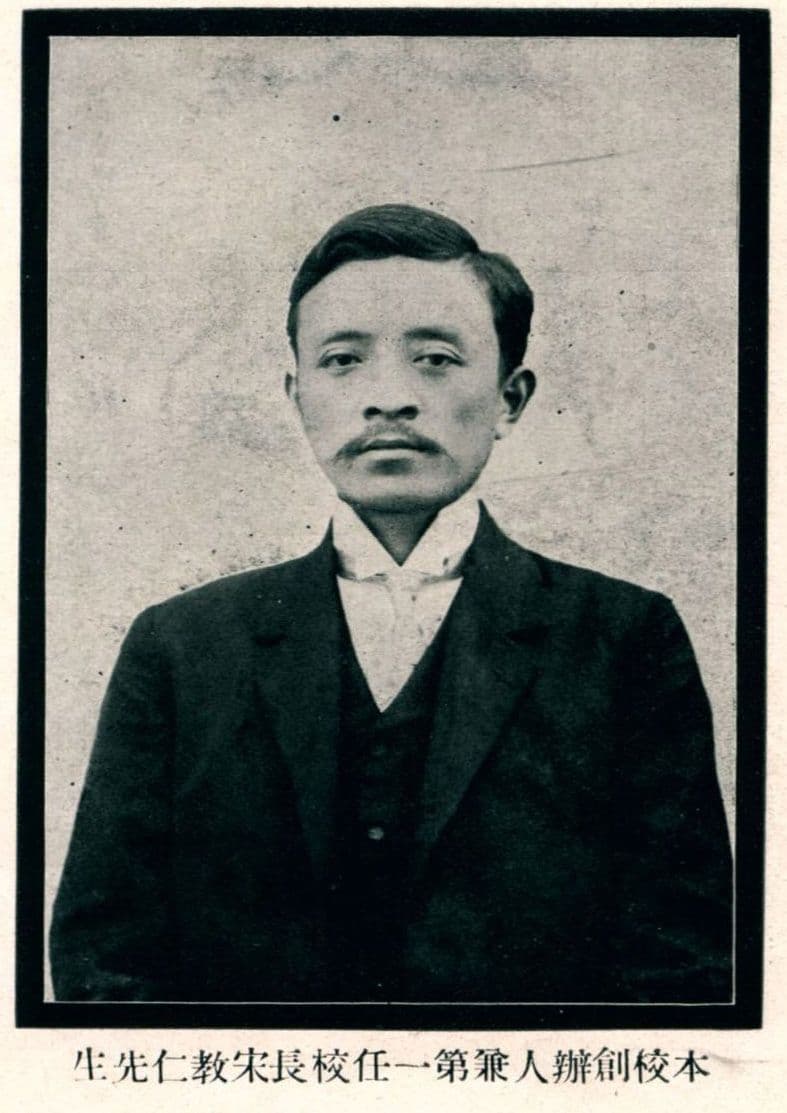
Song Jiaoren and the First Parliamentary Election
Song Jiaoren had served as a minister in Tang Shaoyi’s cabinet and left office with Tang in 1912, afterwards devoting himself to organising the Nationalist Party (Kuomintang). When the party was formed its directors chose Sun Yat-sen as chairman, and Sun asked Song to act in his place. Song advocated a responsible cabinet formed by the party holding a majority in parliament. In the first parliamentary elections, held from late 1912 to early 1913, the Nationalists won 392 of the 870 seats in the two houses, becoming the largest party, with a clear majority in the Senate and a slight edge in the House. As the results became clear, Song toured the Yangzi valley giving speeches that sharply criticised the Yuan government’s diplomacy and finances. According to the American chargé d’affaires, E. T. Williams, Song’s friends alleged that Yuan Shikai “had repeatedly declared that he would not be President with Sung for Premier.”
Shot at Shanghai Station
On the evening of 20 March 1913, Song entered the Shanghai station of the Shanghai–Nanjing Railway with Huang Xing and others to take a train north. At about 10:45 p.m., as the party walked from the reception room to the ticket gate, shots were fired; Song was hit and taken to the nearby railway hospital, where he died in the early hours of the 22nd. Before he died he asked Yu Youren to donate his books to the Nanjing Library and his comrades to look after his mother, and had Huang Xing draft a final telegram to Yuan Shikai urging the president to protect the people’s rights and let parliament establish a lasting constitution. The gunman, Wu Shiying, escaped into the French Concession; arrested on the 23rd, he confessed that he had been hired by Ying Kuicheng (also known as Ying Guixin). Ying was a secret-society figure who had helped in the 1911 seizure of Shanghai and then served as head of intelligence in the Shanghai Military Government under Chen Qimei. The International Settlement police later found a large body of letters and telegrams in his house.
The Telegrams and the Case
According to Zhang Yong of Peking University, who traced the seized correspondence, Ying had earlier attached himself to Yuan Shikai and to Zhao Bingjun, premier and minister of the interior, through Hong Shuzu, a secretary in the Ministry of the Interior. On 2 February 1913 Ying telegraphed Zhao proposing to buy material on a lawsuit involving Song in Japan in order to smear him. When the material failed to materialise, Ying wrote to Hong on 13 March proposing to remove Song. On 18 March Hong telegraphed that Ying’s telegram of the 14th should be acted on, and on the 19th urged him to proceed quickly. The day after the shooting Ying cabled Hong that the “bandit chief has been eliminated.”
On 24 April Wu Shiying died in custody. On 26 April the Jiangsu military governor Cheng Dequan and civil governor Ying Dehong published, by circular telegram, the evidence seized from Ying’s house—53 items that Cheng, Huang Xing and others had inspected, sealed and annotated. On 28 April Zhao Bingjun issued a telegram in his own defence rebutting the evidence. Hong Shuzu fled to the German leased territory at Qingdao, and the Germans refused to extradite him. Huang Xing and others pressed for a special court; after the Ministry of Justice blocked this, they accepted trial by the Shanghai District Court. Government-side newspapers accused Chen Qimei and Huang Xing of being the masterminds; the historian Shang Xiaoming notes that they produced no evidence, “not even one letter or telegram.”
The Reorganisation Loan and the North–South Rift
The first National Assembly opened in Beijing on 8 April, with 682 members present. On 26 April the Beijing government, represented by Premier Zhao Bingjun, Foreign Minister Lu Zhengxiang and Finance Minister Zhou Xuexi, signed the Reorganisation Loan agreement in Beijing with a consortium of British, German, French, Russian and Japanese banks, for a total of £25 million. Nationalist parliamentarians declared that the government had signed the loan without submitting it to parliament, in violation of Article 19 of the Provisional Constitution, stressing that they opposed the unlawful signing and not borrowing as such. On 2 May Sun Yat-sen appealed to foreign governments and peoples, stating that an official investigation had established “that Peking Government is seriously implicated in the crime,” and asking that the bankers be stopped from funding Beijing. The same day the United States recognised the government of the Republic of China.
According to American legation reports, chambers of commerce in various cities telegraphed Beijing protesting against the agitation for a “second revolution.” Yuan removed three Nationalist military governors—Li Liejun of Jiangxi, Hu Hanmin of Guangdong and Bai Wenwei of Anhui; the order of 9 June dismissing Li declared that he had handled matters wrongly and was unfit for his post.
The Second Revolution
On 12 July the Second Revolution broke out at Hukou in Jiangxi, where Li Liejun took office as commander-in-chief of the Jiangxi Anti-Yuan Army. On the 14th Huang Xing went from Shanghai to Nanjing, forced the Jiangsu governor Cheng Dequan to declare independence and was chosen commander-in-chief of the Jiangsu Anti-Yuan Army. On the 16th Yuan proclaimed that Li had secretly returned to Hukou to incite the troops to rebellion and sent Duan Zhigui to Jiangxi. Shanghai, Guangdong and Fujian also declared independence; by the American legation’s count on 29 July, six provinces—Guangdong, Fujian, Jiangsu, Anhui, Jiangxi and Hunan—had joined, “some of these give but a half-hearted support.” The Foreign Office also asked the diplomatic body to expel Huang Xing and Chen Qimei from the International Settlement at Shanghai.
The anti-Yuan forces soon gave way. By early August Sun Yat-sen, Huang Xing and the former Guangdong governor Hu Hanmin had fled to Japan, with rewards offered by Yuan for their capture. On 1 September northern troops captured Nanjing, “the last rebel stronghold in the Yangtze Valley.” In the disorder that followed three Japanese subjects were killed—according to the Japanese account, shot by Zhang Xun’s troops—and Japan presented demands for an apology, punishment of those responsible and compensation.
Yuan Elected President and the Nationalist Party Dissolved
On 6 October the National Assembly elected Yuan Shikai President of the Republic of China, and he was inaugurated on 10 October. On 4 November Yuan ordered the dissolution of the Nationalist Party, citing seized secret telegrams between Li Liejun and Nationalist parliamentarians; all party bodies were to be dissolved within three days, and Nationalist members of parliament were stripped of their certificates and badges.
The Dispute over Who Ordered the Killing
Who was behind the assassination remains unresolved; earlier interpretations have blamed Yuan Shikai, Zhao Bingjun or Chen Qimei. Zhang Yong argues that the telegrams show Hong Shuzu and Ying Kuicheng planned and carried out the killing, but that there is little material on how far Yuan and Zhao were involved: on hearing the news Zhao exclaimed before the cabinet that anyone who said he had killed Song was calling him a man who betrayed his friend, and the Beijing police chief Wang Zhixin later disclosed at Song’s memorial a conversation between Yuan and Hong. In Zhang’s view the question must be left open for want of evidence. In his 2018 book Re-examining the Song Case, Shang Xiaoming concludes that Hong Shuzu was the mastermind, while noting that although Yuan and Zhao had no direct connection with the killing itself, they were connected with other strands of the case that directly led to it.
Gallery
Narrative Comparison
| Source | Narrative |
|---|---|
| Sun Yat-sen’s appeal to foreign governments (1913); Nationalist parliamentarians’ declaration (1913) | Sun Yat-sen and the Nationalists held that the investigation had established “that Peking Government is seriously implicated in the crime,” and that the government had then concluded a £25 million loan with the five-nation group despite the protests of the assembled representatives of the nation. Nationalist parliamentarians stressed that signing the loan without parliament’s decision violated the Provisional Constitution, and that their opposition was to the unlawful signing rather than to borrowing itself. |
| U.S. Chargé d’Affaires E. T. Williams’s dispatches (1913) | U.S. legation reporting was clearly sympathetic to Yuan. Williams wrote that “it seems incredible that the President could have had any knowledge of the plot,” while allowing that “some overzealous follower of Yuan” might have planned it. He called Yuan “the real founder of the Republic,” dismissed the idea that the rising was meant to avenge Song as “without foundation,” and judged that the insurrection was “not supported by the commercial classes of the South,” its aim being the removal of Yuan, “which should be left to settlement by ballot.” |
| Contemporary remarks of Zhao Bingjun and Wang Zhixin (as cited by Zhang Yong, 2013) | According to Zhang Yong, Premier Zhao Bingjun was visibly shaken when told of the shooting during a cabinet meeting and said before the ministers that anyone who claimed he had killed Song was accusing him of betraying a friend. Beijing police chief Wang Zhixin later told Song’s memorial meeting that after the killing Yuan had related to Zhao a remark by Hong Shuzu suggesting that the president’s difficulties came from the opposition and that dealing with one or two of them would warn the rest. Zhang concludes that the extent of Yuan’s and Zhao’s involvement cannot be settled on the available evidence. |
| CPPCC News (2014) | An article on CPPCC News, an official mainland outlet, names Yuan Shikai as the instigator: after the Nationalists won an overwhelming majority, “Yuan Shikai, bent on becoming emperor, deeply resented this and decided to eliminate Song by the despicable means of assassination,” and Song “was shot in the waist by an assassin sent by Yuan Shikai.” |
Key Milestones
- Song Jiaoren shot at Shanghai station
At about 10:45 p.m., Song was shot at the Shanghai station of the Shanghai–Nanjing Railway as he set out for Beijing.
- Song Jiaoren dies
Song died in the early hours of the 22nd at the railway hospital.
- Gunman Wu Shiying arrested
Wu was arrested in the French Concession and confessed that Ying Kuicheng had hired him.
- First National Assembly opens
The two houses met in Beijing for the opening ceremony, with 682 members present.
- Song case evidence published; Reorganisation Loan signed
Cheng Dequan and Ying Dehong published the correspondence seized from Ying’s house; the same day Beijing signed the £25 million loan with the five-nation consortium.
- Yuan dismisses Li Liejun as governor of Jiangxi
In the same period Hu Hanmin and Bai Wenwei were removed as governors of Guangdong and Anhui.
- Second Revolution breaks out at Hukou
Li Liejun took command of the Jiangxi Anti-Yuan Army at Hukou.
- Huang Xing raises Nanjing against Yuan
Huang Xing forced the Jiangsu governor Cheng Dequan to declare independence and became commander of the Jiangsu Anti-Yuan Army.
- Northern troops capture Nanjing
The last anti-Yuan stronghold in the Yangzi valley fell, ending the Second Revolution.
- Yuan elected President
The National Assembly elected Yuan President of the Republic; he was inaugurated on 10 October.
- Yuan orders the Nationalist Party dissolved
Party bodies were to be dissolved within three days, and Nationalist members of parliament were stripped of their credentials.
Last verified:
Cite this page
Chronicles of Modern China. (2026, November 6). The Assassination of Song Jiaoren and the Second Revolution. Retrieved November 6, 2026, from https://www.cmcarchive.org/events/song-jiaoren-assassination-second-revolution-1913
“The Assassination of Song Jiaoren and the Second Revolution.” Chronicles of Modern China. Last modified November 6, 2026. Accessed November 6, 2026. https://www.cmcarchive.org/events/song-jiaoren-assassination-second-revolution-1913.
Chronicles of Modern China. The Assassination of Song Jiaoren and the Second Revolution[EB/OL]. (2026-11-06)[2026-11-06]. https://www.cmcarchive.org/events/song-jiaoren-assassination-second-revolution-1913.