Xi'an Incident
On 12 December 1936, Zhang Xueliang and Yang Hucheng arrested Chiang Kai-shek at his Xi'an headquarters — the climax of months of tension over Chiang's insistence on continuing anti-Communist campaigns while Japan seized Chinese territory. Over thirteen days the kidnapping became a negotiation: Zhou Enlai flew in as CCP mediator; Soong Mei-ling, Chiang's wife, arrived on 22 December and is credited by most historians as pivotal in breaking the deadlock. Chiang was released on 25 December without a written agreement — the terms he gave, if any, he later disputed. What followed was a winding-down of the civil war and the progressive formalisation of a second KMT-CCP united front, announced publicly after Japan's full-scale invasion in July 1937.
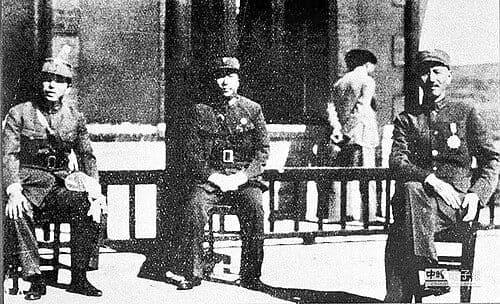
Background: Japan and the Anti-Communist Campaigns
By late 1936, Japan had occupied Manchuria since 1931, established a puppet state in Inner Mongolia, and was pressing the Nanjing government for further concessions in North China. Chiang Kai-shek's strategy was to complete internal consolidation before confronting Japan — the "first pacify the interior, then resist foreign aggression" (攘外必先安内) doctrine. This was deeply unpopular with the Northeastern Army commanded by Zhang Xueliang, whose Manchurian soldiers had families under Japanese occupation yet were being ordered to fight the Red Army. Zhang's troops had suffered humiliating defeats against Communist forces that aggressively recruited them with anti-Japanese appeals.
The military's discontent had a civilian counterpart. In December 1935, tens of thousands of students in Beijing marched in protest against Japanese encroachment and Chiang's failure to resist — the December Ninth Movement (一二·九运动). Zhang Xueliang, then stationed in Shaanxi, secretly met with student representatives who had travelled south to appeal to him directly. He was visibly moved by their arguments. The movement crystallised a broader public sentiment: that Chiang's anti-Communist priority was a betrayal of China's survival at a moment of existential threat from Japan.
Zhang's sympathy with the anti-Japanese cause extended to secret contacts with the Communist side. In early 1936, he opened a clandestine channel to the CCP through Liu Ding, a Communist operative who became a trusted intermediary. By spring, Zhang and local CCP commanders had reached an informal understanding: the Northeastern Army would cease attacking the Red Army, and Communist forces would intensify anti-Japanese outreach to both sides' soldiers. This de facto ceasefire was never disclosed to Chiang Kai-shek. It meant that by December 1936, Zhang had months of clandestine communication with the CCP leadership — which explains why Zhou Enlai could travel to Xi'an within five days of the incident and why negotiations moved as quickly as they did.
Zhang twice petitioned Chiang in person to redirect military effort against Japan. Both times he was rebuffed. Chiang flew to Xi'an in early December 1936 to personally direct the resumption of anti-Communist operations. Zhang Xueliang and Yang Hucheng, the local garrison commander, decided to force the issue.
The Arrest
In the early hours of 12 December, Zhang's troops surrounded the Huaqing Pool resort where Chiang was staying. Chiang, awakened by gunfire, fled in his nightclothes and hid in a crevice on the hillside. He was discovered — without his dentures, with injured ribs — and brought to Xi'an. Zhang and Yang presented an eight-point remonstrance demanding reorganisation of the government, release of political prisoners, cessation of civil war, and preparation for resistance to Japan.
Negotiation, Release, and Aftermath
The kidnapping threw China into political crisis. In Nanjing, War Minister He Yingqin (何应钦) advocated an aerial bombardment of Xi'an and mobilised ground troops toward the northwest — a response ultimately abandoned under pressure from those who feared it would cost Chiang his life. The CCP Politburo initially considered putting Chiang on public trial; it was a direct Comintern instruction from Moscow — principally concerned with keeping Japanese military pressure directed southward rather than toward Soviet Siberia — that steered the Party toward a negotiated settlement. This was not a spontaneous expression of Communist solidarity with the kidnapping but a Soviet strategic directive: maintaining a united Chinese front against Japan mattered more to Moscow than punishing Chiang for years of anti-Communist campaigns.
Zhou Enlai arrived in Xi'an on 17 December as the CCP's chief negotiator. The decisive moment came five days later, when Soong Mei-ling — Chiang's wife and one of the most politically capable figures in the Nationalist establishment — flew from Nanjing to Xi'an on 22 December against the advice of the Nanjing government, accompanied by her brother T.V. Soong. Most historians credit her arrival as pivotal: she negotiated directly with Zhang Xueliang, reassured him that Chiang would not seek retribution, and reportedly gave him a personal guarantee of safety. Her presence transformed the confrontation from a military standoff into a negotiated exit.
Chiang Kai-shek was released on 25 December. No written agreement was signed, and Chiang subsequently denied making any concrete commitments. The historical outcome is not in dispute: anti-Communist military operations were wound down, and the second KMT-CCP united front was progressively formalised — announced publicly after Japan's full-scale invasion in July 1937.
Zhang Xueliang flew back to Nanjing with Chiang — a chivalric gesture he later called the greatest mistake of his life. He was placed under house arrest that lasted until 1990, when he was eighty-nine. Yang Hucheng was imprisoned and executed in 1949 on orders of the retreating Nationalist government. The Northeastern Army they had commanded fared no better as a unit: in the months after the incident, Chiang systematically dispersed its formations, transferred officers, and dismantled its command structure to ensure it could never again act as an independent political force. The men Zhang had led — exiled from Manchuria, their general confined — were absorbed into the broader Nationalist army and never returned to their homeland as a cohesive force.
Narrative Comparison
| Source | Narrative |
|---|---|
| PRC Official Narrative | The Xi'an Incident was an act of patriotic armed remonstrance (兵谏). Zhang Xueliang and Yang Hucheng, unable to accept the sacrifice of national survival on the altar of civil war, took the decisive step of detaining Chiang Kai-shek and demanding that the government reorganise, release political prisoners, and prepare in earnest for resistance against Japan. The Communist Party's response demonstrated its genuine commitment to the Chinese nation: despite years of Nationalist suppression, the CCP advocated for Chiang's peaceful release and directed its energies toward forming a national united front against Japanese aggression — placing China's survival above all partisan considerations. Yang Hucheng, who gave everything for the cause of national resistance, was subsequently murdered by the retreating Nationalist government in 1949 — a fate that speaks to the fundamental difference between those who served China and those who served factional power. The Xi'an Incident brought the decade-long civil war to an end and opened the path to the second KMT-CCP united front, making organised national resistance to Japanese imperialism possible. |
| ROC / Taiwan Narrative | The Xi'an Incident was an illegal mutiny. Zhang Xueliang and Yang Hucheng's seizure of the Commander-in-Chief by armed force was a flagrant violation of military law and constitutional order, regardless of the motivations they claimed. Chiang Kai-shek, throughout his captivity, refused to be coerced: he maintained his dignity, made no binding commitments, and demonstrated the statesmanship of a leader who would not yield to the threat of violence. His subsequent policy of resistance against Japan reflected his own strategic judgement about when conditions were right for a war of national survival — not a concession wrested from him at gunpoint. The punishment of those responsible was an unavoidable consequence of military discipline. No constitutional order can survive if the seizure of the head of state by armed force is permitted to be legitimised after the fact by its political consequences. That the outcome of the mutiny happened to align with historical necessity does not transform an illegal act into a patriotic one. |
| Western Academic Perspective | Western academic scholarship has concentrated on three contested questions that neither official narrative addresses directly. The first is what Chiang Kai-shek actually committed to in Xi'an. The weight of scholarship — drawing on Chiang's diaries, participant accounts, and subsequent political behaviour — suggests that verbal assurances were given but remained deliberately vague; Chiang's subsequent denials were not simple revisionism but reflected genuine ambiguity in what was said and the absence of any written record to resolve it. The second question concerns He Yingqin's motives. Lloyd Eastman and others have noted that He's military mobilisation — advancing troops even as negotiations proceeded — went beyond what rescuing Chiang required, and may have reflected a calculation that the crisis could advance his own position if Chiang did not survive. This remains speculative but has not been satisfactorily refuted. The third question is whether the united front was the necessary result of the Xi'an Incident or would have formed regardless: Japanese military pressure on China in late 1936 was already making some form of KMT-CCP accommodation plausible without a kidnapping. On this reading, the incident accelerated rather than created the united front — a distinction that substantially reduces its world-historical significance in the standard narrative. Zhang Xueliang's voluntary return to Nanjing — against the advice of those who warned him he would not be released — remains the incident's most psychologically compelling enigma. |
| Soviet Archives and Comintern Records (post-1991) | Documents from the Comintern archives, accessible since the early 1990s, reveal that Moscow's intervention was decisive in shaping the CCP's response to the Xi'an Incident. Stalin's primary concern was not the fate of the Chinese Communist Party but the strategic calculus of Northeast Asian security: a Nationalist-Communist united front was essential to keeping Japanese military pressure directed southward, away from Soviet Siberia. Internal Comintern communications show that the directive to seek Chiang's peaceful release reached the CCP within days of the incident — preceding, and effectively determining, the Politburo's formal decision. The Soviet archives thus complicate the standard CCP narrative, which presents the peaceful-resolution decision as an independent expression of Communist commitment to national unity rather than compliance with a Soviet strategic instruction. |
| Zhang Xueliang's Oral History and Self-Account | I did not act on Communist instigation. That charge is false, and I have said so many times. I acted because I could no longer watch my men — men whose families were living under Japanese occupation — being sent to fight the Red Army instead of the Japanese. I had petitioned Chiang twice. He refused to hear me. There was nothing left to try. What we did on the twelfth of December, we decided ourselves, out of our own despair and determination. As for returning to Nanjing — people have asked me about this for decades. I went back because it was the right thing to do. I had forced a resolution; I had to face the consequences. To have fled would have been dishonest. I do not regret going back, even now. The Xi'an Incident was a miscalculation, and it cost me everything — I have made my peace with that. But it was not the Communists' doing. And as for Chiang Kai-shek: I have no hatred for him. He was a great man, and what happened between us was what it was. |
| Yang Hucheng: Family Accounts and Left-Sympathiser Historiography | Yang Hucheng left no substantial memoir: imprisoned in 1937 and executed on 17 September 1949 — along with his wife, young son, and secretary — on orders of the retreating Nationalist government, he had no opportunity to give his own account. His story has been reconstructed through family testimony, the writings of left-leaning sympathisers, and since 1949, PRC commemorative historiography. Unlike Zhang Xueliang, who came from a powerful warlord dynasty and maintained personal ties to Soong Mei-ling's network, Yang was a self-made Shaanxi military figure with deeper ideological affinities to the left and pre-existing contacts with local Communist organisations. In this reading, Yang's participation was not the impulsive act of a frustrated general but the calculated decision of someone with a clearer ideological compass than his co-conspirator. The asymmetry of their fates — Zhang confined but alive for fifty-four years, Yang dead within thirteen — illuminates a structural feature of Chiang Kai-shek's political style: enemies with powerful protectors were neutralised; those without were eliminated. Yang Hucheng had no Soong Mei-ling. |
Key Milestones
- The Arrest at Huaqing Pool
In the early hours of 12 December, Zhang Xueliang's troops surrounded Chiang Kai-shek's headquarters at the Huaqing Pool resort in Lintong. Chiang, awakened by gunfire, fled in his nightclothes and hid in a crevice on the nearby hillside. He was discovered — without his dentures, his ribs injured from the escape — and escorted under guard to Xi'an.
- Zhang and Yang Telegraph the Nation — Nanjing Mobilises
Within hours of the arrest, Zhang Xueliang and Yang Hucheng telegraphed the nation, announcing Chiang's detention and publishing their eight-point remonstrance: demanding reorganisation of the Nanjing government, release of political prisoners, freedom of patriotic movements, cessation of civil war, and immediate preparation for resistance against Japan. The news struck Nanjing like a thunderbolt. War Minister He Yingqin immediately began mobilising ground forces and calling for punitive air strikes against Xi'an — a response that put Chiang's own survival at risk and set the stage for the most dangerous week of the crisis.
- He Yingqin Orders Military Advance — the Crisis Peaks
On 16 December, War Minister He Yingqin formally ordered Nationalist ground forces to advance on Xi'an and authorised bombing raids on nearby cities. The order brought the crisis to its most dangerous point: an armed assault on Xi'an would almost certainly have resulted in Chiang Kai-shek's death, either at the hands of the kidnappers or in the bombardment itself. The order was ultimately not carried out in full — blocked by opposition within the Nanjing leadership, by international pressure, and by the intervention of Soong Mei-ling — but it underscored how close the crisis came to a catastrophic outcome.
- Zhou Enlai Arrives in Xi'an
Zhou Enlai arrived in Xi'an on 17 December as the CCP's chief negotiator. His presence transformed the incident from a bilateral military confrontation into a three-way negotiation in which the CCP participated as a recognised party — a significant shift in the Party's political standing relative to the Nationalist government.
- Soong Mei-ling Arrives — the Turning Point
Soong Mei-ling and her brother T.V. Soong flew to Xi'an on 22 December, against the advice of the Nanjing government. Soong Mei-ling negotiated directly with Zhang Xueliang, offered reassurances that Chiang would not seek retribution, and reportedly gave a personal guarantee of Zhang's safety. Most historians credit her arrival as the decisive moment that broke the deadlock and made Chiang's release possible.
- Chiang Released — Zhang Accompanies Him to Nanjing
Chiang Kai-shek was released on Christmas Day. Against the advice of all around him — including Zhou Enlai, who urged him not to go — Zhang Xueliang voluntarily accompanied Chiang back to Nanjing without immunity or guarantees. He was placed under arrest on arrival. No written agreement had been signed; Chiang subsequently denied making any concrete commitments.
- Zhang Xueliang Tried — Two Fates Sealed by the Incident
Zhang Xueliang was convicted of insubordination, his sentence immediately commuted to indefinite house arrest under Chiang's personal supervision — a confinement that lasted fifty-four years, first on the mainland, then on Taiwan, until his release in 1990 at age eighty-nine. Yang Hucheng was separately imprisoned and never released; he was executed in secret in September 1949 on the orders of the retreating Nationalist government.
Last verified: