Marco Polo Bridge Incident
On the night of 7 July 1937, Japanese and Chinese troops exchanged fire near the Marco Polo Bridge outside Beiping. Japanese forces cited a missing soldier as grounds to demand entry into Wanping Fortress; when refused, they opened artillery fire at dawn on 8 July. Within three weeks, Beiping and Tianjin had fallen. The incident triggered the Second Sino-Japanese War, which claimed an estimated 14–20 million Chinese lives before Japan's defeat in 1945.
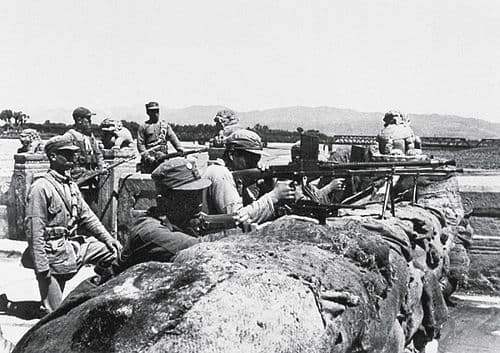
Prelude: Japan's Expanding Military Presence
By mid-1937, Japan had systematically strengthened its military position in North China for years. The 1933 Tanggu Truce demilitarised a buffer zone south of the Great Wall; subsequent agreements excluded Chinese troops from key areas around Beiping and established a nominally autonomous Hebei-Chahar Political Council under Japanese supervision. Japanese units conducted regular exercises in designated zones, normalising their presence. The Marco Polo Bridge — an eleven-arch stone span crossing the Yongding River twelve kilometres west of Beiping — was the key rail and road link to the south, guarded by a Chinese garrison at adjacent Wanping Fortress.
The Night of 7 July
At approximately 11:00 PM on 7 July, Japanese troops from the 1st Infantry Regiment conducting a night exercise reported that a soldier, Shimura Kikujiro, had gone missing after shots were fired. The unit commander demanded entry into Wanping Fortress to search for him. The Chinese garrison refused. Shimura had in fact returned to his unit unharmed before the Chinese even responded — a fact that did not prevent escalation. Japanese artillery opened fire on Wanping at 4:50 AM on 8 July.
Local commanders on both sides attempted ceasefire negotiations over the following days. On 17 July, Chiang Kai-shek delivered a public address at Lushan declaring that "every Chinese — old or young, man or woman — must take up the responsibility of resisting Japan." Tokyo simultaneously announced the dispatch of three additional divisions to North China. By 26–28 July, Japan launched a general offensive. Beiping fell on 29 July; Tianjin on 30 July.
The Road to Full-Scale War
Whether the Marco Polo Bridge Incident was a spontaneous clash or a deliberate provocation remains a contested question among historians. Whatever the nature of the initial incident, Japan's military subsequently expanded operations across North China. On the Chinese side, the framework of KMT-CCP cooperation that had taken shape after the Xi'an Incident provided the political basis for a national resistance. The eight-year war that followed encompassed the Nanjing Massacre, the Battle of Wuhan, and the wartime capital at Chongqing, ending with Japan's surrender on 15 August 1945.
Narrative Comparison
| Source | Narrative |
|---|---|
| PRC Official Narrative | The Marco Polo Bridge Incident was the opening shot of Japanese imperialism's full-scale war of aggression against China, and the beginning of the Chinese People's War of Resistance Against Japanese Aggression — the most important component of the world's anti-fascist war. Under the leadership of the Communist Party, the Chinese people united against the invader. The Eighth Route Army and New Fourth Army, operating in liberated base areas behind enemy lines, served as the backbone and decisive force of national resistance. The Nationalist army fought defensive positional battles on the frontal battlefields; the CCP mobilised the peasant masses and sustained the guerrilla war that ultimately wore down and defeated the Japanese aggressor. The victory of 1945 was the victory of the Communist Party's correct political and military line. |
| ROC / Taiwan Narrative | The Marco Polo Bridge Incident was Japan's unprovoked act of military aggression against the sovereign territory of the Republic of China. Under the supreme command of Generalissimo Chiang Kai-shek, the Republic of China made the decision to resist at whatever cost — announced to the world in the Lushan Declaration of 17 July 1937. The National Revolutionary Army bore the full weight of frontal resistance: from the three-month Battle of Shanghai to the campaigns in Central China, the Burma Road, and the India-Burma theatre, Chinese soldiers fought and bled in major engagements. The Communists, by contrast, preserved the bulk of their forces in remote base areas and expanded their territorial control during the war years. Victory in 1945 was achieved through the sacrifice of the National Army and the diplomatic leadership of the National Government, which secured China's place among the Allied powers. |
| Western Academic Perspective | The incident was almost certainly accidental in origin, not a planned provocation. Japan's China policy in 1937 reflected the military's institutional momentum more than any coherent master plan from Tokyo. Local commanders chose escalation, Tokyo ratified it, and the result was a war that neither side's leadership had fully anticipated or planned for. Both the PRC narrative (CCP as decisive backbone) and the ROC narrative (Nationalist army as the principal combatant) contain elements of truth, but each overstates its own side's contribution. The eight-year war was fought by both, and won through the combination of Chinese endurance, Japanese strategic overextension, and eventual Allied intervention. |
Key Milestones
- The Marco Polo Bridge Incident Begins
At approximately 11:00 PM, Japanese troops from the 1st Infantry Regiment conducting a night exercise near the Marco Polo Bridge reported a missing soldier — Shimura Kikujiro — after shots were fired. The unit commander demanded entry into Wanping Fortress to search for him. The Chinese garrison refused. Shimura had in fact returned to his unit unharmed before the Chinese even responded.
- Japanese Artillery Opens Fire on Wanping
At 4:50 AM on 8 July, Japanese artillery opened fire on Wanping Fortress. The bombardment marked the transition from a standoff over a missing soldier to armed conflict. Both sides suffered casualties. Local commanders on both sides simultaneously began ceasefire negotiations — a pattern of fighting and talking that would continue for three weeks.
- Local Ceasefire Agreement — Soon Violated
Chinese and Japanese local commanders reached a ceasefire agreement on 11 July, pausing the fighting around the Marco Polo Bridge. The agreement reflected the genuine desire of both local commands to contain the incident. It did not hold: Tokyo simultaneously announced it was dispatching three additional divisions to North China, and the Imperial Army's institutional pressure toward escalation overrode local diplomacy.
- Chiang's Lushan Declaration
Chiang Kai-shek delivered a landmark address at Lushan, declaring that China had reached the final moment of survival or extinction: "Every Chinese — old or young, man or woman — must take up the responsibility of resisting Japan." The speech committed the Republic of China to full resistance and ended any remaining possibility of a negotiated local settlement.
- Japan Launches General Offensive
After weeks of build-up, Japan launched a general offensive against the Beiping-Tianjin region on 26–28 July, deploying the reinforcements dispatched since early July. The scale of the assault confirmed that the incident had become the opening phase of a full-scale invasion rather than a containable local dispute.
- Beiping Falls
Japanese forces captured Beiping on 29 July. Song Zheyuan's 29th Route Army withdrew southward. The ancient capital — which had not been captured by a foreign power since the Mongols — fell after minimal resistance, a consequence of Song's attempts to negotiate and the speed of the Japanese advance.
- Tianjin Falls
Tianjin fell to Japanese forces on 30 July, completing Japan's seizure of the two principal cities of North China. The fall of both cities within two days effectively ended the Beiping-Tianjin campaign and opened the road to the broader invasion of China proper that would follow in the coming months.
Last verified: