The Long March
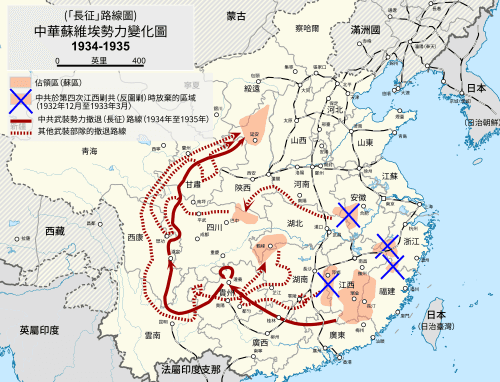
Between October 1934 and October 1935, the Chinese Red Army undertook a 12,500-kilometre strategic retreat from its base areas in Jiangxi Province to Yan'an in Shaanxi, pursued by Nationalist forces. Of the approximately 86,000 soldiers who set out, fewer than 10,000 completed the journey. The march produced the Zunyi Conference — where Mao Zedong secured leadership of the party — and became the foundational myth of the People's Republic of China.
Strategic Failure and the Decision to Break Out
By the autumn of 1934, the Central Soviet Area in Jiangxi — the CPC's largest rural base — was facing imminent military collapse. The KMT's Fifth Encirclement Campaign (1933–34), guided by German military advisor Hans von Seeckt, had applied a strategy of slow, methodical advance supported by a network of blockhouses rather than the mobile pursuit operations that previous campaigns had used. The CPC's military strategy, controlled by Comintern advisors Otto Braun (Li De) and Bo Gu over Mao Zedong's objections, had attempted to counter this with positional warfare — a disastrous choice given the Red Army's inferiority in artillery and logistics.
The decision to abandon the base area and break out westward was made in secret by a small group of leaders. Most soldiers were not told their destination. On the night of 16 October 1934, the main force of approximately 86,000 — including party leaders, military commanders, and a large non-combat apparatus — crossed the Yudu River and began what would become a year-long retreat across some of the most difficult terrain in China.
The Crossing of the Xiang River and the Zunyi Conference
The early weeks of the march were catastrophic. Slowed by an enormous baggage train (including printing presses, industrial machinery, and archives) and harassed by Nationalist forces, the Red Army suffered devastating losses crossing the Xiang River in November 1934. Of the approximately 86,000 who set out, fewer than 30,000 survived the crossing. It was the single most costly episode of the entire march and the moment that decisively discredited the leadership of Bo Gu and Otto Braun.
In January 1935, the army briefly occupied the city of Zunyi in Guizhou Province. The Zunyi Conference (15–17 January 1935) was the pivotal political event of the march: an expanded meeting of the Politburo that criticised Bo Gu and Braun's military leadership, transferred real military authority to a new standing committee under the direction of Mao Zedong, and began the shift away from Comintern-directed strategy toward Mao's emphasis on flexible guerrilla tactics. The conference is officially celebrated in PRC historiography as the moment the party "learned to walk on its own legs."
From Zunyi to Yan'an
After Zunyi, the march became less a retreat and more an extended guerrilla operation, with Mao's forces crossing and re-crossing the Chishui River four times to confuse pursuing Nationalist forces. Key episodes included the crossing of the Jinsha River (May 1935) by a small advance team that captured enemy boats; the storming of the Luding Bridge (29 May 1935) across the Dadu River — though survivor testimony later collected by Sun Shuyun and others suggests the bridge was largely undefended at the time, and the celebrated account of troops charging across the iron chains under heavy fire was substantially embellished in subsequent PRC narratives; and the crossing of the snow-capped Jiajin Mountain and the vast Zoige Grasslands in Sichuan and Gansu, where cold, starvation, and disease killed thousands more.
The Zhang Guotao Split
The most serious internal challenge to CPC unity during the Long March came not from Nationalist forces but from within. When the First Front Army met Zhang Guotao's Fourth Front Army at Maogong in June 1935, Zhang commanded approximately 80,000 troops — eight times the strength of Mao's depleted force — and used this leverage to demand unified command. When Mao's faction refused and moved north in September 1935, Zhang established a rival CCP Central Committee at Zhuokezhi, directly challenging the Party's legitimacy claims. He ordered his army south and west into the high-altitude plateaus of western Sichuan and Qinghai, a maneuver that proved catastrophic: the Fourth Front Army suffered devastating losses to cold, disease, and hostile terrain. Zhang eventually abandoned the rival central committee, and his surviving forces rejoined the main Red Army in 1936. He defected to the Nationalist government in 1938. PRC historiography treats the entire episode as a footnote of factional treachery; Zhang's own account, written in exile, describes a genuine contest for the Party's future direction that Mao's faction won through maneuver rather than democratic legitimacy.
The First Front Army arrived at the Shaanxi Soviet in October 1935 with fewer than 10,000 survivors. A smaller but historically significant force, the 25th Red Army under Xu Haidong, had arrived a full month earlier — reaching Yongping, Shaanxi in September 1935 after departing the Hubei-Henan-Anhui Soviet in November 1934 with approximately 3,000 soldiers. It was the first CPC army to complete a Long March and reach northern Shaanxi; on arrival it merged with the local 26th and 27th Red Armies to form the 15th Army Corps, consolidating the base area before Mao's forces joined. He Long's Second Front Army, which had departed its Hunan-Hubei base in November 1935, completed its own Long March in October 1936. The total number who completed a Long March route — across all CPC armies — is estimated at around 30,000 to 50,000 from a combined starting strength of some 200,000. The arrival in northern Shaanxi established Yan'an as the CPC's new base of operations — the staging ground for the Second United Front with the Nationalists against Japan, and ultimately for the Communist victory in the civil war.
Myth and Historical Record
The Long March became the founding myth of the People's Republic, invested with almost sacred significance in CPC historiography. Edgar Snow's Red Star Over China (1937) — based on extended interviews with Mao and other survivors in Yan'an — brought the march's story to international audiences and shaped the sympathetic Western image of the CPC for decades. Subsequent critical scholarship, notably Sun Shuyun's The Long March (2006), conducted interviews with surviving participants and found accounts that differed significantly from the official narrative: incidents of plunder from local populations, internal coercion, and the improvised rather than strategically planned nature of much of the route.
Narrative Comparison
| Source | Narrative |
|---|---|
| PRC Official Narrative | The Long March was an epic of revolutionary heroism and the founding miracle of the Chinese revolution. Confronted with the enemy's fifth encirclement campaign, the Red Army — guided by the correct leadership of the Party — broke through every obstacle and blazed a trail for the Chinese revolution. The Zunyi Conference was the great turning point: by establishing the leadership of Comrade Mao Zedong within the Party and in the Red Army, it saved the Party, saved the Red Army, and opened the path to revolutionary victory. The tens of thousands who gave their lives on the march sacrificed everything for the liberation of the Chinese people — their spirit of selfless dedication, of placing the revolution above individual survival, remains an inexhaustible source of strength for the Chinese people to this day. |
| Oral History and Field Research (Sun Shuyun, Salisbury) | Critical scholarship based on oral history and field research has documented significant discrepancies between the official narrative and participant testimony. Sun Shuyun's interviews with approximately 40 surviving veterans found widespread evidence of grain requisitions from rural communities, forced conscription of local men as porters, and the largely improvised nature of much of the route. Harrison Salisbury, the first Western journalist to retrace the march on foot, found comparable evidence of local disruption. The Luding Bridge episode — officially celebrated as a heroic charge across iron chains under fire — was described by multiple veterans as a crossing made with minimal resistance, the defending troops having largely withdrawn. These accounts do not diminish the physical ordeal of the march but substantially complicate the sacred narrative of willing sacrifice and infallible leadership. |
| Republic of China Military Historiography | The Long March was not a heroic strategic withdrawal — it was the consequence of total defeat. Our Fifth Encirclement Campaign, guided by German military adviser Hans von Seeckt, successfully destroyed the Jiangxi Soviet and forced the remaining Communist forces to abandon their base areas and flee westward. Of the 86,000 who set out, fewer than 10,000 survived to reach northern Shaanxi: this was near-annihilation. That any Communists survived at all reflects the limited cooperation we received from the southwestern warlords — Long Yun, Wang Jialie, and Liu Xiang — who were more intent on keeping central government forces out of their provinces than on pursuing a retreating enemy. The survival of the Communist remnant was a consequence of China's political fragmentation, not of any superior Communist military capacity. |
| Zhang Guotao's Memoir (1971–72) | At the Maogong junction, my Fourth Front Army numbered over eighty thousand men — far the stronger force. It was not recklessness that led me to contest the northward march, but military judgement: the north offered no secure base, no resources, only an exposed position. When I established a rival central committee, I was not committing treason — I was responding to the fact that Mao had seized control of the Party through manipulation and intrigue rather than democratic process. Someone had to hold the line. As for the Zunyi Conference: it was one move in a longer game. The claim that Zunyi was a turning point of Party maturity is a myth constructed after the fact. My departure in 1938 reflected my honest conclusion: under Mao's personal rule, the Party had ceased to be the party I helped to found. |
| Revisionist Political History (Teiwes, Sun, Yang) | Revisionist historians including Frederick Teiwes, Warren Sun, and Benjamin Yang have argued that Mao's authority after Zunyi was far more limited and contested than CPC mythology suggests. The conference did not install Mao as supreme commander: it created a three-person military committee in which Mao's designated role was to "assist" Zhou Enlai — a formally subordinate position. The first unambiguous recognition of Mao's paramount leadership came only at the Sixth Plenum in 1938, after years of internal maneuvering and the resolution of the Zhang Guotao split. In this reading, Zunyi's primary significance was the expulsion of Comintern advisers from operational military decisions — an assertion of CPC autonomy — rather than the coronation of Mao personally. The "Zunyi as turning point" narrative was itself constructed retrospectively, systematically consolidated during the Yan'an Rectification Campaign (1942–44) when Mao weaponised Party history as a tool of political consolidation. |
| Soviet Archives and Comintern Records (post-1991) | Archives declassified after the Soviet collapse reveal a more ambivalent relationship between Moscow and the Long March than either Chinese or Western popular histories have acknowledged. The Comintern was largely blindsided by the Zunyi Conference: radio communication between the Red Army and Moscow was intermittent throughout the march, and the dismissal of Comintern adviser Otto Braun was carried out without prior consultation. Internal Comintern documents show initial displeasure at the sidelining of Soviet-trained cadres. Moscow ultimately accepted Mao's leadership on pragmatic grounds — maintaining a viable CPC was essential to containing Japanese expansion in Northeast Asia. Significantly, Soviet archives show Moscow declined to endorse either faction during the Zhang Guotao split, maintaining deliberate silence on which "central committee" it recognised. The Comintern's formal dissolution in 1943 ratified what Zunyi had established in practice: the CPC's operational independence from Moscow. |
Key Milestones
- Departure from the Yudu River
Approximately 86,000 soldiers of the Central Red Army crossed the Yudu River in Jiangxi under cover of darkness, beginning the westward breakout from the Fifth Encirclement. The destination was unknown not only to ordinary soldiers but to most commanders — the leadership had not yet determined a final objective. The departure was conducted under strict radio silence, and the enormous column carried an unwieldy baggage train of printing presses, machinery, and archives that would slow the army fatally in the weeks ahead.
- Battle of the Xiang River
Nationalist forces blocked the Red Army at the Xiang River for four days and nights. Of the 86,000 who set out, fewer than 30,000 survived the crossing — the single most catastrophic engagement of the entire Long March.
- Zunyi Conference
An enlarged Politburo session in Zunyi, Guizhou (15–17 January) repudiated the military line of Bo Gu and Comintern adviser Otto Braun, transferring de facto command to a three-person committee including Mao Zedong. Crucially, it was the first time the CPC had resolved a major leadership dispute without reference to Moscow — effectively ending Comintern direct control over CPC military decisions.
- Four Crossings of the Chishui River
Between January and March 1935, Mao's forces crossed the Chishui River four times in a series of rapid maneuvers that confused and outpaced Nationalist pursuers, becoming one of the most celebrated demonstrations of mobile warfare in CPC military lore.
- Crossing of the Jinsha River
Over nine days (3–9 May 1935), a Red Army advance team captured seven enemy boats and ferried the entire First Front Army across the Jinsha River — the upper Yangtze — in Yunnan Province. The crossing left Nationalist pursuit forces stranded on the south bank and marked the moment the Red Army definitively broke free from encirclement. Chiang Kai-shek, who had flown to Kunming to direct the pursuit personally, arrived too late to prevent it.
- Luding Bridge
A Red Army advance unit captured the iron-chain Luding Bridge over the Dadu River in Sichuan, securing a vital crossing. The episode became iconic in CPC propaganda, though the fierceness of the fighting has been questioned by later historians.
- Junction at Maogong with the Fourth Front Army
The First Front Army crossed the Jiajin Mountains and met Zhang Guotao's Fourth Front Army at Maogong (modern Xiaojin) in Sichuan. The combined forces numbered over 100,000, but a sharp dispute over the march's direction soon divided them.
- Crossing the Zoige Grasslands
For approximately ten days in late August 1935, the First Front Army crossed the vast Zoige (Ruoergai) Grasslands in northern Sichuan — a waterlogged high-altitude marshland at over 3,000 metres elevation, with no paths, no food, and no shelter. Thousands died from starvation, hypothermia, and altitude sickness. Many veterans later recalled the grasslands as the most harrowing stage of the entire march — more deadly than any battle.
- Zhang Guotao Establishes a Rival Central Committee
After Mao's faction secretly moved north with the First Front Army in early September, Zhang Guotao established a rival CCP Central Committee at Zhuokezhi and ordered the Fourth Front Army south into the high-altitude Kham plateau of western Sichuan — a decision that would prove catastrophic.
- Arrival at Wuqi, Shaanxi — Long March Ends
The First Front Army reached Wuqi in northern Shaanxi, ending the main Long March after 368 days and approximately 12,500 kilometres. Fewer than 10,000 of the original 86,000 had survived.
Last verified: