Development and Opening of Pudong
On 18 April 1990 Premier Li Peng announced in Shanghai, on behalf of the CPC Central Committee and State Council, approval to accelerate the development of Pudong. Deng Xiaoping had called Shanghai "our trump card". The 14th Party Congress in 1992 made Pudong the "dragon head" of opening along the Yangtze; the State Council approved the Pudong New Area that year and its administration was set up in 1993. Pudong financed infrastructure partly by selling stakes in bridges and tunnels, and Lujiazui grew into a finance and trade zone.
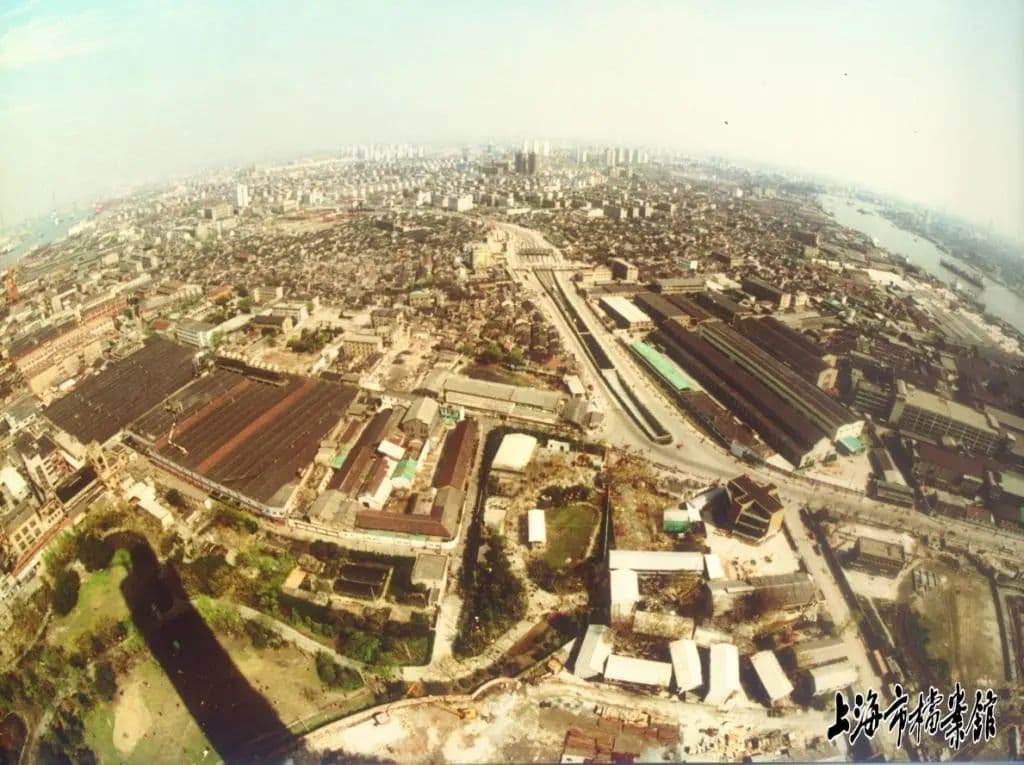
Preparation (1985–1990)
Pudong lies east of the Huangpu River. Before 1990 more than 80% of its land was farmland and it was linked to Puxi mainly by ferry; a local saying held that "a bed in Puxi is better than a flat in Pudong". According to the Shanghai Municipal Archives, Mayor Wang Daohan organised a study of Pudong's development in 1985, and in October 1986 the State Council's approval of Shanghai's master plan called for "planned construction and transformation of the Pudong area". At an international seminar on developing Pudong in May 1988, Shanghai Party Secretary Jiang Zemin said that for various reasons Shanghai had "weakened its function as an economic centre" and that "this situation certainly cannot be allowed to continue".
Deng Xiaoping, briefed in Shanghai over the 1990 Spring Festival, told several central leaders on his return to Beijing: "I have retired, but there is one more thing I must mention: Shanghai's Pudong development — you should pay more attention to it." "Shanghai is our trump card; getting Shanghai going is a short cut." Zhao Qizheng, later head of the Pudong New Area administration, recalled Deng saying after the political turmoil of 1989: "The world is worried that we will close up, so we must do a few things to show that our reform and opening policy is unchanged and that we will reform and open further."
Decision and Announcement
On 18 April 1990, at the fifth-anniversary celebration of Shanghai Volkswagen, Premier Li Peng announced on behalf of the CPC Central Committee and the State Council that the centre agreed to accelerate the development of Pudong. The Shanghai Party committee set the goal "develop Pudong, revitalise Shanghai, serve the nation, face the world". A 2009 China Economic Weekly article called the Shenzhen special zone the "first wave" of opening and Pudong the "second wave". In October 1992 the 14th Party Congress report called for "taking the development and opening of Shanghai's Pudong as the dragon head, further opening cities along the Yangtze, and making Shanghai one of the international centres of economy, finance and trade as soon as possible".
Getting Started: The New Area and "Planning First"
On 3 May 1990 the Shanghai government set up the Pudong Development Office and the Pudong planning and design institute. In December Mayor Zhu Rongji chaired a review of the Pudong master plan. From 1991 the design of Lujiazui's 1.7 sq km core was opened to international consultation, funded in part by a 2-million-franc loan from the French government. In October 1992 the State Council approved abolishing Chuansha County and merging it with the Pudong parts of Huangpu, Nanshi and Yangpu districts and Sanlin township to form the Pudong New Area, covering about 570 sq km; on 1 January 1993 a Party working committee and administrative committee were set up as agencies of the municipal Party committee and government, headed by a Shanghai vice-mayor, with Zhao Qizheng as director of the administrative committee. According to the Shanghai Archives, the New Area began with only 10 functional departments and 800 staff posts.
For financing, the centre let Shanghai "borrow and repay on its own": Shanghai sold 50% of 20-year rights in the Nanpu and Yangpu bridges and the Yan'an East Road tunnel to Hong Kong's CITIC for 2.7 billion yuan, reinvested in further river crossings. According to the Archives, the first round of construction (1990–1995) invested 25 billion yuan in ten major infrastructure projects including two bridges, roads, telecommunications and utilities, and the second (1995–2000) 97 billion yuan in an airport, a deep-water port, Metro Line 2 and other projects. The Shanghai Stock Exchange, opened in Puxi on 19 December 1990, moved to Pudong in 1993, and the development companies of Pudong's zones raised large sums through it.
Attracting Investment and Lujiazui
According to Zhao Qizheng, the move of the People's Bank of China's Shanghai branch to Pudong in June 1995 marked the formal launch of the Lujiazui Finance and Trade Zone, followed by Fuji Bank's Shanghai branch, the headquarters of Thai-Chinese International Bank and others, each presented by the New Area with a symbolic gift. He recalled that at a 1994 promotion in San Francisco one executive wrote that he wanted to come but "for political reasons" would "wait and see"; the New Area promoted the slogan that "clean government is also an important investment environment". Rather than lease a 100,000 sq m site in central Lujiazui, the New Area relocated 1,500 households and built a park there, forgoing, by his estimate, more than 2 billion yuan.
Afterwards
In 2000 the Pudong New Area set up a district Party committee, people's congress, government and CPPCC, becoming a regular district. In May 2009 the State Council approved merging the former Nanhui District into it, enlarging it to about 1,210 sq km. China's first pilot free trade zone and other national strategic projects were later placed in Pudong. On 12 November 2020 Xi Jinping told the 30th-anniversary celebration that Pudong's GDP had risen from 6 billion yuan in 1990 to 1.27 trillion yuan in 2019, and that with 1/8000 of China's land area it produced 1/80 of national GDP and 1/15 of goods trade.
Gallery
Narrative Comparison
| Source | Narrative |
|---|---|
| Xi Jinping's 30th-anniversary speech (12 Nov. 2020); Shanghai Municipal Archives, Archives & History (2020) | Official accounts treat Pudong's development and opening as a national strategy personally championed by Deng Xiaoping and decided by the Party centre, and as a sign of deepening reform. Xi Jinping said in 2020 that the decision "opened a new chapter in pushing China's reform and opening in depth" and that Pudong's 30 years of achievement "provide the most vivid proof of the advantages of the socialist system with Chinese characteristics", quoting Deng that developing Pudong was a question "of using Shanghai as a base to develop the Yangtze Delta and the Yangtze basin". A Shanghai Archives retrospective says the decision "raised Pudong's development from a local idea to a major national strategic decision" and that Pudong played Shanghai's "trump card, astonishing the world". |
| Greenspan, Culture Unbound 4(1), 2011 (abstract) | Western scholars see Pudong both as a symbol of China's rise and as a target of criticism of its urban model. NYU Shanghai's Anna Greenspan (2011) writes that Lujiazui's rapid development is "the symbol of contemporary Shanghai and of China's miraculous rise" but is "also taken as a sign of much that is wrong with China's new urbanism", its skyline seen by critics as a glossy facade; she cites Milton Friedman's reported derision of Pudong as a "Potemkin village" and "the statist monument for a dead pharaoh". She herself argues that such suspicion of spectacle is rooted in a Western philosophical tradition, whereas Chinese culture has long recognised the power of spectacle. |
| Zhao Qizheng, oral account, China Economic Weekly, 28 Sept. 2009 | Zhao Qizheng, then head of the Pudong New Area administration, stresses the political background and the difficulty of attracting investors. He said that after 1989 Deng wanted to "do a few things to show that our reform and opening policy is unchanged", which made Pudong a national decision; in San Francisco in 1994 foreign executives admitted that "for political reasons" they wanted to "wait and see", and he urged them "not to mix politics and economics". He recalled promoting Pudong with the slogan "clean government is also an important investment environment", giving up over 2 billion yuan in land revenue in Lujiazui for a park, and preserving the early-Republican Chen family house, which he called his "last will" before leaving for Beijing. |
Key Milestones
- Li Peng announces Pudong's opening
At Shanghai Volkswagen's fifth-anniversary celebration Li Peng announces central approval to accelerate Pudong's development.
- Pudong Development Office set up
The Shanghai government sets up the Pudong Development Office and planning institute.
- Pudong New Area committee inaugurated
After the State Council approved the New Area in October 1992, its Party working committee and administrative committee are inaugurated under Zhao Qizheng.
- 30th-anniversary celebration
Xi Jinping says Pudong's GDP rose from 6 billion yuan in 1990 to 1.27 trillion yuan in 2019.
Last verified:
Cite this page
Chronicles of Modern China. (2026, October 24). Development and Opening of Pudong. Retrieved October 24, 2026, from https://www.cmcarchive.org/events/pudong-development-1990
“Development and Opening of Pudong.” Chronicles of Modern China. Last modified October 24, 2026. Accessed October 24, 2026. https://www.cmcarchive.org/events/pudong-development-1990.
Chronicles of Modern China. Development and Opening of Pudong[EB/OL]. (2026-10-24)[2026-10-24]. https://www.cmcarchive.org/events/pudong-development-1990.