1989 Tiananmen Square Events
Large-scale protests centred on Beijing's Tiananmen Square were suppressed by the military on 4 June 1989; the death toll remains unknown. The events remain heavily censored in mainland China.
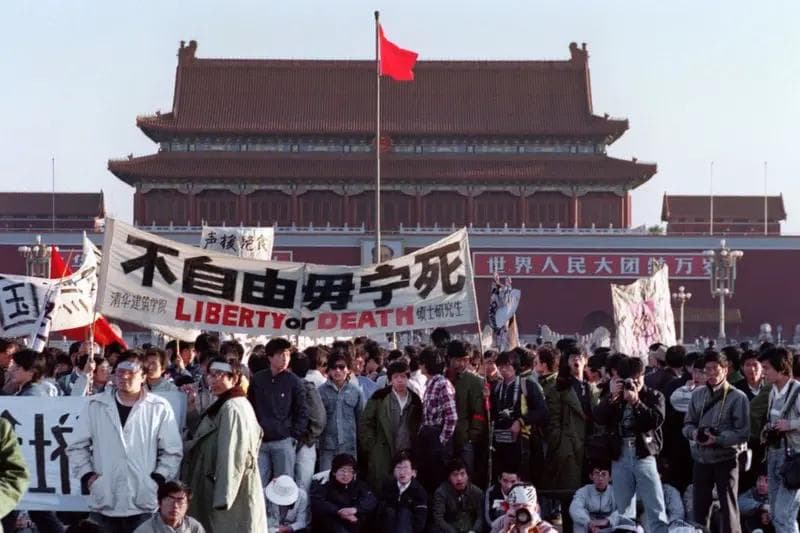
Background and Protests
The protest movement that culminated in the Tiananmen Square events of June 1989 grew from multiple sources: frustration with corruption and official profiteering, high inflation eroding urban living standards, and the intellectual ferment of the 1980s reform decade. The death of former General Secretary Hu Yaobang on 15 April 1989 — widely mourned as a symbol of political liberalisation — triggered an initial gathering in Tiananmen Square that expanded rapidly into a broad-based movement involving students, workers, and citizens across dozens of Chinese cities.
By mid-May, over a million people had gathered in Tiananmen Square. A hunger strike by students drew massive sympathy. The visit of Soviet leader Mikhail Gorbachev — the first Sino-Soviet summit in thirty years — brought intense international media coverage to Beijing, giving the protesters a global audience. Internal Party divisions between General Secretary Zhao Ziyang, who favoured dialogue, and Premier Li Peng and Deng Xiaoping, who favoured a hard line, were exposed.
The Military Crackdown
Martial law was declared on 20 May. On the night of 3–4 June, military units with tanks moved into central Beijing from multiple directions, clearing the square and surrounding streets by force. The exact number of deaths remains unknown; estimates from Chinese Red Cross officials, diplomatic cables, and researchers range from hundreds to potentially several thousand. The Chinese government's official position holds that the crackdown was a necessary response to "political turmoil" and has not disclosed casualty figures.
Aftermath
The crackdown was followed by arrests and executions of protest leaders, purges of officials who had shown sympathy, and the dismissal of Zhao Ziyang, who was placed under house arrest until his death in 2005. Western governments imposed sanctions, including arms embargoes that remain in place.
Narrative Comparison
| Source | Narrative |
|---|---|
| PRC Official Narrative | In the spring of 1989, a small number of people with political ulterior motives deliberately exploited the patriotic enthusiasm and aspirations for reform of some students to create turmoil, which in Beijing escalated into a counter-revolutionary rebellion that seriously threatened the Party's leadership, the socialist system, and national stability. After efforts to seek a peaceful resolution were exhausted, the Party and government were compelled to take resolute measures to quell the rebellion and restore normal order. This decision was entirely correct and necessary — it protected the great achievements of reform and opening-up, safeguarded the stability and unity of the motherland, and defended the fundamental long-term interests of the Chinese people. Over the more than thirty years that followed, China's sustained high-speed economic development, the lifting of hundreds of millions out of poverty, and the substantial leap in the country's comprehensive national power have fully demonstrated the correctness of the Party's decision at this critical historical juncture. Any attempt to negate this historical conclusion or to use it to attack the Party's leadership and the socialist system is a distortion of history and cannot be accepted. |
| Participant Position | The position of participants in the 1989 protest movement has its own textual basis preserved in the historical record. The Hunger Strike Declaration of 13 May stated at the outset: 'We love this country, this land irrigated with the blood and sweat of our fathers' fathers and our mothers' mothers.' The movement's core demands never exceeded the bounds of reform within the existing system, comprising principally: that the government acknowledge the movement's patriotic character; that it enter into equal dialogue with student representatives; that the incomes and assets of Party officials be disclosed; and that press freedom be guaranteed. On 17 May, students and citizens jointly issued the May 17 Declaration, stating that 'China has no democracy and freedom because the rulers have monopolised everything,' calling on the National People's Congress to convene a special session, and demanding that government leaders respond publicly to student demands. Participants consistently emphasised that the gatherings constituted civic expression within constitutionally conferred rights, rather than an insurrection against the socialist system. The declaration of martial law on 20 May was regarded by participants as a clear signal of the government's refusal to engage in dialogue; the military clearance of 4 June is characterised in participants' historical accounts as a forcible response to peaceful petitioning. |
| Western Academic Analysis | Western scholarship on the 1989 Tiananmen events has concentrated on several core dimensions. The first concerns the social composition and demands of the movement: participants included not only students and intellectuals but large numbers of urban workers and residents directly affected by inflation and corruption, giving it a far broader social base than the 1986 student protests; demands ranged across anti-corruption, press freedom, and calls for political dialogue, rather than constituting a single revolutionary programme. The second concerns the casualty scale and historical record: declassified diplomatic cables (including the British Ambassador's telegrams to London) and The Tiananmen Papers (the 2001 published version of leaked internal documents) have provided critical evidence, but the precise death toll remains contested, with estimates ranging from several hundred to over two thousand; the Chinese government has never published official figures and relevant archives in China remain tightly controlled. The third concerns the intra-Party politics of the crackdown decision: Zhao Ziyang's opposition to martial law and military suppression is documented in detail in The Tiananmen Papers, and his subsequent dismissal and house arrest until his death in 2005 marked the definitive defeat of reformist forces at the highest levels of Party leadership. The fourth concerns the event's long-term historical consequences: the political reform agenda in China was comprehensively shelved after June Fourth; the Party's governing legitimacy shifted to centre on economic performance; and the politics of memory — the systematic erasure of June Fourth from public discourse — became a core mechanism of ideological management thereafter. The persistence of Western sanctions including the EU arms embargo, and the event's continued status as a reference point in international human rights discourse, remain structural sources of tension in Sino-Western relations. |
Key Milestones
- Hu Yaobang Dies; Spontaneous Mourning Movements Begin in Tiananmen Square
On 15 April 1989, former CCP General Secretary Hu Yaobang died of a heart attack in Beijing at the age of 73. That evening, students from Beijing universities spontaneously gathered in Tiananmen Square to mourn a reformist leader closely associated with political liberalisation. The commemorative gatherings rapidly acquired a broader character, becoming a focus for the expression of discontent with corruption and demands for political reform. Within days, students at universities across the country responded, and the protest wave spread rapidly to cities beyond Beijing.
- Students Announce Hunger Strike; Protest Movement Reaches Its Peak
On 13 May 1989, hundreds of students in Tiananmen Square announced a hunger strike, issuing a Hunger Strike Declaration demanding that the government publicly acknowledge the movement's patriotic character and enter into dialogue with student representatives before Gorbachev's arrival. The hunger strike rapidly drew strong sympathy from all sectors of society; Beijing residents, workers, and intellectuals flooded the square in support, with numbers exceeding one million within days. Soviet leader Gorbachev's historic visit to China from 15 to 18 May — the first Sino-Soviet summit in thirty years — brought a large international media presence to Beijing, inadvertently providing the protest movement with a global stage.
- Martial Law Declared in Beijing; Zhao Ziyang Politically Isolated
On 20 May 1989, Premier Li Peng announced martial law in parts of Beijing, authorising the military to enter the capital to restore order — the first time martial law had been declared in the capital in the history of the People's Republic. General Secretary Zhao Ziyang was simultaneously politically isolated for his public expressions of sympathy towards the students and his explicit opposition to the martial law decision; he never appeared in public again and was subsequently stripped of all positions.
- PLA Clears Square by Force; Crackdown Completed
In the early hours of 4 June 1989, PLA forces with tanks entered central Beijing from multiple directions and moved on Tiananmen Square, clearing the square and surrounding streets by force. The death toll remains disputed; estimates from Chinese Red Cross officials, declassified diplomatic cables, and researchers range from several hundred to over two thousand, and the Chinese government has never published official figures. The military operation effectively ended the protests in the capital, and protest movements across the country were suppressed over the following weeks.
Last verified: