Xinhai Revolution
On 10 October 1911, revolutionary soldiers mutinied in Wuchang against the Qing dynasty, igniting an uprising that spread across China within weeks. By 1 January 1912, Sun Yat-sen was inaugurated as Provisional President of the Republic of China; on 12 February, the last Qing emperor Puyi abdicated, ending over two millennia of imperial rule. The revolution established Asia's first republic but left China politically fragmented, setting the stage for decades of warlordism and civil conflict.
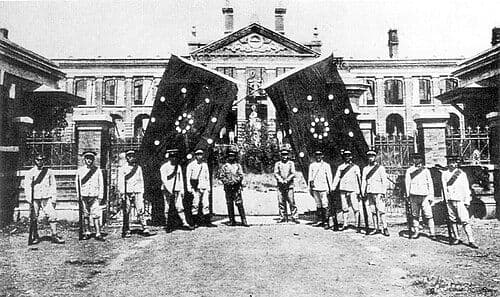
The Wuchang Uprising
The revolution that toppled the Qing dynasty began not with a grand plan but an accidental explosion. On 9 October 1911, a bomb being assembled by members of a secret revolutionary society in a Hankou safe house detonated prematurely. Qing authorities raided the premises and recovered membership lists, confronting local revolutionary soldiers in the Wuchang garrison with the choice between imminent arrest or immediate action. On the night of 10 October, the Eighth Engineering Battalion mutinied. By dawn, the revolutionaries held the governor-general's yamen across the river in Wuchang. The date — the tenth day of the tenth month — became the Double Tenth (雙十節), the national day of the Republic of China.
Within six weeks, fifteen of China's twenty-four provinces had declared independence from the Qing, many led by New Army commanders who had quietly aligned with the revolutionary cause. The speed of this collapse reflected years of groundwork by Sun Yat-sen's Revolutionary Alliance (同盟会, Tongmenghui), founded in Tokyo in 1905, which had systematically built networks within the New Army and local elites across the provinces. The Qing court's most capable general, Yuan Shikai, had been dismissed from active service and was living in semi-retirement — his absence leaving the dynasty without an effective military response.
Negotiating the Republic
Sun Yat-sen, fundraising in the United States when the uprising broke out, returned in late December 1911 and was inaugurated as Provisional President in Nanjing on 1 January 1912. Sun recognised that the revolutionaries lacked the strength to defeat the remaining Qing forces, and offered to resign the presidency in favour of Yuan Shikai if Yuan could persuade the court to abdicate. Yuan accepted. On 12 February 1912, the Empress Dowager Longyu signed the abdication decree on behalf of the six-year-old Emperor Puyi, framing the transfer of sovereignty as a voluntary gift to the Chinese people.
Yuan Shikai was inaugurated as Provisional President on 10 March 1912. Within months he had neutralised the revolutionary parliament. By 1915 he attempted to restore the monarchy with himself as emperor — a project that collapsed under popular opposition. Yuan died in June 1916, leaving China without a functioning central government and opening a decade of warlord fragmentation.
Legacy and Contested Memory
Both the People's Republic of China and the Republic of China on Taiwan claim the Xinhai Revolution as a founding moment, but interpret it differently. The PRC frames it as an incomplete bourgeois revolution that could only be completed by the Communist revolution of 1949. The ROC treats it as the founding act of Chinese constitutional democracy, celebrating Double Tenth as National Day. Western scholarship emphasises that the revolution's outcome — handing power to Yuan Shikai — reflected the limits of the revolutionary movement's social base and institutional capacity.
Narrative Comparison
| Source | Narrative |
|---|---|
| PRC Official Narrative | The Xinhai Revolution was a necessary but incomplete bourgeois-democratic revolution that cleared away the feudal imperial system and prepared the ground for the Communist revolution. Its failure to resolve the fundamental contradictions of imperialism and feudalism demonstrated the impossibility of national liberation without proletarian leadership. The CCP is the true inheritor of the revolutionary spirit of 1911. |
| ROC / Taiwan Narrative | The Xinhai Revolution realised Dr Sun Yat-sen's Three Principles of the People and founded Asia's first republic. The Republic of China, which continues to govern Taiwan, is its legitimate continuation. The Communist seizure of the mainland in 1949 was a usurpation of the republican tradition, not its fulfillment. |
| Western Academic Perspective | The 1911 revolution was a confluence of military mutiny, provincial elite defection, and constitutional negotiation rather than a mass popular uprising. Its outcome — transferring power to Yuan Shikai — reflected the revolutionary movement's limited social base. The republic that emerged was constitutionally ambitious but institutionally fragile from the outset. |
Key Milestones
- Sichuan Railway Protection Movement suppressed
Qing troops fire on protesters defending the Chengdu-Hankou railway against nationalisation, killing dozens and radicalising the province. Troops rushed to Sichuan strip the Wuhan garrison, directly enabling the Wuchang Uprising weeks later.
- Wuchang Uprising
New Army soldiers in Wuchang mutiny after a bomb accident exposes their revolutionary network. The Hubei provincial capital falls within hours; the uprising ignites similar revolts across China.
- Fourteen provinces declare independence
By early November, fourteen of China's twenty-four provinces have declared independence from the Qing dynasty, collapsing the dynasty's authority across most of China in under a month.
- Republic of China proclaimed; Sun Yat-sen inaugurated
Sun Yat-sen, who had been abroad fundraising when the uprising began, returns and is elected Provisional President by delegates in Nanjing. Asia's first republic is formally proclaimed.
- Qing Emperor Puyi abdicates
The six-year-old Emperor Puyi issues the abdication edict, ending over 2,000 years of imperial rule in China. The edict grants Yuan Shikai full authority to organise a republican government.
- Sun Yat-sen resigns in favour of Yuan Shikai
Sun fulfils his promise to step down once the Qing abdicated, recommending Yuan Shikai as his successor. The decision reflected the revolutionary movement's military weakness and reliance on Yuan's Beiyang Army to secure the north.
- Yuan Shikai inaugurated as Provisional President
Yuan Shikai is inaugurated in Beijing rather than Nanjing, on the pretext of managing northern security. His insistence on Beijing signals his intention to dominate the new republic on his own terms.
Last verified: