Shanghai Massacre
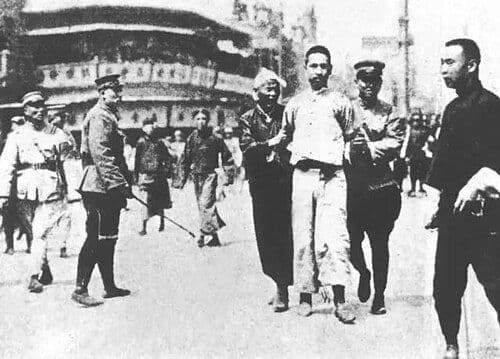
On 12 April 1927, Chiang Kai-shek ordered KMT forces and Green Gang paramilitaries to disarm and massacre Communist-led workers in Shanghai, ending the First United Front between the KMT and CPC. The "White Terror" that followed killed thousands of Communists across China, drove the CPC underground, and set the stage for two decades of civil conflict that would only resolve with the Communist victory of 1949.
Background: The Northern Expedition and Rising Communist Power
By early 1927, the KMT-CPC United Front appeared to be succeeding. The Northern Expedition, launched from Guangzhou in July 1926, had swept rapidly northward, taking Wuhan and Nanjing and reaching the outskirts of Shanghai. The CPC, operating within the KMT framework, had grown enormously — from under 1,000 members in 1923 to nearly 58,000 by early 1927 — and had built powerful labour organisations in the major cities. Shanghai's General Labour Union, under Communist leadership, had mounted two failed general strikes (October 1926 and February 1927) and a successful third insurrection (21–22 March 1927) that seized the city from the warlord Sun Chuanfang before KMT forces even arrived.
Chiang Kai-shek viewed this Communist ascendancy with deep alarm. He was also under pressure from two directions: from Shanghai's foreign concessions and Chinese business elites, who feared a Communist takeover would threaten their property; and from the left wing of his own party in Wuhan, which was moving toward closer alignment with Moscow. Chiang needed to break with the Communists before they broke with him.
The Massacre
In the days before 12 April, Chiang secretly coordinated with Du Yuesheng, leader of the Green Gang — Shanghai's dominant criminal organisation, deeply embedded in the city's labour unions and police. In the early hours of 12 April, armed Green Gang members dressed as workers infiltrated the labour union headquarters and began attacking picket lines. When union members emerged to resist, KMT troops moved in under the pretext of suppressing a "workers' armed conflict," disarming and shooting Communist-led workers.
On the morning of 13 April, thousands of workers marched to the 26th Army garrison headquarters on Baoshan Road to demand the return of their confiscated weapons. Garrison troops opened fire into the crowd, killing dozens in full view of foreign journalists and diplomatic personnel. The combination of the 12 April coordinated attack and the 13 April shooting of protesters — witnessed and reported by the international press — made the break irreversible and internationally visible. In the days that followed, the KMT's Nanjing government issued formal orders proscribing the CPC, and party purification committees (清党委员会) began systematic hunts for Communists across the cities of the lower Yangtze.
The killing in Shanghai continued for weeks. Estimates for deaths in Shanghai alone range from three hundred to several thousand. The White Terror then spread to Nanjing, Guangzhou, Wuhan, and smaller cities. The Guangzhou Commune uprising of December 1927 — a final CPC attempt at armed insurrection — was crushed within days with an estimated 5,700 killed. Nationwide, the CPC lost an estimated two-thirds of its membership to death, arrest, or defection in the months following April 1927. The party was driven from the cities into the countryside.
Consequences: Split and Civil War
The immediate political consequence was the formal collapse of the First United Front. Chiang Kai-shek established a Nationalist government in Nanjing, in opposition to the KMT left wing in Wuhan, which briefly maintained its alliance with the CPC before also turning against the Communists in July 1927. By the end of 1927, the KMT had reunified under Chiang's leadership and the CPC had retreated to rural base areas in Jiangxi and Hunan.
Mao Zedong drew a direct lesson from April 1927 that shaped all subsequent CPC strategy: "Political power grows out of the barrel of a gun." The CPC's survival in the countryside, its eventual development of the Red Army, the Long March, and the final military victory of 1949 all flow from the decision, forced by the Shanghai Massacre, to abandon urban insurrection in favour of rural guerrilla warfare.
Narrative Comparison
| Source | Narrative |
|---|---|
| PRC Official Narrative | The April 12 Massacre was a deliberate act of counter-revolutionary betrayal by Chiang Kai-shek and the comprador-bourgeois faction within the KMT against the working class and its Communist vanguard. Having secured military power through the Northern Expedition, Chiang aligned with imperialist foreign interests, Chinese capitalists, and criminal networks to destroy the revolutionary movement at its moment of greatest strength. The massacre exposed the class character of the KMT right wing and proved the necessity of an independent Communist Party with its own military force. In PRC historiography, 12 April 1927 is the founding moment of the CPC's resolve to seize political power through armed struggle. |
| Republic of China / Taiwan Historical Assessment | The KMT government and mainstream Taiwanese historical scholarship have characterised Chiang Kai-shek's decision as a necessary act of party purification (清党) in the face of Soviet-directed Communist infiltration. By 1927, the CPC — under Comintern direction — was systematically subverting the KMT from within, using the united front as cover to build a parallel power structure. Chiang's action preserved Chinese sovereignty from Soviet manipulation and ensured that the KMT remained the legitimate vehicle of Sun Yat-sen's Three Principles of the People. Contemporary Taiwan historiography increasingly acknowledges the violence while maintaining that the strategic decision was defensible given the Comintern's documented intentions. |
| Western Academic Assessment | Western historians have largely rejected monocausal explanations in favour of multi-factor analysis. Chiang faced simultaneous and genuine pressures: Communist organisations were rapidly building autonomous power within the united front; the Wuhan left-KMT government challenged his authority; Shanghai's foreign community and Chinese business elite offered financial support for a purge; and his own political survival depended on breaking with a movement that threatened to outgrow the KMT. Scholars including Harold Isaacs, C. Martin Wilbur, and Brian Martin have shown that the decision was premeditated over several weeks, involved careful coordination with Green Gang leader Du Yuesheng, and aimed at permanently removing Communist influence from the cities — not a reactive self-defence measure. Most Western historians characterise the event as a political massacre of the first order, regardless of the strategic logic that produced it. |
| CPC / PRC Official Accounts | Chinese Communist Party accounts and PRC official historiography emphasise the full breadth of the White Terror rather than focusing solely on Shanghai. Party histories cite an estimated 310,000 Communists and revolutionary workers killed between 1927 and 1928 — a figure derived from CPC records compiled in subsequent decades. The scale of killing is presented as evidence of the counter-revolutionary violence inherent in the KMT regime and as the moral foundation for the CPC's subsequent people's war. |
| Historical Scholarship | Independent historians note that reliable casualty figures for the White Terror are difficult to establish. For Shanghai alone, contemporaneous estimates range from several hundred killed on 12–13 April to several thousand over subsequent weeks, as arrests, summary executions, and disappearances continued. Nationwide figures in the hundreds of thousands reflect CPC documentation compiled years later under political incentives to demonstrate the scale of Nationalist repression. C. Martin Wilbur's research suggests a Shanghai death toll in the low thousands; Harold Isaacs documented systematic torture and execution throughout the lower Yangtze cities. What is historically uncontested is that the CPC lost approximately two-thirds of its membership in the months following April 1927 — from roughly 58,000 members in early 1927 to under 20,000 by year's end. |
Key Milestones
- Third Workers' Uprising Seizes Shanghai
The CPC-led General Labour Union mounts a successful armed insurrection, seizing control of Shanghai from warlord Sun Chuanfang's forces before KMT troops arrive. The victory gives the CPC enormous leverage — and makes Chiang Kai-shek acutely aware of its independent military capacity.
- Chiang Kai-shek Secretly Meets Du Yuesheng
Chiang Kai-shek holds covert meetings with Green Gang leader Du Yuesheng and Shanghai business elites to coordinate the upcoming purge. KMT weapons are secretly transferred to Green Gang operatives. Foreign concession authorities are informed and tacitly consent to the operation.
- Massacre Begins; Unions Disarmed
In the early hours of 12 April, armed Green Gang members disguised as workers attack the General Labour Union headquarters and picket lines. KMT troops move in under the pretext of suppressing a workers' dispute, disarming and shooting Communist-led workers. Hundreds are killed in Shanghai on this day alone; arrests and executions continue for weeks.
- Workers' Protest March Shot Into
Thousands of workers march to the 26th Army garrison headquarters on Baoshan Road to protest the disarming of the unions and demand the return of their weapons. Garrison troops open fire into the crowd, killing dozens in full view of foreign journalists and diplomatic observers. The massacre is now both irreversible and internationally witnessed.
- Guangzhou Commune Uprising and Suppression
The CPC mounts a final attempt at urban insurrection, seizing Guangzhou and briefly proclaiming a commune. Within three days, KMT and warlord forces retake the city with Soviet adviser involvement. An estimated 5,700 are killed in the suppression — the last major act of the White Terror and the definitive end of CPC urban strategy.
Last verified: