Mukden Incident
On the night of 18 September 1931, officers of Japan's Kwantung Army staged a controlled explosion on a Japanese-owned railway near Shenyang and blamed it on Chinese saboteurs — the pretext for a rapid military occupation of all of Manchuria. Within five months, Japan had established the puppet state of Manchukuo under the last Qing emperor Puyi. The League of Nations condemned the invasion but took no action. The incident began Japan's fourteen-year war in China and is commemorated annually in the PRC as a day of national humiliation.
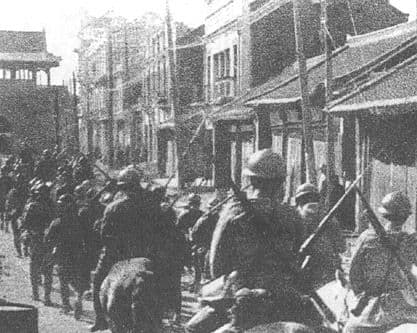
The Staged Explosion
By 1931, Japan's Kwantung Army had been stationed in Manchuria since 1905 under treaty rights stemming from the Russo-Japanese War. A faction of officers, frustrated by what they saw as civilian government timidity in exploiting China's weakness, devised a plan to manufacture a pretext for conquest. On the night of 18 September, officers of the Kwantung Army's Special Service Agency — principally Itagaki Seishiro and Ishihara Kanji, who had designed the operation — planted a small explosive charge on a section of the South Manchuria Railway near the Liutiaohu bridge outside Shenyang. The explosion caused minor damage — certainly not enough to derail a train, which in fact passed over the site shortly after. Japanese forces immediately opened fire on the Chinese garrison at the North Barracks, claiming China had attacked Japanese railway personnel.
The Kwantung Army acted without authorisation from Tokyo. The civilian government of Prime Minister Wakatsuki Reijiro sought to contain the incident; the army refused to obey restraining orders. Within hours, Japanese forces had seized the Shenyang arsenal — one of the largest in Asia — and were advancing on multiple fronts. The ease with which the plan succeeded encouraged wider military activism. The Kwantung Army had demonstrated that it could create facts on the ground faster than any government could reverse them.
The Occupation of Manchuria
Facing the Japanese assault, Zhang Xueliang — the Manchurian warlord whose Northeastern Army controlled the region — had received instructions from Chiang Kai-shek's Nanjing government not to resist. The reasoning was that resistance would be futile without adequate preparation, and that diplomatic avenues through the League of Nations should be exhausted first. The policy of non-resistance (不抵抗政策) allowed Japan to seize an area roughly twice the size of France in roughly five months with minimal combat losses. Zhang Xueliang, who was in Beijing receiving medical treatment for opium withdrawal when the incident began, became a figure of lasting popular anger for what was perceived as cowardice, though he had acted on orders he was not free to reveal.
By early 1932, Japan controlled all of Manchuria's three provinces: Liaoning, Jilin, and Heilongjiang. The region contained China's most developed industrial base, its richest coalfields, and a population of approximately 30 million. Japanese engineers and administrators set about transforming it into an economic colony, constructing railways, mines, and heavy industrial facilities that would underpin Japan's war economy throughout the 1930s and 1940s.
The policy of non-resistance was Nanjing's official stance, but it was not universally obeyed. In the weeks and months after the Mukden Incident, spontaneous armed resistance emerged across Manchuria under leaders who became known as the "volunteer armies" (义勇军). Former soldiers, local militia, and ordinary civilians formed guerrilla units that fought Japanese forces with limited weapons and no government support. By 1932, these scattered units numbered in the hundreds of thousands on paper, though their military effectiveness was constrained by poor coordination and supply. The Communist-led Northeast Anti-Japanese United Army (东北抗日联军), which continued fighting Japanese forces in Manchuria until 1941, represented the most sustained organised resistance. In PRC historiography these fighters receive prominent recognition as the true vanguard of the War of Resistance — evidence that ordinary Chinese did not accept occupation passively even when their government did.
Manchukuo and International Response
On 9 March 1932, Japan proclaimed the establishment of Manchukuo (满洲国) as an ostensibly independent state, installing the last Qing emperor Puyi as nominal head of state — and, from 1934, as Emperor Kangde. In practice, all executive power rested with Kwantung Army officers. The League of Nations dispatched an investigation commission under Lord Lytton; the Lytton Report, published in October 1932, concluded clearly that the military operations could not be regarded as legitimate self-defence and that Manchukuo was not a genuine spontaneous independence movement. The League voted to adopt the report's findings in February 1933. Japan responded by withdrawing from the League, setting a precedent for the organisation's impotence before determined aggression.
Legacy
The Mukden Incident is a foundational event in the People's Republic of China's national memory. September 18 is marked annually with air-raid sirens in northeastern cities — a deliberate reminder of "national humiliation." In historical education, the incident is presented as the beginning of China's fourteen-year War of Resistance Against Japanese Aggression (1931–1945). The gap between this date and the conventionally Western start date for the Second Sino-Japanese War (1937) reflects a genuine historiographical difference: Chinese historical scholarship considers the full period of Japanese occupation and resistance as a single conflict; Western historiography has tended to treat 1937 as the opening of the major war. The incident also set in motion the chain of events — Manchurian exile, northeastern soldier frustration, Zhang Xueliang's radicalisation — that culminated in the Xi'an Incident of 1936.
Narrative Comparison
| Source | Narrative |
|---|---|
| PRC Official Narrative | PRC official historiography places primary responsibility for the non-resistance policy squarely on Chiang Kai-shek's Nanjing government. Chiang's directive to Zhang Xueliang — not to resist and not to expand the incident — is treated as a catastrophic abdication of national responsibility rooted in his priority of eliminating the Communist Party before confronting Japan. The policy of "pacifying internal disorder before resisting external aggression" (攘外必先安内) is condemned as placing KMT factional interests above national survival. Zhang Xueliang is partially rehabilitated in PRC historiography as a patriotic general who ultimately corrected Chiang's errors by forcing the second united front at Xi'an in 1936. |
| ROC / Taiwan Narrative | ROC government and Taiwanese historical scholarship have offered a more nuanced defence of the non-resistance policy. Chiang Kai-shek's directive reflected a realistic assessment of military capacity: the Northeastern Army lacked the equipment, training, and logistical support to resist a modern Japanese military force. Armed resistance in September 1931 would likely have destroyed China's best-equipped northeastern forces and provided Japan with a pretext for deeper invasion. Taiwan historiography also emphasises that Chiang sought to internationalise the conflict through the League of Nations — a strategy consistent with the norms of collective security that Japan's intransigence ultimately defeated. Zhang Xueliang's voluntary accompaniment of Chiang to Nanjing after the Xi'an Incident is presented as an acknowledgement of his own fault. |
| Western Academic Perspective | Western historians have generally treated the non-resistance policy as the product of multiple overlapping constraints rather than a single decision-maker's failure or wisdom. Chiang Kai-shek's government simultaneously managed Communist insurgencies, uncertain warlord loyalties, and a fiscal crisis that left the National Revolutionary Army poorly equipped for major war. The Kwantung Army's rapid seizure of the Shenyang arsenal within hours made effective resistance extremely difficult to organise even had orders permitted it. Scholars including Rana Mitter and Louise Young have highlighted Zhang Xueliang's own role: he had operational command and some room for initiative, yet chose compliance. How much of the non-resistance decision was Chiang's direct order versus Zhang's own interpretation remains genuinely contested in the historical literature. |
| PRC Official Narrative | The People's Republic of China officially designates the Mukden Incident as the beginning of China's "Fourteen-Year War of Resistance Against Japanese Aggression" (十四年抗战). This periodisation, formally adopted in 2017 by the Ministry of Education in updated history curriculum guidelines, treats 1931–1945 as a single, continuous conflict. The volunteer armies (义勇军) and the later Northeast Anti-Japanese United Army (东北抗日联军) who fought Japanese forces from 1931 onward are recognised as the first combatants of the war. The fourteen-year framework emphasises the total duration of Chinese suffering under Japanese aggression and explicitly rejects the Western convention of 1937 as a reduction of China's full war experience. |
| Western Academic Perspective | Western historiography has conventionally dated the Second Sino-Japanese War from 7 July 1937 — the Marco Polo Bridge Incident — when full-scale hostilities commenced across China proper. Under this framework, the Mukden Incident and the occupation of Manchuria (1931–1937) constitute a distinct prior phase of Japanese imperial expansion: one to which China's central government did not respond with declared war and which did not yet draw China's main forces into sustained combat. Historians including Akira Iriye and S.C.M. Paine have argued that the 1937 threshold reflects a meaningful military and political rupture — the shift from incremental expansion to total war across all of China. The fourteen-year periodisation is acknowledged as historically legitimate but viewed by many Western scholars as shaped partly by contemporary Chinese nationalist politics rather than purely military-historical criteria. |
Key Milestones
- Liutiaohu explosion; Japanese forces attack North Barracks
Kwantung Army officers detonate a small explosive on the South Manchuria Railway near Liutiaohu and blame Chinese saboteurs. Japanese forces immediately attack the Chinese garrison at Shenyang's North Barracks. The Kwantung Army acts without authorisation from Tokyo.
- Shenyang falls; arsenal seized
Japanese forces capture Shenyang within hours of the initial attack, seizing the Shenyang Arsenal — one of the largest arms manufacturing facilities in Asia. The Northeastern Army, following non-resistance orders, withdraws without significant combat. The speed of conquest demonstrates the Kwantung Army's ability to create irreversible facts on the ground.
- Jinzhou falls; Manchuria fully under occupation
Japanese forces capture Jinzhou, the last major city held by Zhang Xueliang's forces in Manchuria. The Northeastern Army retreats across the Great Wall into China proper. All three Manchurian provinces are now effectively under Japanese military control.
- January 28 Incident: Japan attacks Shanghai
Japan launches a military assault on Shanghai — ostensibly in response to anti-Japanese protests — in part to divert international attention from the consolidation of Manchuria. The 19th Route Army offers unexpected fierce resistance, producing weeks of urban fighting in full view of the international settlement. The Shanghai ceasefire is reached in May 1932.
- Manchukuo proclaimed; Puyi installed as head of state
Japan announces the establishment of Manchukuo as an ostensibly independent state, installing the last Qing emperor Puyi as nominal head of state. In practice all executive authority rests with the Kwantung Army. In 1934, Puyi is elevated to Emperor Kangde of a formal empire.
- Lytton Report published
The League of Nations commission under Lord Lytton publishes its findings, concluding that the military operations of September 18 cannot be regarded as legitimate self-defence and that Manchukuo is not a genuine spontaneous independence movement. The report is diplomatically clear but produces no enforcement action.
- Japan withdraws from League of Nations
Following the League's vote to adopt the Lytton Report findings, Japan's delegate Matsuoka Yōsuke leads the Japanese delegation out of the assembly chamber. Japan formally withdraws from the League, setting a precedent for the organisation's impotence before determined aggression.
Last verified: