The May Thirtieth Movement
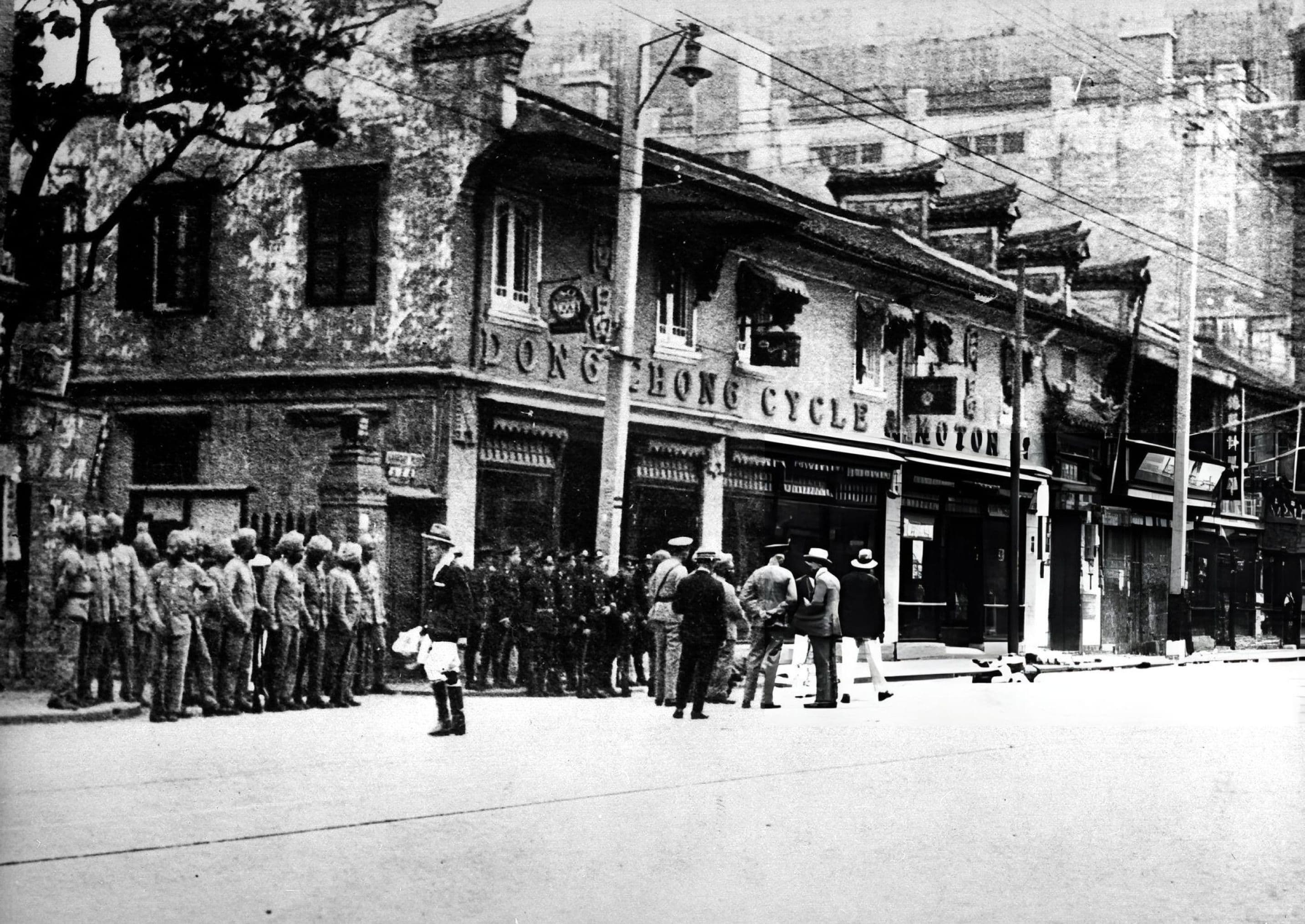
On 15 May 1925 Gu Zhenghong, a worker at a Japanese-owned cotton mill in Shanghai, was shot dead, setting off strikes and student protests. On 30 May, as students and workers demonstrated in the International Settlement, British-led police fired on a crowd outside the Louza police station on Nanking Road; accounts of the dead range from about nine to thirteen. A general strike, class boycott and shop closures followed in Shanghai, and protests spread to Beijing, Hankou and elsewhere. Beijing held the Settlement authorities entirely responsible; the diplomatic body first blamed the demonstrators, then found the police commissioner, K. J. McEuen, primarily responsible, and a British, American and Japanese judicial commission reached differing conclusions. In December the Municipal Council accepted the resignations of McEuen and Inspector Everson and offered compensation. The CPC describes the movement as an anti-imperialist campaign it led; Taiwanese scholarship stresses the Kuomintang’s role.
The Mill Strikes and the Death of Gu Zhenghong
From February 1925 nearly 40,000 workers in 22 Japanese-owned cotton mills in Shanghai struck in succession against beatings, arbitrary dismissals and low wages. According to The Paper, citing the Putuo District Gazetteer, on 15 May the Japanese owners closed Naigai Mills No. 7 and No. 12; the worker Gu Zhenghong led workers who wanted to work in forcing open the gate, and Kawamura, the Japanese manager of Mill No. 7, opened fire. Gu, hit by several bullets, died the next afternoon aged 20; eleven other workers were injured. Communist sources describe Gu as a Party member and workers’ representative.
On 16 May all the Naigai mills struck, demanding punishment of the killer and recognition of the union among eight conditions. On 24 May a memorial meeting for Gu was held at Tanziwan; that day the Settlement authorities arrested four Shanghai University students who had attended, setting their hearing in the Mixed Court for the 30th. On 25 May the Kuomintang Central Executive Committee issued a telegram supporting the mill workers. On 28 May the CPC Central Committee decided to stage an anti-imperialist demonstration in the Shanghai concessions on the 30th.
The Shooting on Nanking Road
On 30 May students and workers made speeches and handed out leaflets in the streets of the International Settlement. According to Communist accounts, British police arrested more than 100 people on Nanking Road; a large crowd then gathered outside the Louza police station demanding their release, and the police opened fire. The Taiwanese scholar Lin Chia-hui writes that the order to fire was given by the British inspector Everson. The U.S. consul general, Edwin Cunningham, reported the next day that the students had become “a threatening mob,” assaulting foreign constables and attempting to force their way into the station: “The order was given to fire.” He judged that the police had “acted in the only possible way consistent with the situation.”
Casualty figures differ. Communist party-history sources say 13 were killed on the spot and dozens wounded. A note from the Beijing Foreign Ministry on 1 June reported “four students being killed on the spot,” two more dying of wounds and three passers-by dying later. Lin Chia-hui gives four dead at the scene and seven who died in hospital. Cunningham’s telegram of 31 May reported three killed, six more dead that night and about twenty wounded. Victims named in sources cited by The Paper include He Bingyi of Shanghai University, Yin Jingyi of Tongji University, the middle-school student Chen Yuqin, the telephone operator Tang Liangsheng and the hotel cook Chen Zhaochang.
The General Strike
According to Communist sources, the Central Committee met again that night and formed an action committee of Qu Qiubai, Cai Hesen, Li Lisan, Liu Shaoqi, Liu Hua and others. From 1 June Shanghai’s workers, students and merchants began a general strike, class boycott and closure of shops, and the Shanghai General Labour Union was founded with Li Lisan as chairman. On 4 June the union, student federations and street merchants’ associations formed the Shanghai Federation of Workers, Merchants and Students, and the Party launched the Rexue Ribao (Hot Blood Daily) under Qu Qiubai. Party sources say more than 200,000 workers and 50,000 students took part; The Paper reports that by 21 July some 250,000 workers had joined 206 strikes in Shanghai.
Further shootings occurred up to 10 June. Foreign naval forces came ashore; Cunningham reported that on 2 June “American and 200 Italian bluejackets were landed to guard light and water supplies,” and Communist sources say foreign marines occupied Shanghai University, Daxia University and other schools. Forty-nine people arrested on 30 May and 1 June were tried for rioting in the Mixed Court; the trials ended on 11 June and “none were imprisoned or fined.” On 26 June “all Chinese banks and most shops reopened” after closing on 1 June, but the strikes in the mill districts and harbour continued, the mill settlement deadlocked over recognition of the unions.
The Movement Spreads
On 3 June students marched in Beijing with handbills demanding punishment of those responsible, “abolition of foreign concessions and extraterritoriality,” withdrawal of foreign forces and “abolition of unequal treaties and special privileges.” On 11 June British sailors fired on demonstrators approaching the concession in Hankou; Communist sources say dozens were killed. Party sources put total participation nationwide at about 17 million. Zhang Zuolin and Feng Yuxiang telegraphed Beijing’s chief executive exonerating the demonstrators and blaming Britain; the U.S. chargé, Ferdinand Mayer, commented that “militarists are making every effort to use present situation in order to cause Chinese people to forget antimilitarist feelings.” On 1 June the Kuomintang’s Shanghai Executive Department issued a declaration condemning the shooting. The Soviet ambassador, Lev Karakhan, wrote to the Foreign Ministry expressing grief at “the shooting of several tens of Chinese workers and students at Shanghai.”
Negotiations and Inquiries
On 1 June the Beijing Foreign Ministry protested to the senior minister, the Italian minister Vittorio Cerruti, stating that the incident was one “for which the authorities of the Concession are entirely responsible.” The diplomatic body replied on 4 June that “the responsibility of the events which followed rests on the demonstrators and not upon the authorities of the Concession.” It then sent delegates to Shanghai on 8 June to investigate and to negotiate with a Chinese government commission; the Chinese side sought to settle the Mixed Court question and Chinese representation on the Municipal Council at the same time, whereas the legations had limited their delegates to compensation, suspensions, the restoration of order and withdrawal of troops, and the talks broke down on 18 June.
On 1 July the heads of legation adopted conclusions: the chairman of the Municipal Council’s conduct was “not devoid of blame”; “more than an hour and a quarter elapsed between the moment when the demonstrators entered the International Settlement and that when the shots were fired but during all this time Colonel McEuen was not at his post,” so that the police commissioner bore primary responsibility and “should be replaced”; Inspector Everson, a subordinate, “could not do otherwise than carry out the orders given him.” They also declared that the demonstrations had been arranged on Chinese territory and called on the Chinese government to fix responsibility. The British government had the communication of these conclusions suspended, and the Municipal Council refused them, claiming to be “primarily responsible only to the electorate of the International Settlement of Shanghai.”
Britain then proposed a judicial inquiry, to which Washington agreed provided “the proposed commission include a Chinese jurist of high standing”; Beijing declared that it would “not only be unwilling to participate but would take no cognizance of any of the findings of the inquiry.” The commission—E. Finley Johnson of the Philippine Supreme Court, Sir Henry Gollan of Hong Kong and Kitaro Suga of the Hiroshima Appeal Court—opened on 7 October without Chinese witnesses. The British and Japanese judges’ reports agreed “in exonerating police and municipal authorities”; Johnson held that the police “had no alternative but to fire in the circumstances which arose” but were “at fault in having allowed such a necessity to arise,” and that McEuen’s presence at Louza station “might have saved the lives of some innocent persons.” Johnson also recommended settling the Mixed Court question, Chinese participation in Shanghai’s government, extraterritoriality and the unequal treaties. In December the Municipal Council accepted the resignations of McEuen and Everson and offered “$75,000 solatium to victims or their families,” announced by the senior minister on 23 December.
Differing Accounts
Communist accounts describe the movement as “a mass anti-imperialist patriotic movement led by the Communist Party of China” that “raised the curtain on the high tide of the Great Revolution.” The Taiwanese scholar Lin Chia-hui argued in 2011 that the CCP’s activities during the May Thirtieth period took place under the Kuomintang’s umbrella—“its gains came because of the Kuomintang and were also limited by it”—while the Kuomintang used the movement to win leadership of anti-imperialist nationalism ahead of the Northern Expedition. American officials disagreed among themselves: the day after the shooting Cunningham stressed the “violent circulars of Bolshevik character,” whereas on 19 June Mayer judged the movement “essentially nationalist in character rather than antiforeign” and urged that foreigners “must make some concession to the Chinese.”
Gallery
Narrative Comparison
| Source | Narrative |
|---|---|
| People’s Daily (2006) | The official CPC account calls the movement “a mass anti-imperialist patriotic movement led by the Communist Party of China” that “marked the arrival of the high tide of the Great Revolution.” The Central Committee’s appeal of 5 June declared that the aim was “by no means limited to punishment of the culprits, compensation and apologies” but “the abolition of all unequal treaties and the overthrow of all imperialist privileges in China.” |
| Lin Chia-hui, Journal of Nan Kai (2011) | Lin Chia-hui argues that the CCP operated under the Kuomintang’s umbrella—“its gains came because of the Kuomintang and were also limited by it”—while the Kuomintang used the nationalist upsurge to lead the anti-imperialist movement, “making important preparations for the Northern Expedition,” even as the Communists, cooperating on the surface, worked to divide the KMT. |
| U.S. diplomatic correspondence (FRUS 1925) | Consul General Cunningham reported the day after the shooting that the police had “acted in the only possible way consistent with the situation.” On 19 June Chargé Mayer judged the movement “essentially nationalist in character rather than antiforeign” and argued that “we foreigners must make some concession to the Chinese.” In the judicial inquiry the American judge, Johnson, held that the police “had no alternative but to fire” yet “were at fault in having allowed such a necessity to arise,” and called for Chinese participation in Shanghai’s government and a settlement of extraterritoriality. |
| Karakhan’s note to the Chinese Foreign Ministry (June 1925, via FRUS) | The Soviet ambassador, Karakhan, wrote that he had learned “with a feeling of profound grief of the shooting of several tens of Chinese workers and students at Shanghai,” expressing sympathy “certainly shared by the peoples of the Union of Soviet Socialist Republics.” The U.S. chargé Mayer thought the Soviets were exploiting the situation but that “just how much they had to do with the actual initiation of the Shanghai incident is at present impossible to say.” |
Key Milestones
- Gu Zhenghong shot
Gu Zhenghong is shot at Naigai Mill No. 7 and dies the next day.
- Memorial for Gu Zhenghong
A memorial is held at Tanziwan; four Shanghai University students who attended are arrested.
- CPC decides on 30 May demonstration
An emergency CPC meeting decides on a demonstration in the concessions on the 30th.
- Shooting on Nanking Road
Police fire on demonstrators outside the Louza police station.
- General strike begins
Strikes, class boycotts and shop closures begin; Beijing’s Foreign Ministry protests.
- Diplomatic body replies
The diplomatic body places responsibility on the demonstrators; the Federation of Workers, Merchants and Students is formed.
- Shooting at Hankou
British sailors fire on demonstrators at Hankou.
- Shanghai banks and shops reopen
Chinese banks and most shops reopen; strikes in the mills and harbour continue.
- Conclusions of the heads of legation
Police commissioner McEuen is found primarily responsible and should be replaced.
- Judicial commission opens
The American, British and Japanese judicial commission opens without Chinese witnesses.
- Settlement announced
The senior minister announces that the Council has accepted the resignations of McEuen and Everson and offered $75,000 in compensation.
Last verified:
Cite this page
Chronicles of Modern China. (2026, November 6). The May Thirtieth Movement. Retrieved November 6, 2026, from https://www.cmcarchive.org/events/may-thirtieth-movement-1925
“The May Thirtieth Movement.” Chronicles of Modern China. Last modified November 6, 2026. Accessed November 6, 2026. https://www.cmcarchive.org/events/may-thirtieth-movement-1925.
Chronicles of Modern China. The May Thirtieth Movement[EB/OL]. (2026-11-06)[2026-11-06]. https://www.cmcarchive.org/events/may-thirtieth-movement-1925.