The First Kuomintang Congress, the First United Front and the Whampoa Military Academy
In January 1923 Sun Yat-sen and the Soviet envoy Adolph Joffe issued a joint manifesto, and Moscow sent Mikhail Borodin as Sun’s adviser; in June the Third CPC Congress decided that Communists would join the Kuomintang as individuals. The Kuomintang’s First National Congress, held in Guangzhou from 20 to 30 January 1924, reinterpreted the Three Principles of the People and elected Li Dazhao and other Communists to its Central Executive Committee, inaugurating the first united front. On 16 June the Whampoa Military Academy opened, with Sun as director-general, Chiang Kai-shek as commandant and Communists such as Zhou Enlai in political work. The CPC says the congress adopted “Three Great Policies”; the Kuomintang rejects that formulation, and both sides of the Taiwan Strait claim the Whampoa tradition.
Sun Yat-sen and Soviet Russia
On 26 January 1923 Sun Yat-sen and Adolph Joffe, representative of the Soviet Russian government, issued a joint manifesto in Shanghai. Its first article stated that Sun “holds that the Communistic order or even the Soviet system cannot actually be introduced into China,” a view “entirely shared by Mr. Joffe,” who held that China’s most pressing problems were unification and full independence and assured Sun that China “can count on the support of Russia.” Other articles left the Chinese Eastern Railway question to a Sino-Russian conference and addressed Outer Mongolia: Joffe declared that Russia had no intention of causing it to secede from China, and Sun held that Russian troops need not be withdrawn immediately. The CPC’s official party chronology says the manifesto publicly established the Kuomintang’s policy of alliance with Russia.
On 2 August 1923 the Politburo of the Russian Communist Party appointed Mikhail Borodin as Sun’s political adviser; Borodin reached Shanghai in late September and Guangzhou on 6 October. On 25 October Sun convened a special conference on reorganising the Kuomintang, appointing nine people including Liao Zhongkai and Tan Pingshan (then a Communist) as provisional Central Executive Committee members and five including Wang Jingwei and Li Dazhao as alternates, and engaging Borodin as adviser for the reorganisation.
The Third CPC Congress and “Joining as Individuals”
From 12 to 20 June 1923 the Communist Party of China held its Third National Congress in Guangzhou, attended by more than thirty delegates representing 420 members. Accepting a Comintern resolution of 12 January on relations with the Kuomintang, it decided that all Communists would join the Kuomintang as individuals in order to form a united front. According to the party chronology, most delegates criticised Zhang Guotao and others who were reluctant to cooperate actively with the Kuomintang, while also rejecting the view of Maring and Chen Duxiu that “all work belongs to the Kuomintang.” A plenum in November 1923 further decided that the CPC would carry out its programme inside the Kuomintang through secret caucus-type cells, striving to “stand at the centre of the Kuomintang.”
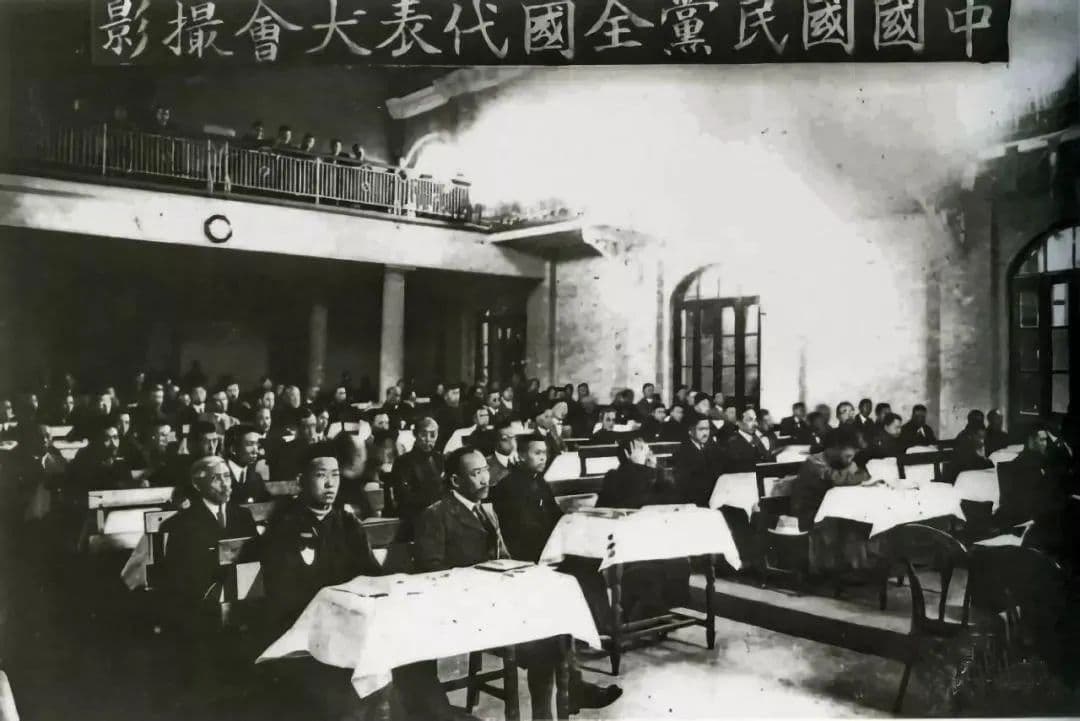
The First Kuomintang National Congress
The First National Congress of the Kuomintang met in Guangzhou from 20 to 30 January 1924 under Sun’s chairmanship. Its manifesto reinterpreted the Three Principles of the People: Nationalism had “a twofold meaning: first, the self-emancipation of the Chinese nation; second, the equality of all nationalities within China”; the principles of People’s Livelihood were “the equalisation of land rights and the regulation of capital”; and the national revolution “can triumph only with the participation of the peasants and workers of the whole country.” The text of the manifesto does not contain the phrases “alliance with Russia,” “alliance with the Communists” or “admitting the Communists.”
According to the CPC chronology, the Central Executive Committee elected by the congress included ten Communists, among them Li Dazhao, Tan Pingshan, Mao Zedong, Lin Boqu and Qu Qiubai, as members and alternates; when the party headquarters was reorganised, Communists headed the Organisation and Peasant departments. During debate on the party constitution, Fang Ruilin, a Guangzhou delegate, and others objected to Communists’ “cross-party” membership and proposed a clause that “members of this party may not join another party.” Li Dazhao replied that “we have joined this party to contribute to it and thereby to the cause of national revolution, and certainly not to take advantage or to carry on Communist activity in the Kuomintang’s name,” and that “our joining this party while keeping our original membership is an open and aboveboard act.” Supported by Liao Zhongkai and most delegates, he carried the day and the proposal was rejected.
The Whampoa Military Academy
After the congress the Kuomintang set up an Army Officer School on Changzhou Island at Whampoa (Huangpu), Guangzhou. It admitted 350 students from 1,200 candidates, with 120 more on a reserve list; the first class began to enrol on 5 May. On 16 June Sun and Soong Ching-ling landed from the warship Jianggu for the opening ceremony, where Sun urged the cadets to devote themselves to saving the nation and harbour no thought of promotion or wealth. Sun was concurrently director-general, Liao Zhongkai party representative and Chiang Kai-shek commandant. Sun’s address at the ceremony, beginning “The Three Principles of the People, the foundation of our party; to build the Republic, to advance to Great Harmony,” was later set to music by Cheng Maoyun and became first the Kuomintang’s anthem and then the national anthem of the Republic of China.
The academy established a political department, in which Zhou Enlai, Yun Daiying, Xiao Chunü, Xiong Xiong, Nie Rongzhen and other Communists successively held political leadership and other posts. According to an article by Pan Jingguo in the Study Times in 2024, “nearly 800 CPC members served at the school as instructors or cadets” between 1924 and 1927. In October 1924 Sun, relying on Whampoa cadets and other forces, suppressed the Guangzhou merchant corps led by Chen Lianbo. On 13 November, before travelling north, Sun returned to the campus aboard the Yongfeng to bid farewell. The academy’s headquarters was destroyed by Japanese aircraft in 1938 and rebuilt on its original site and to its original dimensions in 1996.
The “Three Great Policies”
The CPC chronology states that the First Congress “established the Three Great Policies of alliance with Russia, alliance with the Communists, and assistance to peasants and workers,” and that “the Whampoa Military Academy was a school for training revolutionary officers that the Soviet Union and the Communist Party of China helped Sun Yat-sen establish.” According to a 2004 study by the Taiwanese scholar Ke Siming, the Kuomintang has denied that the congress adopted any “Three Great Policies,” saying the term was coined by Borodin; Ke concluded that “the Communists admitted that, they rather than Sun Yat-sen, had formulated” the term, which was then accepted through common practice, and that both parties held to their positions because the interpretation of the term bore on which of them “could claim revolutionary legitimacy.”
The Centenary on Both Sides of the Strait
The academy’s centenary fell in June 2024. In a letter marking the academy’s centenary and the 40th anniversary of the Whampoa Alumni Association, Xi Jinping said the academy “was a product of the first Kuomintang–Communist cooperation and the first school in our country to train cadres for a revolutionary army,” calling for the “Whampoa spirit of ‘patriotism and revolution’” to be carried forward and for firm opposition to “independence”; on 17 June Wang Huning spoke at a commemorative meeting in Beijing.
The Republic of China Military Academy in Taiwan traces its history to Whampoa and was re-established at Fengshan, Kaohsiung, in 1950. At its centenary celebration on 16 June 2024, Lai Ching-te said the early cadets had set out on “the Eastern Expedition, the Northern Expedition, the suppression of the Communists and the War of Resistance,” and that “wherever the Republic of China is, there the Whampoa spirit is”; according to PTS he also reaffirmed that the Republic of China and the People’s Republic of China are not subordinate to each other. Storm Media reported that a number of retired Taiwanese generals had travelled to the old Whampoa site in Guangzhou for centenary events, sparking a cross-strait dispute over “Whampoa orthodoxy.”
Gallery
Narrative Comparison
| Source | Narrative |
|---|---|
| CPC party-history chronology; Xi Jinping’s letter (2024) | The CPC chronology says the First Congress “established the Three Great Policies of alliance with Russia, alliance with the Communists, and assistance to peasants and workers,” and describes Whampoa as a school “that the Soviet Union and the Communist Party of China helped Sun Yat-sen establish.” In 2024 Xi Jinping called the academy “a product of the first Kuomintang–Communist cooperation” and urged the alumni to uphold “the Whampoa spirit of ‘patriotism and revolution’” and oppose “independence.” |
| Ke Siming, Fu Jen Historical Journal (2004); Lai Ching-te at the Army Academy centenary (2024) | According to Ke Siming, the Kuomintang denies that the First Congress adopted “Three Great Policies,” saying “it was Michael Borodin who created this term in the first place”; Ke concludes that the Communists themselves later formulated the term. Taiwan’s Army Academy regards Whampoa as its founding, and at its 2024 centenary Lai Ching-te said “wherever the Republic of China is, there the Whampoa spirit is,” reaffirming that the ROC and PRC are not subordinate to each other. |
| Sun–Joffe Manifesto (1923) | In the joint manifesto the Soviet envoy Joffe agreed with Sun that “the Communistic order or even the Soviet system cannot actually be introduced into China,” defined China’s most pressing tasks as unification and independence, assured Sun that China “can count on the support of Russia,” and declared that Russia did not intend to detach Outer Mongolia from China. |
Key Milestones
- Sun–Joffe Manifesto
Sun and the Soviet envoy Joffe issue a joint manifesto in Shanghai.
- Third CPC Congress opens
Meeting in Guangzhou, the congress decides that all Communists will join the Kuomintang as individuals.
- Borodin appointed Sun’s adviser
The Russian Communist Party Politburo appoints Borodin; he reaches Guangzhou on 6 October.
- Kuomintang reorganisation conference
Sun appoints Liao Zhongkai, Tan Pingshan and others to a provisional executive committee and engages Borodin.
- First Kuomintang Congress opens
The congress meets in Guangzhou until 30 January.
- Congress manifesto
The manifesto reinterprets the Three Principles of the People.
- First Whampoa class enrols
The first class, 350 chosen from 1,200 candidates, begins to enrol.
- Whampoa opening ceremony
Sun presides and delivers his address; Chiang Kai-shek is commandant.
- Sun bids farewell to Whampoa
Before travelling north, Sun returns aboard the Yongfeng to say farewell.
- Centenary on both sides of the Strait
Taiwan’s Army Academy marks its centenary with Lai Ching-te; mainland media publish Xi Jinping’s letter the next day.
Last verified:
Cite this page
Chronicles of Modern China. (2026, November 6). The First Kuomintang Congress, the First United Front and the Whampoa Military Academy. Retrieved November 6, 2026, from https://www.cmcarchive.org/events/kmt-first-congress-whampoa-1924
“The First Kuomintang Congress, the First United Front and the Whampoa Military Academy.” Chronicles of Modern China. Last modified November 6, 2026. Accessed November 6, 2026. https://www.cmcarchive.org/events/kmt-first-congress-whampoa-1924.
Chronicles of Modern China. The First Kuomintang Congress, the First United Front and the Whampoa Military Academy[EB/OL]. (2026-11-06)[2026-11-06]. https://www.cmcarchive.org/events/kmt-first-congress-whampoa-1924.