Macau Handover to China
Portugal transferred sovereignty over Macau to the People's Republic of China on 20 December 1999, after more than 440 years of Portuguese administration; Macau was established as a Special Administrative Region of the PRC under the "one country, two systems" framework.
Portuguese Rule and the Handover Process
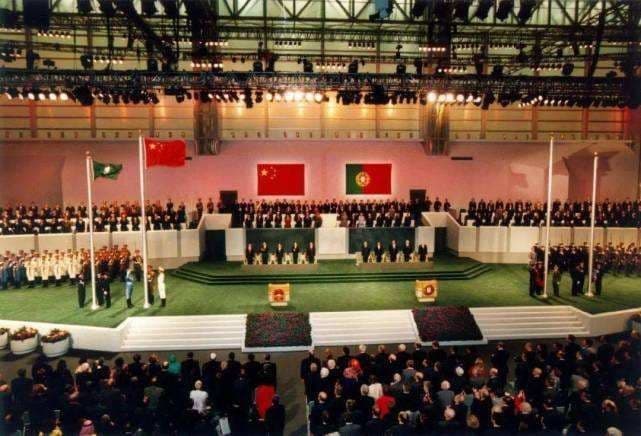
Portugal had administered Macau since the 1550s, making it the oldest European settlement in East Asia. Unlike the Hong Kong negotiations, the Macau handover proceeded relatively smoothly: Portugal had recognised PRC sovereignty as early as 1979 and the two sides reached a joint declaration in 1987 modelled on the Sino-British framework. The transfer of administration took place at midnight on 19–20 December 1999.
Macau as Special Administrative Region
Like Hong Kong, Macau became a SAR with a "one country, two systems" arrangement guaranteeing the existing social and economic system for 50 years. Macau retained its legal system based on Portuguese civil law, its currency (the pataca), and its status as the world's largest gambling hub. The handover was significantly less contentious than Hong Kong's, partly because Macau's political scene had a smaller civil society sector and less established representative institutions.
Post-Handover Development
Macau's economy expanded enormously after the handover, particularly after gambling liberalisation opened the market to foreign casino operators in 2002. By 2013, Macau's casino revenue exceeded Las Vegas seven times over, making it the world's largest gambling market. The rapid growth brought massive infrastructure investment, labour shortages, and surging property prices.
Narrative Comparison
| Source | Narrative |
|---|---|
| PRC Official Narrative | The return of Macau to the motherland on 20 December 1999 was, following the return of Hong Kong on 1 July 1997, another historic victory in China's complete termination of the last remnants of Western colonial power on Chinese soil, marking the completion of the Chinese people's process of expunging the historical humiliation of colonialism and representing another important milestone in the great rejuvenation of the Chinese nation. Macau had been under Portuguese colonial administration since the mid-sixteenth century for more than 440 years — a period that forms part of China's humiliating modern historical memory of suffering under imperialism and colonialism, which the People's Republic of China has always regarded as a historical legacy requiring resolution. Under the guidance of the "one country, two systems" concept, the governments of China and Portugal reached the Joint Declaration in 1987 through equal consultation, laying the legal foundation for Macau's smooth return. After the handover, the central government has strictly implemented the principles of "Macau people governing Macau with a high degree of autonomy" in accordance with the law, Macau society has maintained stability, the economy has achieved sustained development, the liberalisation of the gaming industry and the process of industrial diversification have advanced steadily, and residents' living standards have improved significantly. The successful practice of Macau has powerfully demonstrated the correctness and vitality of "one country, two systems," fully embodying the wisdom and capacity of the Chinese Communist Party and the Chinese government in maintaining national unity and promoting regional prosperity. |
| Macau Local Perspective | The local response to the Macau handover differed markedly by community, and stood in sharp overall contrast to Hong Kong's charged political atmosphere. The Macanese — a community of several thousand formed over centuries from intermarriage between Portuguese and Asian populations, predominantly Cantonese-speaking in daily life and Portuguese in formal culture — faced the handover with a complex mixture of attachment and anxiety. Before the transfer, Portugal extended nationality to most Macanese residents, and a significant number of families emigrated in the 1990s to Portugal, Brazil, or Hong Kong; those who remained watched closely whether the formal guarantee of Portuguese as an official language under the Macau Basic Law would translate into real-world practice, given the steady narrowing of Portuguese in public administration well before 1999. For the majority of Macau's ethnic Chinese residents, the handover was experienced less as a political rupture than as a smooth administrative transition. Macau's political landscape had long been shaped by pro-Beijing trade unions, business associations, and clan organisations — most prominently the Federation of Trade Unions (工聯) — whose presence in daily community life had historically constrained the space available for independent civic mobilisation; there was no structural foundation for large-scale public protest comparable to Hong Kong's. The transfer ceremony at the Macau Cultural Centre on the night of 19–20 December 1999 proceeded with solemnity and order: the last Governor, Vasco Rocha Vieira, departed, and Edmund Ho Hau Wah was inaugurated as the first Chief Executive. In the immediate post-handover years, daily life changed little visibly; it was the opening of the gaming market in 2002 and the subsequent economic transformation that most profoundly reshaped the character of the city. |
| Western Academic Analysis | Western scholarship on the Macau handover typically situates it within a comparative framework with Hong Kong. The first dimension concerns the structural causes of the 'smooth transfer': the Macau handover proceeded more smoothly than Hong Kong's primarily because Portugal's own political position was weaker — a democratised Portugal after the 1974 Carnation Revolution lacked the will for substantive confrontation with China, had voluntarily recognised Macau as Chinese territory in 1979, and had no equivalent of the gubernatorial authority or 'Patten-style' last resistance seen in the Hong Kong model at the negotiating table; moreover, civil society and democratic institutions in Macau had developed quite limitedly by the end of Portuguese rule, and local political mobilisation capacity was far weaker than Hong Kong's. The second dimension concerns the political economy of the gaming economy: the liberalisation of gambling rights in 2002 and the subsequent explosive growth of the gaming industry embedded Macau deeply in the mainland tourist economy while simultaneously producing a fragile economic structure heavily dependent on a single industry (gaming) and migrant labour (particularly from the Philippines and Indonesia). The third dimension concerns the comparative implementation of 'one country, two systems': scholarship broadly notes that the reasons for Macau's 'smooth implementation' are structurally different from the sources of difficulty in Hong Kong — Macau's 'quietness' reflects in significant part a weaker tradition of civic mobilisation, not stronger institutional guarantees; this cannot be taken to imply that 'one country, two systems' could have functioned equally smoothly in Hong Kong. |
Key Milestones
- Sino-Portuguese Joint Declaration Signed, Establishing the Legal Basis for Macau's Return
On 13 April 1987, Premier Zhao Ziyang of the PRC and Prime Minister Aníbal Cavaco Silva of Portugal signed the Joint Declaration of the PRC and Portugal on the Question of Macau in Beijing. The Declaration confirmed that China would resume the exercise of sovereignty over Macau on 20 December 1999 and provided that Macau would be governed under "one country, two systems" following the handover, with its existing social and economic systems maintained for 50 years and both Portuguese and Chinese recognised as official languages. The framework was modelled on the 1984 Sino-British Joint Declaration and provided the international legal basis for Macau's smooth transition.
- National People's Congress Promulgates the Macau Basic Law
On 31 March 1993, the First Session of the Eighth National People's Congress adopted and promulgated the Basic Law of the Macau Special Administrative Region of the People's Republic of China, setting out the political structure, fundamental rights of residents, economic system, and external affairs arrangements of the Macau SAR as the constitutional document governing Macau after the handover. The Basic Law explicitly retained Portuguese as an official language, maintained Macau's existing legal system (based on Portuguese civil law), and confirmed the rights and freedoms to be enjoyed by Macau residents.
- Transfer of Macau Sovereignty; Macau Special Administrative Region Formally Established
At midnight on 19 December 1999 (the early hours of 20 December), in a formal ceremony at the Macau Cultural Centre, sovereignty over Macau was transferred from Portugal to the People's Republic of China and the Macau Special Administrative Region was formally established. The Portuguese flag and the Macau municipal flag were lowered as the national flag of the People's Republic of China and the flag of the Macau SAR were raised. The last Governor, Vasco Rocha Vieira, attended the ceremony before departing Macau; Edmund Ho Hau Wah was sworn in as the first Chief Executive of the Macau SAR. Chinese President Jiang Zemin and Portuguese President Jorge Sampaio attended as witnesses to the end of more than 440 years of Portuguese administration of Macau.
Last verified: