The Jinan Incident (May Third Tragedy)
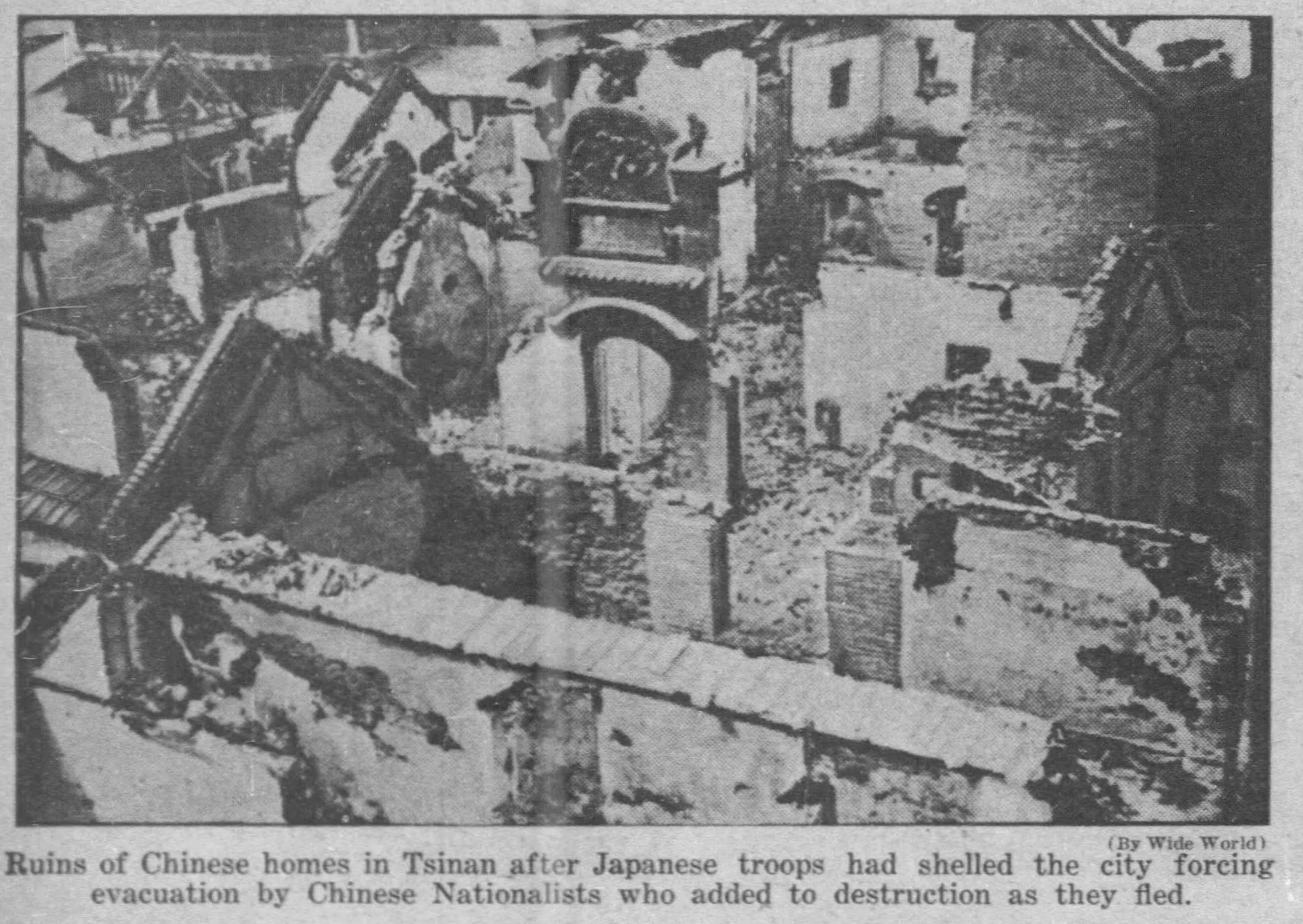
In May 1928 the Nationalist army of the Northern Expedition entered Jinan, Shandong, where Japanese troops had been sent to protect Japanese residents. Fighting broke out on 3 May, and that night the Nationalist negotiation commissioner Cai Gongshi and his staff were killed by Japanese soldiers in their office. Chiang Kai-shek withdrew his main force and bypassed the city; after an ultimatum the Japanese launched a general assault on 8 May and took the walled city on 11 May. Chinese casualties ran into the thousands, with estimates varying. The incident fuelled a wave of anti-Japanese protest; after nearly a year of negotiation the two governments signed a settlement in March 1929, and Japanese troops left Shandong that May.
Japan’s Second Shandong Expedition
When the Nationalist army entered Shandong during the Northern Expedition in May 1927, Japan sent some 2,000 troops to protect its nationals and withdrew them in the autumn without serious damage to Sino-Japanese relations. In April 1928 the Nationalists renewed their offensive in southern Shandong and Zhang Zongchang’s forces fell back. On 20 April the Tanaka Giichi cabinet announced that about 5,000 soldiers would be sent from Japan via Qingdao to the Jiaozhou–Jinan railway zone to protect Japanese residents, with three companies from the China garrison in Tianjin sent to Jinan in the meantime, calling this “an unavoidable measure of self-protection” that implied no unfriendly intention and no interference with either side’s military operations. Japanese histories call it the second Shandong expedition. About 2,000 Japanese lived in Jinan; Lieutenant General Fukuda Hikosuke, commander of the 6th Division, soon moved his troops there from Qingdao.
The Clash of 3 May
According to the American legation, large numbers of Nationalist troops followed the retreating Northern soldiers into the walled city of Jinan and the parts of the foreign settlement not enclosed by Japanese barricades on 1–2 May. The Japanese, then numbering about 3,000, had sealed off two areas of the settlement with sandbags and barbed wire; Nationalist troops in the settlement at one point numbered 10,000. The Italian historian Andrea Revelant writes that on 2 May Fukuda, in response to Chiang Kai-shek’s pledge to maintain order, agreed to clear part of the occupied area; according to the American legation, the Japanese had removed a large portion of their barricades on the assumption that an amicable arrangement had been reached. Chiang himself was in Jinan.
At about 10 a.m. on 3 May Japanese and Nationalist troops clashed. The American consul at Jinan, Ernest Price, reported the next day that the precise cause was unknown; general firing followed, the Japanese sent out armoured cars and detachments to clear the settlement of Southern troops and used field artillery, destroying the Chinese wireless station, and fighting went on intensely until 6 p.m. and intermittently through the night. Accounts of the first shot differ: the Japanese War Ministry said Chinese soldiers looting in the protected area had fired on a Japanese patrol that tried to stop them; the Ōbunsha Dictionary of Japanese History says Japanese troops shot a Nationalist soldier who crossed the boundary of the guarded zone; the American legation called it “the isolated and not definitely determined incident which resulted in the firing of the first shot.” That night Chiang’s representatives negotiated with the Japanese, the main result being that Nationalist troops would withdraw 20 li beyond the settlement.
The Killing of Cai Gongshi and His Staff
Cai Gongshi, head of the foreign affairs section of the Nationalist field political committee and fluent in Japanese, had been made the foreign ministry’s special negotiation commissioner for Shandong, responsible for dealing with the Japanese consulate in Jinan. He arrived on 2 May and on the morning of 3 May opened the Shandong negotiation office at Jingsi Road and Xiaowei Sixth Road in the commercial district. According to commemorative accounts from Jiujiang and Jinan, some twenty Japanese soldiers forced their way in that afternoon, saying a Japanese body had been found outside, and seized the staff’s firearms; at 9 p.m. more than fifty soldiers entered, cut the lights and tied up Cai and his staff. According to “An Account of Cai Gongshi’s Martyrdom” by the orderly Zhang Hanru, the only survivor, Cai’s ears and nose were cut off and his eyes gouged out before he and his staff were shot; their bodies were burned and buried in the courtyard. The Xinhua Daily, as reprinted by People’s Daily Online, gives the dead as 17 Nationalist diplomatic staff; the Jiujiang account as Cai and 16 staff. A CCP circular of 9 May added that Japanese troops searched the office of Foreign Minister Huang Fu, who fled in haste.
Revelant notes that Japan’s Asahi and Mainichi newspapers largely ignored the killing of the negotiators by Japanese soldiers; when the Nanjing government denounced it, the Asahi dismissed it as “risible” propaganda. The former negotiation office, at 370 Jingsi Road, opened as the Cai Gongshi Memorial Hall in 2012.
Fukuda’s Ultimatum and the Battle for the Walled City
On 4 May Chiang told the American and British consuls he was ready to meet the Japanese commander at any neutral consulate; the message was passed to the Japanese, who did not reply. On 5 May Chiang left Jinan, writing to Fukuda that he had ordered all subordinate offices to withdraw from the areas occupied and fortified by the Japanese and that his armies had left to continue northward, leaving only some units to keep order. Revelant puts the balance of forces at about 5,500 Japanese to 35,000 Nationalists; Chiang had no wish to be bogged down in a fight that would delay his advance and left with most of his troops after a cease-fire.
The Japanese regarded the Nationalist troops who remained, building gun emplacements and digging trenches, as a danger. On 7 May Fukuda sent Chiang a twelve-hour ultimatum demanding the punishment of the Nationalist officers involved in the clash, the disarming of their troops, an end to anti-Japanese propaganda and the withdrawal of Nationalist forces from a 20-li zone on either side of the Jiaozhou–Jinan railway. Revelant writes that the Japanese attacked despite a partial acceptance of these terms; the American consul reported that the Chinese troops in the city refused the only terms on which the Japanese would halt, namely surrender of their arms. The Japanese launched a general assault on 8 May; Japan also decided to send the Third Division (the third Shandong expedition), informing the United States on 9 May. About 5,000 Nationalist troops held the walled city until the morning of 11 May, when the Japanese took it. The main Nationalist force bypassed Jinan and continued north.
Casualty figures vary. Japanese reference works put Chinese casualties at about 5,000, mostly civilians; a survey by the association of victims’ families reported 6,123 Chinese soldiers and civilians killed, more than 1,700 wounded and property losses of 29.57 million yuan, the figure used by mainland official media; the CCP circular of 9 May spoke of more than a thousand killed or wounded. On the Japanese side, newspapers initially reported, on unconfirmed information, that over one hundred or 280 residents had been massacred; the consular police finally reported about 14 dead and more than 20 missing. Hallett Abend of the New York Times wrote from Jinan that apart from corpses not a Chinese could be seen on the streets. Shuncheng Street by the city moat was destroyed and later renamed May Third Street.
Negotiation and Withdrawal
By the American legation’s count Japan sent some 20,000 troops to Shandong within a few weeks. Each side accused the other of premeditation, and both submitted statements to the League of Nations. On 18 July Tanaka told the representatives of Britain, France, Italy and the United States that Japan had no intention of occupying Shandong, that the attack on Jinan had been precipitated by undisciplined Southern troops, and that Japan would seek an apology from the Nationalist Government, punishment of those responsible, compensation for Japanese residents and guarantees of future security. Between 16 and 28 July Japan withdrew 5,700 men from Shandong, leaving about 13,200 in Qingdao, Jinan and the railway zone.
Foreign Minister Wang Zhengting then negotiated with the Japanese consul general in Shanghai, Yada, over the Jinan, Nanjing and Hankou cases and treaty revision; the talks broke off at the end of October, and in November the State Council insisted that a date for the Japanese evacuation of Shandong be fixed first, suspending the talks, while the anti-Japanese boycott intensified. On 28 March 1929 the two governments signed a settlement expressing deep regret for the incident and referring compensation for both sides to a joint committee; Japanese troops left Shandong that May.
Differing Accounts
The Japanese government’s position at the time was that undisciplined Southern soldiers had started the incident, that the whole responsibility lay with China, and that its troops were there only to protect residents. Japanese reference works today generally record that Japan sent troops in the name of protecting residents, that its bombardment caused heavy casualties among civilians, and that Chinese opinion saw this as going beyond the protection of residents. The American legation judged at the time that both sides’ claims of premeditation were mistaken and that Japan’s presentations were “more restrained and credible than the Nationalist versions.”
Mainland official media say the Japanese used the protection of nationals as a pretext, attacked suddenly and killed 6,123 Chinese soldiers and civilians. The CCP’s circular at the time condemned the Japanese killings while attacking Chiang for not daring to resist and for banning anti-Japanese propaganda. Revelant argues that the incident convinced Chiang that Japan was the greatest threat to China’s future and set a precedent for those in Japan who favoured military force to assert national interests on the continent.
Gallery
Narrative Comparison
| Source | Narrative |
|---|---|
| Xinhua Daily (via the CPC News site, 2014) | Mainland official media say that during the Nanjing government’s second Northern Expedition in 1928 “the Japanese aggressors sent troops into Shandong on the pretext of protecting their nationals,” and on 3 May “suddenly attacked the Northern Expedition army on a large scale, killing 6,123 of our soldiers and civilians,” cutting off the ears and nose of the negotiator Cai Gongshi in violation of international practice and killing 17 Nationalist diplomatic staff; Shuncheng Street was destroyed and later renamed May Third Street. |
| Japanese government statement of April 1928, memorandum of July and Tanaka’s remarks (via FRUS) | The Japanese government called the expedition “an unavoidable measure of self-protection” to protect residents, with no interference in China’s civil war. Afterwards it said it deeply regretted the incident but that, “as it was perpetrated by the undisciplined soldiers belonging to the Southern Army, the whole responsibility for it must be said to rest with the Chinese,” and demanded an apology, punishment of those responsible, compensation and guarantees, while insisting it had no intention of occupying Shandong. |
| U.S. legation and Tsinan consulate reports (FRUS 1928) | The American consul at Jinan reported that the precise cause of the clash was unknown. The legation judged that congestion in the settlement made “the isolated and not definitely determined incident which resulted in the firing of the first shot” more or less inevitable, that both sides’ claims of premeditation were “it is felt erroneously” made, and that Japan’s presentations were “more restrained and credible than the Nationalist versions.” The consul also reported that Chiang had offered to negotiate at a neutral consulate and the Japanese commander did not reply. |
| Andrea Revelant, “Revolution Deconstructed” (Ca’ Foscari, 2018) | The Italian historian Andrea Revelant sees the fighting as escalating from a minor incident; Chiang agreed a cease-fire and left, but “the Japanese command was not conciliatory,” and Fukuda sent “an ultimatum with humiliating conditions,” attacking despite a partial acceptance. He notes that Japan’s main newspapers largely ignored the killing of the negotiators, the Asahi dismissing Nanjing’s protest as “risible” propaganda, and argues that the incident convinced Chiang that Japan was the greatest threat while setting a precedent for advocates of military force in Japan. |
Key Milestones
- Japan announces second Shandong expedition
The Tanaka cabinet announces about 5,000 troops will be sent via Qingdao to the Jiaozhou–Jinan railway zone to protect residents.
- Nationalist troops enter Jinan
Zhang Zongchang’s forces withdraw and Nationalist troops enter the city and settlement.
- Clash in Jinan; Cai Gongshi killed
Fighting breaks out at about 10 a.m.; that night the negotiator Cai Gongshi and his staff are killed by Japanese troops in the negotiation office.
- Chiang Kai-shek leaves Jinan
Chiang writes to Fukuda that his forces are withdrawing and leaves with most of his troops to continue north.
- Fukuda’s ultimatum
Fukuda sends Chiang a twelve-hour ultimatum demanding punishment of officers, disarmament and withdrawal 20 li from the railway.
- Japanese general assault
The Japanese launch a general assault on the walled city; Japan also decides to send the Third Division.
- Japanese occupy Jinan
About 5,000 Nationalist defenders leave and the Japanese occupy the walled city.
- Tanaka sets terms for settlement
Tanaka demands an apology, punishment, compensation and guarantees from the Nationalist Government.
- Settlement signed
The two governments express deep regret and refer compensation to a joint committee.
- Japanese troops leave Shandong
Japanese troops withdraw from Shandong under the settlement.
Last verified:
Cite this page
Chronicles of Modern China. (2026, November 9). The Jinan Incident (May Third Tragedy). Retrieved November 9, 2026, from https://www.cmcarchive.org/events/jinan-incident-1928
“The Jinan Incident (May Third Tragedy).” Chronicles of Modern China. Last modified November 9, 2026. Accessed November 9, 2026. https://www.cmcarchive.org/events/jinan-incident-1928.
Chronicles of Modern China. The Jinan Incident (May Third Tragedy)[EB/OL]. (2026-11-09)[2026-11-09]. https://www.cmcarchive.org/events/jinan-incident-1928.