The Twenty-One Demands
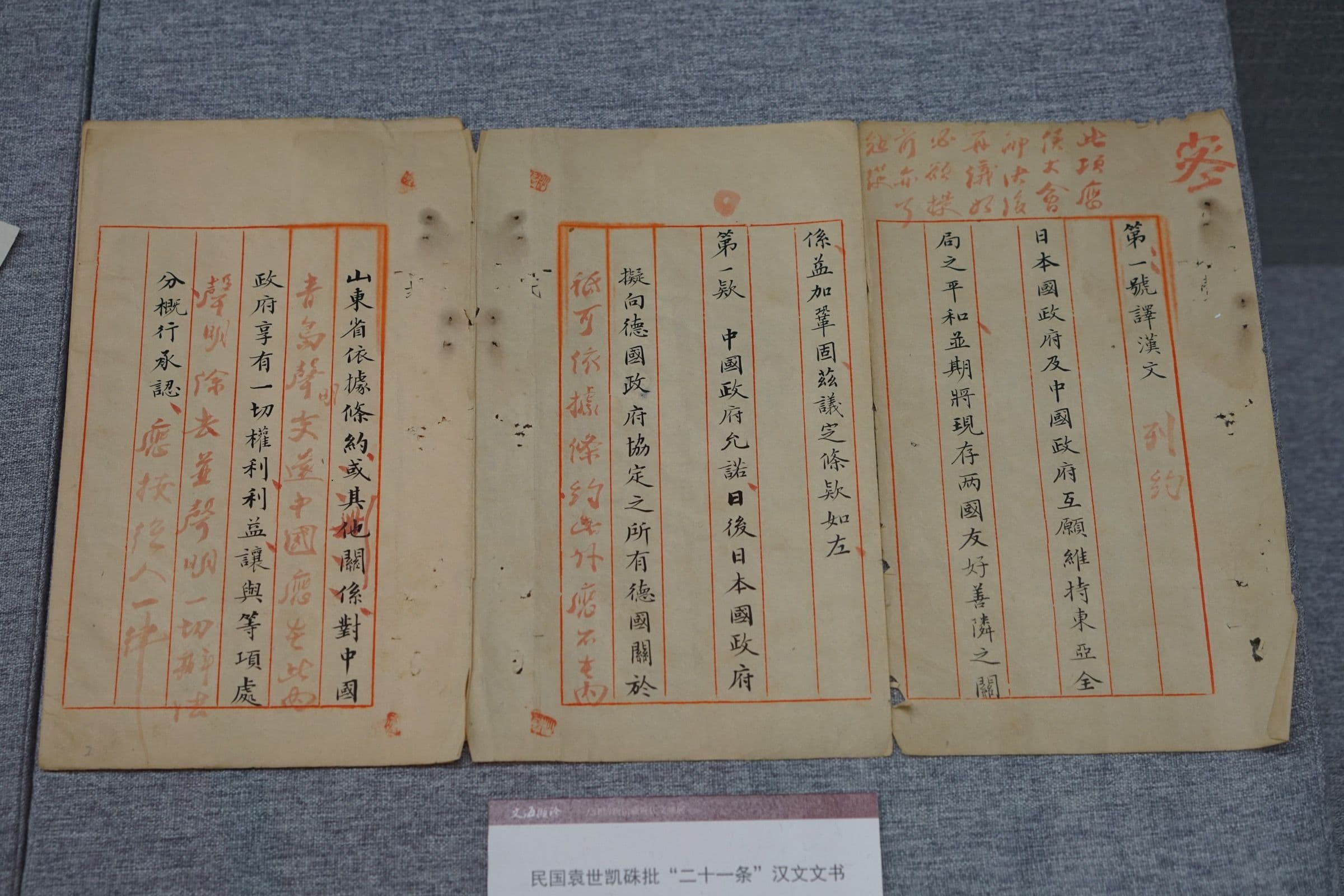
On 18 January 1915 the Japanese government of Ōkuma Shigenobu, through its minister Hioki Eki, presented Yuan Shikai with twenty-one demands in five groups concerning Shandong, South Manchuria and eastern Inner Mongolia, the Hanyeping company, China’s coastal islands and the employment of Japanese advisers in the central government. After four months of negotiation Japan issued an ultimatum on 7 May that postponed most of Group 5; China accepted on 9 May, and the two sides signed treaties on 25 May. Many Chinese came to mark 9 May as National Humiliation Day, and historians still disagree about how the Yuan government handled the negotiations.
The Manchuria Question and Japan’s Entry into the War
After the Russo-Japanese War Japan took over Russia’s leasehold on the Liaodong Peninsula and the South Manchuria Railway, but these rights were time-limited: the Liaodong lease was due to expire in 1923 and the railway in 1939. According to the Japanese historian Sōchi Naraoka, extending these terms was a major outstanding problem for Japanese diplomacy, and one that Katō Takaaki, who became foreign minister in Ōkuma Shigenobu’s cabinet in 1914, took especially seriously. On 23 August 1914 Japan declared war on Germany, citing the Anglo-Japanese Alliance, and then occupied the German leasehold around Jiaozhou Bay in Shandong. Naraoka argues that Katō’s “foremost objective was to use the return of the newly acquired German interests on the Shandong Peninsula as a bargaining chip” to settle the Manchuria question, while the “expansion fever” that swept Japan after the outbreak of war led the Foreign Ministry to pile every pending issue into the list.
The Demands Presented
On 18 January 1915 the Japanese minister in Beijing, Hioki Eki, handed Yuan Shikai a list of demands, “pledging the President and Ministers of State not to divulge the character of the demands to other Powers on pain of serious consequences to China.” The list had five groups and twenty-one articles. Group 1 required China to accept whatever disposition Japan agreed with Germany concerning German rights in Shandong; Group 2 extended the Port Arthur–Dalian lease and the South Manchuria and Andong–Mukden railways to 99 years and gave Japanese subjects rights to lease land, reside and mine in South Manchuria and eastern Inner Mongolia; Group 3 would make the Hanyeping company a joint enterprise; Group 4 barred China from ceding or leasing any coastal harbour or island to another power; and Group 5 required the central government to employ influential Japanese as political, financial and military advisers, called for jointly administered police in certain places, and covered arms purchases, railways in the Yangzi valley, Fujian province and missionary rights. The American minister, Paul Reinsch, reported on 24 January that the demands were recognised in Beijing as “the greatest crisis yet experienced in China.”
The Negotiations
Foreign Minister Lu Zhengxiang and Vice-Minister Cao Rulin led the talks for China. The memorandum Japan gave the United States and other powers on 8 February listed only Groups 1–4, omitting Group 5; the Chinese government then instructed its ministers abroad to pass the full text of the 18 January demands confidentially to the governments concerned. On 22 February Japan supplied a supplementary memorandum, and Katō told the American ambassador that these matters had been presented to China only as “requests” or wishes. Naraoka judges that “Tokyo’s attempt initially to keep the Group 5 demands secret from the Western Powers played a major role in hardening the attitude of Britain and the United States,” and that “by skillfully leaking information regarding the talks to the public at home and abroad, the Yuan administration succeeded in fomenting domestic public opinion against Japan and increasing the Western Powers’ wariness toward Tokyo.”
The United States was at first restrained. In a note of 13 March Secretary of State William Jennings Bryan wrote that the “United States frankly recognizes that territorial contiguity creates special relations between Japan and these districts,” raising no question for the time being about the articles on Shandong and South Manchuria, but stating that the Group 5 provisions on purchasing arms from Japan and on Fukien would, if put into effect, violate the principle of equal opportunity for other nations. In mid-March Beijing was informed that Japan’s second squadron had sailed with 30,000 men for Manchuria, Tianjin, Shandong and Hankou. On 26 April Japan tabled revised demands: those on Manchuria and Shandong were unchanged, and Group 5 was formally withdrawn but was to be dealt with separately by note.
Ultimatum and Acceptance
On the afternoon of 7 May Hioki handed the Foreign Minister an ultimatum requiring a categorical reply to a further revised set of demands by 6 p.m. on 9 May; all of the original Group 5 except the article on Fujian was marked “discussion postponed.” On 9 May the Chinese government accepted. On 11 May Bryan notified Japan that the United States “cannot recognize any agreement or undertaking which has been entered into or which may be entered into between the Governments of Japan and China, impairing the treaty rights of the United States and its citizens in China, the political or territorial integrity of the Republic of China, or the international policy relative to China commonly known as the open door policy”; an identical note went to China. On 14 May Yuan issued a secret instruction to officials describing China as fish on Japan’s chopping board and urging that the nation could survive only by strengthening itself.
On 25 May the two governments signed a treaty on South Manchuria and eastern Inner Mongolia, a treaty on Shandong and a series of exchanges of notes. The Port Arthur–Dalian lease and the South Manchuria and Andong–Mukden railway terms were extended to 99 years, the notes fixing expiry of the lease in 1997 and of the South Manchuria Railway in 2002. On Jiaozhou Bay, Japan declared that once the leasehold came under its free disposal after the war it would restore it to China on certain conditions.
Boycotts and National Humiliation Day
As news of the demands spread, protest meetings were held in Shanghai and elsewhere, a boycott of Japanese goods and a national salvation savings movement were launched, and many Chinese students in Japan returned home. Naraoka calls it “the first time that such large-scale and organized anti-Japanese protests had happened.” After China accepted the demands, some killed themselves in protest, such as the Baoding military cadet He Guanglie. The National Education Association designated 9 May as National Humiliation Day for schools, while many northern groups marked 7 May; according to the historian Peng Nansheng, those who commemorated 7 May blamed Japan, while those who chose 9 May blamed the Yuan government for accepting. The commemorations continued year after year, and Naraoka sees the May Fourth Movement of 1919 as the eruption of this nationalism.
Differing Views of the Negotiations and of Yuan Shikai
Mainstream accounts in mainland China treat the demands as the starting point of Japan’s aggression against China—one 2013 academic article describes them as “aimed at subjugating China” and the 1915 agreements as “traitorous treaties” accepted by Yuan—and some earlier historians held that Yuan made concessions to win Japanese support for his imperial ambitions. Tang Chi-hua of National Chengchi University in Taiwan, drawing on British and Japanese diplomatic archives, argues instead that Yuan refused from the outset to yield on Group 5 and that Japanese records treat the negotiations as a failure; the resulting treaty was humiliating, but Japan did not achieve all its aims. Naraoka concludes that “militarily weak, the Yuan government had no choice but to concede, but it had resisted Japan using all the powers it had,” attributing the disorder of the talks to agitated Japanese opinion, Katō’s clumsy leadership and skilful Chinese resistance. He also cites the former Japanese Air Self-Defense Force chief of staff Tamogami Toshio, who has argued that compared with the colonial practices of the great powers at the time “there was nothing terribly unusual” about the demands.
Gallery
Narrative Comparison
| Source | Narrative |
|---|---|
| Statements by Ōkuma Shigenobu and Katō Takaaki to the U.S. ambassador (1915, FRUS) | Prime Minister Ōkuma told the American ambassador in February that “Japan’s interest in China was to preserve peace and China’s territorial integrity” and that Japan intended to adhere to the open door and equal opportunity. Foreign Minister Katō explained that the list given to the powers contained the “demands” on which Japan would insist, while Group 5 and other matters had been presented to China only as “requests” or wishes for friendly consideration. |
| Minister Reinsch’s dispatches and Secretary Bryan’s notes (1915) | Minister Reinsch called the demands “the greatest crisis yet experienced in China.” Bryan’s March note stated that the “United States frankly recognizes that territorial contiguity creates special relations between Japan and these districts” while objecting that the Group 5 articles on arms purchases and Fukien violated equal opportunity; after China accepted the ultimatum, he declared on 11 May that the United States “cannot recognize any agreement or undertaking” impairing its treaty rights, China’s political or territorial integrity, or the open door policy. |
| Tang Chi-hua, National Chengchi University (2011 interview) | Drawing on British and Japanese diplomatic archives, Tang argues that the old view that Yuan sold out to Japan to become emperor is the reverse of the truth: Yuan declared from the start that Group 5 could never be conceded, and his negotiators endured four months of torment and humiliation; in Japanese records the talks were a failure. The resulting treaty, he adds, was still one that forfeited sovereignty and humiliated the nation, but Japan’s aim of subjugating China was not achieved. |
| Sōchi Naraoka (Springer, open access) | The Japanese historian Sōchi Naraoka traces the demands to the problem of the Manchurian leaseholds, with Katō seeking to trade the return of Shandong for concessions in Manchuria; the disorder of the talks stemmed from agitated Japanese opinion, Katō’s clumsy leadership and skilful Chinese resistance. “Militarily weak, the Yuan government had no choice but to concede, but it had resisted Japan using all the powers it had.” Japan achieved its objectives at the cost of a vigorous anti-Japanese movement in China and deepened Western mistrust, making the demands a source of later conflict. |
Key Milestones
- Japan declares war on Germany
Citing the Anglo-Japanese Alliance, Japan entered the war and went on to occupy the German leasehold at Jiaozhou Bay in Shandong.
- Hioki presents the demands to Yuan Shikai
Japan pressed China not to divulge the demands to other powers.
- Japan gives the powers an abridged memorandum
The memorandum listed only Groups 1–4; a supplementary memorandum on the “requests” followed on 22 February.
- Bryan’s note to Japan
The United States acknowledged Japan’s special relations with the contiguous regions but held that the Group 5 articles on arms and Fukien violated equal opportunity.
- Japan tables revised demands
The Manchuria and Shandong demands were unchanged; Group 5 was formally withdrawn, to be handled separately.
- Japanese ultimatum
China was given until 6 p.m. on 9 May to reply; most of Group 5 was “postponed.”
- China accepts the ultimatum
The date later became National Humiliation Day.
- U.S. non-recognition note
The United States declared it would not recognise any Sino-Japanese agreement impairing its treaty rights, China’s integrity or the Open Door.
- Sino-Japanese treaties signed
Treaties on South Manchuria and eastern Inner Mongolia and on Shandong were signed, with a series of exchanges of notes.
Last verified:
Cite this page
Chronicles of Modern China. (2026, November 6). The Twenty-One Demands. Retrieved November 6, 2026, from https://www.cmcarchive.org/events/twenty-one-demands-1915
“The Twenty-One Demands.” Chronicles of Modern China. Last modified November 6, 2026. Accessed November 6, 2026. https://www.cmcarchive.org/events/twenty-one-demands-1915.
Chronicles of Modern China. The Twenty-One Demands[EB/OL]. (2026-11-06)[2026-11-06]. https://www.cmcarchive.org/events/twenty-one-demands-1915.