Founding of Manchukuo (1932)
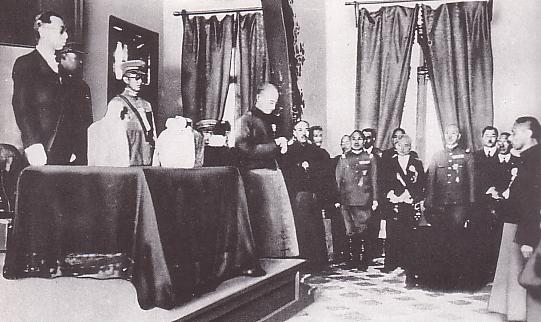
After the Mukden Incident the Kwantung Army resolved to set up a new regime in Northeast China headed by the deposed Qing emperor Puyi. In November 1931 Puyi left Tianjin’s Japanese concession under arrangements made by Doihara Kenji; on 18 February 1932 a Northeastern Administrative Committee under Zhang Jinghui declared independence from the Nationalist government, on 1 March it proclaimed “Manchukuo”, and on 9 March Puyi was installed as Chief Executive in Changchun. Puyi then wrote to the Kwantung Army commander handing defence, transport and official appointments to Japan. On 15 September Japan signed the Japan-Manchukuo Protocol, formally recognising the state and gaining the right to station troops. The Nationalist government, the United States and the League of Nations refused recognition, and the Lytton Report found the regime was not the product of a genuine and spontaneous independence movement; Japan then left the League. Mainland China calls it “Puppet Manchukuo”; the Japanese government of the time called it an act of self-determination.
The Kwantung Army’s Plans
After the Mukden Incident of 18 September 1931 the Kwantung Army swiftly occupied the Northeast. According to the Peking University historian Zang Yunhu, within days Kwantung Army staff officers Itagaki Seishiro and Ishiwara Kanji argued it out with Tatekawa Yoshitsugu, head of the General Staff’s operations bureau, and settled on the goal of “establishing an independent Manchu-Mongol state”. On 22 September the Kwantung Army adopted a plan for “establishing a Chinese regime supported by our country, with territory comprising the four northeastern provinces and Mongolia and with the Xuantong Emperor as head of state”, with its defence, foreign affairs, transport and communications in Japanese hands. A plan drafted by Ishiwara on 24 October spoke more plainly of an independent state cut off from China proper and “ruled on the surface by Chinese while we hold real power”.
The Japanese scholar Suzuki Sadami takes a different view. He writes that “Initially, the Japanese military had not planned to create a puppet state”, and credits Ugaki Kazushige, governor-general of Korea and a long-serving army minister, with bringing the Kwantung Army under control and masterminding the plan for an independent Manchurian state through orders to the army and the cabinet.
Puyi Leaves Tianjin
Puyi, the last Qing emperor, had lived in the Jing Garden in Tianjin’s Japanese concession since his expulsion from the Forbidden City in 1924. According to a 2014 article in the CPPCC Daily, on 3 November 1931 Doihara Kenji, sent by the Kwantung Army, visited him and said that “The Kwantung Army has no territorial ambitions; it only sincerely wishes to help the people of Manchuria build their own new state”; when Puyi asked whether the new state would be a republic or a monarchy, Doihara replied, “An empire, of course — there is no question about that.” Tianjin mayor Zhang Xueming, on the orders of Chiang Kai-shek and Zhang Xueliang, had the Jing Garden closely guarded.
Kuwashima Kazue, then Japanese consul general in Tianjin, recalled in 1955 that he had met Puyi about once a week before the incident and urged him, if he went to Manchuria, to go openly; Puyi assured him he would not flee at the instigation of others. Around 3 November, he wrote, two fruit baskets containing bombs were delivered to Puyi’s residence (the CPPCC Daily article dates this to 6 November), which he attributed to a plot by Doihara’s group. On the night of 8 November shooting broke out between Japanese troops and Chinese police on the concession boundary — the first Tianjin Incident. At the garrison commander’s residence Kuwashima found Doihara sitting there in civilian clothes, and “sensed from this that the Japanese side had arranged everything in advance”. On the evening of the 10th the garrison posted armed soldiers at street corners in the concession and stopped traffic; Kuwashima judged that “That night’s martial law was precisely the climax of a play staged to get Puyi out.”
According to the CPPCC Daily article, on the night of 10 November Doihara had Puyi taken to a wharf in the British concession; he slipped down the Hai River past Dagu, transferred to the Japanese steamer Awaji Maru and reached Yingkou, where Itagaki’s men met him. The next morning the Japanese police chief in Tianjin reported to Kuwashima that Puyi had escaped and his whereabouts were unknown. Puyi then lived at Port Arthur in the Kwantung Leased Territory. Zang writes that in late November Itagaki sent Kawashima Yoshiko to stir up another disturbance in Tianjin and used it to bring Puyi’s wife Wanrong to the Northeast as well.
The “Declaration of Independence”
As Japanese forces occupied the Northeast, provincial administrations were set up under Chinese officials cooperating with the Kwantung Army. The League of Nations Commission of Enquiry (the Lytton Commission) reported that the chief agency in bringing about independence was the Self-Government Guiding Board in Mukden, which reliable witnesses said had been organised and largely staffed by Japanese and functioned as an organ of the Fourth Department of Kwantung Army headquarters. In January 1932 Foreign Minister Yoshizawa Kenkichi told the American ambassador W. Cameron Forbes that the Chinese governors of Kirin, Heilungkiang and Jehol favoured an independent government and that “this was on Chinese initiative”; asked whether these men had been placed in power by the Japanese military, he gave a vague reply.
In February, Zang writes, the Kwantung Army held ten consecutive “state-founding staff conferences” to settle the questions of the founding. On 17 February the American consul general in Mukden, M. S. Myers, reported reason to believe that Japanese officials, with the knowledge and probably the sanction of high authorities, were “strongly urging the immediate establishment of the new state owing to the immediate visit of the League Commission and conditions at Shanghai”, while Chinese officials had agreed at a secret meeting to try to postpone it.
On 17 February Zhang Jinghui, Zang Shiyi, Xi Qia, Ma Zhanshan and others formed the Northeastern Administrative Committee in Mukden, with Zhang as chairman. According to the Lytton Report, the Kwantung Army commander gave a dinner that night in honour of the “Heads of the new State” and assured them of his assistance in case of need. On 18 February the committee issued a declaration of independence severing the provinces from the Nanjing government. Myers reported the next day that “the program which was carried out during the last few days was prepared and dictated by the Japanese military.” The committee then decided on a republic, invited Puyi to become Chief Executive, and chose Changchun as capital and Datong as the era name. On 23 February the Chinese Foreign Ministry declared that the Three Eastern Provinces were part of China, that the Japanese authorities were trying to compel Chinese citizens to join a puppet organisation, and that it would not recognise the secession of the provinces or any administration set up there without its consent.
The Founding and Puyi’s Installation
According to the CPPCC Daily article, on 22 February Itagaki told Puyi that “This is not a restoration of the Great Qing Empire; this is a new state”, whose head would bear the title of Chief Executive. Puyi insisted on keeping the imperial title and the two argued for more than three hours. Itagaki then had Zheng Xiaoxu and Luo Zhenyu pass on the message: “The army’s demands cannot be changed. If they are not accepted, this can only be regarded as a state of hostility, and the answer will be the means used against an enemy.” Puyi finally proposed to serve “Only provisionally, for one year; if the monarchy is not restored by then, I will abdicate”, and Itagaki agreed. The Lytton Report records that Puyi at first declined the committee’s invitation, but on 4 March a second delegation of twenty-nine obtained his consent “to accept the post for one year only”.
On 1 March the committee proclaimed “Manchukuo” in a founding declaration. Reviewing warlord rule in the Northeast since the 1911 Revolution, it declared “our separation from the Republic of China” and promised equal treatment for all peoples and “the open door and equal opportunity in practice”. Suzuki notes that “there was no mention of Puyi, or indeed who would be the head of state, in the founding announcement”, and argues that the Kwantung Army needed the appearance of a Manchukuo state before the Lytton Commission arrived.
On 9 March Puyi was installed as Chief Executive in an old circuit intendant’s yamen in Changchun, which was soon renamed Xinjing (Hsinking). The American consul general at Harbin declined an invitation to the ceremony on the grounds that Changchun lay outside his district and he had no instructions, adding that “The attitude of my consular colleagues except the Japanese is the same as mine”; he reported that “Pu Yi is butt of many jokes among Russians and Chinese who realize his inauguration is a farce.” On 12 March Hsieh Chieh-shih (Xie Jieshi), Manchukuo’s foreign minister, cabled the U.S. Secretary of State announcing the new state and requesting formal diplomatic relations.
According to Zang, on 10 March, under Itagaki’s pressure, Puyi wrote to Kwantung Army commander Honjo Shigeru entrusting defence and public order to Japan at Manchukuo’s expense, placing railways, ports, waterways and aviation under Japan or bodies it designated, and agreeing to appoint Japanese as councillors and as central and local officials; on 12 May Honjo replied, “We have no objection.” The exchange became known as the “Japan-Manchukuo secret pact”. Myers reported on 18 March that Japanese held key posts in every department and that “The Japanese advisers, it has been noted, have already adopted Chinese dress”; in his view the dictator was not Puyi but General Honjo. The Lytton Report likewise noted that while the premier and ministers were Chinese, the heads of the Boards of General Affairs, “which, in the organisation of the new State, exercise the greatest measure of actual power, are Japanese”.
Japanese Recognition and the Protocol
On 15 May 1932 Prime Minister Inukai Tsuyoshi was assassinated in the May 15 Incident and Saito Makoto formed a cabinet. On 25 August Foreign Minister Uchida Kosai told the Diet that to solve the Manchuria-Mongolia question Japan was “united as a nation, determined to carry this through even if the country is reduced to scorched earth” — the so-called “scorched-earth diplomacy”. On 13 September the Privy Council, with the emperor present, approved the protocol in just 1 hour 35 minutes.
On 15 September Kwantung Army commander Muto Nobuyoshi, as ambassador plenipotentiary, and Manchukuo premier Zheng Xiaoxu signed the Japan-Manchukuo Protocol in Hsinking, formally recognising the state. Its preamble stated that Manchukuo, “in accordance with the free will of its inhabitants, has organized and established itself as an independent territory”; Manchukuo was to confirm all Japanese rights and interests under Sino-Japanese treaties and agreements; the two would cooperate in defence, with “such Japanese forces as may be necessary for this purpose” stationed in Manchukuo; and in case of differences of interpretation “the Japanese text shall prevail”. Uchida’s accompanying statement invoked Japanese self-defence and Manchukuo’s self-determination and disclaimed any territorial designs.
Ambassador Joseph Grew observed that the second article bore “a striking resemblance in intent (although not in phraseology) to the fourth article of the Japan-Korea Protocol of February 23, 1904”, and that the protocol was reported to be accompanied by a secret military agreement. Lieutenant Brown, an American who witnessed the signing in Changchun, reported “Japanese forces practically directing all activities” and a city that “resembled armed camp”, with the Chinese populace showing no interest. On 16 September the Chinese government protested to Japan that it had seized Manchuria and set up “the puppet organization entitled Manchukuo with Pu Yi posing as its head”.
International Non-Recognition
As early as 7 January 1932, Secretary of State Henry Stimson had notified China and Japan that the United States would not recognise any treaty or agreement impairing American treaty rights, including those relating to China’s sovereignty, independence or territorial and administrative integrity, nor “any situation, treaty or agreement which may be brought about by means contrary to the covenants and obligations of the Pact of Paris” — the Stimson Doctrine. On 11 March the League Assembly resolved that members should not recognise any situation, treaty or agreement brought about by means contrary to the Covenant or the Pact of Paris.
The Lytton Report, published on 2 October, found that the two decisive factors in creating “Manchukuo” were the presence of Japanese troops and the activities of Japanese officials, without which the state could not have been formed, so that “the present regime cannot be considered to have been called into existence by a genuine and spontaneous independence movement”; it also concluded that the local Chinese regarded the government as “an instrument of the Japanese”. On 24 February 1933 a special League Assembly adopted a report based on it by 42 votes to 1 (Japan), and Japanese delegate Matsuoka Yosuke walked out; on 27 March Japan gave notice of withdrawal from the League. Puyi did not step down after his year as Chief Executive; in 1934 Manchukuo became a monarchy with Puyi as emperor.
Differing Accounts
In mainland China the state is called “Puppet Manchukuo” (Wei Manzhouguo) and regarded as a puppet regime set up by Japan. Zang argues that creating and recognising Manchukuo was the end result of the Mukden Incident and that Japan ruled the Northeast indirectly — Puyi was “Chief Executive” on the surface while the Kwantung Army was its “overlord”; he adds that Manchukuo has been seen as “a monstrosity and a malignant tumour in China’s modern history of more than a century”. The Nationalist government of the time likewise called it a puppet organisation of Japan’s making.
The Japanese government of 1932 cited self-determination, describing Manchukuo as an independent state founded by the free will of its inhabitants on Chinese initiative. The Japanese scholar Suzuki Sadami titled a 2023 essay “Manchukuo: Imperial Japan’s Puppet State” and wrote that its history “shows us a tragic confusion of disregard for human rights alongside a form of multiculturalism”. The Western historian Thomas DuBois argues that “Although Manchukuo is easily dismissed as a puppet of Japan, at the time of its founding, it was one of many examples of a partially sovereign state”; without denying Japan’s deliberate attempt to misrepresent its independence, he examines how its limited sovereignty crippled its legal institutions.
Gallery
Narrative Comparison
| Source | Narrative |
|---|---|
| CPPCC Daily (2014); Zang Yunhu, Social Science Journal (2021) | Mainland China calls it “Puppet Manchukuo”, a regime set up by Japan after the Mukden Incident. Zang Yunhu notes that the Kwantung Army fixed on “establishing an independent Manchu-Mongol state” right after the incident and settled the founding at ten “state-founding staff conferences” in February 1932; after his installation Puyi was coerced into an exchange of letters with Honjo handing defence, transport and appointments to Japan — the “Japan-Manchukuo secret pact” — so that on the surface Puyi was “Chief Executive”, while the Kwantung Army became its “overlord”. The CPPCC Daily stresses that Puyi himself sought a restoration, went north after Doihara promised “An empire, of course”, and accepted the lesser title after Itagaki threatened “the means used against an enemy”. |
| Chinese Foreign Ministry statement (23 February 1932) and Chinese note to Japan (16 September 1932) | The Nationalist government of the Republic of China never recognised Manchukuo. On 23 February 1932 its Foreign Ministry declared that the Three Eastern Provinces “are always an integral part of China”, that the Japanese authorities were trying “to compel the Chinese citizens to participate in the puppet organization”, and that it would not recognise their secession or any administration organised there without its consent. After Japan’s recognition, its note of 16 September charged that Japan had set up “the puppet organization entitled Manchukuo with Pu Yi posing as its head, but with every vestige of power resting in the hands of the Japanese”, and called recognition “a headlong step”. |
| Foreign Minister Yoshizawa (January 1932), the Japan-Manchukuo Protocol and Foreign Minister Uchida’s statement (September 1932), via FRUS | The Japanese government of the time presented Manchukuo as a state founded by the Chinese themselves. In January 1932 Foreign Minister Yoshizawa told the American ambassador that the Chinese governors favoured an independent government and that “this was on Chinese initiative”. The protocol’s preamble declared that Manchukuo, “in accordance with the free will of its inhabitants, has organized and established itself as an independent territory”, and provided for Japanese troops to be stationed there for common defence. Uchida’s statement on the signing invoked “self-defensive measures taken by Japan and of self-determination by Manchukuo”, disclaimed territorial designs, and expected the powers soon to establish relations with Manchukuo. |
| The Stimson note (7 January 1932) and reports from U.S. posts in Mukden, Harbin and Tokyo | The United States announced non-recognition before Manchukuo existed: the Stimson note of 7 January 1932 refused to recognise “any situation, treaty or agreement which may be brought about by means contrary to the covenants and obligations of the Pact of Paris”. American consuls in the Northeast saw the founding as a Japanese arrangement: Myers in Mukden reported Japanese officials “strongly urging the immediate establishment of the new state” before the League Commission arrived, that the independence programme “was prepared and dictated by the Japanese military”, and that the real dictator was “General Honjo, Commander-in-Chief of the Kuantung Army”; the consul at Harbin declined the inauguration and reported it was seen as “a farce”. Ambassador Grew saw “a striking resemblance” between the protocol and the 1904 Japan-Korea Protocol. |
| Thomas DuBois, Journal of Asian Studies (2010), abstract | DuBois argues that “Although Manchukuo is easily dismissed as a puppet of Japan, at the time of its founding, it was one of many examples of a partially sovereign state.” Without “denying the deliberate attempt made by Japan to misrepresent the independence of Manchukuo”, he examines how its architects assumed limits to its sovereignty: Japan controlled the staffing and ideology of its judiciary, and with the outbreak of war Manchukuo “effectively surrendered its national sovereignty to the needs of the Japanese empire”, a limited sovereignty that “systematically crippled the new state's legal institutions”. |
| Memoir of Kuwashima Kazue, then Japanese consul general in Tianjin (1955) | Kuwashima was the Japanese consul general in Tianjin when Puyi left. He recalled urging Puyi to go openly if he went to Manchuria, since slipping away would not win the world’s sympathy, and Puyi promising not to flee at others’ instigation. But he believed the bombs sent to Puyi’s house, the shooting on the concession boundary and the garrison’s martial law were all the work of Doihara’s group: “That night’s martial law was precisely the climax of a play staged to get Puyi out.” On the morning of 11 November the police chief reported, “Last night the Xuantong Emperor escaped and his whereabouts are unknown.” Puyi, he concluded, had kept even the empress in the dark and escaped alone “exactly according to the script written by the Tianjin garrison and Doihara’s group”. |
Key Milestones
- Kwantung Army plan for a new regime
The Kwantung Army adopts a plan for a regime headed by the Xuantong Emperor.
- Doihara meets Puyi
Doihara visits Puyi at the Jing Garden in Tianjin and urges him to go to the Northeast.
- First Tianjin Incident
Shooting erupts on the Japanese concession boundary; the garrison imposes martial law.
- Puyi leaves Tianjin
Puyi sails via Dagu to Yingkou and then lives at Port Arthur.
- Stimson note
The United States declares it will not recognise any situation brought about contrary to the Pact of Paris.
- Declaration of independence
The Northeastern Administrative Committee declares the provinces independent of Nanjing.
- Nanjing refuses recognition
The Chinese Foreign Ministry declares it will not recognise the secession of the Northeast.
- Manchukuo proclaimed
The committee issues the founding declaration of Manchukuo.
- Puyi installed as Chief Executive
Puyi is installed in Changchun, soon renamed Xinjing.
- Puyi’s letter to Honjo
Puyi agrees to entrust defence and transport to Japan and to appoint Japanese officials.
- Japan-Manchukuo Protocol
Japan formally recognises Manchukuo and gains the right to station troops.
- Lytton Report published
The report finds Manchukuo was not the product of a genuine independence movement.
- League adopts report
A special League Assembly adopts the report 42 to 1; the Japanese delegation walks out.
- Japan leaves the League
Japan gives notice of withdrawal from the League of Nations.
- Monarchy proclaimed
Manchukuo becomes a monarchy with Puyi as emperor.
Last verified:
Cite this page
Chronicles of Modern China. (2026, November 24). Founding of Manchukuo (1932). Retrieved November 24, 2026, from https://www.cmcarchive.org/events/founding-of-manchukuo-1932
“Founding of Manchukuo (1932).” Chronicles of Modern China. Last modified November 24, 2026. Accessed November 24, 2026. https://www.cmcarchive.org/events/founding-of-manchukuo-1932.
Chronicles of Modern China. Founding of Manchukuo (1932)[EB/OL]. (2026-11-24)[2026-11-24]. https://www.cmcarchive.org/events/founding-of-manchukuo-1932.