January 28 Incident (Shanghai, 1932)
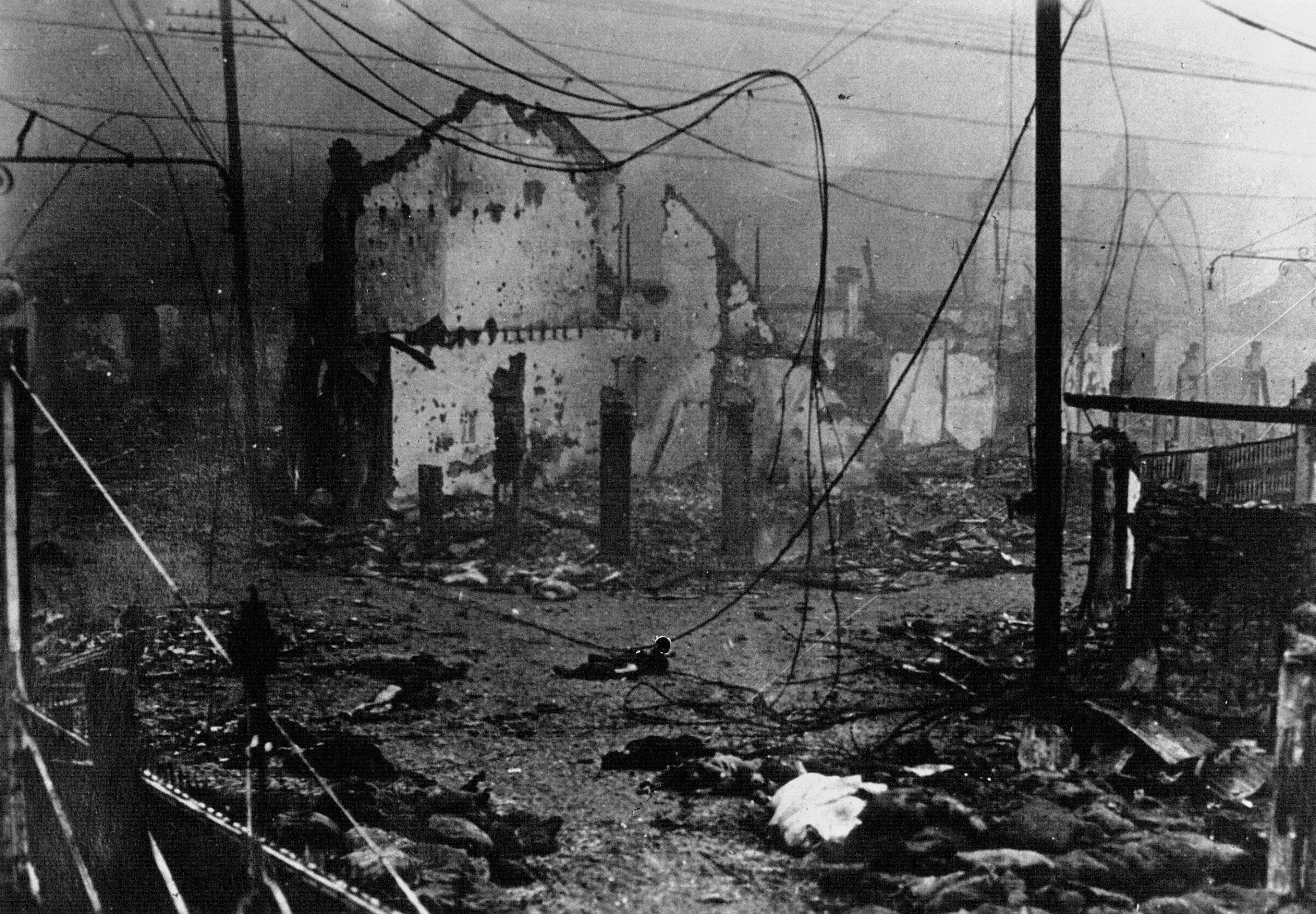
On the night of 28 January 1932 Japanese marines attacked Chinese troops in the Zhabei district of Shanghai. The 19th Route Army, led by Jiang Guangnai and Cai Tingkai, resisted, and in mid-February Zhang Zhizhong’s Fifth Army joined the fighting. Japan repeatedly sent reinforcements and changed commanders; on 1 March Japanese troops landed at Qiyakou on the south bank of the Yangtze to outflank the defenders, the Chinese withdrew from their front lines, and on 3 March the Japanese ordered a halt. Much of Zhabei and the Commercial Press were destroyed, and casualty figures vary widely. On 5 May China and Japan, assisted by British, American, French and Italian representatives, signed the Shanghai Ceasefire Agreement, under which Japanese troops withdrew to the International Settlement and extra-Settlement roads. Chinese, Japanese and other accounts differ over the causes and responsibility.
Background: Shanghai after the Mukden Incident
After the Mukden Incident of September 1931 Japan’s Kwantung Army occupied Northeast China, setting off a wave of nationalism and boycotts of Japanese goods in Chinese cities. According to the historian Christian Henriot, the invasion forced the Nationalist factions to end their split and form a new unified government; as a safeguard, the Cantonese faction had the Cantonese 19th Route Army stationed in Shanghai, where most of its leaders lived, while the Shanghai authorities walked a thin line between avoiding open conflict with Japan and accommodating the nationalist protests. The 19th Route Army was led by its commander-in-chief Jiang Guangnai, army commander Cai Tingkai and Songhu garrison commander Dai Ji, with the backing of Chen Mingshu, vice-president of the Executive Yuan and commander of the Nanjing–Shanghai garrison.
Accounts of Japan’s motives differ. The mainland history of the War of Resistance serialised by CPC News says Japan created the incident in Shanghai to divert attention from, and ease international pressure over, its occupation of the Northeast. Citing the postwar testimony of Tanaka Ryūkichi, assistant military attaché at the Japanese legation in Shanghai, it says the Kwantung Army staff officer Itagaki Seishirō cabled him from Tokyo to use the Sino-Japanese tension to stage an incident “so as to turn the eyes of the powers to Shanghai.” The Japanese site nippon.com likewise says the incident is generally believed to have been triggered by a Japanese plot to suppress the anti-Japanese movement and divert the powers’ attention from the creation of Manchukuo. Henriot stresses the role of the Japanese Navy, arguing that its move into Zhabei was meant as a punitive action against Shanghai’s anti-Japanese stand and as a show of strength in its veiled rivalry with the Army.
From the Monks Incident to the Fighting in Zhabei
On the afternoon of 18 January 1932 five Japanese monks from the Myōhōji temple on Jiangwan Road clashed with a workers’ volunteer corps outside the Sanyou Industrial Company’s main factory; the Japanese side later said one injured monk died in hospital. The mainland history says the clash was provoked by the monks throwing stones at the instigation of Kawashima Yoshiko. The Japanese government’s statement of 7 February said the monks “were the subjects of an unprovoked attack by Chinese desperados,” leaving three severely wounded and one dead, and cited as a further cause an article in the Minkuo Daily News of 9 January insulting the Imperial house. On the morning of 20 January some thirty Japanese attacked the Sanyou company, burned its towel factory and wounded a constable who telephoned the police; the mainland history attributes this to a group from the Japanese Youth Comrades’ Association led by the military police captain Shigefuji Chiharu on Tanaka’s instructions.
The Japanese consul general, Murai Kuramatsu, then presented four demands to the Shanghai municipal government: an apology from the mayor, arrest and punishment of the assailants, payment of medical costs and compensation, and suppression of anti-Japanese activity including the dissolution of anti-Japanese groups; the Japanese statement dates them to 21 January. On 27 January Mayor Wu Tiecheng agreed to abolish the Anti-Japanese National Salvation Association, and on the afternoon of the 28th he declared full acceptance. Accounts of what followed diverge. The Japanese statement says the mayor’s acceptance was received at 3 p.m. on the 28th, but that the 19th Route Army, for reasons of internal politics, showed signs of recalcitrance towards Nanjing and appeared to be preparing for hostilities; the Settlement authorities proclaimed a state of siege at 4 o’clock, and when Japanese marines were proceeding to their assigned sector in Zhabei the Chinese opened fire. The National Government’s declaration says the municipal government had at 1.45 p.m. given a reply that even the Japanese consul found satisfactory, yet at 11.25 that night the commander of the Japanese squadron suddenly demanded that Chinese troops give up their positions and then attacked them. The mainland history says Rear Admiral Shiozawa Kōichi issued an ultimatum at 8.30 p.m. demanding the 19th Route Army leave Zhabei, and that more than 2,000 Japanese marines attacked Zhabei at 11.30 p.m. before it had even reached the municipal government.
Street Fighting in Zhabei and the First Truce
Weng Zhaoyuan’s brigade of the 19th Route Army in Zhabei returned fire at once. Early on 29 January Jiang Guangnai, Cai Tingkai and Dai Ji issued a joint circular telegram saying the Japanese had openly attacked their lines and declaring that “even if sacrificed to the last man and the last bullet we will never retreat.” According to the mainland history, the army’s officers had already resolved on 23 January to “fight the Japanese to the death.” From the morning of the 29th Japanese aircraft bombed the North Railway Station and the Commercial Press; the Commercial Press, China’s largest publisher, was burned down and the Oriental Library was also hit. The US consul general in Shanghai, Edwin Cunningham, cabled Washington that day relaying the Japanese position that the occupation of Zhabei was a measure to protect Japanese nationals and part of the Settlement’s general defence scheme, unconnected with the consul general’s demands; the Japanese had suffered 95 casualties, including 11 killed, in the first night’s fighting, while Chinese casualties were unknown “but must be many times heavier.”
On the evening of the 29th, through the good offices of the British, American and other consuls, the two sides agreed a temporary truce. The Japanese statement says the Chinese broke it the next day; the mainland history says the Japanese proposal was a delaying tactic, that the 19th Route Army also used the pause to redeploy, and that the Japanese Navy meanwhile sent destroyers, cruisers, aircraft carriers and several thousand marines to Shanghai. Japan then replaced Shiozawa with Vice Admiral Nomura Kichisaburō, commander of the Third Fleet. Late on 1 February Nanjing came under a bombardment lasting less than an hour; the Lytton Commission thought it probably arose from a misunderstanding, but it led the government to move temporarily from Nanjing to Luoyang. In its declaration on the move, the National Government said it would urge the army and police to defend themselves and never yield an inch of territory while continuing to use diplomacy to call on other states to honour their treaty obligations, and that Japan’s actions had utterly destroyed the Nine-Power Treaty, the League Covenant and the Kellogg Pact.
Wusong, the Yunzaobang and the Fifth Army
Nomura avoided street fighting in Zhabei, relied more on air bombing and moved his main force north towards Jiangwan and Wusong. According to the mainland history, on 13 February Japanese troops forced a crossing of the Yunzaobang and broke through near Caojiaqiao, but were then surrounded and wiped out by nightfall, at a cost of nearly 1,000 Chinese casualties in what it calls the first great bloody battle of the war. The Japanese cabinet sent Lieutenant General Ueda Kenkichi with the 9th Division to reinforce and take command. Zhang Zhizhong, then at the Central Military Academy, saw the 19th Route Army fighting alone and asked Chiang Kai-shek to send central troops; Chiang appointed him commander of the Fifth Army, which reached the Songhu area around 18 February and formed the left wing. The Lytton Report records that in the offensive beginning on 20 February the Japanese learned that the 87th and 88th Divisions of the Chinese Guard Army were now fighting alongside the 19th Route Army.
On 20 February, after his ultimatum was rejected, Ueda ordered a general offensive aimed chiefly at Jiangwan. On the 22nd the Japanese 24th Mixed Brigade broke into the eastern end of Miaohang under cover of morning fog; the Chinese counter-attacked along the whole line and the fighting turned to bayonets. According to Japanese data cited in the mainland history, the Japanese suffered more than 800 casualties in this battle and the 19th Route Army and Fifth Army more than 1,000. Henriot argues that the difficult terrain favoured the militarily weaker Chinese, who first made full use of Zhabei’s urban environment and then held up the Japanese behind the canals and trenches of the countryside; but the Japanese had two major advantages, long-range artillery and air power, enjoyed “an open sky to themselves” throughout, and broke through only by a massive input of weaponry.
The Liuhe Landing and the Chinese Withdrawal
Japan then formed a Shanghai Expeditionary Army under General Shirakawa Yoshinori and sent the 11th and 14th Divisions, bringing Japanese strength in Shanghai, according to the mainland history, to 80,000. The Lytton Report records that Shirakawa arrived on 29 February and that on 1 March, the frontal attack having advanced slowly, the main force of the 11th Division landed near Qiyakou on the south bank of the Yangtze to outflank the Chinese left, forcing the Chinese beyond the 20-kilometre limit demanded in the Japanese ultimatum of 20 February. The mainland history says the 19th Route Army and Fifth Army had asked the Ministry of Military Administration for two more divisions to defend Liuhe but were ignored, and that Jiang Guangnai ordered a general withdrawal at 9 p.m. on 1 March. Japanese troops occupied Zhabei, Dachang and Zhenru on 2 March and reached Nanxiang on the 3rd. According to the Lytton Report, the Japanese commander ordered a halt on the afternoon of 3 March and the Chinese commander did likewise on the 4th; the Chinese protested strongly that the Japanese 14th Division landed at Shanghai between 7 and 17 March, after hostilities had ceased, and was sent on to Manchuria about a month later.
The Shanghai Ceasefire Agreement
On 4 March the League of Nations Assembly adopted a resolution under which the British, American, French and Italian representatives in China assisted the Sino-Japanese negotiations; the mainland history dates the League’s call for a ceasefire to 3 March. On 14 March Vice-Minister of Foreign Affairs Guo Taiqi and the Japanese minister Shigemitsu Mamoru agreed to halt military operations, and the ceasefire conference opened on 24 March. On 5 May the two sides signed the Sino-Japanese Agreement on the Cessation of Hostilities and Japanese Withdrawal at Shanghai. It made the ceasefire definite from that day; Chinese troops were to remain in their present positions pending arrangements for the restoration of normal conditions; Japanese troops were to withdraw to the International Settlement and the extra-Settlement roads in Hongkou as before the incident of 28 January 1932, beginning within a week and completing within four weeks; a twelve-member Joint Commission of one civil and one military representative each from China, Japan, Britain, the United States, France and Italy would supervise; and in case of discrepancy between the Chinese, Japanese and English texts the English text would prevail. The Lytton Report records that the evacuated areas were handed to the Chinese Special Police Force between 9 and 30 May.
The mainland history argues that under the agreement Chinese troops could in effect no longer move beyond the Suzhou–Kunshan–Shanghai line, that Shanghai became “an undefended city,” and that the Songhu resistance “ended in compromise and concession by the Chinese government.”
Casualties and Losses
Casualty figures vary widely. The mainland history, by incomplete count, gives more than 4,270 killed and 9,830 wounded in the 19th Route Army and Fifth Army; more than 6,080 Shanghai residents dead, 2,000 wounded and 10,400 missing; and property losses of 1.6 billion yuan. Citing Japanese data, it gives 620 Japanese army dead and 1,622 wounded, and 149 navy dead and 700 wounded. The Lytton Report relays a Chinese estimate of 24,000 soldiers and civilians killed, wounded or missing and material losses of about 1.5 billion Mexican dollars. Henriot writes that the battle left 8,300 soldiers killed and 11,700 wounded, tens of thousands of civilian casualties and hundreds of thousands of refugees, with about a third of Zhabei’s housing gone; he cites 2,240 Japanese casualties according to the Japanese army general staff and about 3,000 according to Donald Jordan. A 2015 article in Taiwan’s Army Bimonthly, published by the Ministry of National Defense, says the 19th Route Army and Fifth Army inflicted “more than ten thousand casualties on the Japanese.”
International Reaction and Significance
On 23 February US Secretary of State Henry Stimson wrote to Senator William Borah, chairman of the Senate Foreign Relations Committee, that the hostilities begun in Manchuria and extended to Shanghai showed the importance of faithfully observing the Nine-Power Treaty and the Kellogg–Briand Pact; it was unnecessary, he wrote, to “apportion the blame between the two nations which are unhappily involved,” since the situation could not be reconciled with the treaties in any case. The Lytton Commission stated that it had not officially investigated the Shanghai affair and expressed no opinion on the disputed points, but judged that the 19th Route Army’s stout resistance had been hailed throughout China; the fact that the original 3,000 marines had to be replaced by three divisions and a mixed brigade before the Chinese were driven back after six weeks “created a profound impression upon the Chinese morale,” fostering the feeling “that China must be saved by her own efforts” and stiffening the volunteer armies in Manchuria.
According to the mainland history, Shanghai residents formed volunteer corps, first-aid and stretcher teams to support the front, and the CCP’s underground organisation worked through trade unions and student unions; Soong Ching-ling and He Xiangning visited the army’s front headquarters at Zhenru on 30 January; and three quarters of the 10.68 million yuan in donations the 19th Route Army received came from overseas Chinese. In Japan the episode is called the First Shanghai Incident; in China, the January 28 Incident or the January 28 Songhu Resistance. Henriot argues that the 1932 battle “was indeed a full-scale conflict” rather than a rehearsal, that Shanghai was the first city subjected to modern warfare with a massive civilian population in the line of fire, and that the experience gave the Japanese army the template for its operations in 1937, when Chinese and Japanese forces met again in the Battle of Shanghai.
Gallery
Narrative Comparison
| Source | Narrative |
|---|---|
| History of the Chinese Nation’s War of Resistance against Japan, 1931–1945 (serialised by CPC News, 2015) | The official mainland account treats the January 28 Incident as aggression deliberately planned by Japan to divert attention from and ease pressure over its occupation of the Northeast, stressing that Japan staged the monks incident and attacked even after the Shanghai government had accepted all its demands. It says the 19th Route Army and Fifth Army, with 70,000 poorly equipped men, held off 80,000 well-equipped Japanese for 33 days and forced Japan to change commanders three times, and it emphasises support from the CCP’s underground organisation, the public and overseas Chinese. It criticises the Nationalist military ministry for ignoring requests for reinforcements and argues that the ceasefire left Shanghai “an undefended city,” the resistance having “ended in compromise and concession by the Chinese government.” |
| National Government declaration on moving to Luoyang (1932); Army Bimonthly (ROC Ministry of National Defense, 2015) | The National Government’s declaration at the time said it had repeatedly accommodated Japanese demands to avoid war, that the Shanghai government had on the afternoon of 28 January given a reply even the Japanese consul found satisfactory, and that Japanese forces nonetheless demanded that night that Chinese troops give up their positions, attacked, and used a policy of unrestricted aerial bombing; the government would urge its forces to defend themselves and never yield an inch of territory while pursuing diplomacy, and moved to Luoyang to avoid coercion. A 2015 article in the ROC Defense Ministry’s Army Bimonthly says the 19th Route Army and Fifth Army “took the initiative to meet the attack, not only upholding national dignity but inflicting more than ten thousand casualties on the Japanese,” shattering the Japanese boast that Zhabei “could be flattened in four hours.” |
| Statement of the Japanese Government, 7 February 1932 (via FRUS) | The Japanese government’s statement of 7 February 1932 blamed long-standing anti-foreign and anti-Japanese agitation in China, citing an article in the Minkuo Daily News insulting the Imperial house and the attack on Japanese monks. It said that although the mayor had accepted Japan’s demands, the 19th Route Army appeared to be preparing for hostilities for reasons of internal politics, and that after the Settlement proclaimed a state of siege the Chinese opened fire on Japanese marines proceeding to their assigned sector in Zhabei; a truce reached on the 29th with British and American help was broken by the Chinese the next day. Sending the army, it said, carried no more significance than past despatches of marines and aimed only at discharging Japan’s international duty and protecting Japanese nationals and property; Japan had no political ambitions in the Shanghai region. |
| Consul General Cunningham’s telegram (29 January 1932); Secretary Stimson’s letter to Senator Borah (23 February 1932) | The day after the fighting began, the US consul general in Shanghai relayed the Japanese claim that the occupation of Zhabei protected Japanese nationals and was unconnected with the consul’s demands, reporting 95 Japanese casualties on the first night while Chinese casualties “must be many times heavier.” Secretary Stimson’s public letter to Senator Borah of 23 February declined to assign responsibility—“It is not necessary in that connection to inquire into the causes of the controversy or attempt to apportion the blame between the two nations which are unhappily involved”—but stressed that the situation created by hostilities extending from Manchuria to Shanghai could not be reconciled with the Nine-Power Treaty and the Kellogg Pact, that the perils and losses of foreigners in Shanghai showed the value of the treaties, and that the United States would not recognise situations brought about by treaty violation, urging other governments to take the same position. |
| Christian Henriot, Journal of Military History (2021) | The French historian Christian Henriot argues that when the Japanese Navy marched into Zhabei on the pretext of protecting its nationals, “There was no reason for this military intervention,” since the Chinese municipality had accepted all the consul’s demands and controlled public order; the move was a punitive action against Shanghai’s anti-Japanese stand and a show of strength in the Navy’s rivalry with the Army. He contends that the five-week battle was a full-scale conflict rather than an incident, leaving 8,300 soldiers killed, 11,700 wounded and tens of thousands of civilian casualties; the terrain at first favoured the weaker Chinese, but Japanese artillery and air superiority prevailed, and the campaign became the template for Japanese operations in 1937. |
Key Milestones
- Monks clash with Sanyou workers
Five Japanese monks clash with a workers’ volunteer corps outside the Sanyou factory; Japan says one later died.
- Sanyou towel factory burned
Some thirty Japanese attack the Sanyou company, burn its towel factory and wound a constable.
- Consul general’s four demands
The Japanese consul general presents four demands, including dissolution of anti-Japanese societies.
- Mayor accepts; Japanese attack Zhabei
Mayor Wu accepts the demands in the afternoon; that night Japanese marines attack Zhabei and the 19th Route Army fights back.
- 19th Route Army telegram; Commercial Press bombed
Jiang Guangnai and others issue a telegram vowing resistance; Japanese aircraft bomb the North Station and the Commercial Press; a temporary truce is agreed that evening.
- Nanjing shelled; government moves to Luoyang
Nanjing is briefly shelled and the government temporarily moves to Luoyang.
- Battle of the Yunzaobang and Caojiaqiao
Japanese troops crossing the Yunzaobang are surrounded; the mainland history puts Chinese casualties near 1,000.
- Ueda’s general offensive
The Japanese attack chiefly along the Jiangwan–Miaohang line; Zhang Zhizhong’s Fifth Army is now fighting on the left wing.
- Stimson’s letter to Borah
Secretary of State Stimson’s public letter to Senator Borah reaffirms the Nine-Power Treaty and the Kellogg Pact.
- Shirakawa arrives
General Shirakawa, commander of the Shanghai Expeditionary Army, arrives.
- Landing at Qiyakou; Chinese withdraw
The 11th Division lands at Qiyakou to outflank the Chinese; Jiang Guangnai orders a general withdrawal that night.
- Japanese order a halt
The Japanese commander orders a halt; the Chinese commander follows the next day.
- League Assembly resolution
The four powers’ representatives assist ceasefire negotiations under this resolution.
- Ceasefire conference opens
Formal Sino-Japanese talks on a ceasefire begin.
- Ceasefire agreement signed
Japanese troops are to return to the Settlement and extra-Settlement roads, Chinese troops to stay in place, under a Joint Commission.
- Handover of evacuated areas begins
Areas evacuated by Japanese troops are handed to the Chinese Special Police between 9 and 30 May.
Last verified:
Cite this page
Chronicles of Modern China. (2026, November 11). January 28 Incident (Shanghai, 1932). Retrieved November 11, 2026, from https://www.cmcarchive.org/events/january-28-incident-1932
“January 28 Incident (Shanghai, 1932).” Chronicles of Modern China. Last modified November 11, 2026. Accessed November 11, 2026. https://www.cmcarchive.org/events/january-28-incident-1932.
Chronicles of Modern China. January 28 Incident (Shanghai, 1932)[EB/OL]. (2026-11-11)[2026-11-11]. https://www.cmcarchive.org/events/january-28-incident-1932.