1989 Lhasa Martial Law
On 5 March 1989 a march on Lhasa’s Barkhor turned into three days of clashes. On 7 March Premier Li Peng signed a State Council order imposing martial law in Lhasa from 00:00 on 8 March—the first such order in the history of the People’s Republic. Officials said a small number of separatists had rioted and fired on police, leaving more than a hundred killed or injured, with state radio giving 16 dead; foreign eyewitnesses denied that Tibetans had guns and accused the police of indiscriminate shooting, and unofficial estimates of the dead range from dozens to several hundred, with hundreds to a thousand or more arrested. Foreigners were expelled and Beijing then shifted to a harder line in Tibet. Martial law lasted until 1 May 1990.
Background
From September 1987 Lhasa saw repeated marches by monks and nuns carrying the “snow lion flag” and calling for Tibetan independence, several of which turned into bloody clashes with the police. According to Asia Watch, citing UPI, Qiao Shi—the Politburo Standing Committee member in charge of security—told local officials during a tour of Tibet in July 1988 that the regional government must “adopt a policy of merciless repression toward all rebels”; in late September, as the first anniversary of the 1 October 1987 protest approached, the military presence in Lhasa was increased further. In December 1988 monks demonstrated on International Human Rights Day, which the American anthropologist Melvyn C. Goldstein counts as Lhasa’s third bloody riot.
On 28 January 1989 the tenth Panchen Lama died unexpectedly. According to Goldstein, Beijing had the Buddhist Association of China invite the Dalai Lama to Beijing for the Panchen Lama’s memorial ceremony, signalling that it would be a good time to discuss the political situation informally with top Chinese officials; the exile leadership persuaded the Dalai Lama to decline. Goldstein writes that many look back at this as one of the most important lost opportunities of the post-1978 era. Official sources say that since 13 February there had been several marches in Lhasa and that the authorities had “consistently exercised restraint and avoided direct confrontation.”
5–7 March
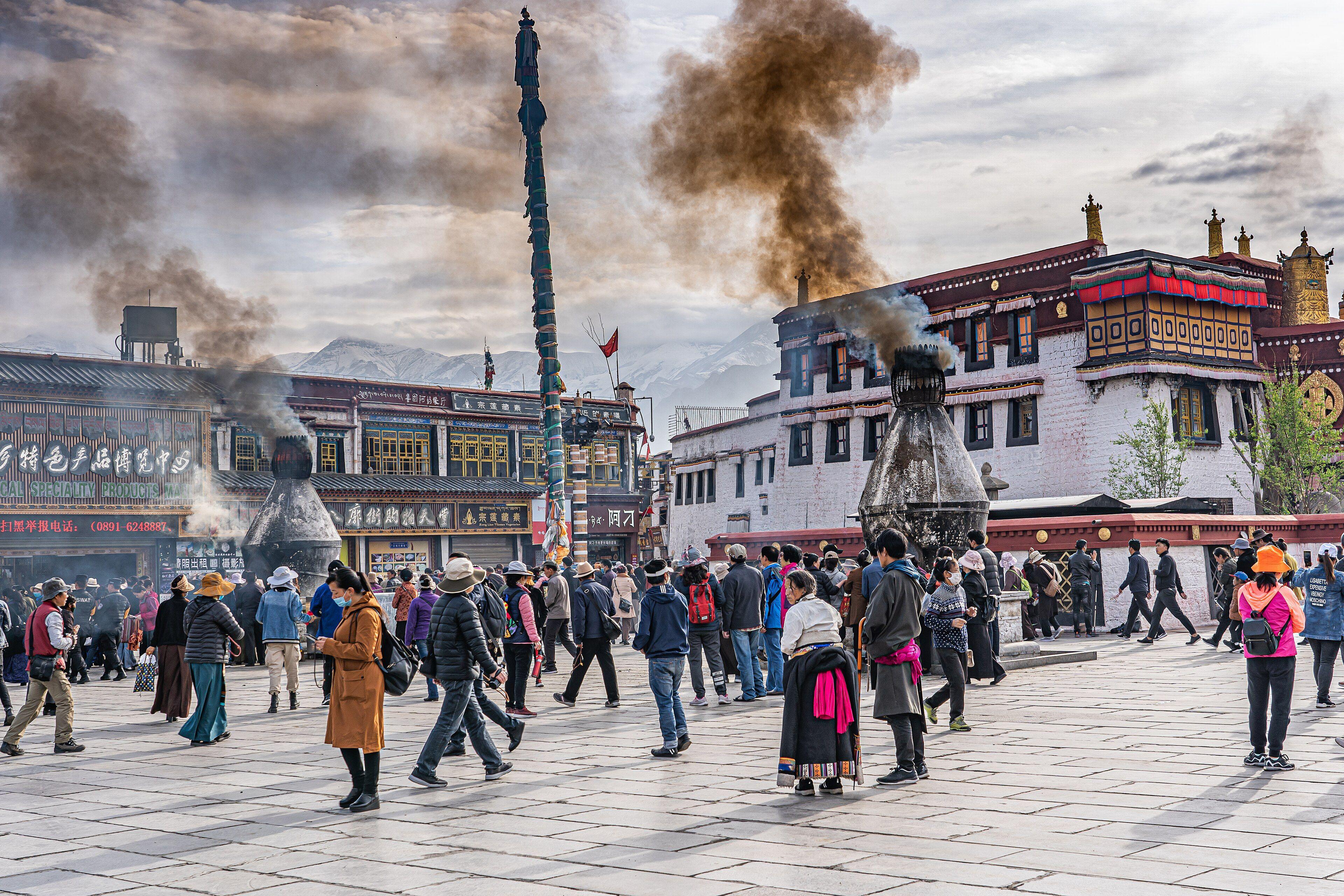
According to People’s Daily Online, at noon on 5 March 13 lamas and nuns marched along the Barkhor carrying the “snow lion flag”; by the second circuit the marchers and followers had grown to several hundred, who shouted for “Tibetan independence” and threw stones at officers of the Barkhor police station. Around 3 p.m. more than 600 people marched on East Beijing Road, beating, smashing, looting and burning offices and shops, and stormed the Chengguan District Party and government offices four times. The official account says the rioters “even openly fired at public security and armed police.” The rioting continued until 7 March.
Asia Watch’s 1990 report, based on accounts by Tibetan exiles and foreign tourists, describes a different sequence: at noon a procession of fewer than 40 people circled the Jokhang twice and faced armed security personnel posted on the roof of the police station; the police are said to have thrown bottles, the protesters responded with rocks, and the police began shooting. Shortly before 12:30 tear gas was fired, followed minutes later by automatic rifle fire; in the afternoon up to 1,000 Tibetans gathered again, and by the end of the day 20 to 25 shops had been gutted and burned. On 6 March the government tax office was burned and police fired on crowds from a rooftop. By 7 March the violence had subsided considerably; after dark some 1,000 armed police together with PLA troops took up positions in the Tibetan quarter and began going into Tibetan homes.
The Martial Law Order
On 7 March Premier Li Peng signed a State Council order stating that “a small number of separatists have repeatedly created riots in Lhasa, Tibet Autonomous Region, seriously endangering social stability”, and, under Article 89, Item 16 of the Constitution, imposed martial law “in Lhasa from 00:00 on 8 March 1989, to be organised and implemented by the People’s Government of the Tibet Autonomous Region.” People’s Daily Online notes that it was the first martial law order issued by the State Council in the 39 years since the founding of the People’s Republic. Dorje Tsering, chairman of the regional government, then signed six government orders (three each on 7 and 8 March). Order No. 1 defined the martial law area as urban Lhasa and the area west of Lamu Township in Dazi County and east of Dongga Township in Duilongdeqing County; during martial law “assemblies, demonstrations, strikes, class boycotts, petitions and other gatherings are strictly forbidden,” foreigners could not enter without permission and those present had to leave within a set time, and public security organs and martial law personnel could search “suspects of creating riots” and suspicious places. Another order authorised security forces to take necessary measures to halt acts including incitement of separatism and to detain those involved on the spot.
Once martial law took effect, the few foreign tourists remaining in Lhasa were ordered out. According to an Amnesty International urgent action of 16 March, tourists told to leave by noon on 9 March reported seeing Tibetans, including children, forcibly taken from their homes and driven away in police trucks; Asia Watch records that a British journalist who had reached Lhasa was detained, interrogated and threatened at gunpoint before being ordered out of Tibet with a colleague. Amnesty also relays a state radio report of 9 March that regional Party secretary Hu Jintao had urged the police to remain vigilant against separatists now that martial law had been declared and to adopt firmer measures even against those who obstinately resisted.
Casualties and Arrests
Casualty figures diverge widely. People’s Daily Online says that in three days of rioting more than 90 shops, hotels and restaurants were attacked, the windows and doors of dozens of offices, schools and hospitals were smashed, and “more than a hundred people were killed or injured”, with direct losses exceeding 3 million yuan. According to Amnesty, state radio announced on 9 March that the official death toll had risen from 12 to 16 after four injured demonstrators died in hospital; Xinhua said Tibetans had fired first on 5 March and killed a policeman, which foreign eyewitnesses denied. Foreign tourists initially estimated about 60 Tibetans dead and 100 wounded. In August 1990 the British Observer reported that the former journalist Tang Daxian—who had been in Tibet representing the Chinese Journalists’ Association, the State Council, the United Front Department and other offices—had produced a copy of a Public Security Bureau and Tibet Military District report dated 11 March stating that 387 Lhasa residents had been killed, 721 injured and 2,100 arrested or detained, and 82 religious people killed; the document’s authenticity has not been independently verified.
As for arrests, Asia Watch cites an unconfirmed report that Tibetans in Lhasa estimated some 1,000 people were arrested immediately after martial law was imposed; Lhasa’s mayor said at the end of March that more than 300 had been detained, and a Public Security Bureau spokesman told a visiting British journalist in October that more than 400 had been arrested since March. Asia Watch said it could verify none of these figures but was certain that at least several hundred Tibetans had been arrested.
Conflicting Accounts
Official reports stressed the rioters’ violence and use of firearms, and ultimately held that separatist groups abroad had colluded with people entering Tibet as tourists to smuggle in arms in preparation for the riots. Foreigners present insisted that no Tibetans were seen carrying or using guns. A collective statement by 35 tourists who witnessed the events acknowledged that the Tibetan demonstrators had become violent and destructive in expressing their anger, but held that the scale and bloodiness of the crisis were caused by the incompetence of the authorities, whose shootings had been “excessive, unpredictable, indiscriminate.” Tang Daxian further claimed that the Lhasa police had received orders from their commander in Beijing, Gen. Li Lianxiu, to provoke an incident—likewise a claim resting on his account alone.
Policy Shift
Goldstein argues that by the end of 1989 Beijing’s internal and external strategies for Tibet were in shambles: besides the Lhasa riots and martial law, the year brought the Tiananmen crisis (martial law was declared in parts of Beijing on 20 May) and the award of the Nobel Peace Prize to the Dalai Lama. Beijing responded by moving to a more hard-line, integrationist policy; many officials drew a parallel between Mao’s gradualist policy of supporting the Dalai Lama while postponing reforms, which preceded the 1959 rebellion, and Hu Yaobang’s liberal policy, which they blamed for the 1987–1989 riots, and the shift was formalised at a Politburo meeting in the winter of 1989. Official sources say that in October 1989 Jiang Zemin chaired a Politburo Standing Committee meeting that heard Hu Jintao’s report on behalf of the regional Party committee and produced ten opinions guiding Tibet work, which became “a turning point” for Tibet work in the new period; in 1990 the Centre set the principle of “one centre, two major tasks, three guarantees.”
After martial law was lifted in parts of Beijing in January 1990, Foreign Office Minister of State Francis Maude told the House of Commons in a written answer that Britain had frequently raised its concern about human rights in Tibet, hoped the Chinese government would further strengthen human rights protection throughout China, “including the lifting of martial law in Lhasa,” and would raise the matter with its European Community partners at the UN Commission on Human Rights.
Lifting of Martial Law
On 30 April 1990 Li Peng signed a State Council order stating that “the situation in Lhasa has stabilised, social order has returned to normal and the task of martial law in Lhasa has been victoriously completed,” and lifting martial law from 1 May. By the count of the Central Tibetan Administration (the Tibetan government-in-exile) it had lasted 419 days; the Dalai Lama’s bureau in New Delhi welcomed the move but said it could not help seeing it as more a public relations exercise in view of growing international criticism. Asia Watch, reporting the same month, said the end of martial law had not altered the repressive political climate in Tibet and that it knew of no political prisoner released as a result; Goldstein records that in the seven years after martial law was lifted in 1990 there were frequent demonstrations in Lhasa but no further riots. The Central Tibetan Administration has since held a service in Dharamsala every 8 March, “Lhasa Martial Law Day”, to mourn the Tibetans killed in the Lhasa protests of 1987–1989.
Narrative Comparison
| Source | Narrative |
|---|---|
| State Council martial law orders; People’s Daily Online; Guangming Daily (2009) | Official accounts describe a serious riot deliberately created by a small number of separatists who marched under the snow lion flag, beat, smashed, looted and burned, stormed government offices and “even openly fired at public security and armed police,” leaving more than a hundred killed or injured. The authorities say they had consistently exercised restraint and that the State Council imposed martial law under the Constitution to maintain order and protect lives and property. Later official writing attributes the late-1980s Lhasa riots to planning by the Dalai clique, says the Party and government swiftly quelled them, and calls the ten opinions adopted by the Politburo Standing Committee in October 1989 “a turning point” for Tibet work. |
| Melvyn C. Goldstein, The Snow Lion and the Dragon (1997) | Goldstein treats the 5 March 1989 clash as Lhasa’s fourth riot since 1987 and places it in the context of failed dialogue between Beijing and the Dalai Lama: after the Panchen Lama’s death Beijing secretly invited the Dalai Lama to Beijing, but the exile leadership talked him out of it—one of the most important lost opportunities after 1978. He sees martial law as Beijing’s acknowledgement that Tibet was veering out of control, followed in the winter of 1989 by a turn to a hard-line, integrationist policy that blamed Hu Yaobang’s liberal approach and relied on security and economic development; in the following seven years there were demonstrations but no further riots. |
| Testimony of foreign tourists in Lhasa (via Asia Watch 1990 and Amnesty International 1989) | Foreign tourists present said the clash began when a procession of fewer than 40 people faced armed police on a rooftop, who then opened fire; they insisted that no Tibetans were seen carrying or using guns and disputed the official claim that Tibetans fired first. A statement by 35 tourists acknowledged that the demonstrators became violent and destructive, but blamed the scale and bloodiness of the crisis on the incompetence of the authorities, whose shootings were “excessive, unpredictable, indiscriminate.” On the night martial law took effect and in the following days tourists saw Tibetans, including children, taken away; they initially estimated about 60 dead. The tourists were then ordered out, after which independent information became scarce. |
| Central Tibetan Administration; Bureau of the Dalai Lama, New Delhi | The Tibetan exile side calls the Lhasa events of 1987–1989 an uprising, marks 8 March as “Lhasa Martial Law Day” and holds a service in Dharamsala each year for the demonstrators shot dead and for those killed, arrested or disappeared since. When martial law was lifted in 1990, the Dalai Lama’s bureau in New Delhi welcomed the move but saw it as a public relations exercise in the face of growing international criticism rather than a change of policy. |
| House of Commons written answers (January 1990) | The British government said it had frequently raised its concern about human rights in Tibet with China. After martial law was lifted in parts of Beijing in January 1990, Foreign Office minister Francis Maude said Britain hoped China would further strengthen human rights protection throughout the country, “including the lifting of martial law in Lhasa,” and would raise its concerns about human rights in China, including Tibet, with European Community partners at the UN Commission on Human Rights. |
Key Milestones
- Human Rights Day protest
Monks demonstrate on International Human Rights Day; Goldstein counts it as Lhasa’s third bloody riot.
- Death of the tenth Panchen Lama
The Panchen Lama dies; Beijing invites the Dalai Lama to the memorial, and he declines.
- Barkhor march turns violent
A march on the Barkhor turns into three days of clashes; official and eyewitness accounts differ.
- State Council martial law order
Li Peng signs the order imposing martial law in Lhasa from 00:00 on 8 March.
- Martial law takes effect
Martial law takes effect; regional orders follow and security forces search homes and make arrests.
- Foreign tourists ordered out
Foreign tourists are ordered to leave Lhasa by noon; state radio raises the official death toll to 16.
- Politburo Standing Committee’s ten opinions
The Politburo Standing Committee hears Hu Jintao’s report and adopts ten opinions on Tibet work.
- British statement in Parliament
The British government tells the Commons it hopes martial law in Lhasa will be lifted.
- Order lifting martial law
The State Council declares Lhasa stable and lifts martial law from 1 May.
- Martial law lifted
Martial law in Lhasa ends after 419 days (Central Tibetan Administration count).
Last verified:
Cite this page
Chronicles of Modern China. (2026, November 24). 1989 Lhasa Martial Law. Retrieved November 24, 2026, from https://www.cmcarchive.org/events/lhasa-martial-law-1989
“1989 Lhasa Martial Law.” Chronicles of Modern China. Last modified November 24, 2026. Accessed November 24, 2026. https://www.cmcarchive.org/events/lhasa-martial-law-1989.
Chronicles of Modern China. 1989 Lhasa Martial Law[EB/OL]. (2026-11-24)[2026-11-24]. https://www.cmcarchive.org/events/lhasa-martial-law-1989.