16th Party Congress: Hu Jintao Era Begins
Jiang Zemin handed over Party leadership to Hu Jintao at the 16th National Congress and enshrined the 'Three Represents' theory in the Party constitution, marking the first relatively orderly transfer of supreme power in PRC history.
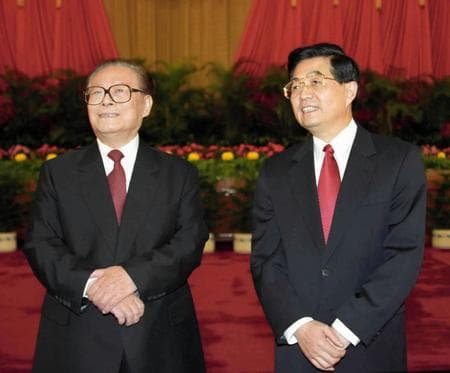
The Transfer of Power
The 16th Party Congress in November 2002 marked the first relatively orderly transfer of supreme power in PRC history without the death or purge of the outgoing leader. Jiang Zemin handed the General Secretaryship to Hu Jintao, who had been groomed as successor for a decade. The congress also formally enshrined Jiang's 'Three Represents' theory — holding that the Party represents advanced productive forces, advanced culture, and the fundamental interests of the broadest masses — in the Party constitution as a guiding ideology. Jiang retained chairmanship of the Central Military Commission for two more years, limiting Hu's initial authority, but the transfer nonetheless represented an institutional step toward more routinised succession.
The Hu-Wen Era
Hu Jintao and Premier Wen Jiabao (the 'Hu-Wen administration') governed from 2003 to 2013. Their decade was characterised by continued high growth (averaging 10.5% per year), a rhetorical emphasis on social equity and rural development ('harmonious society,' 'Scientific Outlook on Development'), and a more assertive foreign policy. Major events included SARS, the 2008 Tibet unrest and Olympics, the Sichuan earthquake, and the 2008 global financial crisis, which China navigated with a massive stimulus package. The same period also saw rising inequality, pervasive corruption, and environmental degradation, alongside a tightening of internet controls and increasing restrictions on civil society.
Narrative Comparison
| Source | Narrative |
|---|---|
| PRC Official Narrative | The 16th Party Congress was an important milestone in the political construction of socialism with Chinese characteristics. In accordance with the Party constitution, the congress completed the generational transition of the Party Central leadership collective, with Comrade Jiang Zemin smoothly handing over responsibilities to the new central leadership collective headed by Comrade Hu Jintao as General Secretary — fully embodying the Party's firm resolve to strengthen Party self-building, advance intra-Party democracy, and maintain political stability. The congress enshrined the 'Three Represents' in the Party constitution as a guiding ideology, further enriching the theoretical achievements of the Sinicisation of Marxism and providing fundamental guidance for advancing reform and modernisation in the new century. The congress set forth the goal of comprehensively building a moderately prosperous society, delineating the strategic tasks for China's development in the first two decades of the 21st century and consolidating the will and strength of the entire people to build socialism with Chinese characteristics. |
| Western Academic Analysis | Western scholarship interprets the 16th Party Congress as an important node in the institutionalisation of CCP power succession, while identifying the inherent limitations of this process. The first concerns the historical significance of institutionalised succession: compared with power transferring upon the death of the leader in the Mao era, or Deng-era designation of successors through behind-the-scenes deliberation, Hu Jintao's smooth assumption of office pursuant to pre-established arrangements represented a quantifiable step towards institutionalisation in top-level Party politics, characterised by some scholars as an important source of Chinese authoritarian resilience. The second concerns the political constraints of the 'dual-core' configuration: Jiang Zemin's continuation as CMC Chairman for two years after relinquishing the General Secretaryship (2002–04) created what scholars have termed a 'dual leadership' situation, weakening Hu Jintao's initial authority and reflecting the continuing tension in Chinese supreme power transitions between institutionalised and personalised factors. The third concerns Hu Jintao's governing character: most scholarly analyses portray him as a leader of bureaucratic caution who favoured incremental decision-making and collective leadership mechanisms, presenting a consensus-driven rather than decisive style on major policy questions. The fourth concerns retrospective significance: against the backdrop of Xi Jinping's subsequent consolidation of power, the Hu-Wen era has been frequently used by scholars as a comparative reference point for exploring structural changes in CCP elite politics. |
Key Milestones
- 16th Party Congress Closes; "Three Represents" Enshrined; Hu Jintao Elected General Secretary
The 16th National Congress of the CCP convened in Beijing from 8 to 14 November 2002, passing amendments to the Party constitution that enshrined Jiang Zemin's 'Three Represents' theory as a guiding ideology. On 15 November, the First Plenary Session of the 16th Central Committee elected Hu Jintao as CCP General Secretary and constituted a new Politburo Standing Committee headed by Hu. Jiang Zemin did not attend the First Plenary but retained the chairmanship of the Central Military Commission, creating a 'dual-core' configuration for the period of power transition.
- Jiang Zemin Resigns as CMC Chairman; Hu Jintao Consolidates Full Authority
On 19 September 2004, the Fourth Plenary Session of the 16th Central Committee convened in Beijing, at which Jiang Zemin formally resigned as Chairman of the CCP Central Military Commission; Hu Jintao succeeded to the position. Hu now simultaneously held the positions of CCP General Secretary, State President, and CMC Chairman, ending the 'dual-core' transitional arrangement in place since 2002 and consolidating supreme authority over the Party, state, and military.
- 17th Party Congress Opens; "Scientific Outlook on Development" Enshrined; Succession Line-up Established
The 17th National Congress of the CCP opened in Beijing on 15 October 2007, passing amendments to the Party constitution that enshrined Hu Jintao's 'Scientific Outlook on Development' as a guiding ideology. The Politburo Standing Committee constituted at the First Plenary Session of the 17th Central Committee saw Xi Jinping and Li Keqiang enter the body for the first time, ranked sixth and seventh respectively — widely interpreted as designating them as the successors for the next supreme leadership collective.
- Xi Jinping Elected General Secretary; Hu Jintao Simultaneously Relinquishes CMC Chairmanship; Hu-Wen Era Ends
The 18th National Congress of the CCP convened in Beijing from 8 to 14 November 2012. On 15 November, the First Plenary Session of the 18th Central Committee elected Xi Jinping as CCP General Secretary; Hu Jintao stepped down, formally ending the ten-year Hu-Wen era. Unlike Jiang Zemin's retention of the CMC chairmanship in 2002, Hu Jintao simultaneously relinquished both the General Secretaryship and the CMC chairmanship — a step widely noted by scholars as an important precedent for the smooth institutionalised transfer of supreme power.
Last verified: