SARS Epidemic
A novel coronavirus emerged in Guangdong province in November 2002 and spread globally, ultimately infecting over 8,000 people across 29 countries with 774 deaths. China's initial management of information flows delayed the international response. Following containment, China and the international community undertook systemic reforms to public health emergency and reporting mechanisms.
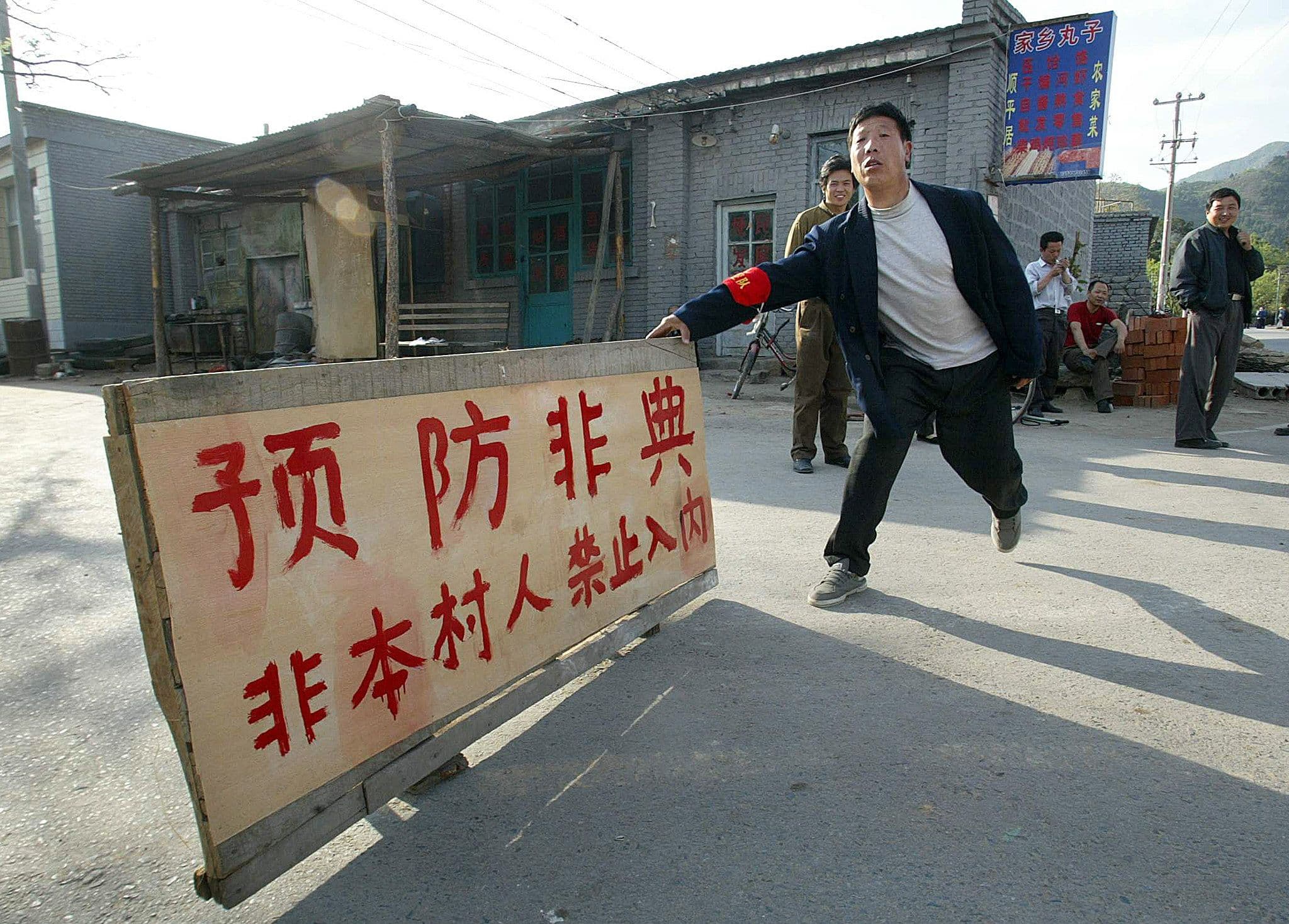
Emergence and Information Management
The first SARS cases appeared in Foshan, Guangdong province, in November 2002. Provincial health officials knew of an unusual pneumonia but restricted information sharing, fearing panic and economic damage. By February 2003, the virus had spread to Hong Kong via a hotel guest — a physician from Guangdong who was himself infected. From Hong Kong, travellers carried SARS to Singapore, Toronto, Hanoi, and beyond. China's Ministry of Health notified the WHO of the Guangdong outbreak on 11 February 2003, nearly three months after the first known cases; the WHO issued its first global alert on 12 March 2003.
The Cover-up Exposed
Military doctor Jiang Yanyong sent a letter to Chinese media in April 2003 revealing that Beijing hospitals were hiding cases — that the true number of patients far exceeded official figures. His letter was suppressed domestically but leaked abroad, triggering an international crisis. Health Minister Zhang Wenkang publicly denied the problem on 3 April; both he and Beijing mayor Meng Xuenong were dismissed on 20 April. China began releasing accurate figures and implementing aggressive containment measures.
Legacy
SARS killed 774 people across 29 countries, with 349 in China. The economic cost to the Asia-Pacific region was estimated at $40 billion. The crisis forced fundamental reforms to China's public health system and CDC structure. The WHO declared SARS contained globally on 5 July 2003.
Narrative Comparison
| Source | Narrative |
|---|---|
| PRC Official Narrative | Following the SARS outbreak, the Party and government placed the highest importance on the situation and rapidly activated emergency response mechanisms. Confronting this novel, highly transmissible disease, health departments at all levels responded in accordance with existing procedures under conditions of limited initial information. As the situation developed, the central leadership acted decisively: President Hu Jintao and Premier Wen Jiabao went to the front line of epidemic prevention and control in person to offer encouragement to medical workers and the general public. The Party Central Committee and State Council made comprehensive arrangements for epidemic prevention and control, implementing a large-scale national mobilisation, marshalling medical resources, implementing quarantine measures, and effectively breaking chains of transmission. On accountability, the central authorities dealt seriously with officials who had committed derelictions of duty in handling the epidemic in accordance with laws and regulations: the dismissal of Health Minister Zhang Wenkang and Beijing Mayor Meng Xuenong powerfully demonstrated the Chinese Communist Party's governing philosophy of accountability to the people and rectifying errors without exception. China maintained close communication and cooperation with the WHO, sharing data in a timely manner and actively participating in the global epidemic response. Through the institutional advantages of a whole-nation system and the capacity to concentrate forces for major tasks, China ultimately succeeded in controlling the epidemic, fully demonstrating the superiority of the socialist system in responding to major public health crises. After SARS, China further improved its public health emergency management system, strengthened disease control institutions, established a direct infectious disease reporting system, and substantially enhanced early warning and emergency response capabilities for major infectious diseases, building a more robust institutional safeguard for the protection of the lives and health of the people. |
| Hong Kong Medical and Public Perspective | In the spring of 2003, Hong Kong bore the most devastating impact of the SARS outbreak. With 1,755 confirmed cases and 299 deaths — more than a third of the global death toll — Hong Kong's medical system was left to confront an unknown lethal pathogen without warning, caught off guard by the restricted flow of information from the mainland. Healthcare workers at Prince of Wales Hospital were exposed to early patients without knowing what they faced, triggering a major nosocomial outbreak; medical staff ultimately accounted for approximately 21 percent of Hong Kong's confirmed cases, and several frontline doctors, nurses, and paramedical staff died in the course of duty. The Amoy Gardens cluster was particularly shocking to the public: 321 residents of Block E were infected within a short period, and investigators subsequently concluded that the building's sewage system was the primary transmission pathway — revealing that community spread of the virus far exceeded early public understanding. Operating under severely limited information, Hong Kong's medical community — including research teams led by David Ho, the University of Hong Kong's microbiology department, and frontline staff at Prince of Wales — rapidly identified the pathogen, developed isolation protocols, and participated in multi-country research collaboration, making critical contributions to the global understanding of and response to SARS and earning wide respect in the international public health community. The resentment within Hong Kong society over the mainland's initial lack of transparency, however, did not dissipate after the outbreak was contained, persisting in various forms over the years that followed. After SARS, the Centre for Health Protection was formally established in 2004, dedicated to building a more robust infectious disease surveillance, risk assessment, and emergency coordination system, so that Hong Kong would never again face a lethal outbreak without warning and in disarray. |
| Western Academic Analysis | Western scholarship on the SARS crisis has concentrated on several core dimensions. The first concerns the institutional roots of information suppression: research by scholars including Yanzhong Huang and Thomas Abraham documented the deeply entrenched incentive structure within China's local and central health system to report good news and suppress bad — local officials systematically concealed negative information from superiors, partly from concern about economic and political reputational effects and partly from fear of accountability for mishandling. This structural feature is not specific to SARS but is a characteristic manifestation of information flow mechanisms under authoritarian systems. The second concerns the role of Jiang Yanyong and the limits of civil society: Jiang Yanyong's whistleblowing action revealed the acute scarcity of independent channels available to Chinese civil society — formal media outlets could not function as such, and a personal letter that leaked abroad became the critical trigger for an international crisis. It is notable that Jiang's SARS disclosure did not result in immediate punishment; it was a separate letter in 2004 calling for a reassessment of the 1989 Tiananmen crackdown that led to his being placed under house arrest for approximately 45 days. Taken together, these two episodes illustrate the broader absence of protected political speech: the same individual who exposed a public health cover-up escaped immediate reprisal, yet subsequently faced state punishment for a different act of public record — demonstrating that what was tolerated was not whistleblowing per se, but the authorities' selective acceptance of speech in particular circumstances. The third concerns the tension between the WHO and the sovereignty framework: the WHO faced conspicuous resistance from China during its investigations, and Taiwan's initial exclusion from information-sharing mechanisms became a classic case study in the contradiction between sovereignty and transparency in the international health law framework, directly driving the major revision of the International Health Regulations in 2005. The fourth concerns post-SARS institutional reforms and their limits: scholarship broadly acknowledges China's efforts to establish direct reporting systems and strengthen the CDC structure after SARS, but notes that the initial handling of COVID-19 in 2019–20 replicated the SARS pattern almost exactly — local suppression of outbreak information, delayed reporting to the WHO — indicating that the institutional roots were not fundamentally corrected and that systemic incentive structures continued to drive similar behaviour. |
Key Milestones
- First Unidentified Pneumonia Cases Appear in Guangdong; SARS Outbreak Begins
In November 2002, the first cases of pneumonia of unknown cause appeared in Foshan, Guangdong province, with patients presenting with high fever and severe respiratory distress. Provincial health authorities, upon learning of the cases, restricted the circulation of information within the system under the pretext of preventing panic and economic damage, failing to report upward and to international bodies in a timely manner as required. These cases were subsequently identified as the earliest recorded cases of Severe Acute Respiratory Syndrome (SARS), caused by a novel coronavirus (SARS-CoV).
- Guangdong Physician Liu Jianlun Checks into Hotel Metropole Hong Kong; SARS Reaches Hong Kong and Spreads Globally
On 21 February 2003, Liu Jianlun, a nephrologist at the Second Affiliated Hospital of Sun Yat-sen University in Guangdong, checked into the ninth floor of the Hotel Metropole in Mong Kok, Hong Kong, while himself already infected with SARS. He transmitted the virus to at least 16 other guests on the same floor within a single day. These guests subsequently travelled to Singapore, Hanoi in Vietnam, Toronto in Canada, and other destinations, exporting SARS to multiple countries within days and transforming the outbreak from a regional epidemic into an international public health emergency. Liu died in a Hong Kong hospital shortly after admission.
- WHO Issues First Global SARS Alert; Name "Severe Acute Respiratory Syndrome" Formally Established
On 12 March 2003, the World Health Organization issued its first global alert about Severe Acute Respiratory Syndrome (SARS), formally warning the international community of an unknown pathogen causing severe pneumonia; the name 'SARS' was first formally used in this alert. The alert followed a report submitted to the WHO in late February by Dr Carlo Urbani, a WHO infectious disease specialist working in Hanoi, who had identified an unusual pneumonia cluster centred on an American businessman at a local hospital. At the time of the alert, the WHO did not yet have full visibility of the scale of the Guangdong outbreak; the alert covered clusters in both Hong Kong and Vietnam. Urbani himself contracted SARS while investigating the Hanoi cluster and died in Bangkok, Thailand, on 29 March 2003.
- Health Minister Zhang Wenkang and Beijing Mayor Meng Xuenong Dismissed; China Begins Accurate Reporting
On 20 April 2003, Health Minister Zhang Wenkang and Beijing Mayor Meng Xuenong were announced dismissed by the central government — the highest-level accountability action of the SARS outbreak — following the international attention generated by military doctor Jiang Yanyong's whistleblower letter in early April. On the same day, the Ministry of Health published substantially revised figures for confirmed cases in Beijing, acknowledging that the actual numbers were far higher than previously official data had indicated. China thereafter established a daily data reporting system, began sharing information with the WHO, and implemented large-scale quarantine and lockdown measures in Beijing and other cities.
- WHO Declares SARS Contained Globally
On 5 July 2003, the World Health Organization announced that Taiwan, the last remaining SARS-affected area in the world, had been removed from its list of areas with recent local transmission, declaring SARS contained globally. The outbreak, lasting approximately eight months, resulted in 8,098 infections across 29 countries and territories, with 774 deaths and a case-fatality rate of approximately 9.6 percent. Mainland China (including Hong Kong) was the most severely affected region. The WHO subsequently called on member states to strengthen early warning and emergency notification mechanisms for infectious diseases, and drove a major revision of the International Health Regulations in 2005 that established the legal obligation of member states to report public health emergencies of international concern to the WHO.
Last verified: