The 1 July 2003 March and the Withdrawal of Hong Kong’s Article 23 Bill
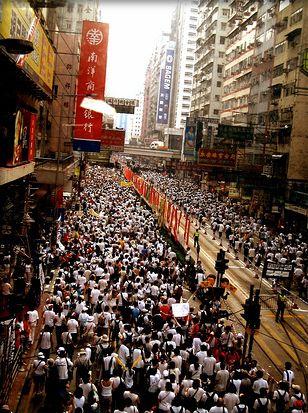
In September 2002 the Hong Kong government issued proposals to implement Article 23 of the Basic Law, and in February 2003 introduced the National Security (Legislative Provisions) Bill, whose provisions on proscribing organisations, unlawful disclosure and warrantless searches drew controversy. On 1 July 2003, the sixth anniversary of the handover, organisers said more than 500,000 people and police 350,000 at the peak marched against the bill. Tung Chee-hwa announced amendments to three provisions on 5 July but kept the vote on schedule; after the Liberal Party asked for a delay and James Tien left the Executive Council, the second reading was deferred on 7 July. Secretary for Security Regina Ip and Financial Secretary Antony Leung resigned on 16 July, and the bill was withdrawn on 5 September. Beijing called the legislation entirely necessary and said it respected the deferral; the US and UK governments voiced concern about the provisions. Local Article 23 legislation was not completed until 2024.
Background: Article 23 and the consultation
Article 23 of the Basic Law requires the Hong Kong SAR to enact laws on its own to prohibit treason, secession, sedition, subversion against the Central People’s Government and theft of state secrets, to prohibit foreign political organisations from conducting political activities in Hong Kong, and to prohibit Hong Kong political organisations from establishing ties with foreign political organisations. More than five years after the handover no such law had been passed. According to a Legislative Council Secretariat brief, the government published a consultation document, “Proposals to implement Article 23 of the Basic Law,” on 24 September 2002; the three-month consultation ended on 24 December. The National Security (Legislative Provisions) Bill was gazetted on 14 February 2003 and introduced into the Legislative Council on 26 February. According to China News Service, nearly 100,000 submissions, both for and against, were received during the consultation, and the government then made nine important changes to its original proposals.
Rallies for and against the legislation took place during the consultation. According to the BBC, police estimated 12,000 people at a march against the proposals on 15 December 2002, while organisers said 50,000; on 22 December a coalition of 27 pro-Beijing groups held a rally in support, which its organisers said drew 40,000.
The controversy over the bill
The dispute centred on a few provisions. According to a report by Taiwan’s Mainland Affairs Council at the time, the bill allowed a local organisation to be proscribed as long as “the Secretary for Security reasonably believes for the purpose of the interests of national security” that proscription “is necessary,” including local groups subordinate to mainland organisations banned by the Central Authorities on national security grounds. A former chairman of the Bar Association called this an “automatic proscription mechanism,” and Catholic bishop Joseph Zen said it undermined “one country, two systems.” The absence of a public interest defence for unlawful disclosure of official information and police powers to search without a warrant in emergencies were also criticised; the Hong Kong Journalists Association warned that the lack of a public interest defence would weaken the public’s right to know. After the first reading on 26 February, 21 pro-democracy legislators walked out, and Democratic Party chairman Yeung Sum criticised the government for refusing to publish a “white bill” for a second round of consultation.
Foreign governments also voiced concern. On 19 June 2003 the White House said the legislation, “as currently drafted, could harm local freedoms and autonomy over time,” singled out the proscription provisions and the lack of a “public interest” defence, and said the United States opposed any law threatening Hong Kong’s unique identity, “including the current version of Article 23 legislation.” The British Foreign Office said in a statement on 30 June that the proscription provisions introduced linkages to mainland law into Hong Kong legislation and were inconsistent with the “One Country, Two Systems” principle.
The 1 July march
1 July 2003 was the sixth anniversary of the handover, and Premier Wen Jiabao attended the celebrations in Hong Kong. Asked about the bill, he said it “absolutely will not affect the different rights and freedoms that Hong Kong people -- including reporters -- enjoy under the law.” That afternoon a march organised by the Civil Human Rights Front took place; many participants wore black and called for Article 23 legislation to be dropped, and some for Tung Chee-hwa to step down. Estimates of its size differ: organisers said more than 500,000, police said 350,000 were on the streets at the peak, and the US State Department spokesman said that day “a quarter million.” The march was peaceful and lasted six and a half hours. The Associated Press reported that pro-Beijing groups held a carnival and football tournament the same day and that fishermen sailed boats flying the national flag around the harbour in support of the law.
That evening Tung issued a statement expressing understanding of the marchers’ aspirations but reiterating that enacting the bill was the SAR’s constitutional duty and that the government had pledged rights and freedoms would not be affected. On 3 July Foreign Ministry spokesman Kong Quan said it was “entirely necessary” for Hong Kong to legislate on its own under Article 23.
Concessions, deferral and withdrawal
On 5 July Tung acknowledged that hundreds of thousands had marched to express concern over the proposals and dissatisfaction with government policies “and over my governance in particular.” He announced further amendments to the three most controversial areas: deleting the provision on local organisations subordinate to mainland organisations proscribed by the Central Authorities; introducing a “public interest” defence for unlawful disclosure of certain official information; and deleting the police power to search without a court warrant in emergency investigations. But he insisted the bill would resume second and third reading on 9 July as scheduled, calling it “a matter relating to the national dignity and the glory of the Chinese race.” The same day an official of the NPC Standing Committee’s Legislative Affairs Commission said the further amendments were appropriate and urged legislators and the public to support the SAR government in completing the legislation as scheduled.
On the evening of 6 July the normally pro-government Liberal Party asked the government to defer the second reading, and the party’s James Tien resigned from the Executive Council. In the early hours of 7 July, after a special Executive Council meeting, Tung announced that the second reading would be deferred. Liaison Office director Gao Siren said he respected the decision and that the SAR government’s priority should be developing the economy and improving livelihoods. On 8 July, asked by a reporter about the march of 500,000, the Foreign Ministry spokesman said the question did not fall within the scope of what the ministry’s spokesman answers.
On 16 July Secretary for Security Regina Ip announced her resignation, saying she had given notice on 25 June, that her decision was “entirely due to personal reasons,” and that she deeply regretted that the legislation was not completed as scheduled. Financial Secretary Antony Leung resigned the same day; he had earlier been criticised for buying a car shortly before raising the first registration tax on vehicles. On 17 July Tung announced that the bill would be put to public consultation again and that the timing of the legislative process would depend on the consultation.
On 5 September, after a special Executive Council meeting, Tung announced that the bill would be withdrawn. He gave two reasons: the community still had doubts about the provisions and needed time to study them, and the public’s main concern was the economy and the recovery. The Security Bureau would set up a working group to review the legislation afresh, with no timetable. He also said enacting Article 23 legislation remained “a constitutional duty that the HKSAR must fulfil.” The next day Secretary for Security Ambrose Lee stressed that the government had only withdrawn the bill and had not shelved Article 23 legislation.
Aftermath
For the next two decades no local Article 23 bill was reintroduced. On 30 June 2020 the NPC Standing Committee enacted the Hong Kong National Security Law for application in Hong Kong. On 19 March 2024 the Legislative Council passed the Safeguarding National Security Bill, which the government said fully implemented the constitutional duty under Article 23. After 2003 the Civil Human Rights Front organised a march every 1 July until police banned it during the pandemic; the group disbanded after the national security law took effect.
Gallery
Narrative Comparison
| Source | Narrative |
|---|---|
| Foreign Ministry spokesman Kong Quan (3 and 8 July 2003); NPCSC Legislative Affairs Commission official (5 July 2003); Liaison Office director Gao Siren (7 July 2003) | Beijing’s position was that it was entirely necessary for Hong Kong to legislate on its own under Article 23, in the interests of Hong Kong and the whole country and in line with international practice; that the legislation was the “sacred duty” of Hong Kong citizens and the SAR government and the precondition for “one country, two systems” and “Hong Kong people governing Hong Kong”; and that the government had listened to public views, protected residents’ rights and acted appropriately in amending the contested clauses. Asked about the march, the Foreign Ministry spokesman said the SAR government had commented and the question was outside his remit, adding that the overwhelming majority of Hong Kong compatriots love the country and love Hong Kong and would support the legislation, and that anyone using the occasion to sow discord between Hong Kong and Taiwan or smear “one country, two systems” would get nowhere. After the deferral the Liaison Office said it respected the decision and that the priority was the economy and livelihoods. |
| White House Press Secretary statement (19 June 2003); State Department spokesman Richard Boucher (1 July 2003) | The US government said the Article 23 legislation, “as currently drafted, could harm local freedoms and autonomy over time,” with the proscription provisions and the absence of a “public interest” defence especially worrisome; Hong Kong’s special status under the Hong Kong Policy Act depended on the protection of rights and autonomy, and the United States opposed any law threatening the territory’s unique identity, “including the current version of Article 23 legislation,” while the controversy underlined the importance of moving toward universal suffrage. On the day of the march the State Department said “a quarter million” people had protested peacefully, showing the importance of free speech and civil liberties to Hong Kong people, and urged the government not to rush the bill before the Legislative Council could discuss public concerns and to consider further clarifications and safeguards. |
| Mainland Affairs Council: Hong Kong and Macao section of its quarterly report (Q1 2003); Tenth Anniversary of the Handover analytical report (2007) | Reports by Taiwan’s Mainland Affairs Council at the time documented criticism of the bill in Hong Kong — the “automatic proscription mechanism,” appeal hearings that could proceed in the appellant’s absence, the refusal to include a public interest defence — as well as concerns voiced by the United States, Britain and the European Parliament. The Council’s 2007 review argued that from 1997 to 2003 China exercised restraint and did not visibly interfere in Hong Kong, to preserve the international propaganda value of “one country, two systems”; after the 1 July march of 500,000, China, shocked, promptly adjusted its strategy, tightened its governance of Hong Kong and intervened ever more visibly. The report listed the Article 23 proposals among the disputes it regarded as breaches of the “one country, two systems” promise. |
| Carole J. Petersen, Introduction to National Security and Fundamental Freedoms: Hong Kong’s Article 23 Under Scrutiny (Hong Kong University Press, 2005) | Carole Petersen, then a law scholar at the University of Hong Kong, argued that the government’s inflexible approach, combined with the poor economy and the stress of SARS, created a “spring of discontent” in 2003; the march of more than 500,000 was “the largest protest march ever held against the Hong Kong government,” after which the Liberal Party withdrew its support and the government was compelled to delay and ultimately withdraw the bill. In her view the government created its own crisis by including controversial proposals outside the scope of Article 23 and taking an inflexible, at times arrogant, approach to consultation; had it issued a White Paper and made a few significant concessions earlier, it likely could have secured enactment. In the same volume the HKU law scholar Albert Chen took a more favourable view: the general orientation of the bill was reasonable, and the proposals as a whole “represented a sincere and genuine attempt to put the principle of one country, two systems into practice,” with its vague clauses largely technical defects that could be fixed. |
Key Milestones
- Consultation document published
The government publishes its proposals to implement Article 23 for three months of consultation.
- March against the proposals
A march against the proposals; police estimate 12,000, organisers 50,000.
- Rally in support
27 pro-Beijing groups rally in support; organisers say 40,000.
- Bill gazetted
The National Security (Legislative Provisions) Bill is gazetted; it is introduced into LegCo on 26 February.
- White House statement
The White House says the US opposes the current version of the Article 23 legislation.
- 1 July march
On the handover anniversary, organisers say over 500,000 and police 350,000 at peak march against the bill.
- Three amendments announced
Tung announces amendments to the three most contested provisions but keeps the 9 July second reading.
- Second reading deferred
After the Liberal Party asks for a delay and James Tien quits the Executive Council, Tung defers the second reading.
- Regina Ip and Antony Leung resign
Secretary for Security Regina Ip and Financial Secretary Antony Leung resign.
- Fresh consultation announced
Tung announces the bill will be put to public consultation again.
- Bill withdrawn
Tung announces the withdrawal of the bill, with no timetable for legislation.
- Safeguarding National Security Bill passed
LegCo passes the Safeguarding National Security Bill, completing local Article 23 legislation.
Last verified:
Cite this page
Chronicles of Modern China. (2026, November 11). The 1 July 2003 March and the Withdrawal of Hong Kong’s Article 23 Bill. Retrieved November 11, 2026, from https://www.cmcarchive.org/events/hong-kong-article-23-protest-2003
“The 1 July 2003 March and the Withdrawal of Hong Kong’s Article 23 Bill.” Chronicles of Modern China. Last modified November 11, 2026. Accessed November 11, 2026. https://www.cmcarchive.org/events/hong-kong-article-23-protest-2003.
Chronicles of Modern China. The 1 July 2003 March and the Withdrawal of Hong Kong’s Article 23 Bill[EB/OL]. (2026-11-11)[2026-11-11]. https://www.cmcarchive.org/events/hong-kong-article-23-protest-2003.