Hong Kong Handover
The United Kingdom transferred sovereignty over Hong Kong to the PRC, establishing the "one country, two systems" framework that guaranteed Hong Kong's existing legal and economic systems for 50 years.
Road to Handover
Britain had administered Hong Kong since acquiring it in stages: Hong Kong Island ceded in perpetuity by the Treaty of Nanking (1842), Kowloon Peninsula in perpetuity by the Convention of Peking (1860), and the New Territories on a 99-year lease from 1898. The expiry of the New Territories lease in 1997 was the proximate driver of the handover: the New Territories comprised over 90 per cent of Hong Kong's land area and could not practically be administered separately. Sino-British negotiations from 1982 to 1984 produced the Joint Declaration, in which China promised to maintain Hong Kong's capitalist system and high degree of autonomy for 50 years under the "One Country, Two Systems" framework. The last governor, Chris Patten (1992–1997), significantly expanded the direct-election element of the Legislative Council, drawing fierce opposition from Beijing; China announced that the electoral arrangements would be dismantled after the handover and established a Provisional Legislative Council to replace the legislature whose members remained in office, bringing Sino-British relations to a state of serious antagonism.
The Handover Ceremony
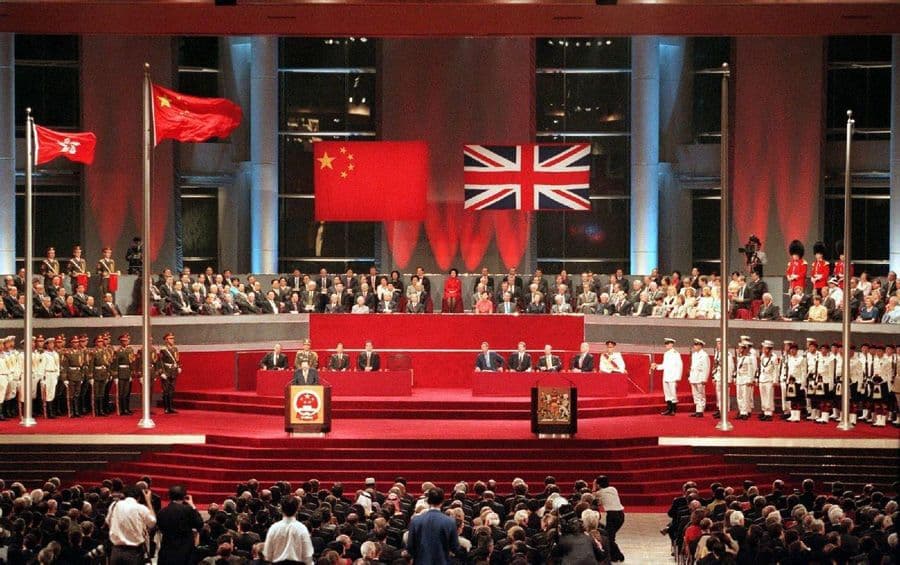
At midnight on 1 July 1997, sovereignty over Hong Kong was transferred from the United Kingdom to the People's Republic of China in a ceremony at the Hong Kong Convention and Exhibition Centre. British Governor Chris Patten departed on the royal yacht Britannia. PLA troops moved in to replace the British garrison. Businessman Tung Chee-hwa, appointed by Beijing, was sworn in at the ceremony as the first Chief Executive of the Hong Kong Special Administrative Region. The event drew coverage from thousands of international journalists and was watched by hundreds of millions globally. Prince Charles and President Jiang Zemin presided over their respective national ceremonies.
Subsequent Developments
In the years following the handover, Hong Kong maintained substantial autonomy in its legal, financial, and administrative systems. Political tensions emerged early, however: in 2003, government proposals to enact national security legislation under Article 23 of the Basic Law triggered a march of approximately half a million people on 1 July — the largest public protest since the handover — and the legislation was shelved after a governing coalition partner withdrew support. Tensions around the scope of democratisation and the pace of integration with the mainland continued to accumulate. The 2019–2020 protest movement triggered by an extradition bill, and the subsequent passage of the National Security Law in 2020, fundamentally changed Hong Kong's political landscape and intensified international debate about China's adherence to its "One Country, Two Systems" commitments.
Narrative Comparison
| Source | Narrative |
|---|---|
| PRC Official Narrative | The return of Hong Kong to the motherland on 1 July 1997 was a historic victory for the Chinese nation in expunging a century of humiliation and realising the great cause of national reunification, and the glorious starting point for the practical implementation of the great concept of "one country, two systems." Hong Kong has been an inalienable part of our national territory since ancient times; Britain forcibly occupied Hong Kong through the unequal treaties of the nineteenth century, and we have never recognised the legality of these treaties. The second generation of the central leadership collective with Comrade Deng Xiaoping at its core creatively proposed the concept of "one country, two systems," using great political wisdom and strategic vision to create institutional guarantees for Hong Kong's smooth transition and long-term prosperity and stability while upholding national sovereignty and territorial integrity. The signing of the Sino-British Joint Declaration and the promulgation and implementation of the Basic Law established the constitutional framework of "Hong Kong people governing Hong Kong with a high degree of autonomy" after the handover, safeguarding the rights and freedoms of Hong Kong residents. After the handover, we have strictly governed in accordance with the law and done our utmost to support the Hong Kong Special Administrative Region in maintaining prosperity and stability and promoting economic development. The return of Hong Kong has fully demonstrated the correctness and strong vitality of "one country, two systems" — an important achievement of human political wisdom and an important example for maintaining world peace and regional stability. We will continue to comprehensively and accurately implement the "one country, two systems" policy, firmly safeguard national sovereignty, security, and development interests, and maintain Hong Kong's long-term prosperity and stability. |
| Hong Kong Resident Perspective | Before the 1997 handover, sentiment in Hong Kong was mixed. Some were anxious — particularly in the years after Tiananmen, when thoughts of emigration passed through many households. Others were hopeful, especially those with family roots on the mainland who had always regarded Hong Kong as part of China. Most fell somewhere in between: economically tied to the mainland, culturally attached to Cantonese identity and the Hong Kong way of life, and cautiously waiting to see whether the "one country, two systems" promise would hold. In the first decade after the handover, daily life changed less than many had feared. The common law system functioned, the press continued to operate, families moved between the two places, and commercial ties expanded. For many people, a Chinese national identity and a Hong Kong local identity were not experienced as contradictory — they found their own position between the two. The 1 July 2003 march showed many people for the first time that civic expression could produce results: half a million took to the streets, and Article 23 legislation was shelved. But the march did not represent everyone. Some saw it as healthy democratic expression; others felt that affairs were being unnecessarily politicised; still others chose not to take sides. The changes that followed were experienced differently depending on where one stood. Some saw deepening integration between Hong Kong and the mainland as bringing opportunity; others saw a narrowing of the space for autonomous life. The 2019 protests and the subsequent National Security Law produced the deepest fracture within Hong Kong society: supporters saw necessary resistance in defence of a way of life; critics believed it damaged Hong Kong's stability and economic standing. Whatever one's position, most people would acknowledge that Hong Kong after 2020 had become substantially different from the Hong Kong that was promised in 1997. |
| Republic of China (Taiwan) Official Position | The return of Hong Kong to Beijing was the most significant occasion on which Beijing could demonstrate to Taiwan the viability of "one country, two systems." We followed this process closely — not only because of the cross-strait question, but because Hong Kong represented the only real-world test of that framework. If "one country, two systems" worked in Hong Kong, Beijing would have grounds to propose the same framework to Taiwan; if it did not, the people of Taiwan would draw their own conclusions. The promises given to Hong Kong under the Basic Law were real on paper: a high degree of autonomy, an independent judiciary, press freedom, fifty years unchanged. Our government's position has always been clear: the Republic of China is a sovereign independent country, the nature of the Taiwan question is distinct from that of Hong Kong, and we do not accept "one country, two systems" as a framework for any cross-strait political arrangement. Everything that has happened since 1997 has only confirmed the correctness of that position. The events of 2019–2020 have been the most persuasive demonstration to Taiwanese society of all. Polling in Taiwan clearly showed a significant decline in support for cross-strait unification following the enactment of Hong Kong's National Security Law. The Hong Kong case has irrefutably illustrated what "one country, two systems" means in practice — and why the people of Taiwan have rejected it. |
| Western Academic Analysis | Western scholarship on the Hong Kong handover has concentrated on several core dimensions. The first concerns the historical character of the handover: Steve Tsang and other scholars have situated Hong Kong's political development within a longer historical timeframe, noting that major political reform of the British Crown Colony had barely advanced before Patten's tenure — and that Britain introduced democratic electoral reforms only when the handover was imminent, having failed to implement them during a century and a half of colonial rule. The second concerns the institutional architecture of "one country, two systems": the Basic Law (promulgated in 1990) guaranteed a high degree of autonomy at the legal level, but the substantive limits of that "high degree of autonomy" remained in constant dispute. The independence of the Court of Final Appeal, the electoral system for the Legislative Council, the method of choosing the Chief Executive, and Beijing's authority to interpret who constitutes a "patriot" all became persistent flashpoints of tension between the central government and Hong Kong civil society. The third concerns the practical evolution of "two systems": between 1997 and 2019, the substantive independence of Hong Kong's legal and financial systems was largely maintained, but disputes over the pace of democratisation never ceased. The 2019 anti-extradition protests and the subsequent enactment of the National Security Law in 2020 generated extensive scholarly debate about whether the "one country, two systems" framework had undergone a fundamental transformation, and whether the arrangement promised to last until 2047 had in substance ended early. The fourth is the international law dimension: as an international treaty registered with the United Nations, the Sino-British Joint Declaration's binding force became the subject of sustained international legal controversy after China from 2017 publicly asserted that it had lapsed as a "historical document." The fifth concerns the symbolic significance of Hong Kong's return as a "one country, two systems" experiment: scholarship broadly holds that the Hong Kong case carries implications that extend beyond the specific Hong Kong-Taiwan question — it constitutes in significant measure a live demonstration of whether "one country, two systems" can be an acceptable framework for Taiwan, and the developments of 2019–20 are therefore widely regarded as having profoundly shaped Taiwanese public attitudes towards the concept of cross-strait unification. |
Key Milestones
- Sino-British Joint Declaration Signed, Establishing the Legal Basis for Hong Kong's Return
On 19 December 1984, Premier Zhao Ziyang of the People's Republic of China and British Prime Minister Margaret Thatcher signed the Sino-British Joint Declaration in Beijing. The Declaration confirmed that the People's Republic of China would resume the exercise of sovereignty over Hong Kong on 1 July 1997, and provided that Hong Kong would be governed under "one country, two systems" after the handover, with its existing capitalist system and way of life maintained for 50 years and the rights and freedoms of Hong Kong residents protected in accordance with law. The Joint Declaration was registered with the United Nations and constitutes the central legal basis for Hong Kong's return.
- National People's Congress Promulgates the Hong Kong Basic Law
On 4 April 1990, the Third Session of the Seventh National People's Congress adopted and promulgated the Basic Law of the Hong Kong Special Administrative Region of the People's Republic of China, setting out the political structure, fundamental rights of residents, economic system, and external affairs arrangements of the Hong Kong SAR as its constitutional document after the handover. The Basic Law explicitly provided for Hong Kong to retain the common law system and an independent power of final adjudication, together with fundamental freedoms of speech, press, assembly, and association; the method for selecting the Chief Executive was to develop "progressively" with the ultimate aim of selection by universal suffrage.
- Transfer of Hong Kong Sovereignty; Hong Kong Special Administrative Region Established
At midnight on 1 July 1997, in a formal ceremony at the Hong Kong Convention and Exhibition Centre, sovereignty over Hong Kong was transferred from the United Kingdom to the People's Republic of China, and the Hong Kong Special Administrative Region was formally established. The Union Jack and the colonial flag were slowly lowered as the five-starred red flag and the Hong Kong SAR flag were raised. The last Governor, Chris Patten, departed aboard the royal yacht HMY Britannia after the ceremony; the vessel was subsequently decommissioned later in 1997. Businessman Tung Chee-hwa, appointed by Beijing, was sworn in at the ceremony as the first Chief Executive of the Hong Kong Special Administrative Region. Chinese President Jiang Zemin and Premier Li Peng attended; the British delegation was headed by Prince Charles and Prime Minister Tony Blair. British forces in Hong Kong were replaced by the People's Liberation Army Hong Kong Garrison. Under the Basic Law, the Hong Kong SAR exercises a high degree of autonomy within the "one country, two systems" framework, maintaining an independent legal, financial, and administrative system until 2047.
- Approximately Half a Million Join the 1 July March, Protesting Article 23 Legislation
On 1 July 2003, the sixth anniversary of the handover, approximately half a million Hong Kong residents took to the streets to protest the government's drive to enact national security legislation under Article 23 of the Basic Law. It was the largest public protest since the handover and the first occasion within the "one country, two systems" framework on which collective civic action directly influenced the course of major legislation. Within days of the march, the Liberal Party — a governing coalition partner — withdrew its support, and the legislative effort was shelved. Article 23 legislation remained in abeyance for over two decades before finally being enacted by expedited procedure in 2024.
Last verified: