The 1967 Hong Kong Riots
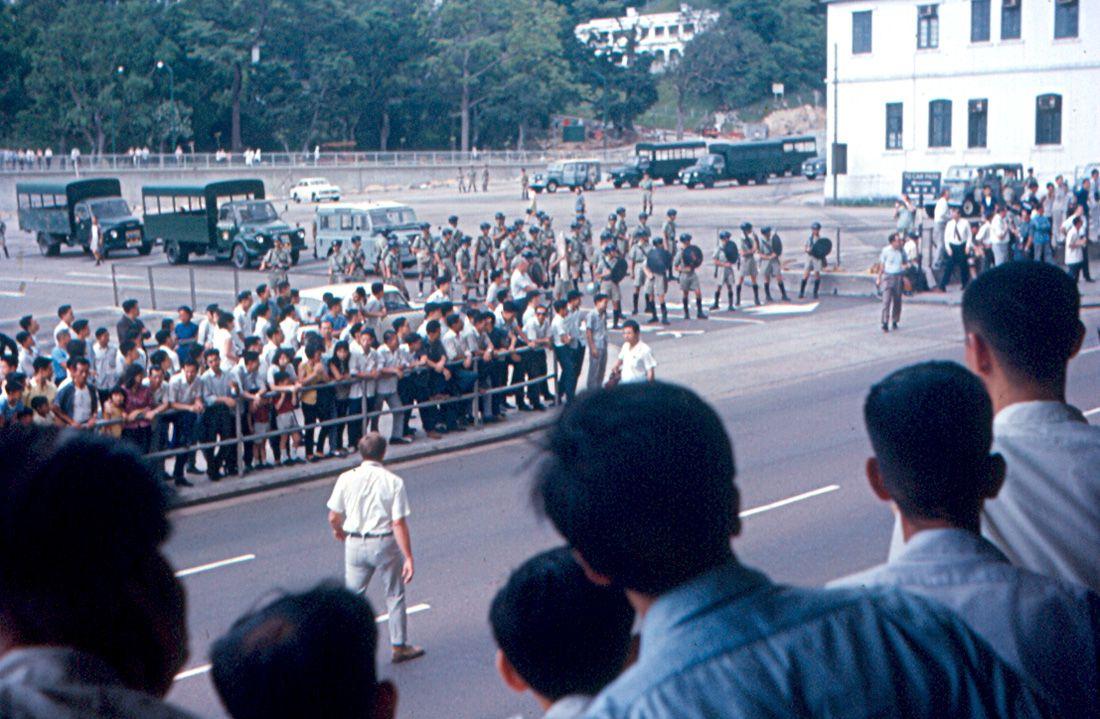
In May 1967 a labour dispute at an artificial-flower factory in San Po Kong, Kowloon, led to clashes with police and, under the influence of the Cultural Revolution, quickly grew into an “anti-British” campaign launched by Hong Kong’s leftists with Beijing’s backing. From May to December the colony saw strikes, demonstrations, a deadly shooting at the Sha Tau Kok border and widespread bombing; the government enacted emergency regulations, made mass arrests, suspended leftist newspapers and closed leftist schools. Official figures record at least 51 dead, over 800 injured and thousands arrested, and order was not restored until early 1968. Labour and social reforms followed. After the Cultural Revolution a 1978 CCP work conference judged the “line was wrong”; in 2001 the SAR government’s award of the Grand Bauhinia Medal to struggle-committee leader Yeung Kwong drew controversy.
Background
In the 1960s Hong Kong workers were poorly paid, had little protection and lived in dire housing, and social tensions were building. In April 1966 a Star Ferry fare rise set off the Kowloon disturbances, which lasted several days and ended with curfews and mass arrests. At the end of that year Macau’s leftists clashed with the Portuguese authorities in the “12-3” incident, in which Macau’s leftists brought the Portuguese administration to its knees—an inspiration to Hong Kong’s leftists. Ray Yep notes that the colonial government’s minimal approach to welfare had left room for the leftists to expand among workers; the Federation of Trade Unions and other leftist unions, newspapers, schools and film companies formed a network that could be mobilised.
The San Po Kong Dispute
On 6 May 1967 a dispute over cuts to bonuses and allowances at the Hong Kong Artificial Flower Works in San Po Kong, Kowloon, spiralled out of control: the employer fired 92 workers, and when police were called in many workers were injured and 18 arrested. The communist-led Hong Kong Federation of Trade Unions intervened at once with four demands—release of those arrested, punishment of those responsible and compensation, guarantees of workers’ safety, and no further police interference in labour disputes—and the dispute was quickly politicised.
Beijing Intervenes
Yep sees the turning point as the intervention of China’s Ministry of Foreign Affairs on 15 May, when it handed a protest to the British chargé d’affaires; anti-British demonstrations followed in Beijing and Guangzhou and the People’s Daily ran supportive editorials. Hong Kong leftists formed the All Circles Anti-Persecution Struggle Committee, and strikes, marches and demonstrations spread across the territory, with protesters waving Mao’s Little Red Book. On 25 May officials of the Central Foreign Affairs Office, the Foreign Ministry and the Central Investigation Department in Beijing formed an Anti-Persecution Joint Office, with Wu Dizhou, a veteran of the Party’s underground work in Hong Kong, heading its mass-struggle group.
According to the historian Yu Ruxin, drawing on Wu’s notes, about a week after the flower-factory incident Liao Chengzhi, director of the State Council Foreign Affairs Office, proposed a struggle plan to Zhou Enlai, who approved it and passed it to the Guangdong Military Control Commission and the Hong Kong and Macao Work Committee; Zhou was kept informed of the leftists’ actions throughout and often issued instructions. On 3 June a People’s Daily editorial urged Hong Kong’s “patriotic compatriots” to mobilise further and stand ready to answer the motherland’s call. Citing Li Weiying, former deputy political director of the Guangzhou Military Region, Yu says that in early June Zhou summoned three deputy commanders of the region to Beijing to discuss recovering Hong Kong, but then relayed four considerations from Mao and decided on “no fighting now”; on 6 June Zhou instructed that there be no general strike and no immediate demand to recover Hong Kong, and that legal and illegal struggle be combined. Wu’s notes also record that he stopped leftists from shipping 8,400 cane knives into Hong Kong.
The Colonial Government’s Response
Governor Sir David Trench judged the original dispute “spontaneous” and not premeditated by Beijing, and the escalation largely the work of local communist leaders proving their loyalty to the radicals on the mainland; he favoured firm containment, reasoning that if the crisis were contained before it spiralled, Beijing would not be pushed into direct confrontation. The government enacted emergency regulations, arrested organisers and protesters en masse, suspended leftist newspapers, closed leftist schools and deported some activists. A Special Branch assessment of 15 May concluded that the leftists’ actions were organised by the Federation of Trade Unions and Xinhua’s Hong Kong branch with the agreement of the Central People’s Government. The scholar Hsu Chung-tak notes that the government also set up propaganda bodies to win public support.
Escalation
On 8 July several hundred demonstrators crossed the border at Sha Tau Kok and attacked the police post; according to the Commonwealth Secretary’s statement to the House of Commons, they included militia, the post came under fire including “automatic fire from Chinese territory”, and “Five police were killed and 11 wounded”; water supplies from the mainland had also been cut off. Demonstrations then gave way to bombing: according to the Hong Kong Police’s online history, 8,074 suspected bombs were found that year, of which 1,167 were real. Lam Bun, a Commercial Radio host and prominent opponent of the riots, was burned to death in his car, and in North Point a girl of seven and her two-year-old brother were killed by a bomb. On 22 August Red Guards in Beijing burned the British mission.
Suppression and Casualties
According to a British written answer in the House of Commons in November 1967, “During the period from 11th May to 8th November, 47 people have been killed and 781 have been injured.” The Hong Kong Police history records at least 51 deaths, including ten police officers, and 802 injured; Yep counts about 4,500 arrests. Strikes, clashes and bombings were concentrated between May and December, and order was gradually restored by early 1968. Yep argues that the government’s firm measures worked in large part because Mao was then anxious to curb radicalism on the mainland by imposing military control.
Impact
After the riots labour conditions improved: regulations on working hours and on women’s and child labour were introduced, and debates on social insurance gained urgency. Yep also notes that the confrontation tarnished the image of leftist unions, removing the best-organised labour groups from policy debate. Hsu Chung-tak argues that through its “Riots, 1967—Undeniable Facts” series, published from the early days of the riots to 1969, the government fostered a sense of being “Hongkongers” and that “Hong Kong is my home”, so that the Hongkonger identity was in part a product of the propaganda war between the government and the leftists.
Verdicts and Controversy
According to Ching Cheong, after the Cultural Revolution the CCP’s 1978 work conference on Hong Kong and Macao concluded that “the masses were heroic, the line was wrong, the responsibility lies with the Centre”; the version cited by Yu Ruxin from former Hong Kong and Macao Affairs Office deputy director Li Hou ends “the losses were severe”. In 2001 Chief Executive Tung Chee-hwa awarded the Grand Bauhinia Medal to Yeung Kwong, who had led the struggle committee, prompting controversy. In 2015 the Hong Kong Police revised its online account of 1967, changing “communist militia” to “gunmen” and “Chinese side of the border” to “border area in Sha Tau Kok” in the Sha Tau Kok passage; the police said the changes were only to make the text more concise and correct sentences.
Gallery
Narrative Comparison
| Source | Narrative |
|---|---|
| Chinese Foreign Ministry protest and People’s Daily editorials (1967); CCP Hong Kong–Macao work conference verdict (1978, via Ching Cheong) | At the time Beijing and Hong Kong’s leftists called it the “anti-British, anti-violence struggle”: China’s Foreign Ministry protested to Britain, and People’s Daily editorials urged Hong Kong’s “patriotic compatriots” to mobilise and “smash the reactionary rule of British imperialism”, presenting the colonial crackdown as persecution of Chinese compatriots. After the Cultural Revolution the assessment changed: according to Ching Cheong, the 1978 Hong Kong and Macao work conference concluded that “the masses were heroic, the line was wrong, the responsibility lies with the Centre.” In 2001 the SAR government awarded struggle-committee leader Yeung Kwong the Grand Bauhinia Medal for his contribution to the labour movement. |
| Ray Yep, “The Hong Kong Riots of 1967” (2022); Hsu Chung-tak (Twenty-First Century) | Scholars generally see the riots as rooted in a labour dispute among impoverished workers but driven mainly by the spillover of Cultural Revolution radicalism. Drawing on declassified British files, Ray Yep shows that Governor Trench judged Beijing had not planned the unrest and pursued firm containment—arrests, suspension of leftist newspapers, closure of leftist schools and emergency powers—restoring order by early 1968, though success also depended on Mao’s own wish to curb radicalism on the mainland. The riots spurred labour legislation and social reform but tarnished leftist unions. Hsu Chung-tak’s research on the government’s propaganda war argues that a “Hongkonger” identity partly took shape through it. |
| Notes of CCP Hong Kong official Wu Dizhou (via Yu Ruxin and HK01, 2017) | Wu Dizhou, who headed the mass-struggle group of Beijing’s Anti-Persecution Joint Office, left working notes from May to August 1967. As read by the historian Yu Ruxin, they show that the struggle plan was proposed by Liao Chengzhi and approved by Zhou Enlai before being passed to Guangdong to execute, that Zhou was informed throughout and often issued instructions, and that Wu himself stopped leftists from shipping 8,400 cane knives into Hong Kong. According to Ching Cheong, Wu was later placed under investigation during the Cultural Revolution because his stand was deemed not firm enough. Yu regards the riots, like the Cultural Revolution, as an error of the whole Party, and cites former deputy director Li Hou’s verdict—“the masses were heroic, the line was wrong, the losses were severe”—to argue that they should not be rehabilitated. |
| UK parliamentary statements and written answers (1967); Hong Kong Special Branch assessment and Governor Trench’s telegrams (via HK01 and Ray Yep, from British archives) | The British government and the colonial authorities saw the unrest as riots and terrorism launched by local leftists under the influence of the Cultural Revolution, with Beijing’s agreement. Governor Trench judged in his telegrams that the original dispute was “spontaneous” and not premeditated by Beijing, and that the escalation stemmed mainly from local communist leaders’ instinct for self-preservation, so he argued for firm containment; a Special Branch assessment of 15 May concluded that the leftists’ actions were organised by the Federation of Trade Unions and Xinhua with the agreement of the Central People’s Government. After Sha Tau Kok, the Commonwealth Secretary told the Commons that the demonstrators included militia and the post had come under “automatic fire from Chinese territory”, that the British chargé d’affaires had strongly protested to the Chinese Foreign Ministry, and that the Hong Kong authorities, “with the full support of Her Majesty's Government, will take all necessary measures to maintain peace and security of Hong Kong.” In November the government reported 47 dead and 781 injured between 11 May and 8 November. |
Key Milestones
- San Po Kong factory clash
A labour dispute spirals; 92 workers are fired and 18 arrested after police intervene.
- Chinese Foreign Ministry protests
The Foreign Ministry protests to the British chargé d’affaires; anti-British demonstrations follow.
- Beijing forms Anti-Persecution Joint Office
Central bodies form a joint office; Wu Dizhou heads its mass-struggle group.
- People’s Daily editorial
An editorial urges Hong Kong’s “patriotic compatriots” to mobilise further.
- Sha Tau Kok shooting
Demonstrators cross the border and attack a police post; five police are killed.
- British mission in Beijing burned
Red Guards burn the British mission in Beijing.
- Britain gives casualty figures
The British government reports 47 dead and 781 injured since 11 May.
- Order restored
Strikes, clashes and bombings subside by early 1968.
- 1978 Party verdict
A CCP work conference concludes that the masses were heroic but the line was wrong.
- Yeung Kwong honoured
Struggle-committee leader Yeung Kwong receives the SAR’s highest honour, prompting controversy.
- Police revise online history
The Hong Kong Police revise their online account of the 1967 riots.
Last verified:
Cite this page
Chronicles of Modern China. (2026, November 21). The 1967 Hong Kong Riots. Retrieved November 21, 2026, from https://www.cmcarchive.org/events/hong-kong-1967-riots
“The 1967 Hong Kong Riots.” Chronicles of Modern China. Last modified November 21, 2026. Accessed November 21, 2026. https://www.cmcarchive.org/events/hong-kong-1967-riots.
Chronicles of Modern China. The 1967 Hong Kong Riots[EB/OL]. (2026-11-21)[2026-11-21]. https://www.cmcarchive.org/events/hong-kong-1967-riots.