Burning of the British Mission in Beijing (1967)
On the night of 22 August 1967—amid the Hong Kong riots and a rebel seizure of power in the Foreign Ministry—a Chinese note giving the Hong Kong authorities 48 hours to lift the closure of three leftist newspapers expired, and Red Guards and crowds stormed the Office of the British Chargé d’Affaires in Beijing, burning the building and cars, sacking the residence and beating the staff, including chargé Donald Hopson. Zhou Enlai ordered garrison troops to fight the fire and protect the staff, and sternly criticised the rebels the next morning; Wang Li and Guan Feng were soon placed in isolation. Britain and China then restricted each other’s diplomats. Zhou apologised to Britain in 1971. The official mainland account blames ultra-leftism stirred up by Wang Li, while the recollections of British witnesses and a Chinese participant emphasise different things.
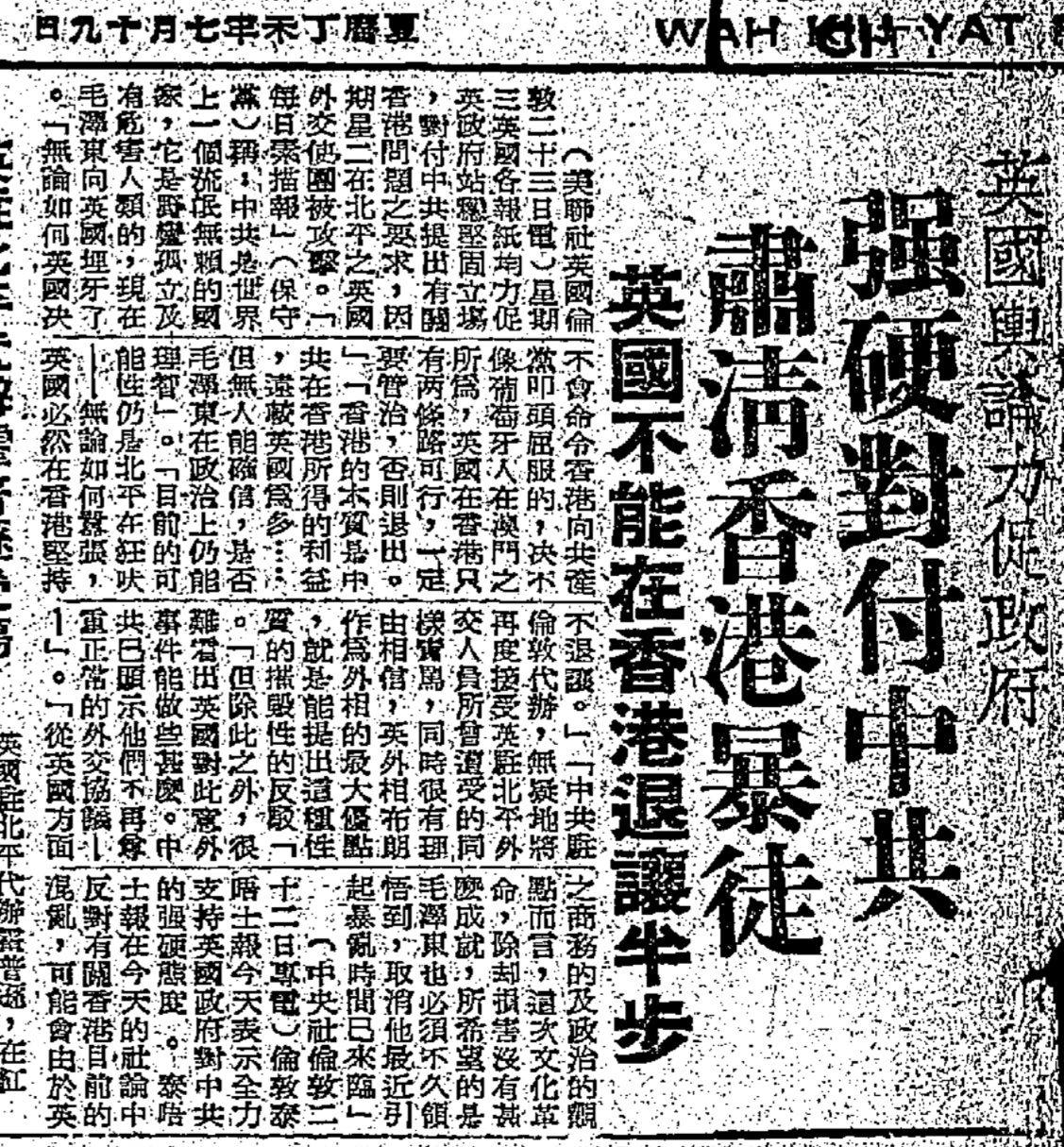
Background: The Hong Kong Riots and the Seizure of Power in the Foreign Ministry
In May 1967 a labour dispute in Hong Kong set off months of demonstrations, strikes and violence. The scholar Ray Yep argues that these events were primarily a spillover of political radicalism on the mainland; on 15 May the Chinese Foreign Ministry handed a protest to the British chargé d’affaires in Beijing, followed by anti-British demonstrations in Beijing and Guangzhou and supportive People’s Daily editorials. The Hong Kong government responded with mass arrests and the suspension of leftist newspapers. According to a China News Service article, in August 1967 the Hong Kong authorities detained Xue Ping, a Xinhua reporter; on 20 August, after the closure of three newspapers (Ye Bao, Tian Feng Bao and Xin Wu Bao), the Chinese Foreign Ministry sent a note to the British office demanding that the closure orders be revoked within 48 hours.
Meanwhile rebels inside the Foreign Ministry were seizing power. According to an article from the journal Party Documents published by CPC News, on the evening of 7 August Wang Li of the Central Cultural Revolution Group received Foreign Ministry rebels and told them: “Diplomacy is just a bluff!” and “Can’t Red Guards do diplomacy?”, asking why the ministry’s Party committee could not be shaken up; the article says Wang’s “7 August speech” fuelled ultra-leftism in foreign affairs. It dates the rebels’ declaration that they had seized power over the ministry to 19 August, while the China News Service article gives 16 August and says vice-ministers Ji Pengfei and Qiao Guanhua were locked in a basement. The CPC News article says Zhou Enlai had repeatedly insisted that authority over diplomatic business belonged to the Centre and could only be supervised, not seized.
The Night of 22 August
The 48-hour deadline expired on the evening of 22 August. According to the account of the participant Li Bing carried by China News Service, a crowd led by workers of the Beijing No. 1 Machine Tool Plant and students of the Beijing Foreign Languages Institute came to demonstrate at the British office that evening. According to Room for Diplomacy, a catalogue of British diplomatic buildings, the 23 British staff had come prepared for a siege and began burning classified papers after dark; fifteen minutes after the ultimatum expired, a furious attack began. Percy Cradock, then political counsellor, recalled “the noise of breaking glass, heavy blows against the door, then flames as cars were set alight”; the staff retreated into the registry, and as smoke thickened he and the chargé d’affaires Donald Hopson decided to open the door and get out, whereupon they were seized and beaten by the crowd.
According to the CPC News article, Zhou Enlai on hearing the news ordered garrison troops to persuade the crowd to withdraw and protect the staff; the troops fought the fire until midnight, rescuing the chargé and 15 others, while seven more escaped to the diplomatic flats and the Finnish Embassy. Cradock wrote that “The Residence had been sacked; the Office itself had been burned down. There had been no fatalities, though there were cases of concussion and all had been badly bruised and beaten,” and that “It seems likely that the army had had orders to save lives.” A British staff member quoted by China News Service recalled that 23 people, five of them women, were in the building and all were injured, Hopson most seriously. Li Bing’s account says that in the chaos someone—nobody knew who—set fire to office documents in the courtyard, that he himself climbed the flagpole to replace the British flag, and that loudspeakers later broadcast a statement by Zhou asking everyone to leave.
On 23 August the People’s Daily reported that more than ten thousand Red Guards and revolutionary masses had demonstrated at the British office and, “moved by righteous indignation, took strong action against the office.” At 3 a.m. that day Zhou Enlai summoned the leaders of the rebel organisations in the foreign affairs system and sternly criticised the seizure of power in the Foreign Ministry and the burning of the British office.
Stand-off and Mutual Restrictions
Britain at once forbade Chinese diplomats in Britain to leave the country and restricted their movements. Cradock recalled that the mission “advised against a rupture of relations, but proposed an evacuation of women and children (a forlorn hope as it turned out).” On 29 August Chinese mission staff in London clashed with British police in Portland Place, with injuries on both sides; Cradock considered the episode engineered by the Chinese “so that they could claim to match us in terms of outrage”. Vice Foreign Minister Luo Guibo then delivered a “most serious and strong protest”, cancelled all exit visas and confined British staff to their office, residences and the road between. A written answer in the House of Commons on 20 November 1967 stated that since 22 August no exit visas had been granted to mission members except for five schoolchildren and two wives with a small child.
The Fall of Wang Li and Guan Feng, and the Aftermath
According to the CPC News article, early on 25 August Zhou Enlai sent Acting Chief of Staff Yang Chengwu to report to Mao in Shanghai with material on Wang Li’s speech; the next day Mao said: “Wang, Guan and Qi are wrecking the Cultural Revolution; they are not good people! Wang’s speech is a big, big, big poisonous weed!” On the evening of 26 August Wang Li and Guan Feng were placed in isolation, and Qi Benyu followed four months later. The article calls the burning the most serious incident involving foreigners since 1949 and rare in diplomatic history, which together with the earlier attacks on the Indian and Indonesian embassies brought China’s diplomacy and international reputation to “freezing point”. According to China News Service, Zhou Enlai publicly apologised to Britain for the burning on 2 March 1971. Li Bing was later labelled a “May 16 element”; he maintained that he had acted from indignation and simple patriotic passion and that “nobody secretly put me up to it”.
Gallery
Narrative Comparison
| Source | Narrative |
|---|---|
| Article from Party Documents (CPC News, Zhou Enlai memorial site, 2019) | The current official mainland account blames the burning on the ultra-leftism stirred up by Wang Li and others in the Central Cultural Revolution Group: Wang’s “7 August speech” encouraged Foreign Ministry rebels to seize power, after which they set fire to the British office. It stresses that Zhou Enlai had insisted diplomatic authority must not be seized, that he immediately ordered garrison troops to protect the British staff and fight the fire, and that he sternly criticised the rebels the next morning; Mao then called Wang’s speech “a big, big, big poisonous weed” and Wang and Guan Feng were isolated. The account describes the burning as the most serious incident involving foreigners since 1949, which brought China’s diplomacy and international reputation to “freezing point”. |
| British eyewitness: Percy Cradock’s memoir extract (The Spectator, 1994) | Percy Cradock, then political counsellor at the British mission, recalled the staff retreating behind successive defence points until the burning building forced them out into the crowd, where they were seized and beaten; Hopson emerged “his head in a bloodstained bandage”, the residence was sacked and the office burned down, with no deaths but everyone injured. He judged that the army “had had orders to save lives” but could do little more. He regarded the Portland Place clash in London on 29 August as “undoubtedly engineered by the Chinese so that they could claim to match us in terms of outrage”, and recorded the subsequent ban on exit visas and confinement of the staff. |
| Chinese participant: Li Bing’s account as recorded by Zhang Zheng (China News Service, from Beijing Daily, 2009) | Li Bing, a worker at the Beijing No. 1 Machine Tool Plant who took part, presented the event as a spontaneous protest prompted by the Hong Kong authorities’ detention of a Xinhua reporter, led by workers from his plant and students of the Beijing Foreign Languages Institute; in the chaos someone—nobody knew who—set fire to documents in the courtyard, he himself climbed the flagpole to replace the British flag, and the crowd dispersed after loudspeakers broadcast a statement by Zhou Enlai. Later labelled a “May 16 element”, he insisted that “nobody secretly put me up to it; it was just indignation and simple patriotic passion”, while conceding that he “loved too much and went too far”. |
Key Milestones
- Chinese protest over Hong Kong
The Foreign Ministry protests to the British chargé in Beijing; anti-British demonstrations follow in Beijing and Guangzhou.
- Wang Li’s 7 August speech
Wang Li receives Foreign Ministry rebels and questions why Red Guards cannot conduct diplomacy.
- Rebels seize the Foreign Ministry
According to CPC News, rebels smash the ministry’s political department and declare a seizure of power (China News Service gives 16 August).
- 48-hour note
The Foreign Ministry gives the British office 48 hours to revoke the closure of three Hong Kong newspapers.
- British office burned
After the deadline, a crowd storms the British office, burns the building and cars and beats the staff.
- Zhou criticises rebels
At 3 a.m. Zhou Enlai summons rebel leaders and sternly criticises the seizure of power and the burning.
- Wang Li and Guan Feng isolated
On Mao’s decision, Wang Li and Guan Feng are placed in isolation.
- Portland Place clash and Luo Guibo’s protest
Chinese staff clash with police in London; China then cancels British exit visas and confines the staff.
- Zhou apologises
According to China News Service, Zhou Enlai publicly apologises to Britain for the burning.
Last verified:
Cite this page
Chronicles of Modern China. (2026, November 11). Burning of the British Mission in Beijing (1967). Retrieved November 11, 2026, from https://www.cmcarchive.org/events/burning-of-british-mission-beijing-1967
“Burning of the British Mission in Beijing (1967).” Chronicles of Modern China. Last modified November 11, 2026. Accessed November 11, 2026. https://www.cmcarchive.org/events/burning-of-british-mission-beijing-1967.
Chronicles of Modern China. Burning of the British Mission in Beijing (1967)[EB/OL]. (2026-11-11)[2026-11-11]. https://www.cmcarchive.org/events/burning-of-british-mission-beijing-1967.