Launch of Dongfanghong-1, China's First Satellite
On 24 April 1970 China launched its first artificial satellite, Dongfanghong-1, on a Long March 1 rocket from the Jiuquan Satellite Launch Center, becoming the fifth country to build and launch a satellite independently. The 173 kg satellite broadcast "The East Is Red". The project began in 1965 as "Task 651" and was developed during the Cultural Revolution, in which scientists including Zhao Jiuzhang and Yao Tongbin died as a result of persecution. The satellite stopped transmitting on 14 May and remains in orbit.
From "581" to "651"
After the Soviet Union launched the first artificial satellite in October 1957, according to Sun Jiadong, scientists including Qian Xuesen and Zhao Jiuzhang proposed at a Chinese Academy of Sciences forum that China also begin satellite research; on 17 May 1958 Mao Zedong declared at the Second Session of the Eighth Party Congress, "We too shall make satellites." It was the Great Leap Forward: at a mobilisation meeting that June the Academy proposed launching a heavy satellite as a gift for the tenth National Day in 1959, and in the second half of the year it set up a body for satellite and rocket research, code-named "581", with Qian as head and Zhao as deputy. In autumn 1958 Zhao led a delegation to the Soviet Union to study space technology but was given the cold shoulder, saying afterwards that China had "only ourselves to rely on". Lacking basic theory and launch capability, and facing economic difficulties, satellite work was suspended in early 1959 in favour of sounding rockets; on 19 February 1960 a T-7M sounding rocket was launched from the outskirts of Shanghai.
In 1964 China test-fired a domestically designed ballistic missile and conducted its first nuclear test, and the satellite plan returned to the agenda. According to Sun, Zhao wrote to Zhou Enlai in December 1964 proposing a satellite programme, and Qian made a similar proposal; in 1965 the project was approved by the central leadership under the code name "Task 651". That autumn researchers spent 42 consecutive days discussing the overall design, with a launch planned for 1970. In January 1966 Zhao became director of the Academy's "651" Satellite Design Institute.
Development During the Cultural Revolution
The Cultural Revolution hit the satellite team hard. According to a 2016 Xinhua report, in early 1967 many scientists, including Long March 1 chief designer Wang Xiji, were denounced and sidelined, and Qian Ji, who drafted the launch plan, was labelled a "reactionary academic authority"; rocket expert Yao Tongbin was beaten to death at the door of his home; and Zhao Jiuzhang took his own life in 1968 rather than endure further persecution. Sun said the Academy's satellite team was "paralysed".
In 1967 Zhou Enlai and Nie Rongzhen assigned Qian Xuesen to rebuild the satellite team, and Sun was transferred to take charge of overall technical design. On 20 February 1968 the China Academy of Space Technology was founded, with Qian as its president, and took over development of Dongfanghong-1. Sun recalled that after political vetting "half of our team of over 100 were judged unqualified"; those told to "stand aside" sat idle by day but still slipped into the laboratory at night to work. Zhou personally intervened on manufacturing problems such as connector panels.
Technical Goals and Design
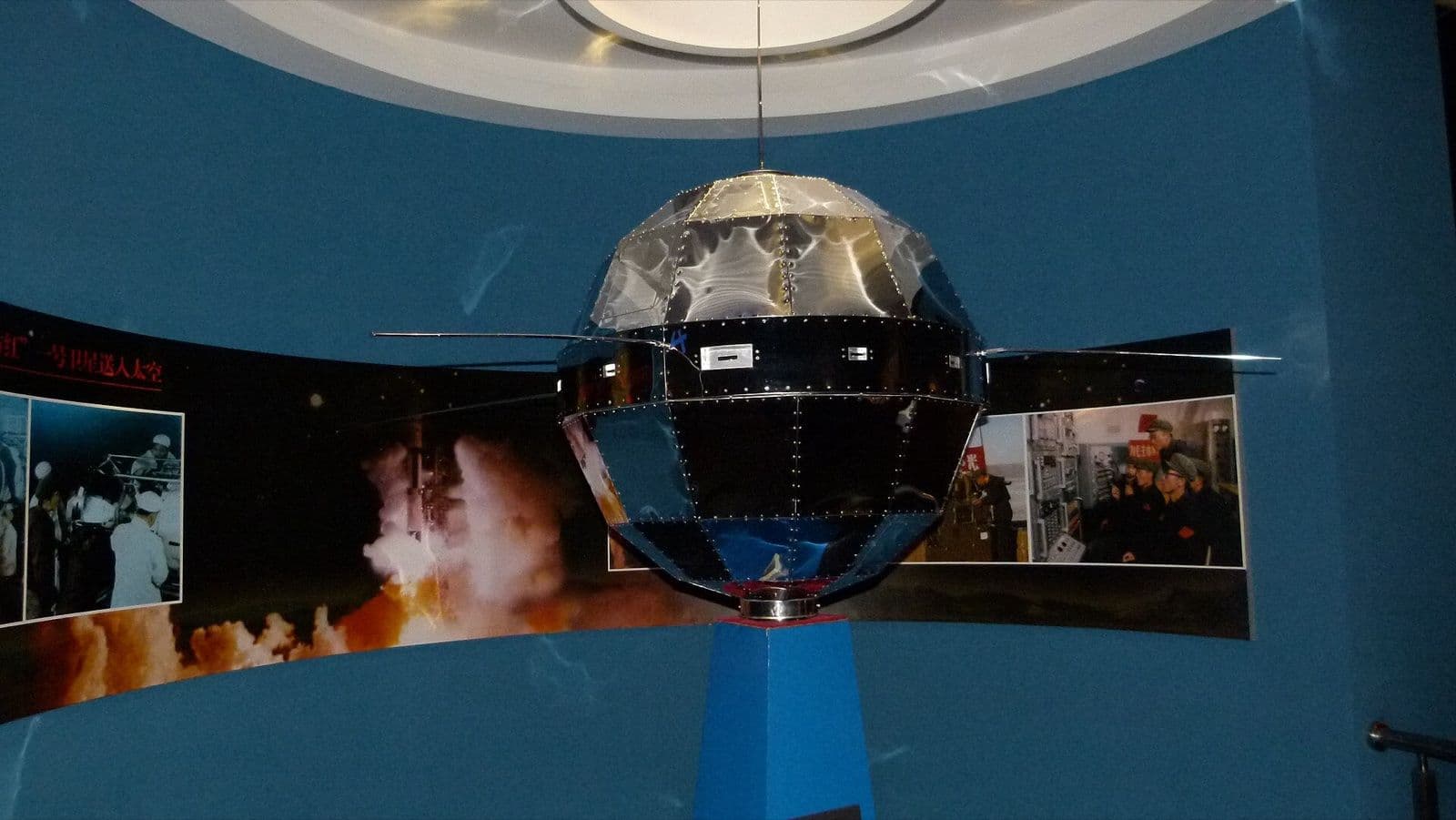
In 1967 the first satellite was named Dongfanghong-1 ("The East Is Red 1") and its launcher Long March 1. The satellite was a near-spherical 72-faced polyhedron one metre across; as the design evolved its mass rose from 150 kg to 173 kg. The state set four requirements: "get it up, keep track of it, hear it and see it." Long March 1 used an intermediate-range missile as its first and second stages and a third stage developed from sounding-rocket technology; ground tracking relied on Doppler measurement; an electronic tone generator played "The East Is Red", which Central People's Broadcasting Station received with high-power equipment and rebroadcast, while the frequency was announced so listeners abroad could tune in; and to make it visible to the naked eye a highly reflective "observation body" that unfolded in space was fitted to the rocket's third stage. Sun noted that the satellite outweighed the first satellites of the Soviet Union, the United States, France and Japan combined, but that this "did not mean our manufacturing standard was high": more than 80 of its 173 kg were batteries. A 2015 paper by researchers at the National University of Defense Technology argues that design features including the observable sphere, the orbit and the tone generator were shaped by the needs of political propaganda.
Launch
In February 1970 the satellite and rocket arrived at the Jiuquan Satellite Launch Center. At 21:35 on 24 April Long March 1 lifted off; about 15 minutes later the satellite separated and entered orbit. Xinhua's communiqué of 25 April gave its orbit as 439 km perigee, 2,384 km apogee, 68.5 degrees inclination and a 114-minute period, its mass as 173 kg, and its broadcast of "The East Is Red" on 20.009 MHz. The communiqué attributed the success to leadership by "the Party Central Committee with Chairman Mao as leader and Vice-Chairman Lin as deputy leader" (that is, Lin Biao), calling it "another rich fruit of the Great Proletarian Cultural Revolution". China thus became the fifth country, after the Soviet Union, the United States, France and Japan, to build and launch a satellite independently. Designed to operate for 20 days, the satellite stopped transmitting on 14 May 1970 and remains in orbit.
Assessments and Commemoration
On 18 September 1999 the Party Central Committee, State Council and Central Military Commission awarded the "Two Bombs, One Satellite" Meritorious Medal to 23 scientists, including Qian Xuesen, Sun Jiadong, Wang Xiji and Ren Xinmin, and posthumously to Zhao Jiuzhang, Yao Tongbin and Qian Ji, among others. Since 2016, 24 April has been China's Space Day. On 23 April 2020 Xi Jinping replied to a letter from veteran scientists of the mission, recalling that he was "very excited" to hear of the launch in Liangjiahe, northern Shaanxi, and calling for the "Two Bombs, One Satellite" spirit to be carried forward.
Gallery
Narrative Comparison
| Source | Narrative |
|---|---|
| Xinhua communiqué (25 April 1970; People's Daily, 26 April 1970) | The official account of 1970 credited the launch to the political line. Xinhua's communiqué opened by declaring that Chairman Mao's "great call" to make satellites "has been realised", attributing the success to the Party Central Committee "with Chairman Mao as leader and Vice-Chairman Lin as deputy leader" and to "grasping revolution and promoting production", and calling it "a great victory of Mao Zedong Thought" and "another rich fruit of the Great Proletarian Cultural Revolution". |
| Wu Yansheng, People's Daily, 24 April 2020; Xinhua (English), 2016; Xinhua, 24 April 2020 | Present-day official accounts no longer speak of a "fruit of the Cultural Revolution"; they stress Party leadership, the whole-nation system and self-reliance, while acknowledging the persecution of scientists. In 2020 Wu Yansheng, chairman of China Aerospace Science and Technology Corporation, called the launch "a great achievement of upholding the Party's correct leadership and the advantages of the whole-nation system" and "a great feat of self-reliance and independent innovation" that nurtured the "Two Bombs, One Satellite" spirit; a 2016 Xinhua report states that Wang Xiji and others were denounced, Yao Tongbin was beaten to death and Zhao Jiuzhang committed suicide. Xi Jinping's 2020 letter said the determination of "self-reliance and hard struggle must not be lost". |
| Yang, CHINOPERL 44(2), 2025 (abstract) | Western scholarship focuses on the satellite's political and cultural symbolism. Yingchuan Yang (2025) traces "The East Is Red" from a northern Shaanxi folk song to the "anthem of the Cultural Revolution", arguing that broadcasting it from orbit showcased the socialist state's technological capacity, with mass campaigns organised for people to listen together; the celesta-and-noise "space version" kept its Shaanxi flavour, illustrating the enduring impulse of Communist cultural and political elites to harness the symbolic power of sound. |
| Sun Jiadong, oral account, China Economic Weekly, 28 September 2009; Qi Faren quoted by Xinhua (English), 2016 | Participants' recollections dwell on working under political campaigns and on technical limits. Sun Jiadong (2009) said that after Zhao Jiuzhang was overthrown he "could not bear the humiliation and took his own life", leaving the Academy's team "paralysed"; half the team failed political vetting yet slipped back into the lab at night; the satellite had to be audible and visible because otherwise "the political and social effect would be greatly diminished"; and its weight "did not mean our manufacturing standard was high" but reflected backward technique, though it did demonstrate the rocket's lift. Qi Faren (2016): "Many people made outstanding contributions but were sidelined, some even persecuted. They should not have been treated like this." |
Key Milestones
- Mao: "We too shall make satellites"
Mao calls for satellite development at the Second Session of the Eighth Party Congress; the Academy of Sciences later sets up the "581" satellite group.
- T-7M sounding rocket launched
With satellite work suspended, the T-7M sounding rocket is launched near Shanghai.
- China Academy of Space Technology founded
Qian Xuesen becomes president; the institute takes over development of Dongfanghong-1.
- Dongfanghong-1 launched
At 21:35 Long March 1 lifts off from Jiuquan; the satellite reaches orbit about 15 minutes later.
- Xinhua communiqué
Xinhua announces the orbit, the 173 kg mass and the broadcast of "The East Is Red" on 20.009 MHz.
- Mao receives members of the launch team
According to a 2003 China News Service report, Mao Zedong personally received some of the personnel who launched the Dongfanghong satellite.
- Satellite stops transmitting
The satellite, designed to work for 20 days, stops transmitting; it remains in orbit.
- "Two Bombs, One Satellite" medals
Twenty-three scientists are awarded the medal, some posthumously, including Qian Xuesen, Sun Jiadong, Zhao Jiuzhang and Qian Ji.
- Xi replies to veteran scientists
On the eve of the 50th anniversary, Xi Jinping replies to veteran scientists of the mission.
Last verified:
Cite this page
Chronicles of Modern China. (2026, November 1). Launch of Dongfanghong-1, China's First Satellite. Retrieved November 1, 2026, from https://www.cmcarchive.org/events/dongfanghong-1-satellite-1970
“Launch of Dongfanghong-1, China's First Satellite.” Chronicles of Modern China. Last modified November 1, 2026. Accessed November 1, 2026. https://www.cmcarchive.org/events/dongfanghong-1-satellite-1970.
Chronicles of Modern China. Launch of Dongfanghong-1, China's First Satellite[EB/OL]. (2026-11-01)[2026-11-01]. https://www.cmcarchive.org/events/dongfanghong-1-satellite-1970.