December 9th Movement (1935)
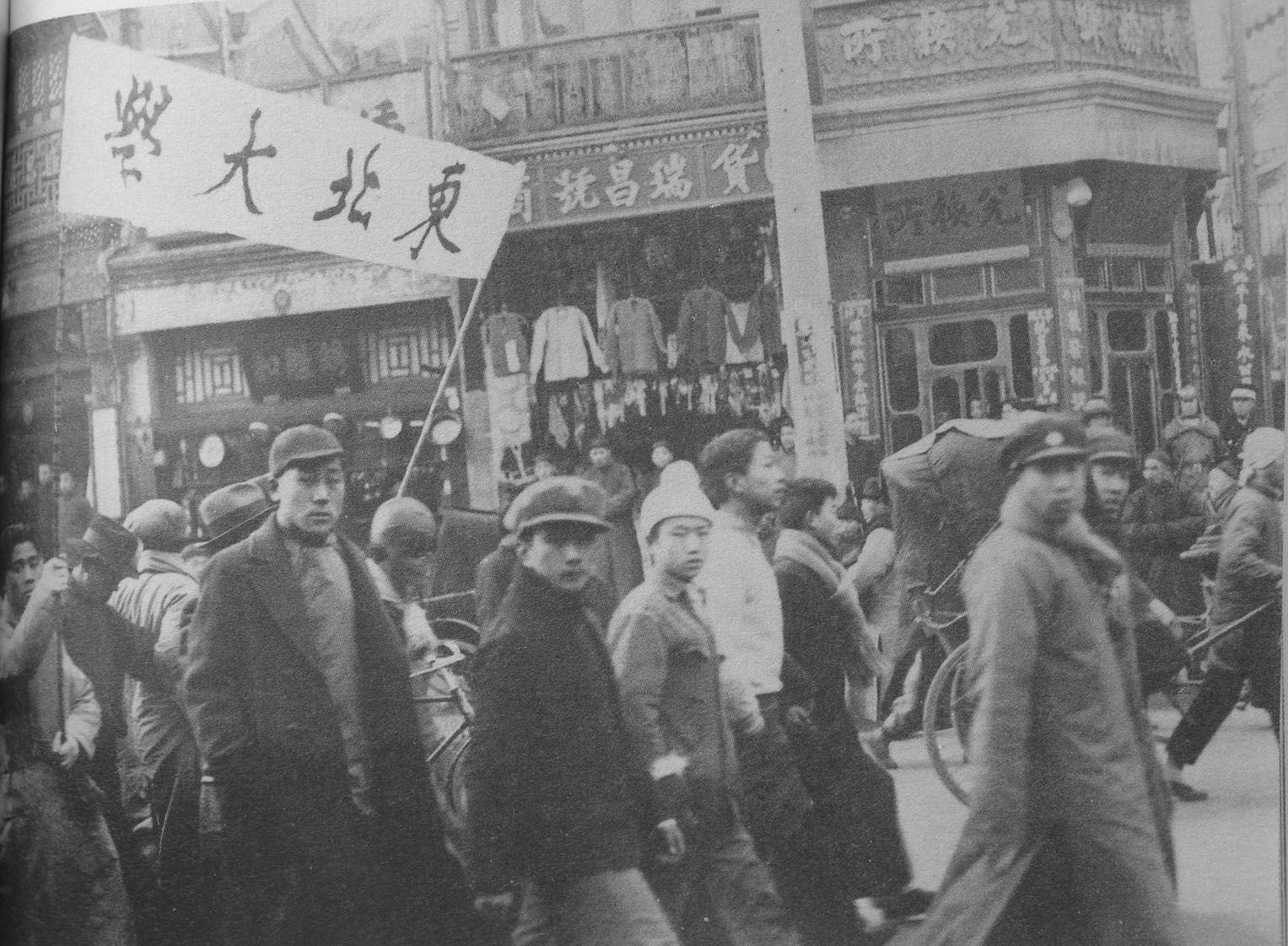
In 1935, as the Japanese military pushed for North China “autonomy”, the Nationalist government decided to set up a Hopei-Chahar Political Council under Song Zheyuan. On 9 December Peiping students, organised by the CCP Peiping Provisional Work Committee and the Peiping Students’ Union, petitioned the authorities at Xinhua Gate with six demands, including opposition to “anti-communist autonomy”; rebuffed, they marched and were dispersed by police, and on the 16th held a larger rally and march. The movement spread to many cities, Peiping–Tianjin students sent propaganda corps into the countryside, and the Chinese National Liberation Vanguard was founded in February 1936. The official mainland account, the Nationalist side, Japan and US diplomats differ over the numbers involved, whether the council was postponed, and the nature of the movement.
Background: The North China Incident and the Hopei-Chahar Council
In 1935 the Japanese military stepped up its campaign to detach North China. According to the website of the CCP Institute of Party History and Literature, in June and July Japan forced the Nationalist government to sign the He–Umezu and Qin–Doihara agreements, in effect taking control of most of the sovereignty of Hebei and Chahar, and promoted an “anti-communist autonomy movement”—what mainland histories call the North China Incident. In late November Yin Rugeng, administrative inspector of eastern Hebei, declared “autonomy”. A telegram of 6 December from the US ambassador, Nelson Johnson, reported that Song Zheyuan had gone into seclusion and that Yin’s plane had dropped handbills over Peiping urging support for autonomy; it relayed the view of well-informed Chinese that “Nanking has no intention of risking war with Japan to save Hopei and Chahar.”
The government sent He Yingqin north to handle the situation. According to the Japanese historian Tanaka Hitoshi, on 8 December the government decided to establish a Hopei-Chahar Political Council under Song Zheyuan. The arrangement was characterised differently. Mainland party histories say the government did so to meet Japan’s demand for a “special status for North China”, placing the region outside ordinary administration. Hu Shih told the US ambassador at the time that the government took part in order to dissuade Song from declaring independence and keep his army loyal, and that “Nanking is not ready to fight but expects to fight eventually as there is no end to Japanese ambition.” He Yingqin’s farewell letter to the university presidents said the council was being set up by central decree and that “Changes of personnel do not affect national unity.” On 11 December a liaison officer of the Japanese War Office told the US military attaché in Tokyo that talks between He and Song for “a semiautonomous state in Hopei and Chahar” were going smoothly and that the Japanese army authorities were well satisfied.
Student Organisation and Preparations
According to the CCP Party History Research Centre’s History of the Communist Party of China, the CCP Peiping Provisional Work Committee, set up in November 1935, led students in forming the Peiping Union of University and Middle School Students. The Tsinghua University National Salvation Association’s “Letter to the People of the Whole Country” declared: “Vast as North China is, there is no longer room for a quiet desk!” On 6 December the student associations of 15 Peiping schools issued a circular telegram condemning the government’s policy of compromise since the Mukden Incident. On hearing that the Hopei-Chahar Political Council would be inaugurated on 9 December, the union’s Party group decided to stage a petition march that day. Tanaka Hitoshi argues that the movement was triggered by the “political vacuum” created by Japan’s campaign to detach North China and by the arrival of the Comintern’s new line from its Seventh Congress, and that the organisational bases of the student movement in the area were all under direct CCP leadership.
The Petition and March of 9 December
According to the party history, on 9 December, under the Provisional Work Committee of Li Changqing, Peng Tao and Zhou Xiaozhou and with students such as Yao Yilin, Guo Mingqiu, Huang Jing and Song Li as organisers, students from Northeastern, Tsinghua, Yenching, Normal, China and Peking universities and several middle schools marched into the streets; several thousand broke through police lines to petition the Peiping authorities before Xinhua Gate with six demands: opposition to the “anti-communist autonomy” movement, publication of Sino-Japanese negotiations, no arbitrary arrests, security of the territory, an end to all civil war, and freedom of speech, assembly, association and publication. When these were rejected the petition became a demonstration. Soldiers and police broke up the marchers at the southern end of Wangfujing and elsewhere with broadswords, fire hoses, whips and clubs; the party history records more than 30 arrests and several hundred injured.
Tsinghua and Yenching students locked out at Xizhimen held a mass meeting beside the city wall, where the Tsinghua student Lu Cui spoke for the students’ union; a photograph of her speech later appeared on the cover of Zou Taofen’s Life of the Masses. Estimates of numbers vary widely. The party history speaks of several thousand students and the Institute’s website gives more than 5,000. Ambassador Johnson’s telegram that day, citing foreign observers, said five or six hundred Tsinghua and Yenching students were shut out of the city while three or four hundred students demonstrated in front of He Yingqin’s residence, the crowd later reaching about 1,200. Hu Shih told Johnson the next day that about 1,000 students took part inside and outside the city, that “The demonstration was spontaneous,” and that “A few radicals took advantage of the opportunity to distribute radical propaganda.”
The Strike and the March of 16 December
From 10 December Peiping students declared a general strike; on the 11th the US ambassador reported that students at five universities including Yenching, Tsinghua and Peiping National were refusing to attend classes. On 16 December students broke through police lines to hold a citizens’ rally at Tianqiao, which the party history says drew more than 30,000 people and resolved on “non-recognition of the Hopei-Chahar Political Council”; the march that followed was again suppressed, with dozens arrested and more than 300 injured. According to the Institute’s website, the American journalist Edgar Snow followed the arrested Lu Cui into a police station that day and interviewed her.
Accounts differ over the council itself. The party history says that under pressure from the movement the authorities “were forced to announce that the Council’s establishment would be postponed”; Ambassador Johnson’s telegram of 18 December and Tanaka’s study both record that the Hopei-Chahar Political Council was formally inaugurated on 18 December.
The Japanese Reaction
According to US embassy telegrams, after the 9 December demonstration a Japanese official named Takahashi protested to the municipal authorities at their inadequate handling, claimed the demonstration was communist and accused Hu Shih and Chiang Monlin of instigating it; the ambassador concluded that “anti-Japanese activities in China proper will hereafter be termed by the Japanese as communist.” On 16 December the Japanese assistant military attaché demanded that Tsinghua president Mei Yiqi and Peking University chancellor Chiang Monlin be punished and expelled from Peiping, that the schools involved be closed and that the police be punished. On 19 December the Japanese ambassador met Chiang Kai-shek in Nanjing; according to information reaching the Americans, he expressed Tokyo’s disappointment that the good effect anticipated from the recent changes in North China “had been marred by the action of the Chinese authorities in permitting recrudescence of student agitation,” adding that Japan reserved liberty to act as circumstances might dictate.
The Movement Spreads
According to the party history, from 11 December students in Tianjin, Baoding, Taiyuan, Xi’an, Jinan, Hangzhou, Shanghai, Wuhan, Chengdu, Chongqing, Guangzhou and other cities held rallies and marches, and on 12 December more than 280 people including Shen Junru, Ma Xiangbo, Zou Taofen and Zhang Naiqi issued a national salvation manifesto of Shanghai cultural circles. The US consul general in Shanghai reported that on 23 December some 400 students occupied the North Station demanding trains to Nanjing to see government leaders, and that according to the local foreign press Chiang Kai-shek telegraphed the students expressing understanding of their patriotic motives and urging them to return to school. Tanaka notes that the movement reached Tianjin on the 18th and that the government ordered winter vacation brought forward to calm it.
On 30 December a Peiping Students’ Union delegates’ meeting resolved after fierce debate on southward propaganda; Tanaka records more than 450 participants in four corps setting out on 2–3 January 1936, while the party history gives about 500. Out of this propaganda corps the Chinese National Liberation Vanguard was founded in Peiping on 1 February 1936, which the party history says grew into a national organisation of more than 20,000. From February the Peiping–Tianjin authorities began suppressing the student movement. The CCP Centre named Liu Shaoqi its representative to the North on 29 December 1935; he reached Tianjin at the end of March 1936 and in April became secretary of the reorganised North China Bureau.
Assessments
The official mainland history describes the December 9th Movement as an anti-Japanese patriotic movement organised by the Peiping Students’ Union under CCP leadership, which exposed Japan’s plot to annex North China, struck at the government’s policy of compromise and marked a new upsurge of national-salvation activity; it quotes Mao Zedong in 1939 as saying the movement prepared the ideas, the hearts and the cadres for the war of resistance. The Japanese side at the time branded the demonstrations communist. Hu Shih’s contemporary view was that the demonstration was spontaneous and exploited by a few radicals; in the Independent Critic he supported the central government’s decision to entrust Hebei and Chahar to the leaders of the 29th Army, while insisting that the people of the region had no demand whatever for “autonomy” or “independence”. Tanaka Hitoshi argues that the popular national-salvation movement the December 9th Movement set off led, through the Xi’an Incident, to the Second United Front of September 1937.
Gallery
Narrative Comparison
| Source | Narrative |
|---|---|
| CCP Party History Research Centre, History of the CPC, vol. 1 (2002); CCP Institute of Party History and Literature website (2025) | The official mainland account calls the December 9th Movement “a large-scale anti-Japanese patriotic movement organised and launched by the Peiping Students’ Union under the leadership of the Communist Party of China,” provoked by Japan’s push for North China “autonomy” and the government’s plan, made to meet Japanese demands, to set up the Hopei-Chahar Political Council; the students were brutally suppressed by Nationalist police. It holds that the movement struck at the government’s policy of compromise, forced the authorities to postpone the council, grew into a nationwide mass movement and “promoted the formation of the anti-Japanese national united front,” training many future cadres. |
| He Yingqin’s farewell letter (December 1935, quoted by Hu Shih in the Independent Critic); the government’s reasoning as relayed by Hu Shih and Chiang Kai-shek’s telegram to students (via FRUS) | The Nationalist government presented the Hopei-Chahar Political Council as a measure to preserve unity. He Yingqin’s farewell letter to the Peiping university presidents said the council was established by central decree, that the local authorities “are all full of national feeling” and that “Changes of personnel do not affect national unity.” According to Hu Shih’s account to the US ambassador, the government took part in order to dissuade Song Zheyuan from declaring independence and keep his army loyal, and was not ready to fight but expected to fight eventually. As for the students, according to the foreign press in Shanghai, Chiang Kai-shek telegraphed those seeking to go to Nanjing, expressing understanding of their patriotic motives and urging them to return to school. |
| Statements by the Japanese official Takahashi, the assistant military attaché in Peiping, the Japanese ambassador and a War Office liaison officer (December 1935, via FRUS) | The Japanese side regarded the Hopei-Chahar council as progress towards a “semiautonomous state” in North China; a War Office liaison officer said talks between He Yingqin and Song Zheyuan were going smoothly and the army authorities were “well satisfied with the progress made.” On the student movement, a Japanese official named Takahashi claimed the demonstration was communist and accused Hu Shih and Chiang Monlin of instigating it, and the assistant military attaché later demanded that Mei Yiqi and Chiang Monlin be punished and expelled and the schools closed; the Japanese ambassador told Nanjing that the authorities’ toleration of renewed student agitation had marred the good effect of the changes in North China and that Japan reserved liberty to act. |
| Telegrams of US Ambassador Nelson Johnson and Consul General John Davis (December 1935) | The US embassy and consulate telegrams chiefly recorded events and the claims of each side: on 9 December five or six hundred Tsinghua and Yenching students were shut out of the city while students inside demonstrated before He Yingqin’s residence, the crowd reaching about 1,200; strikes followed, there were no demonstrations after the 16th, and the council was inaugurated on the 18th. They relayed Hu Shih’s view that “The demonstration was spontaneous” and recorded the Japanese branding of it as communist, from which Johnson inferred that Japan would henceforth term anti-Japanese activity in China communist. They also passed on the view of well-informed Chinese that Nanking had no intention of risking war to save Hebei and Chahar. |
| Hu Shih (then dean of arts, Peking University): account to the US ambassador (10 December 1935, via FRUS); “Settling the Hopei-Chahar Situation” (1935) | Hu Shih, who was in Peiping and was accused by the Japanese of instigating the protest, told the US ambassador the next day that about 1,000 students had taken part inside and outside the city, that the demonstration was spontaneous, and that only a few radicals had used it to distribute radical propaganda. In the Independent Critic he argued that the central government’s entrusting of Hebei and Chahar to the leaders of the 29th Army “is a proper course”—“The central government trusts them, and we the people should trust them too”—while insisting that the people of the region had no demand for “autonomy” or “independence”, and urging the council to arrest Yin Rugeng and end the eastern Hebei “autonomy”. |
Key Milestones
- He–Umezu and Qin–Doihara agreements
In June–July 1935 Japan forces two agreements on Nanjing; mainland histories say Japan thereby took effective control of most of Hebei and Chahar.
- Peiping schools’ circular telegram
Student associations of 15 Peiping schools condemn the government’s policy of compromise.
- Decision on the Hopei-Chahar Council
The Nationalist government decides to set up a political council under Song Zheyuan.
- Petition at Xinhua Gate and march
Peiping students petition the authorities, march when rebuffed and are dispersed by police.
- General student strike
Peiping students declare a general strike from classes.
- Tianqiao rally and march
A citizens’ rally at Tianqiao rejects the council; the march is again suppressed.
- Hopei-Chahar Council inaugurated
According to the US embassy the council is inaugurated that morning; the movement spreads to Tianjin.
- Shanghai students occupy North Station
About 400 Shanghai students occupy the North Station demanding trains to Nanjing.
- Southward propaganda approved
A students’ union meeting resolves after fierce debate to send propaganda corps south.
- Propaganda corps set out
The Peiping–Tianjin southward propaganda corps set out on 2–3 January.
- National Liberation Vanguard founded
The Chinese National Liberation Vanguard is founded in Peiping from the propaganda corps.
Last verified:
Cite this page
Chronicles of Modern China. (2026, November 11). December 9th Movement (1935). Retrieved November 11, 2026, from https://www.cmcarchive.org/events/december-9th-movement-1935
“December 9th Movement (1935).” Chronicles of Modern China. Last modified November 11, 2026. Accessed November 11, 2026. https://www.cmcarchive.org/events/december-9th-movement-1935.
Chronicles of Modern China. December 9th Movement (1935)[EB/OL]. (2026-11-11)[2026-11-11]. https://www.cmcarchive.org/events/december-9th-movement-1935.