China's Population Begins to Decline
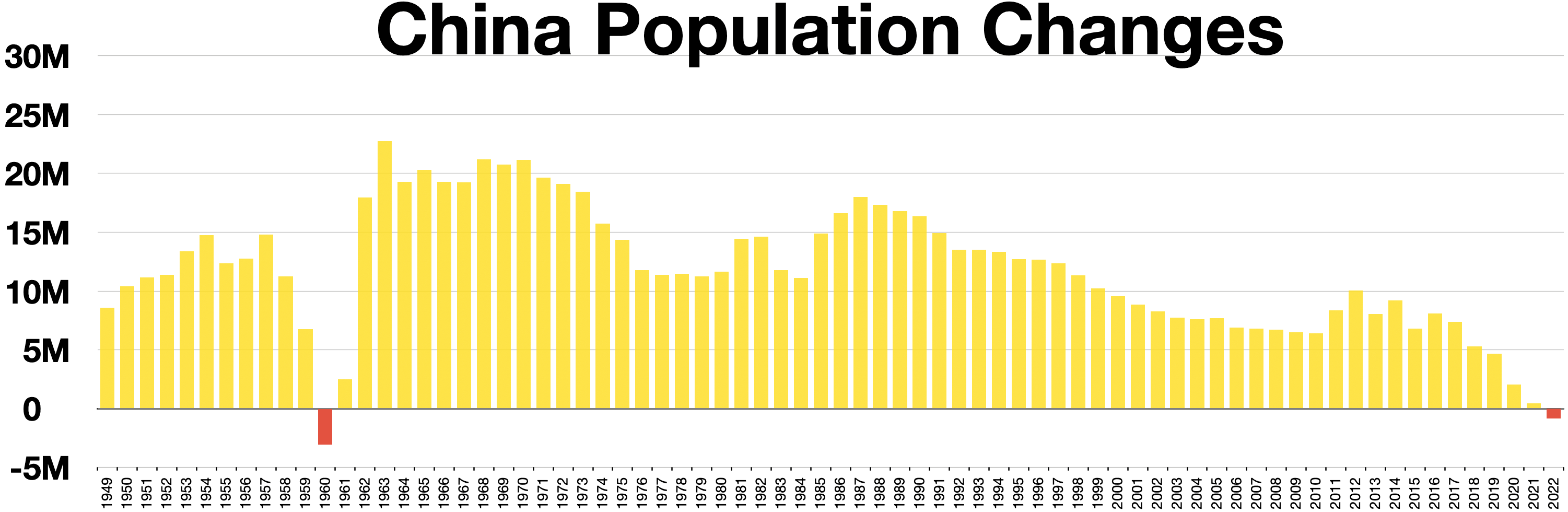
On 17 January 2023 the National Bureau of Statistics announced that China's population fell by 850,000 in 2022, its first decline since 1962, attributing it to fewer women of childbearing age and falling fertility. In April that year the UN projected that India had overtaken China as the most populous country. China's population has fallen every year since, with births dropping to 7.92 million in 2025, the lowest since 1949.
Background: From One Child to Three
China enforced a one-child policy from the 1980s and allowed all couples two children from 2016. Births rose to 17.86 million that year but fell every year thereafter. On 31 May 2021 a Politburo meeting chaired by Xi Jinping decided to allow couples three children, with supporting measures. Demographers had long expected China's population to peak in the early 2020s.
The First Decline
On 17 January 2023 the National Bureau of Statistics announced that China's population at the end of 2022 was 1,411.75 million, 850,000 fewer than a year earlier; births totalled 9.56 million, a birth rate of 6.77 per thousand, and deaths 10.41 million, a death rate of 7.37 per thousand, giving a natural growth rate of −0.60 per thousand. It was the first population decline in China since 1962; the previous fall had come during the famine years after the Great Leap Forward.
Wang Pingping, head of the bureau's population and employment statistics department, said the decline was mainly due to fewer births: first, the number of women of childbearing age kept falling — women aged 15–49 numbered more than 4 million fewer in 2022 than in 2021, including nearly 5 million fewer in the peak childbearing ages of 21–35; second, fertility fell further, affected by changing attitudes to childbearing, later marriage and childbearing and other factors. Kang Yi, head of the bureau, said that overall labour supply still exceeded demand.
India Overtakes China
In April 2023 the UN Department of Economic and Social Affairs projected in a policy brief that China would that month cede its long-held status as the world's most populous country to India.
Later Trends and Policy
China's population continued to shrink. According to official data, births in 2021–2025 were 10.62 million, 9.56 million, 9.02 million, 9.54 million and 7.92 million; after a brief rise in 2024, births fell to 7.92 million in 2025, by media counts the lowest since 1949. China's population at the end of 2025 stood at 1,404.89 million, the fourth consecutive annual decline. To encourage births, the General Offices of the CCP Central Committee and the State Council published an Implementation Plan for the Childcare Subsidy System in July 2025, paying RMB 3,600 per child per year for children under three from 1 January 2025, whether first, second or third children.
Fewer Children, More Elderly
Falling births have been accompanied by deepening ageing. According to the National Health Commission's statistical bulletin for 2025, the natural growth rate fell to −2.41 per thousand that year; people aged 65 and over made up 15.9% of the population, up 0.3 percentage points from a year earlier, while those aged 0–15 made up 16.4%, a gap of only 0.5 points. China became a moderately aged society in 2021, when the share aged 65 and over first exceeded 14%. National Health Commission head Lei Haichao wrote that the government would improve its system of support for childbearing, including through childcare subsidies, maternity insurance and affordable childcare services.
Gallery
Narrative Comparison
| Source | Narrative |
|---|---|
| Chinese official position (National Bureau of Statistics) | China's total population declined slightly in 2022 mainly because of fewer births: the number of women of childbearing age kept falling, and fertility declined further owing to changing attitudes to childbearing, later marriage and childbearing and other factors. Although the population fell slightly, overall labour supply still exceeds demand and urbanisation continues to rise. The state has introduced the three-child policy with supporting measures and set up a childcare subsidy system to ease the burden of having and raising children. |
| Western academic analysis (Wang Feng, University of California, Irvine) | Wang Feng, a sociology professor at the University of California, Irvine, argues that Beijing's abandonment of the one-child policy in 2016 did not reverse the demographic decline — births fell every year thereafter — calling it "a slow storm that has gained strength over the past few years", and that the "historical footprint" of the policy has left families accustomed to having a single child. He had earlier argued that China's population had peaked, that 2021 would be the last year of population growth, and that the long-term decline would be hard to reverse. |
| Ordinary citizens (as interviewed by Reuters, January 2023) | After the population figures were released, Wei, a Shanghai mother of twins, told Reuters: "Nowadays many people do not want to have children if they can't provide a good education for them," arguing that the government should do more to help families. Ding Ding, the 37-year-old father of a three-year-old girl, said: "People born in the 1980s or 1990s are not as keen to have children as our parents' generation. Our parents think if they have more children, they can get more care when they grow old. But the younger generation don't think the same anymore… They think raising one child is already very tiring." |
Key Milestones
- Three-child policy adopted
A CCP Politburo meeting decided to allow couples three children, with supporting measures.
- NBS announces first population decline
China's population at end-2022 was 1,411.75 million, down 850,000 — the first decline since 1962; births 9.56 million, deaths 10.41 million.
- UN: India overtakes China
A UN DESA policy brief projected that China would cede the title of most populous country to India in April 2023.
- Childcare subsidy announced
The childcare subsidy plan was published, paying RMB 3,600 per child per year for children under three.
Last verified:
Cite this page
Chronicles of Modern China. (2026, November 2). China's Population Begins to Decline. Retrieved November 2, 2026, from https://www.cmcarchive.org/events/china-population-decline-2022
“China's Population Begins to Decline.” Chronicles of Modern China. Last modified November 2, 2026. Accessed November 2, 2026. https://www.cmcarchive.org/events/china-population-decline-2022.
Chronicles of Modern China. China's Population Begins to Decline[EB/OL]. (2026-11-02)[2026-11-02]. https://www.cmcarchive.org/events/china-population-decline-2022.