Beijing 2022 Winter Olympics
The XXIV Olympic Winter Games were held in Beijing and Zhangjiakou, Hebei, from 4 to 20 February 2022, making Beijing the first city to host both the Summer and Winter Olympics. Staged under COVID-19 "closed-loop" management, the Games drew international controversy over diplomatic boycotts by the United States and others citing human rights in Xinjiang, and over the case of tennis player Peng Shuai. China finished third in the gold-medal table with 9 gold, 4 silver and 2 bronze, its best Winter Olympics.
The Bid
On 31 July 2015, at the 128th IOC Session in Kuala Lumpur, Malaysia — where the vote switched to paper ballots after the new electronic voting system malfunctioned — Beijing defeated Almaty, Kazakhstan, by 44 votes to 40 to win the right to host the XXIV Olympic Winter Games in 2022, becoming the first city to host both the Summer and the Winter Olympics. The Games were co-hosted by Beijing and Zhangjiakou in Hebei Province.
Diplomatic Boycotts and Human Rights Controversy
As the opening approached, the Games were drawn into international political disputes. On 6 December 2021, White House Press Secretary Jen Psaki announced that, given what she called China's "ongoing genocide and crimes against humanity in Xinjiang", the Biden administration would send no diplomatic or official representation to the Beijing Winter Olympics and Paralympics, although American athletes would compete as usual; Australia, Britain, Canada and other countries announced similar diplomatic boycotts. Chinese Foreign Ministry spokesperson Zhao Lijian had said earlier that the Winter Olympics were not a stage for political posturing, that the US should stop hyping a so-called "diplomatic boycott", and that if it insisted on going its own way, "China will certainly take resolute countermeasures"; Liu Pengyu, spokesperson of the Chinese Embassy in the US, said China had never invited American politicians.
The case of tennis player Peng Shuai also drew attention. In November 2021, Peng accused former Vice Premier Zhang Gaoli of sexual assault in a social-media post that was quickly deleted; she then largely disappeared from public view, and the Women's Tennis Association (WTA) suspended all its tournaments in China. On 5 February 2022, IOC President Thomas Bach had dinner with Peng in Beijing; in an interview with the French newspaper L'Équipe around the same time, Peng said she had never said anyone sexually assaulted her and that the post had been misunderstood. The IOC's statement did not address the assault allegation itself.
The COVID-19 "Closed Loop"
Because of the COVID-19 pandemic, the Games operated under closed-loop management: the organising committee began a trial run on 4 January 2022 and switched to Games-time closed-loop management on 23 January. Athletes, officials, media and other Games participants travelled by dedicated transport between the Olympic villages, venues and contracted hotels, were tested daily and were kept apart from the general public. According to the organisers, 393 people tested positive on retest between 23 January and 7 February, with no cluster outbreaks inside the loop. Some athletes who tested positive complained about isolation arrangements; Belgian skeleton racer Kim Meylemans was moved back to an isolation wing in the Olympic Village after posting a tearful video from isolation.
Opening and Competition
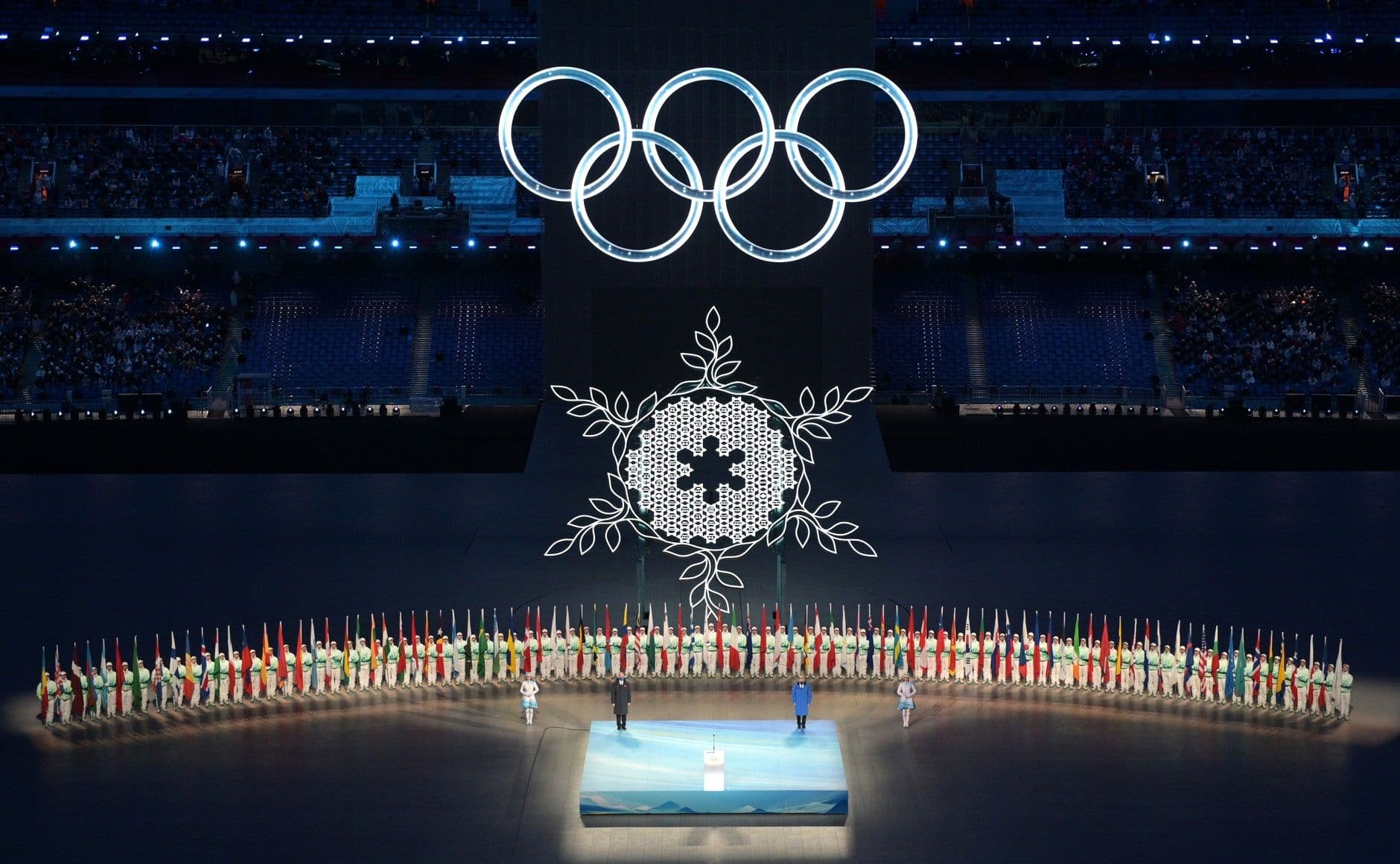
The Games opened at the National Stadium on 4 February 2022. Russian President Vladimir Putin attended the opening ceremony and held talks with Xi Jinping that day. The two countries issued a joint statement the same day declaring that "friendship between the two States has no limits, there are no 'forbidden' areas of cooperation", with Russia supporting China in successfully hosting the Games. In the opening ceremony, Uyghur cross-country skier Dinigeer Yilamujiang and Nordic combined athlete Zhao Jiawen, as the final torchbearers, placed the flame at the centre of a giant snowflake in place of a traditional cauldron — a choice that drew attention given international criticism of China's policies in Xinjiang.
The Games closed on 20 February. The Chinese delegation, with 9 gold, 4 silver and 2 bronze medals, ranked third in the gold-medal table — its best Winter Olympic result — with young athletes such as Eileen Gu (Gu Ailing), Su Yiming and Gao Tingyu winning gold. The Beijing Winter Paralympics followed from 4 to 13 March.
Post-Games Commendation Conference
On 8 April 2022, a commendation conference for the Beijing Winter Olympics and Paralympics was held in the Great Hall of the People. In his speech Xi Jinping said that China had overcome the COVID-19 pandemic and other difficulties to "present the world with a streamlined, safe and splendid Olympic Games", that Beijing had become the world's first "dual Olympic city", and he set out a "Beijing Winter Olympic spirit" of "keeping the big picture in mind, being confident and open, rising to challenges, pursuing excellence and creating a better future together".
Gallery
Narrative Comparison
| Source | Narrative |
|---|---|
| Chinese official position (Xi Jinping's speech, Foreign Ministry, Beijing 2022 organisers) | Overcoming COVID-19 and other difficulties, China delivered on schedule a streamlined, safe and splendid Olympic Games, fully honouring its solemn commitment to the international community; Beijing became the world's first "dual Olympic city" and the Chinese delegation achieved its best-ever Winter Olympic result. Strict closed-loop management was effective, with no cluster outbreaks inside the loop. The Olympics are not a stage for political posturing; the "diplomatic boycott" by politicians of certain countries on so-called human rights grounds politicised sport and seriously violated the spirit of the Olympic Charter. |
| Western academic research (Jacobsen, International Journal of Sport Policy and Politics, 2026) | Jacobsen, a University of Würzburg researcher who competed at Beijing 2022 as a member of Denmark's curling team, analysed media coverage and official materials and argued that China's Olympic narrative centred on three elements — unity, technological innovation and sustainability — continuously reinforced by state media; that critical terms such as "boycott", "human rights" and "Uyghurs" appeared less often in European coverage as the Games went on; and that strict restrictions on media and athletes helped the host control the narrative. He argues that such "sportswashing" may be aimed as much at a domestic audience — fostering unity, legitimising the political system and even turning foreign accusations of sportswashing to the regime's advantage — as at an international one, so simple moral yes-or-no judgements are insufficient. |
| Eyewitnesses (athletes inside the closed loop, as reported by AP) | Belgian skeleton racer Kim Meylemans was isolated after testing positive on arrival; believing her isolation was over and she was being taken to the Olympic Village, she saw the ambulance drive past it to another isolation facility, and posted a tearful video. After being moved to an isolation wing in the village she said: "I am now in a wing that's just isolation, but at least I'm back in the village. I feel safe and I'll be able to train a little better here." US bobsledder Kaillie Humphries said of the unknowns after a positive test: "It's so confusing. It's very frustrating. It's scary." |
Key Milestones
- Beijing wins the 2022 Winter Olympics
At the 128th IOC Session in Kuala Lumpur, Beijing beat Almaty 44–40, becoming the first city awarded both the Summer and Winter Olympics.
- US announces diplomatic boycott
The White House announced it would send no diplomatic or official representation to the Beijing Winter Olympics and Paralympics, citing human rights in Xinjiang; China vowed resolute countermeasures.
- Closed-loop management trial begins
The Beijing organising committee began a trial of closed-loop management, switching to Games-time closed-loop management on 23 January.
- Opening ceremony; China–Russia joint statement
The Games opened at the National Stadium with Putin in attendance; China and Russia issued a joint statement saying their friendship had "no limits".
- Bach dines with Peng Shuai
IOC President Thomas Bach had dinner with tennis player Peng Shuai in Beijing; the IOC statement did not address the sexual assault allegation.
- Closing; China third with 9 golds
The Games closed, with China third in the gold-medal table on 9 gold, 4 silver and 2 bronze — its best Winter Olympics.
- Beijing Winter Paralympics open
The Beijing Winter Paralympics opened, closing on 13 March.
- Commendation conference
A commendation conference for the Games was held in the Great Hall of the People, where Xi Jinping called them a "streamlined, safe and splendid" Olympics.
Last verified:
Cite this page
Chronicles of Modern China. (2026, November 2). Beijing 2022 Winter Olympics. Retrieved November 2, 2026, from https://www.cmcarchive.org/events/beijing-winter-olympics-2022
“Beijing 2022 Winter Olympics.” Chronicles of Modern China. Last modified November 2, 2026. Accessed November 2, 2026. https://www.cmcarchive.org/events/beijing-winter-olympics-2022.
Chronicles of Modern China. Beijing 2022 Winter Olympics[EB/OL]. (2026-11-02)[2026-11-02]. https://www.cmcarchive.org/events/beijing-winter-olympics-2022.