Beijing Summer Olympic Games
China hosted the Summer Olympics, presenting itself to the world through a grand opening ceremony and topping the gold medal count with 51 golds; the torch relay preceding the Games was disrupted by Tibet-related and human rights protests in several Western cities.
Preparation and Symbolism
Beijing's hosting of the 2008 Summer Olympics, under the motto "One World, One Dream," was conceived by Chinese leaders as a showcase of China's emergence as a major power after decades of economic growth. China had first bid for the 2000 Olympics and narrowly lost to Sydney; winning the 2008 bid in 2001 was celebrated nationally as a historic achievement. The preparations involved massive infrastructure investment: new subway lines, the Olympic Green complex, the National Stadium (the "Bird's Nest" designed by Herzog & de Meuron), and the National Aquatics Centre (the "Water Cube").
Controversy and the Games
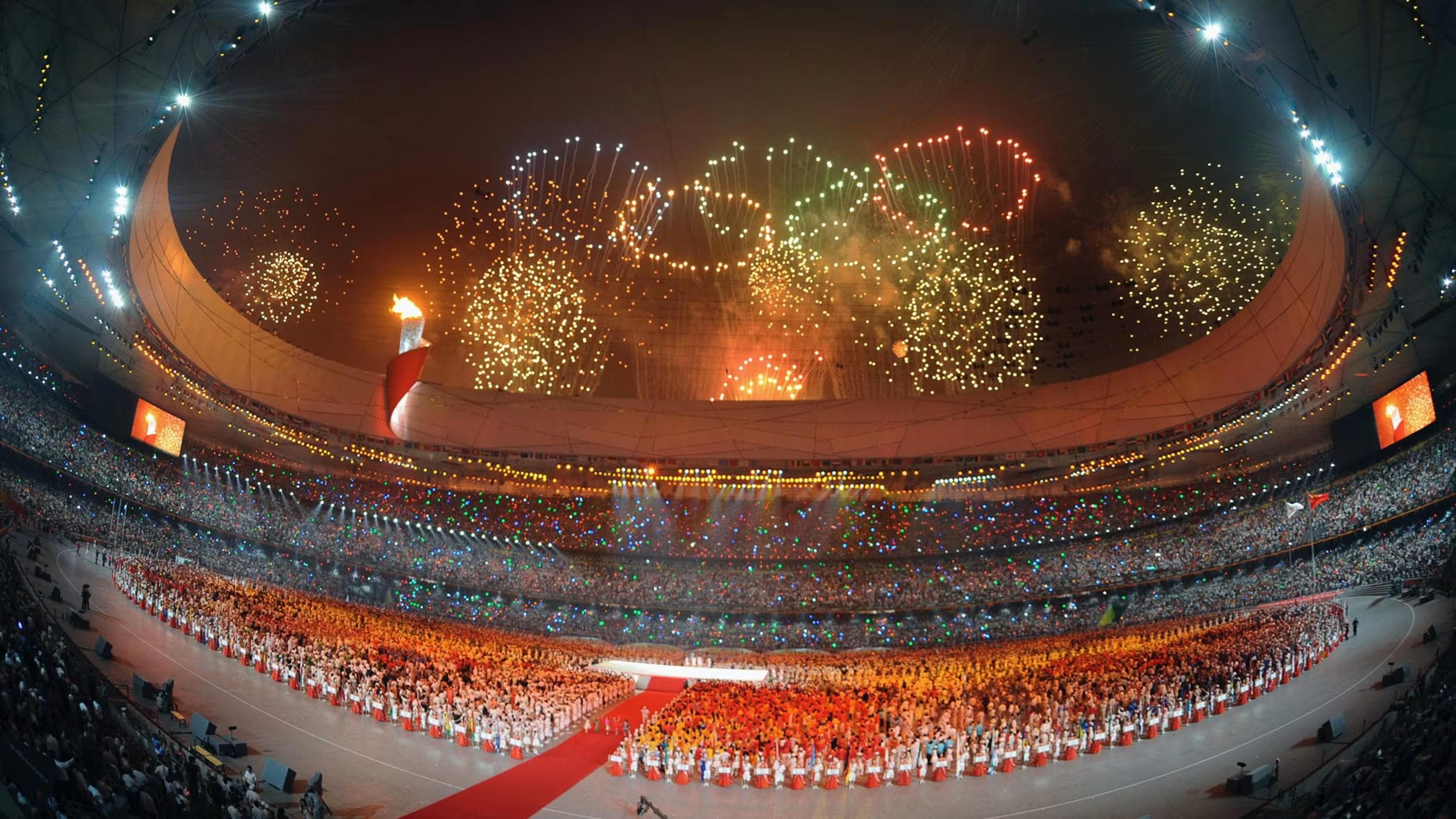
The torch relay preceding the Games was disrupted by protests in Paris, London, and San Francisco related to Tibet and human rights, generating significant diplomatic friction. The opening ceremony on August 8, 2008 — beginning at 8:08 PM on 08/08/08, a date chosen for its auspicious associations in Chinese numerology — was a massive spectacle directed by filmmaker Zhang Yimou, watched by an estimated four billion viewers globally. China topped the gold medal table with 51 golds, ahead of the United States's 36.
Legacy
The Beijing Olympics accelerated infrastructure development, prompted environmental cleanup efforts in Beijing, and generated enormous national pride. The Games marked China's symbolic arrival on the world stage as a confident, organized major power. The tight security and restrictions on protest zones, however, drew criticism from human rights organizations. The Games also raised the international profile of issues including Tibet, Xinjiang, and press freedom in China.
Narrative Comparison
| Source | Narrative |
|---|---|
| PRC Official Narrative | The successful hosting of the Beijing Olympics was a concentrated embodiment of the significant enhancement of China's overall national strength and its continuously rising international standing over the three decades since reform and opening up, and the fulfilment of the Chinese people's century-old Olympic dream. Under the firm leadership of the Party Central Committee and the State Council, Beijing completed all preparatory work to a high standard, presenting the world with an Olympic Games that was "distinctive and of a high level." The opening ceremony, taking Chinese civilisation across five thousand years as its central axis, showcased China's profound historical and cultural heritage alongside its modern achievements. The Chinese delegation topped the gold medal table with 51 golds, fully reflecting the tenacious and striving spirit of the Chinese nation. Deliberate efforts by a small number of hostile foreign forces to make an issue of the so-called "Tibet question" and disrupt the torch relay constituted a trampling on the Olympic spirit and were firmly opposed by the Chinese government and the Chinese people. The successful hosting of the Beijing Olympics powerfully demonstrated that China has the confidence and capability to shoulder greater international responsibilities. |
| Western Academic Analysis | Western scholarly study of the Beijing Olympics has concentrated on several dimensions. The first concerns the Games as an instrument of soft power: the Chinese government conceived the Beijing Olympics as a central platform for demonstrating China's 'peaceful rise' to the international community, serving dual functions of diplomatic strategy and domestic nation-building; some scholars have drawn comparisons with the 1936 Berlin Olympics, examining the historical pattern of authoritarian states using major sporting events to shape national image. The second concerns the torch relay and internet nationalism: the eruption of Tibet-related protests during the global torch relay provoked a strong nationalist backlash among Chinese citizens — large numbers of overseas Chinese spontaneously organised to escort the torch and launched online campaigns such as the 'anti-CNN' movement — which scholars have treated as a landmark event in the maturation of Chinese internet nationalism. The third concerns press freedom and control: China had promised a more relaxed environment for foreign media in the lead-up to the Games, but significant restrictions remained in practice, and the Foreign Correspondents' Club of China documented cases of interference. The fourth concerns the national narrative construction of the opening ceremony: the ceremony directed by Zhang Yimou, combining displays of Chinese historical civilisation with modern technological achievement, has been interpreted as a carefully designed exercise in national narrative construction, with the tension between the image projected and the realities of China's domestic politics also subjected to critical scrutiny. |
Key Milestones
- Beijing Awarded 2008 Olympic Games at IOC Session
On 13 July 2001, the 112th Session of the International Olympic Committee voted in Moscow to award the 2008 Summer Olympics to Beijing by 56 votes to 44 over Toronto. China had previously bid for the 2000 Games and narrowly failed in 1993. The announcement prompted large-scale spontaneous public celebrations in Beijing and other major Chinese cities.
- Beijing Olympics Opens; Zhang Yimou's Opening Ceremony Watched by an Estimated Four Billion
At 20:08 on 8 August 2008, the 29th Summer Olympic Games were formally opened at the National Stadium (the "Bird's Nest") in Beijing, with delegations from 204 countries and regions participating. The opening ceremony, directed by Zhang Yimou, took Chinese historical civilisation as its central axis, employing visual elements including fireworks, drum performances, and moveable-type printing; an estimated four billion viewers watched the broadcast globally. The start time was deliberately set for 20:08 on 08/08/08, corresponding to the auspicious associations of the number eight in Chinese culture.
- Beijing Olympics Closes; China Tops Gold Medal Table with 51 Golds
On 24 August 2008, the Beijing Olympics held its closing ceremony, bringing the 16-day competition to a formal close. The Chinese delegation topped the gold medal table with 51 golds, 21 silvers, and 28 bronzes, ahead of the United States' 36 golds. A total of 43 world records were broken at the Games, and swimmer Michael Phelps set a new Olympic record with eight gold medals in a single Games.
Last verified: