Yan'an Rectification Movement
In February 1942 Mao Zedong called in Yan'an for opposing subjectivism, sectarianism and stereotyped writing, and the CCP launched a Party-wide rectification of study, criticism and self-criticism. Wang Shiwei was attacked for his essay "Wild Lilies" and later killed, being rehabilitated in 1991; during the 1943 screening of cadres Kang Sheng launched the "Rescue Campaign," in which many people were wrongly labelled spies, and in August the Centre ordered an end to forced confessions. The April 1945 history resolution officially closed the movement and confirmed Mao's leadership.
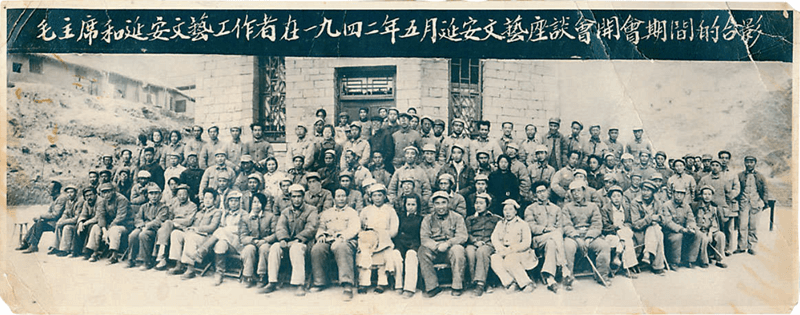
From Study Movement to Rectification
According to a 2021 article in China Organization and Personnel News, the Party leadership held that after the Zunyi Conference the intellectual roots of Wang Ming's "leftist" errors had not yet been dealt with, and that more than 700,000 new members who had joined since the start of the war mostly lacked Marxist education. On 19 May 1941 Mao Zedong gave the report "Reform Our Study" to senior cadres in Yan'an, beginning rectification study at the top. On 1 February 1942 he delivered "Rectify the Party's Style of Work" (originally titled "Rectify the Styles of Study, Party and Writing"), calling for "opposing subjectivism to rectify the style of study, opposing sectarianism to rectify the Party style, and opposing stereotyped Party writing to rectify the style of writing," followed by "Oppose Stereotyped Party Writing." The movement's watchwords were "learn from past mistakes to avoid future ones" and "cure the sickness to save the patient"; its methods were studying set documents, self-examination of one's thinking and work, and criticism and self-criticism.
According to a 2012 article in Guangming Daily, the Propaganda Department issued a decision on 3 April 1942 to discuss the rectification reports; from April to June 10,098 people in Yan'an took part; on 8 June the Centre extended the movement from Yan'an to the whole Party; and on 3 April 1943 it decided to continue rectification for another year.
Wang Shiwei and "Wild Lilies"
In March 1942 Wang Shiwei, a special researcher at the Central Research Institute in Yan'an, published the essay "Wild Lilies" in Liberation Daily in two parts on 13 and 23 March 1942, criticising the hierarchy of privileges in Yan'an. "I am not an egalitarian," he wrote, "but I see no necessity or justice in clothing divided into three colours and food into five grades," contrasting sick comrades who could not get a bowl of noodle soup and students who got two meals of thin gruel a day with "big shots" enjoying unnecessary privileges. Wang was then attacked during the rectification and later arrested; he was branded a "counter-revolutionary Trotskyist spy," a "hidden Nationalist agent" and a member of an "anti-Party clique of five," and in 1947, after the Party leadership evacuated Yan'an, he was killed on the march. On 7 February 1991 the Ministry of Public Security fully rehabilitated him.
Screening Cadres and the "Rescue Campaign"
In its later phase rectification was combined with the screening of cadres and the hunt for spies. Kang Sheng, who headed the Party's intelligence and security work, became chairman of the cadre investigation committee in August 1941 and vice-chairman of the General Study Committee in July 1942, with Mao as chairman. On 15 July 1943, in the Central Auditorium in Yan'an, Kang gave the speech "Rescuing Those Who Have Lost Their Footing" — "to rescue young people who have lost their footing we have the heart of a bodhisattva, but to resolutely suppress spies we have a will of steel" — which opened the so-called Rescue Campaign. The scholar Wu Yidi notes that few studies accept that the alleged spies really existed; he argues that Nationalist agents had indeed infiltrated the border region, but that the CCP consciously exaggerated the danger of civil war and greatly overestimated the number of spies. Tang Zong, who oversaw military intelligence for Chiang Kai-shek, wrote in his diary in August 1942 that the Nationalists had no inside sources among the Communists at all.
On 15 August 1943 the Central Committee issued its Decision on Screening Cadres. It stated that the screening was "not to be called a purge of counter-revolutionaries" and described the old method of extracting confessions — torture or disguised torture, random confessions implicating innocent people, and credulous acceptance of those confessions leading to arbitrary arrests, beatings and killings — as "an entirely subjectivist policy and method." It acknowledged that "excessively leftist actions will certainly occur," said that more than two thousand people had been identified in Yan'an, "some of whom were mistaken or wronged," and required that the wrongly accused "must be rehabilitated."
The History Resolution and the End of Rectification
From September 1943 rectification moved on to discussion of Party history. On 20 April 1945 the Seventh Plenum of the Sixth Central Committee adopted the Resolution on Certain Questions in the History of Our Party, drafted by a committee convened by Ren Bishi with Liu Shaoqi, Zhou Enlai, Bo Gu and Luo Fu (Zhang Wentian) among its members and finally revised by Mao. It summed up the lessons of the Party's "leftist" errors, especially the third, and praised Mao's contribution; the Party treats it as marking the end of the rectification. The Seventh Party Congress later that year made Mao Zedong Thought the Party's guiding ideology.
Official Accounts and Scholarly Research
The Party describes the Yan'an rectification as a Party-wide campaign of Marxist education and "a movement of intellectual emancipation" that unified the Party's thinking and established Mao's leadership and the guiding role of Mao Zedong Thought. Wu Yidi notes that official Party history makes Kang Sheng the culprit for all the errors of the Rescue Campaign while presenting Mao as having launched a "correct" rectification and halted the excesses in time; he notes that scholars such as Chen Yung-fa, Dai Qing and Gao Hua have linked the Rescue Campaign to the rectification, with Gao affirming Mao's central role in the inner-Party struggle, and argues himself that Kang could not have launched the Rescue Campaign without Mao's support.
Narrative Comparison
| Source | Narrative |
|---|---|
| China Organization and Personnel News (2021); Guangming Daily (2012); 1945 Resolution on Party History | Official accounts call the Yan'an rectification "a Party-wide campaign of Marxist education and a movement of intellectual emancipation … a great initiative"; a Guangming Daily article says it "unified Mao's position as Party leader with the guiding role of Mao Zedong Thought." The official narrative marks its end with the 1945 Resolution on Party History and generally does not present the Rescue Campaign as part of the rectification. |
| Wu Yidi, in 1943: China at the Crossroads (CUHK Press) | Wu Yidi argues that the official narrative separates the rectification from the Rescue Campaign in order to preserve the former's positive image, attributing the latter to excesses; noting that some scholars see the Rescue Campaign as an integral part of the rectification, he argues that Kang Sheng could not have launched it without Mao's support. He also finds that Nationalist agents did infiltrate the border region, but that the CCP consciously exaggerated the threat of civil war and overestimated the number of spies. |
| Wang Shiwei, "Wild Lilies" (1942); Kang Sheng's speech "Rescuing Those Who Have Lost Their Footing" (1943, as quoted by Wu Yidi) | Wang Shiwei wrote in "Wild Lilies": "I am not an egalitarian, but I see no necessity or justice in clothing divided into three colours and food into five grades." A year later, launching the Rescue Campaign, Kang Sheng declared: "To rescue young people who have lost their footing we have the heart of a bodhisattva, but to resolutely suppress spies we have a will of steel." |
Key Milestones
- Mao's report "Reform Our Study"
Rectification study among senior cadres begins.
- Mao's report "Rectify the Party's Style of Work"
Mao calls for opposing subjectivism, sectarianism and stereotyped writing.
- "Wild Lilies" published
Wang Shiwei's essay appears in Liberation Daily in two parts (13 and 23 March).
- Propaganda Department decision
Officially regarded as the start of the movement proper.
- Rectification extended to the whole Party
The Centre extends rectification from Yan'an to the whole Party.
- Kang Sheng's "rescue" speech
The Rescue Campaign begins.
- Decision on Screening Cadres
The Centre rejects forced confessions as subjectivist and requires the wrongly accused to be rehabilitated.
- Resolution on Party History adopted
The Seventh Plenum adopts the history resolution, officially marking the end of rectification.
- Wang Shiwei rehabilitated
The Ministry of Public Security fully rehabilitates Wang Shiwei.
Last verified:
Cite this page
Chronicles of Modern China. (2026, November 3). Yan'an Rectification Movement. Retrieved November 3, 2026, from https://www.cmcarchive.org/events/yanan-rectification-movement-1942
“Yan'an Rectification Movement.” Chronicles of Modern China. Last modified November 3, 2026. Accessed November 3, 2026. https://www.cmcarchive.org/events/yanan-rectification-movement-1942.
Chronicles of Modern China. Yan'an Rectification Movement[EB/OL]. (2026-11-03)[2026-11-03]. https://www.cmcarchive.org/events/yanan-rectification-movement-1942.