The Yalta Agreement and the Sino-Soviet Treaty of 1945
At the Yalta Conference in February 1945 Roosevelt, Churchill and Stalin, without informing China, signed a secret agreement making preservation of the status quo in Outer Mongolia, internationalisation of Dairen, a Soviet lease of Port Arthur and joint Sino-Soviet operation of the Manchurian railways conditions of Soviet entry into the war against Japan, with Roosevelt to obtain Chiang Kai-shek’s concurrence. In negotiations in Moscow from June, led by T. V. Soong, Stalin insisted that “status quo” meant Chinese recognition of Mongolian independence; Chiang finally conceded in exchange for Soviet respect for Chinese sovereignty in Manchuria and exclusive support for the Nationalist government. On 14 August Wang Shijie and Molotov signed the Sino-Soviet Treaty of Friendship and Alliance, with China pledging to recognise Outer Mongolian independence after a plebiscite, which was held in October; the Nationalist government recognised Mongolia in January 1946. The treaty was declared abrogated when the PRC and the USSR signed a new treaty in 1950, and in 1952 the UN General Assembly determined that the Soviet Union had failed to carry it out.
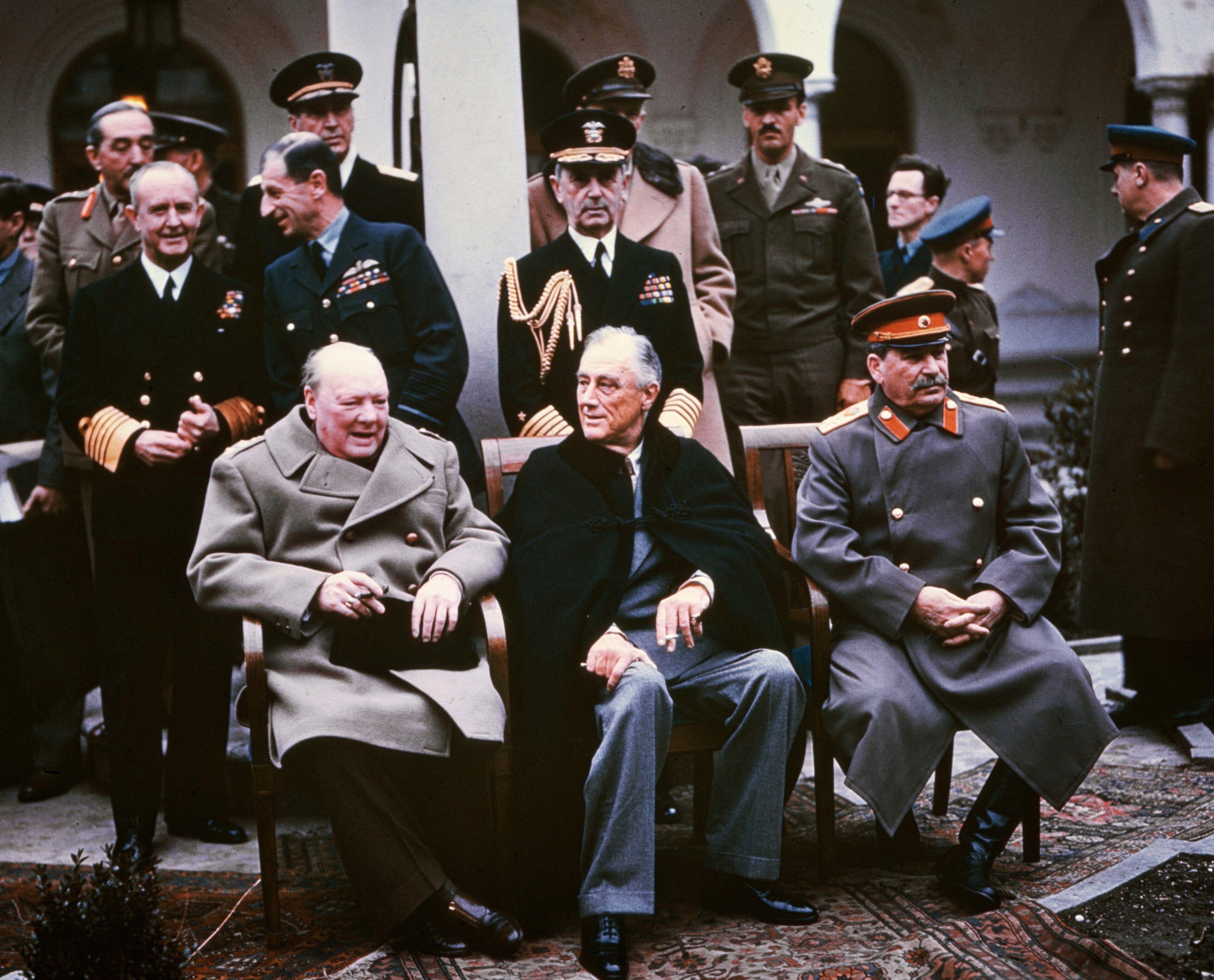
The Far Eastern Terms at Yalta
From 4 to 11 February 1945 Roosevelt, Churchill and Stalin met at Yalta in the Crimea. According to the American record, when Roosevelt and Stalin met on 8 February Stalin raised the political conditions for Soviet entry into the war against Japan. Roosevelt said “there would be no difficulty whatsoever” in southern Sakhalin and the Kuril Islands going to Russia; for a warm-water port he suggested Dairen at the end of the South Manchurian Railway, either leased from China or made a free port under an international commission; the Manchurian railways could be leased to the Soviets or run by a joint Sino-Soviet commission. He said he “had not yet had an opportunity to discuss this matter with Marshal Chiang Kai-shek, so therefore he could not speak for the Chinese.” Stalin said that without these conditions it would be difficult “to explain to the Soviet people why Russia was entering the war against Japan.” Roosevelt remarked that “anything said to them was known to the whole world in twenty-four hours”; Stalin agreed it was not yet necessary to speak to the Chinese and proposed setting the conditions down in writing.
On 11 February the three leaders signed an agreement under which the Soviet Union would enter the war against Japan two or three months after Germany’s surrender on condition that “The status quo in Outer-Mongolia (The Mongolian People’s Republic) shall be preserved”; southern Sakhalin would be returned; Dairen would be internationalised with the Soviet Union’s preeminent interests safeguarded and the lease of Port Arthur as a Soviet naval base restored; the Chinese Eastern and South Manchurian railways would be run by a joint Soviet-Chinese company, with Soviet preeminent interests safeguarded and China retaining full sovereignty in Manchuria; and the Kuril Islands would be handed over. The provisions on Outer Mongolia, the ports and the railways would “require concurrence of Generalissimo Chiang Kai-Shek”, which the President would obtain on Stalin’s advice, and the three agreed that the Soviet claims “shall be unquestionably fulfilled after Japan has been defeated.” The agreement was kept secret; the State Department released it only on 11 February 1946.
China Learns of the Agreement
According to Hou Zhongjun of the Chinese Academy of Social Sciences, the Nationalist government sought the contents through various channels, and Wellington Koo, ambassador in London, learned them exactly through his personal relationship with Admiral William Leahy before the American ambassador Patrick Hurley informed Chiang. On 15 June Hurley formally presented to Chiang President Truman’s message conveying the terms. According to Hurley’s report, Chiang at once raised three questions: whether the United States would take part in the joint use of Port Arthur as a naval base; whether it would be a party to China’s agreement with the Soviet Union; and whether the transfer of Sakhalin and the Kurils should be considered by the United Nations or at least the four powers rather than by China and the Soviet Union alone.
The Moscow Negotiations
On 30 June a Chinese delegation led by Premier T. V. Soong arrived in Moscow, including Vice Foreign Minister Victor Hoo, Ambassador Foo Ping-sheung and Chiang Ching-kuo. Outer Mongolia quickly became the sticking point. The American ambassador Averell Harriman reported that at the talk of 2 July Stalin insisted that “status quo in Outer Mongolia shall be preserved” meant China should recognise its independence; Soong argued it meant only that China would not raise the issue for now, telling Stalin “that no Government in China could last if it ceded Outer Mongolia.” Stalin proposed a secret agreement on independence to be published after Japan’s defeat, which Soong also rejected. Asked by Soong for the American interpretation, Harriman replied that at Yalta “there had been no discussion of interpretation. The words were accepted as written.”
According to the scholar Bai Lin, Chiang Ching-kuo explained to Stalin as his father’s personal representative why the Nationalist government would not recognise Outer Mongolian independence; on 4 July Stalin received the Mongolian premier Choibalsan in Moscow with honours equal to the Chinese delegation’s. On 6 July Chiang told Truman through Hurley that “status quo” should mean, as in the 1924 Sino-Soviet agreement, that Outer Mongolia was part of the Republic of China; that China “would rather not have any secret agreement”; and that China would recognise Mongolian independence after the war if the Soviet Union fully respected Chinese sovereignty and integrity in Manchuria and gave no support to the Chinese Communists or rebels in Xinjiang — the “maximum concessions” China could make. At the talk of 7 July Stalin handed Soong a draft agreement formally recognising Mongolian independence; Soong said the Generalissimo could not cede territory “by Executive Act”, and the talks reached an impasse. Chiang then agreed to a plebiscite in Outer Mongolia after the war.
The Treaty
The first round broke off when Stalin left for the Potsdam Conference and resumed on 7 August, now with Foreign Minister Wang Shijie taking part. On the night of 13 August Soong and Stalin settled all outstanding points. Harriman reported that Port Arthur would officially be a jointly used naval base “but it is recognized that the Chinese will have little to say”; that the Soviet Union would give its support “solely to the Chinese National Government”; and that China would recognise Outer Mongolian independence after a plebiscite. Soong, he wrote, was convinced that without active American involvement “he would have had to concede to all Stalin’s demands.”
On 14 August Wang Shijie and People’s Commissar for Foreign Affairs Vyacheslav Molotov signed in Moscow the Sino-Soviet Treaty of Friendship and Alliance, agreements on the Chinese Changchun Railway, Dairen and Port Arthur, and related notes. According to the Soviet Embassy’s notification to the State Department, the two Manchurian railways were merged as the Chinese Changchun Railway, to be run jointly for thirty years and then pass “gratis” to China; Dairen became a free port with part of its facilities leased to the Soviet Union; Port Arthur became a jointly used naval base; and the Soviet side gave assurances that it would respect Chinese sovereignty over Manchuria and support the Central Government of China. In the note on Outer Mongolia, China declared that if after Japan’s defeat a plebiscite confirmed the Mongolian people’s repeatedly expressed desire for independence, it would recognise Outer Mongolia’s independence within its existing boundaries.
The Plebiscite and Recognition
On 20 October 1945 Outer Mongolia held an independence plebiscite by open, signed ballot. Drawing on Mongolian archives, Bai Lin notes that preliminary figures of 22 October showed 494,074 eligible voters and 483,291 votes cast; the authorities announced “100 percent” support for independence, but in fact concealed the signed votes against it and filled in and altered some voters’ choices without authorisation. The Nationalist government recognised Mongolian independence on 5 January 1946.
The Treaty’s Fate
On 1 February 1952 the UN General Assembly adopted Resolution 505, noting that the Soviet Union had obstructed the National Government’s efforts to re-establish its authority in Manchuria after Japan’s surrender and had aided the Chinese Communists, and determining that the Soviet Union, in its relations with China since Japan’s surrender, “has failed to carry out the Treaty of Friendship and Alliance concluded on 14 August 1945”. Meanwhile, when the People’s Republic of China and the Soviet Union signed the Treaty of Friendship, Alliance and Mutual Assistance on 14 February 1950, their foreign ministers exchanged notes declaring the 1945 treaty and agreements abrogated.
Differing Accounts
Mainland Chinese scholarship generally calls the Yalta agreement the “Yalta secret agreement”. Hou Zhongjun writes that the United States, the Soviet Union and Britain concluded, without China’s consent, a secret agreement “that sacrificed Chinese sovereignty” and set the tone for the Sino-Soviet negotiations; Bai Lin calls the Mongolian plebiscite “a political product of great-power rivalry”. The Nationalist government at the time insisted that Outer Mongolia was a question of territorial sovereignty and conceded only in exchange for Soviet respect for its sovereignty in Manchuria and exclusive support for the Nationalist government. The Soviet Union described the treaty as corresponding to the agreement reached at the Crimea (Yalta) Conference and as an alliance for joint war against Japan and prevention of renewed Japanese aggression.
Gallery
Narrative Comparison
| Source | Narrative |
|---|---|
| Hou Zhongjun, Academic Monthly (2021); PRC Ministry of Foreign Affairs | Mainland Chinese scholarship generally calls it the “Yalta secret agreement”. Hou Zhongjun of the Chinese Academy of Social Sciences argues that, to bring the Soviet Union into the war, the United States, the Soviet Union and Britain concluded without China’s consent a secret agreement that sacrificed Chinese sovereignty, promising the Soviets terms ceding Chinese sovereignty and setting the tone for the Sino-Soviet negotiations. The PRC Foreign Ministry describes the 1945 treaty as one signed by the Soviet government with the “Chinese Kuomintang government” and notes that it was abrogated by exchange of notes when the new treaty was signed in 1950. |
| Chiang Kai-shek’s position of 6 July 1945 via Hurley and T. V. Soong’s statements in Moscow (via FRUS) | The Nationalist government of the time treated Outer Mongolia as a question of territorial sovereignty. Soong told Stalin that China could not agree to the cession of territory and that “no Government in China could last if it ceded Outer Mongolia”, and he rejected a secret agreement. Chiang held that “status quo” should mean, as in the 1924 Sino-Soviet agreement, that Outer Mongolia was part of the Republic of China; under Soviet pressure he agreed to recognise its independence after the war on condition that the Soviet Union fully respect Chinese sovereignty in Manchuria and not support the Communists or rebels in Xinjiang — the “maximum concessions” China could make. In 1952 the UN General Assembly’s Resolution 505 determined that the Soviet Union had failed to carry the treaty out. |
| The Yalta agreement, Roosevelt–Stalin minutes and the reports of Harriman and Hurley (FRUS) | The American record shows that at Yalta Roosevelt, to secure Soviet entry into the war against Japan, accepted Stalin’s demands on Outer Mongolia, Dairen, Port Arthur and the Manchurian railways and undertook to obtain Chiang’s concurrence, agreeing not yet to tell the Chinese because “anything said to them was known to the whole world in twenty-four hours.” During the Moscow talks Ambassador Harriman said there had been no discussion at Yalta of how to interpret the Mongolian clause — “The words were accepted as written” — and the United States later opposed Soviet demands beyond the Yalta terms. Harriman reported Soong’s conviction that without active American involvement “he would have had to concede to all Stalin’s demands.” |
| Soviet Embassy to the Department of State (August 1945) | The Soviet government presented the treaty as the fulfilment of the Crimea (Yalta) agreement: its contents “corresponds to the agreement reached at the Crimea Conference”, providing for Soviet-Chinese cooperation in the war against Japan and after it “so as to make impossible any repetition of aggression and violation of peace by Japan.” Moscow stressed that the Chinese Changchun Railway would pass “gratis” to China after thirty years of joint operation, that the Soviet Union would respect Chinese sovereignty over Manchuria and support the Central Government of China, and that on Outer Mongolia China would recognise independence in view of the desire “repeatedly expressed by the people of Outer Mongolia”, once confirmed by plebiscite. |
Key Milestones
- Roosevelt and Stalin discuss Far Eastern terms
Stalin sets out the political conditions for Soviet entry into the war against Japan.
- Yalta agreement signed
The three leaders sign the secret agreement on Soviet entry into the war against Japan.
- Hurley informs Chiang
Chiang raises three questions on Port Arthur and American participation.
- Soong arrives in Moscow
Sino-Soviet negotiations begin.
- Deadlock over Outer Mongolia
Stalin insists “status quo” means recognising Mongolian independence.
- Chiang’s “maximum concessions”
Chiang agrees to recognise Mongolian independence after the war, on conditions.
- Talks resume
The second round begins with Wang Shijie taking part.
- Treaty signed
Wang Shijie and Molotov sign the treaty in Moscow.
- Mongolian plebiscite
Outer Mongolia votes by open, signed ballot.
- Nationalist recognition of Mongolia
The Nationalist government recognises Mongolian independence.
- Yalta agreement published
The State Department releases the text of the Yalta Far Eastern agreement.
- 1945 treaty abrogated
The PRC and USSR sign a new treaty and declare the 1945 treaty abrogated.
- UN Resolution 505
The General Assembly determines that the USSR failed to carry out the 1945 treaty.
Last verified:
Cite this page
Chronicles of Modern China. (2026, November 24). The Yalta Agreement and the Sino-Soviet Treaty of 1945. Retrieved November 24, 2026, from https://www.cmcarchive.org/events/yalta-agreement-sino-soviet-treaty-1945
“The Yalta Agreement and the Sino-Soviet Treaty of 1945.” Chronicles of Modern China. Last modified November 24, 2026. Accessed November 24, 2026. https://www.cmcarchive.org/events/yalta-agreement-sino-soviet-treaty-1945.
Chronicles of Modern China. The Yalta Agreement and the Sino-Soviet Treaty of 1945[EB/OL]. (2026-11-24)[2026-11-24]. https://www.cmcarchive.org/events/yalta-agreement-sino-soviet-treaty-1945.