China Joins the World Trade Organization
After 15 years of negotiations, China formally became the 143rd member of the World Trade Organization in December 2001, committing to reduce tariffs, open its markets, and accept the disciplines of the multilateral trading system.
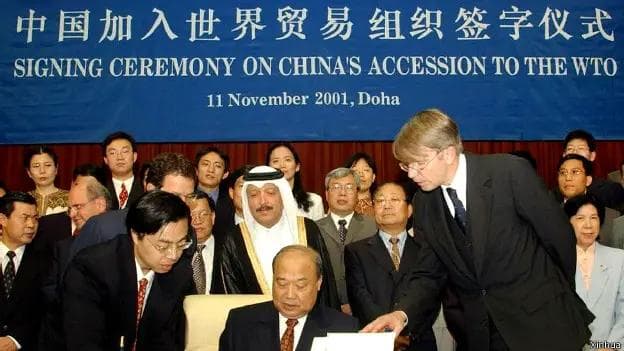
Fifteen Years of Negotiation
China began seeking membership in the General Agreement on Tariffs and Trade (GATT) and its successor, the World Trade Organization, in 1986. Negotiations stretched over fifteen years, complicated by debates over whether China should be treated as a developing or developed economy, concerns about state subsidies and market access, and the political rupture following the Tiananmen crackdown of 1989. The decisive breakthrough came with bilateral market access agreements: the United States and China signed a landmark deal on 15 November 1999, followed by a China–EU agreement on 19 May 2000; these two accords cleared the principal obstacles to multilateral accession. The accession process required China to commit to opening its markets, reducing tariffs, and accepting external adjudication of trade disputes.
Accession
China formally joined the WTO on 11 December 2001, at the Fourth Ministerial Conference in Doha. Accession commitments included reducing average tariffs from 15.3 to 9.9 percent, opening financial services and telecommunications to foreign competition, and accepting review mechanisms for trade practices. The agreement was the largest and most complex accession in WTO history, running to hundreds of pages of specific commitments.
Economic Consequences
WTO accession produced significant changes in China's trade position and economic structure. Export growth accelerated sharply, with China's share of global exports growing from roughly three percent in 2001 to thirteen percent by 2010. China became the world's largest exporter by 2009. Manufacturing investment flooded in. However, critics argued that China's state-directed industrial policies and currency management constituted unfair subsidisation.
Narrative Comparison
| Source | Narrative |
|---|---|
| PRC Official Narrative | China's accession to the World Trade Organization was a major strategic decision by the Chinese government to resolutely advance reform and opening-up and actively participate in economic globalisation, marking China's deep integration into the rules-based international economic system. After fifteen years of arduous negotiations, China proactively undertook market-opening commitments commensurate with its stage of development in the posture of a responsible major country, fully demonstrating China's sincerity and determination to advance opening-up and abide by international rules. Since accession, China has comprehensively fulfilled all commitments, promoted the deepening of domestic economic system reform, advanced the rule of law and the transformation of government functions, and made important contributions to global economic growth through expanding imports, attracting foreign investment, and participating in the formulation of international rules. China's development has lifted hundreds of millions of people out of poverty, providing the world with quality and affordable goods, lowering the cost of living for consumers worldwide, and creating large numbers of jobs — China is both a beneficiary and a contributor to economic globalisation. Currently, a small number of countries are imposing unilateral tariff barriers against China under the pretext of 'unfair trade,' which constitutes protectionism running counter to globalisation, violates the fundamental principles of the WTO multilateral trading system, and undermines the stability and efficiency of global supply chains. China will firmly uphold the authority of the multilateral trading system and promote the building of an open world economy. |
| US Official Narrative | The United States government regarded support for China's WTO accession as a central component of its engagement strategy. The core judgement of the Clinton administration was that trade opening would gradually integrate China into the rules-based international order, and that market-oriented reforms would catalyse broader social and political change, ultimately serving regional stability and long-term US strategic interests. The signing of the US–China bilateral market access agreement on 15 November 1999 was the decisive breakthrough in advancing China's accession; the passage of Permanent Normal Trade Relations (PNTR) legislation by Congress in 2000 provided the necessary domestic legal foundation for China's entry. The central goals of US negotiations included substantial market access for American goods and services, commitments on intellectual property protection, a transparent and predictable regulatory environment, and the channelling of trade disputes into the WTO dispute settlement mechanism. The United States anticipated that these commitments, once implemented, would create significant commercial opportunities for US exporters, agricultural producers, and service industries, while competitive pressures would drive improvements in Chinese enterprise efficiency and deepen domestic reforms. In practice, however, implementation diverged systematically from these expectations: market access commitments were incompletely fulfilled, state enterprise subsidies and industrial policies persisted, and intellectual property protection was not effectively enforced. The US government began filing WTO dispute settlement cases intensively during the Obama administration and progressively reframed its China policy from 'engagement' to 'strategic competition' — a transition that reached an open confrontation during the Trump administration through large-scale unilateral tariffs on Chinese goods, a competitive framework that the Biden administration subsequently maintained in its essential features. |
| Western Academic Analysis | Western scholarship on China's WTO accession has concentrated on several core dimensions. The first concerns the 'China shock' and labour market impacts: research by David Autor, David Dorn, and Gordon Hanson documented significant disruption to US manufacturing employment from the sharp increase in Chinese exports — contrary to the traditional predictions of trade liberalisation economics, workers in affected regions did not rapidly transition to other industries but experienced sustained unemployment and income losses; these findings posed an important challenge to the policy consensus that 'trade liberalisation is broadly beneficial' and provided scholarly context for the subsequent rise of protectionist political discourse. The second concerns the compatibility of Chinese state capitalism with WTO rules: one of the systemic assumptions of China's WTO accession was that market reforms would naturally advance over time, eventually converging Chinese economic institutions towards the liberal trade model. Scholarship has noted, however, that practice in areas such as state enterprise subsidies, industrial policy, exchange rate intervention, and market access restrictions did not evolve as expected, indicating that China maintained a form of 'state capitalism' with inherent tensions with the WTO rules framework. The third concerns the link between WTO accession and political liberalisation: Western policymakers — the Clinton administration foremost among them — regarded trade integration as a strategic lever for driving China's political liberalisation, premised on the theory that economic opening would nurture a middle class that would in turn generate demand for political participation and push authoritarian institutions towards gradual transformation. This proposition was refuted by China's subsequent political trajectory: the Party's control over the political agenda not only remained intact under conditions of sustained economic growth but was further consolidated under Xi Jinping. Scholarship offers several explanatory pathways for this miscalculation: Carl Minzner and others have argued that economic growth strengthened rather than eroded the authoritarian regime's legitimacy base; comparative research by Levitsky and Way demonstrated that economic integration exerts far weaker pressure on regime transition than scholarship had previously theorised; other scholars have explained the Party's ability to maintain political control under conditions of economic opening through the lens of CCP organisational resilience and adaptive capacity. This theoretical miscalculation has had far-reaching implications for the broader Western rethinking of the engagement policy towards China. The fourth concerns the impact of WTO accession on China's domestic reform: scholars such as Nicholas Lardy have emphasised the positive aspects driven by accession, including improvements in domestic laws and regulations, reductions in tariff barriers, and the gradual opening of the services sector, arguing that external constraints played a key 'lock-in' role in advancing domestic reforms that would otherwise have faced significant resistance. |
Key Milestones
- China formally submits application to resume Contracting Party status in the General Agreement on Tariffs and Trade (GATT)
China submitted an application to the GATT Secretariat to restore the status of the People's Republic of China as a contracting party — the Republic of China had participated in GATT as a founding member but announced its withdrawal in 1950. China thereafter participated in GATT affairs as an observer and began negotiations with contracting parties on the terms of accession.
- China–US bilateral market access agreement signed, removing the principal obstacle to multilateral accession
US Trade Representative Charlene Barshefsky and Minister of Foreign Trade and Economic Cooperation Wu Yi signed the agreement in Beijing, making specific commitments on market access for agricultural products, industrial goods, services, and intellectual property — the decisive breakthrough in years of bilateral negotiations. The US Congress subsequently passed the Permanent Normal Trade Relations (PNTR) Act in 2000, removing the domestic legal obstacle to China's accession.
- China–EU bilateral agreement signed, completing the principal bilateral negotiations required for accession
China and the European Union concluded bilateral market access negotiations and signed an agreement in Beijing, representing the last major bilateral negotiation prior to China's accession. The agreement centred on commitments to open the services sector — including telecommunications, insurance, banking and financial services, and automobile distribution — and reached agreement on a schedule for industrial tariff reductions. China subsequently entered the final multilateral consultation phase with the WTO Working Party.
- China formally becomes the 143rd member of the World Trade Organization
Minister of Foreign Trade and Economic Cooperation Shi Guangsheng signed the Accession Protocol in Doha, Qatar on behalf of the People's Republic of China, formally completing the legal procedures. The Protocol set out China's specific commitments, including phased tariff reductions to be completed by 2010 and the opening of service and agricultural markets.
Last verified: