The 2025 US-China Tariff War
After Donald Trump announced "reciprocal tariffs" on 2 April 2025, the US and China raised tariffs on each other in rapid succession within ten days, the US to a combined 145% and China to 125%, with China's commerce ministry vowing to "fight to the end". Talks in Geneva in May led both sides to cancel 91 points and suspend 24, a pause extended in August. After China expanded rare-earth export controls in October and Trump threatened a further 100%, the two leaders met in Busan on 30 October: the US halved its fentanyl tariff and China paused the rare-earth controls and resumed buying US soybeans. In February 2026 the US Supreme Court struck down tariffs imposed under the International Emergency Economic Powers Act.
Background
During Donald Trump's first term, from 2018 to 2020, the United States and China fought a trade war that paused with the Phase One agreement of January 2020. After Trump returned to office in January 2025, the US imposed tariffs totalling 20% on Chinese goods early that year under the International Emergency Economic Powers Act, citing fentanyl.
The April Escalation
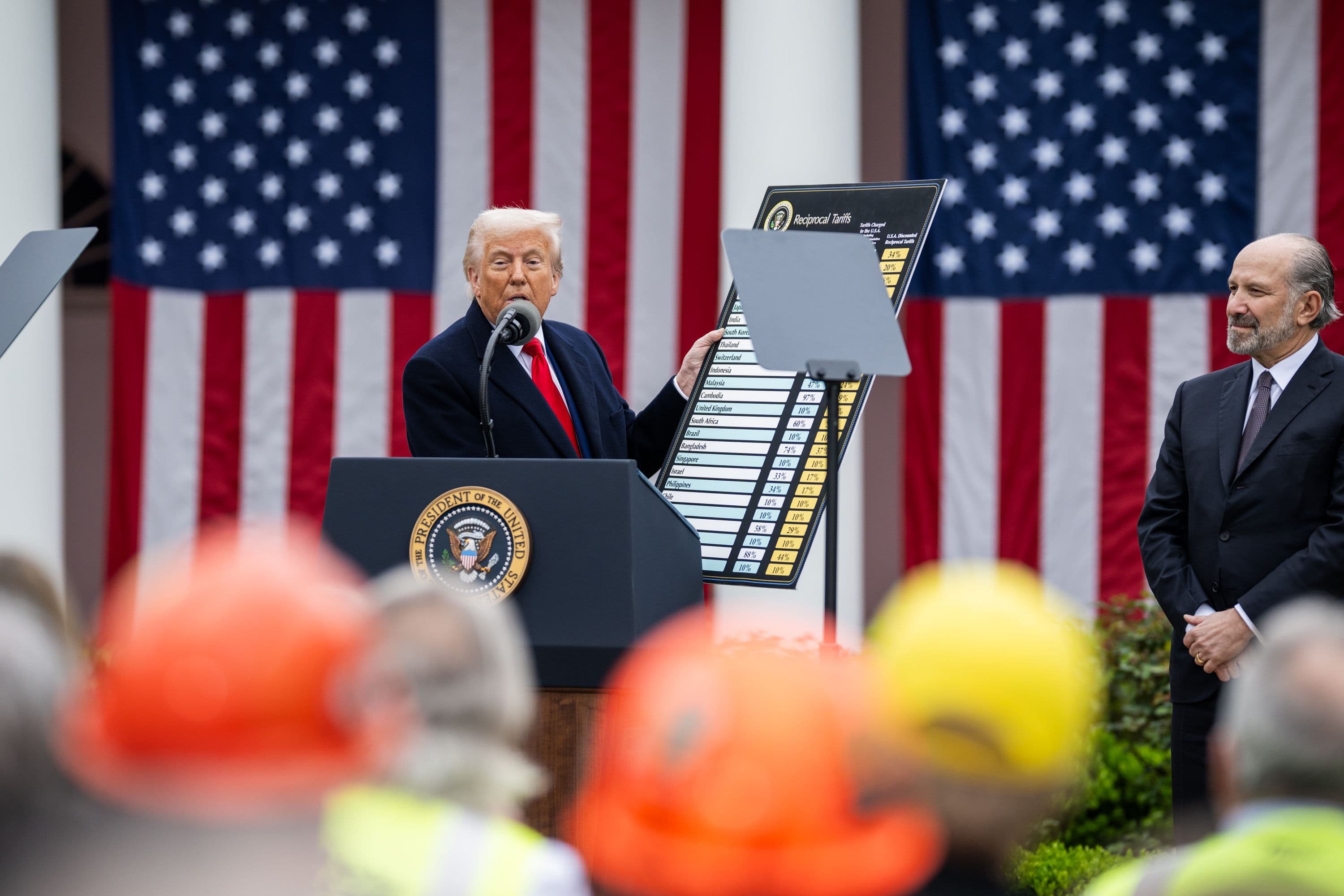
On 2 April 2025 Trump announced "reciprocal tariffs" on trading partners, setting the rate for China at 34%, and China retaliated with a 34% tariff on imports from the US. On 7 April the US threatened a further 50%; the next day China's commerce ministry said the threat "again exposes the US's blackmailing nature" and that "if the US insists on its own way, China will fight to the end".
On 8 April the US raised its reciprocal tariff on China to 84%, and on 9 April the Customs Tariff Commission of the State Council matched it, raising China's rate from 34% to 84% from 10 April. On 10 April the US raised its reciprocal tariff to 125%, bringing the total with the earlier 20% fentanyl tariff to 145%; the commission raised China's rate to 125% from 12 April, saying that at current levels US goods no longer had any market in China and that "if the US continues its tariff numbers game, China will ignore it".
The Geneva Truce
On 10–11 May Vice Premier He Lifeng met US Treasury Secretary Scott Bessent and Trade Representative Jamieson Greer in Geneva, and on 12 May the two sides issued a joint statement: the US cancelled the combined 91% in tariffs imposed by its executive orders of 8 and 9 April and suspended 24 points of the 34% reciprocal tariff for 90 days, keeping 10%; China correspondingly cancelled its 91% in countermeasure tariffs, suspended 24% and kept 10%, and suspended or cancelled its non-tariff countermeasures. After further talks in London in June and Stockholm in July, a joint statement of 12 August extended the suspension of the 24% for another 90 days.
Rare Earths and the Busan Summit
On 9 October China's commerce ministry announced export controls on relevant overseas rare-earth items. The next day Trump announced on social media that from 1 November the US would impose a further 100% tariff on Chinese goods on top of existing duties.
On 30 October Xi Jinping and Trump met in Busan, South Korea, their first face-to-face meeting since 2019. Trump said afterwards that in exchange for China cracking down on the fentanyl trade, resuming purchases of US soybeans and keeping rare earths flowing, the US would halve the fentanyl-related tariff to 10%, cutting overall tariffs on Chinese goods from about 57% to 47%; China agreed to pause the rare-earth export controls it had announced that month.
Aftermath
On 20 February 2026 the US Supreme Court ruled 6–3 that the International Emergency Economic Powers Act does not authorise the president to impose tariffs, invalidating the tariffs imposed under it, including the fentanyl-related and reciprocal tariffs on China.
Gallery
Narrative Comparison
| Source | Narrative |
|---|---|
| Chinese official position (Ministry of Commerce spokesperson, Customs Tariff Commission) | The so-called "reciprocal tariffs" on China are groundless and a typical act of unilateral bullying; China's countermeasures are legitimate actions to protect its sovereignty, security and development interests and the normal international trading order. US threats to escalate expose its blackmailing nature, and if the US insists on its course China will fight to the end; at current tariff levels US goods have no market in China, and China will ignore further "tariff numbers games". There are no winners in a trade war, and protectionism leads nowhere. The Geneva joint statement was an important step toward resolving differences through equal dialogue. |
| US official position (Trump's social media posts and remarks after the Busan summit) | After China announced expanded rare-earth export controls, Trump said that from 1 November 2025 — or sooner, depending on China's further actions — the US would impose a 100% tariff on China over and above any tariff it was already paying. After the Busan summit he called the meeting "amazing" and said the fentanyl-related tariff was halved "because I believe they are really taking strong action", with China cracking down on fentanyl, resuming soybean purchases and keeping rare earths flowing. |
| Overseas analysts (interviewed by Reuters, October 2025) | Reuters judged that the Busan agreement appeared to be no more than a fragile truce in a trade war whose root causes were unresolved. Emily Kilcrease of the Center for a New American Security said the talks amounted to de-escalating the measures both sides had taken since the Trump administration took office. Joe Mazur, a geopolitics analyst at the consultancy Trivium China, said the year had been "a more or less total vindication of China's strategy of never striking first but always striking back". |
Key Milestones
- US announces "reciprocal tariffs"
Trump announced a 34% reciprocal tariff on China, and China retaliated with 34%.
- MOFCOM: "fight to the end"
After a US threat of a further 50%, China's commerce ministry vowed to "fight to the end".
- US tariffs on China reach 145%
The US raised its reciprocal tariff to 125%, totalling 145% with the fentanyl tariff.
- China raises tariffs to 125%
China raised its tariff to 125% from 12 April and said it would ignore further US "tariff numbers games".
- Geneva joint statement
Both sides cancelled 91 percentage points of tariffs and suspended 24 for 90 days, keeping 10.
- Stockholm joint statement
The suspension of the 24% tariff was extended for another 90 days.
- China expands rare-earth controls
China imposed export controls on overseas rare-earth items; the next day Trump announced an extra 100% tariff.
- Busan summit
The US halved the fentanyl tariff to 10%; China paused its rare-earth controls and resumed soybean purchases.
- US Supreme Court strikes down IEEPA tariffs
The Supreme Court ruled 6–3 that the president cannot impose tariffs under the act.
Last verified:
Cite this page
Chronicles of Modern China. (2026, November 3). The 2025 US-China Tariff War. Retrieved November 3, 2026, from https://www.cmcarchive.org/events/us-china-tariff-war-2025
“The 2025 US-China Tariff War.” Chronicles of Modern China. Last modified November 3, 2026. Accessed November 3, 2026. https://www.cmcarchive.org/events/us-china-tariff-war-2025.
Chronicles of Modern China. The 2025 US-China Tariff War[EB/OL]. (2026-11-03)[2026-11-03]. https://www.cmcarchive.org/events/us-china-tariff-war-2025.