2008 Tibet Unrest
Protests by Tibetan monks in Lhasa escalated into riots targeting Han Chinese businesses, spreading to Tibetan areas of Qinghai, Gansu, and Sichuan, and prompting a security crackdown months before the Beijing Olympics that triggered international criticism of China's Tibet policy.
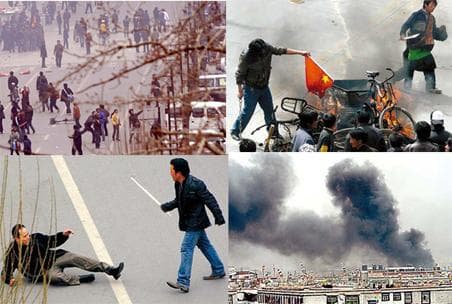
The Protests
On March 10, 2008 — the 49th anniversary of the 1959 Tibetan Uprising — monks began peaceful protests in Lhasa. Police detained some monks; the following days saw escalating demonstrations across Tibet, Qinghai, Gansu, and Sichuan. On March 14, protests in Lhasa turned violent: Han Chinese shops and businesses were attacked and burned. Chinese officials reported 18 deaths; Tibetan exile sources claimed a far higher toll from the subsequent security crackdown.
Olympic Torch Protests
The unrest occurred less than five months before the Beijing Olympics, when China was under intense international scrutiny. The Olympic torch relay became a global flashpoint: protesters disrupted the relay in Paris, London, San Francisco, and other cities, some attempting to grab the torch. French President Sarkozy suggested boycotting the opening ceremony; China accused Western governments of using Tibet as a pretext to undermine China's rise. The episode deepened Chinese nationalist sentiment and suspicion of Western motives.
Crackdown and Aftermath
China imposed a security crackdown across Tibetan areas, restricting access for foreign journalists and tourists for months. Beijing blamed the Dalai Lama for inciting the violence; he denied involvement and offered to meet Chinese leaders for dialogue, which was refused. The episode reinforced the Tibetan government-in-exile's international profile but produced no political concessions from Beijing.
Narrative Comparison
| Source | Narrative |
|---|---|
| PRC Official Narrative | On 14 March 2008, instigated by the Dalai separatist clique with the support of hostile forces abroad, a violent criminal incident of smashing, looting, and arson erupted in Lhasa, seriously endangering the lives and property of the people and undermining social stability. This was a concentrated outburst of the Dalai clique's long-term activities aimed at splitting the motherland and undermining national unity, and a conspiratorial act designed to exploit international attention surrounding the Beijing Olympics for political ends. The Party and government took decisive lawful measures, swiftly bringing the violent incident under control and protecting the lawful rights and interests of people of all ethnic groups. The facts demonstrate that Tibet has been an inseparable part of Chinese territory since ancient times, and that under the leadership of the Communist Party of China, the people of all ethnic groups in Tibet have achieved thoroughgoing democratic transformation and accelerated development. The interference by certain Western governments and media in China's internal affairs, in disregard of the facts, constitutes a grave affront to the feelings of the Chinese people and is firmly opposed by them. |
| Tibetan Government-in-Exile Official Narrative | On 10 March 2008, hundreds of monks staged a peaceful march in Lhasa to commemorate the 49th anniversary of the 1959 uprising; their arrest by the authorities triggered wider demonstrations that subsequently spread across Tibetan areas of Tibet, Qinghai, Gansu, and Sichuan. Documentation by the Tibetan government-in-exile indicates that the violence in Lhasa on 14 March occurred after the authorities used force against peaceful demonstrators, and that the Chinese authorities' figure of 18 deaths severely understated the actual casualties. The Dalai Lama issued clear public statements regarding the unrest: he expressed deep regret at any form of violence, called for an independent investigation, and proposed direct dialogue with Beijing to seek a negotiated resolution to the Tibetan question — an offer rejected by the Chinese authorities, who placed full responsibility for the events on him personally. The Central Tibetan Administration has stated that the protests arose from the long-standing cultural suppression, religious controls, and economic marginalisation endured by Tibetans, and had no connection with instigation by any external forces. |
| Western Academic Analysis | Western scholarly analysis of the 2008 Tibet unrest has concentrated on several dimensions. The first concerns historical context: the choice of 10 March — the 49th anniversary of the 1959 uprising — for the monks' protest was not coincidental; protests in Tibetan areas had recurred around this anniversary on multiple notable occasions across the intervening decades. The second concerns the uncertainty of casualty figures: because Chinese authorities blocked on-the-ground access by foreign journalists and diplomats, the gap between the official figure of 18 deaths and exile-source figures of dozens to hundreds has never been independently verified. The third concerns the Olympic political effect: the timing of the unrest, against the backdrop of the countdown to the Beijing Olympics, produced the highest-ever international media exposure for the Tibetan issue; the torch relay protests demonstrated that transnational Tibetan advocacy networks had developed the capacity to redirect international attention to specific issues. The fourth concerns subsequent developments: Beijing rejected the Dalai Lama's proposal for dialogue; since the 2010s, the systems of political control and surveillance in Tibetan areas have continued to intensify, and formal negotiations between Beijing and Tibetan political representatives in exile have remained at an impasse. |
Key Milestones
- Lhasa Monks Stage Peaceful Protest on 49th Anniversary of 1959 Uprising
On 10 March 2008 — the 49th anniversary of the 1959 Tibetan Uprising — hundreds of monks from Sera, Drepung, and Ganden monasteries marched peacefully through Lhasa, calling for the release of monks previously detained. The authorities deployed police to disperse the demonstration and detained a number of the participating monks; this response triggered wider protests that spread over the following days to other parts of Tibet and to Tibetan areas of Qinghai, Gansu, and Sichuan.
- Lhasa Riots Erupt; Han Businesses Attacked; Chinese Authorities Report 18 Deaths
On 14 March 2008, the protests in Lhasa escalated into large-scale riots: Han Chinese and Hui Muslim shops were attacked, looted, and set on fire, buildings were set alight, and dozens of vehicles were damaged. Chinese authorities reported an official death toll of 18, the majority being civilians killed in the rioting; exile Tibetan sources cited far higher figures and alleged that these included Tibetans who died in security operations.
- Olympic Torch Relay Disrupted in Paris; Route Substantially Shortened
On 7 April 2008, the Paris leg of the Beijing Olympic torch relay was met with large-scale protests. Demonstrators along the route made multiple attempts to seize the torch, forcing the organising committee to halt the relay five times, move the torch onto a bus, and ultimately curtail the route substantially, ending the event ahead of schedule. The London leg the day before had similarly encountered intense disruption, and the San Francisco leg on 9 April also had its route changed at short notice.
- Beijing Olympics Opens on Schedule; International Boycott Calls Fail to Coalesce
On 8 August 2008, the 29th Summer Olympic Games opened at the National Stadium in Beijing, with delegations from more than 200 countries and regions participating. International calls for boycotts prompted by the Tibet unrest, and the absence of some heads of state from the opening ceremony, did not coalesce into a collective boycott; President Sarkozy attended the ceremony.
Last verified: