Tianjin Port Explosions of 12 August 2015
Late on 12 August 2015 a fire at the dangerous goods warehouse of Ruihai International Logistics at Tianjin Port led to two explosions equivalent to about 450 tonnes of TNT. According to the State Council investigation, 165 people died (110 of them firefighters and police), 8 were missing and 798 injured, with direct losses of 6.866 billion yuan. The report found that self-igniting nitrocellulose set off illegally stored ammonium nitrate, that Ruihai had long operated illegally, and that several authorities had approved and supervised it improperly. In 2016, 49 people were convicted; the company chairman received a suspended death sentence.
The Explosions
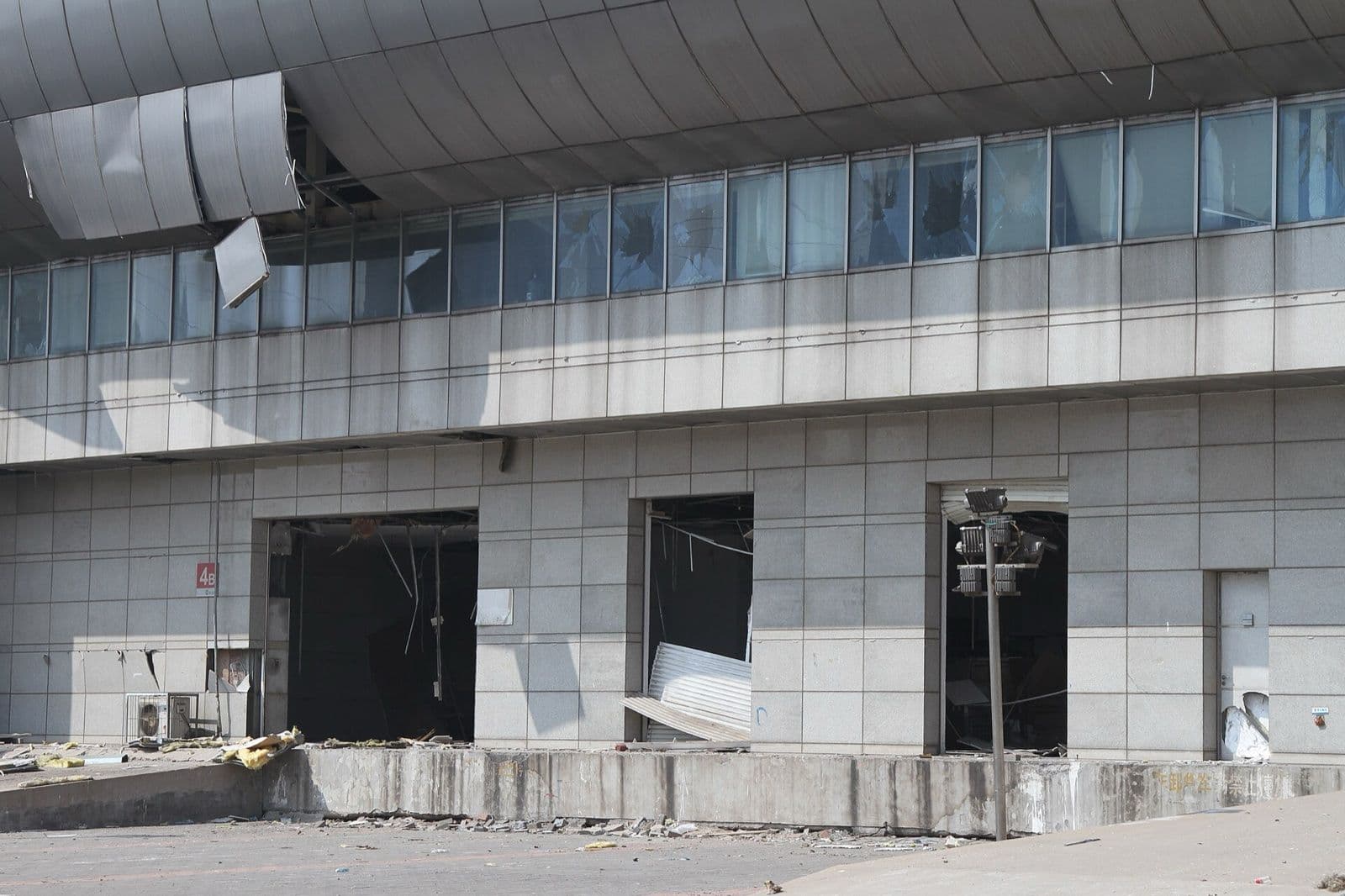
According to the State Council investigation report published in February 2016, at 22:51 on 12 August 2015 fire broke out in the customs holding area of the dangerous goods warehouse of Ruihai International Logistics at Tianjin Port in the Binhai New Area; at 23:34:06 a first explosion occurred and 31 seconds later a second, more violent one, equivalent to about 15 and 430 tonnes of TNT respectively. Six major fires and dozens of smaller ones burned until 16:40 on 14 August. The blast wave damaged doors and windows up to 13.3 km away.
Casualties and Losses
The report found that 165 people died — 24 active-duty public security firefighters, 75 Tianjin Port firefighters, 11 police officers, and 55 employees of the company and nearby firms and nearby residents — while 8 were missing and 798 hospitalised. 304 buildings, 12,428 new cars and 7,533 containers were damaged, and direct losses assessed as of 10 December 2015 were 6.866 billion yuan. At least 129 chemical substances exploded, burned or leaked, polluting local air, water and soil; water within about 2.3 km of the blast centre was contaminated mainly with cyanide.
Causes and Responsibility
The report found that the direct cause was nitrocellulose in a container in the holding area that had dried out as its wetting agent dissipated; in hot weather it decomposed, self-ignited and set fire to neighbouring chemicals, leading to the explosion of ammonium nitrate and other substances stacked there — 800 tonnes of ammonium nitrate were illegally stored in the holding area that day. It said Ruihai, founded in 2012, had "built before approval and operated while building", had at times handled dangerous goods without a licence, and handled more than 14 times its approved monthly throughput; one of its actual controllers, Dong Shexuan, "used his father's former position as head of the Tianjin Port Public Security Bureau to smooth approvals and supervision". It also faulted Tianjin's transport, customs, planning and work-safety authorities for unlawful approvals and lax supervision, including failure to review the safety distance between the warehouse and nearby housing, and acknowledged that after the accident "information disclosure and handling of public opinion were not timely or effective enough".
The investigation team recommended action against 123 people, including Party and administrative discipline for 74, five of them at provincial or ministerial rank; prosecutors opened cases against 25 officials. In November 2016 the Tianjin No. 2 Intermediate Court and nine other courts delivered first-instance verdicts in 27 cases against 49 defendants: Ruihai chairman Yu Xuewei was sentenced to death with a two-year reprieve for illegally storing hazardous substances and other crimes; vice-chairman Dong Shexuan, general manager Zhi Feng and others received life to 15 years; and 25 state functionaries received 3 to 7 years for dereliction of duty or abuse of power.
Rescuers and Information
The Tianjin Port firefighters who died belonged to an enterprise fire brigade outside the public security fire service. A local reporter later wrote that several press conferences gave no figures for Tianjin Port fire brigade casualties, and that relatives of its members at one point stormed a press conference, saying no one was attending to missing personnel "outside the establishment". According to the Beijing Times, in September some families of Tianjin Port firefighters who died received about 2.3 million yuan in compensation, and a first batch of 55 were recognised as martyrs. After the disaster many rumours about casualties and pollution circulated on Weibo, and state media and police issued rebuttals.
Gallery
Narrative Comparison
| Source | Narrative |
|---|---|
| State Council investigation report (Feb. 2016); Enorth expert interview (Nov. 2016) | The official investigation classed the disaster as a "particularly serious work-safety liability accident", placing primary blame on Ruihai's "serious illegal operations" and finding that several government departments had approved unlawfully and failed to supervise; it stressed that Xi Jinping issued instructions twice and that the centre ordered the cause "thoroughly investigated and those responsible strictly held to account", while conceding that information disclosure and handling of public opinion afterwards were "not timely or effective enough". After the trials, legal experts interviewed by official media said Yu Xuewei's suspended rather than immediate death sentence reflected lawful distinctions between charges, and that criminal liability for the heads of three units was "relatively rare in recent accident cases". |
| Zeng, Burgess & Bruns, Global Media and China 4(1), 2019 (abstract) | Western scholarship has focused on information and public opinion. Jing Zeng and colleagues at Queensland University of Technology (2019), studying Weibo after the blasts, found that rumour rebuttals by ordinary users drew more reposts and approval than official ones, that "the official narratives about the Tianjin blasts were challenged, and the credibility of the official rumour-debunking messages was commonly questioned", but that Weibo's community verification system had limited effect. |
| A Tianjin reporter's WeChat post (Aug. 2015, via China Digital Times); Beijing Times (10 Sept. 2015) | A local Tianjin reporter who entered the site wrote that the Tianjin Port police and firefighters who arrived first "had no establishment posts and were contract workers", that early press conferences gave no figures on their casualties, and that their relatives, complaining that "no one paid attention to families of those outside the establishment", stormed a press conference; he lamented that "without an establishment post, even death does not carry the same value". Later, some families of Tianjin Port firefighters received about 2.3 million yuan in compensation and some of the dead were recognised as martyrs. |
Key Milestones
- Fire and explosions at Ruihai warehouse
Fire breaks out at 22:51; two explosions at 23:34 release energy equivalent to about 450 tonnes of TNT.
- Fires extinguished
Open flames at the site are extinguished at 16:40.
- Investigation report published
The State Council team classifies it as a particularly serious work-safety liability accident: 165 dead, 8 missing, 798 injured, direct losses of 6.866 billion yuan.
- Verdicts for 49 defendants
Ruihai chairman Yu Xuewei receives a suspended death sentence; 25 state functionaries receive 3 to 7 years.
Last verified:
Cite this page
Chronicles of Modern China. (2026, October 24). Tianjin Port Explosions of 12 August 2015. Retrieved October 24, 2026, from https://www.cmcarchive.org/events/tianjin-port-explosion-2015
“Tianjin Port Explosions of 12 August 2015.” Chronicles of Modern China. Last modified October 24, 2026. Accessed October 24, 2026. https://www.cmcarchive.org/events/tianjin-port-explosion-2015.
Chronicles of Modern China. Tianjin Port Explosions of 12 August 2015[EB/OL]. (2026-10-24)[2026-10-24]. https://www.cmcarchive.org/events/tianjin-port-explosion-2015.