Taiwan's 2024 Elections and Lai Ching-te's Inauguration
On 13 January 2024 Taiwan held leadership and legislative elections. The DPP's Lai Ching-te and Hsiao Bi-khim won with 40.05% of the vote, giving the party more than eight consecutive years in power for the first time, while in the legislature the KMT won 52 seats, the DPP 51 and the TPP 8, leaving no party with a majority. Beijing's Taiwan Affairs Office said the result showed the DPP "does not represent mainstream public opinion", and US Secretary of State Antony Blinken congratulated Lai. Lai took office on 20 May, saying the ROC and PRC "are not subordinate to each other"; on 23–24 May the PLA Eastern Theater Command held the "Joint Sword-2024A" exercise around Taiwan.
Background
Tsai Ing-wen of the Democratic Progressive Party won Taiwan's leadership (ROC presidential) elections in 2016 and 2020. For 2024 the DPP nominated Vice President and party chairman Lai Ching-te with former representative to the United States Hsiao Bi-khim as running mate; the Kuomintang nominated New Taipei Mayor Hou Yu-ih with Jaw Shaw-kong, and the Taiwan People's Party nominated former Taipei Mayor Ko Wen-je with Cynthia Wu, making it a three-way race.
The Vote and the Results
On 13 January 2024 Taiwan held its leadership and legislative elections together. According to the Central Election Commission, about 19.55 million people were eligible to vote and turnout was 71.86%, down from 74.90% in 2020. Lai and Hsiao won with 5,586,019 votes, or 40.05%; Hou and Jaw took 33.49% and Ko and Wu 26.46%. Lai became the first vice president since direct elections began to be elected to the top post, and the DPP secured more than eight consecutive years in power for the first time.
In the simultaneous legislative election, of 113 seats the KMT won 52, the DPP 51, the TPP 8 and independents and non-party candidates 2, leaving no party with a majority.
At an international press conference that night Lai said that between democracy and authoritarianism Taiwan had chosen democracy and that its people had resisted interference by external forces. In accordance with the ROC constitutional order, he said, he would "maintain the status quo, neither humble nor overbearing", replacing containment with exchanges and confrontation with dialogue on the basis of parity and dignity, while remaining determined to protect Taiwan in the face of China's "verbal and military intimidation".
Reactions
On the evening of 13 January Taiwan Affairs Office spokesperson Chen Binhua said the results showed that "the DPP does not represent mainstream public opinion on the island", that the election would not change the basic landscape and direction of cross-Strait relations or stop "the trend that the motherland will eventually and inevitably be reunified", and that Beijing would adhere to the 1992 Consensus and resolutely oppose "Taiwan independence" separatist acts and external interference. The same day US Secretary of State Antony Blinken congratulated Lai and said Washington looked forward to working with him and leaders of all parties to further its longstanding unofficial relationship with Taiwan, consistent with the US one China policy.
The Inauguration and "Joint Sword-2024A"
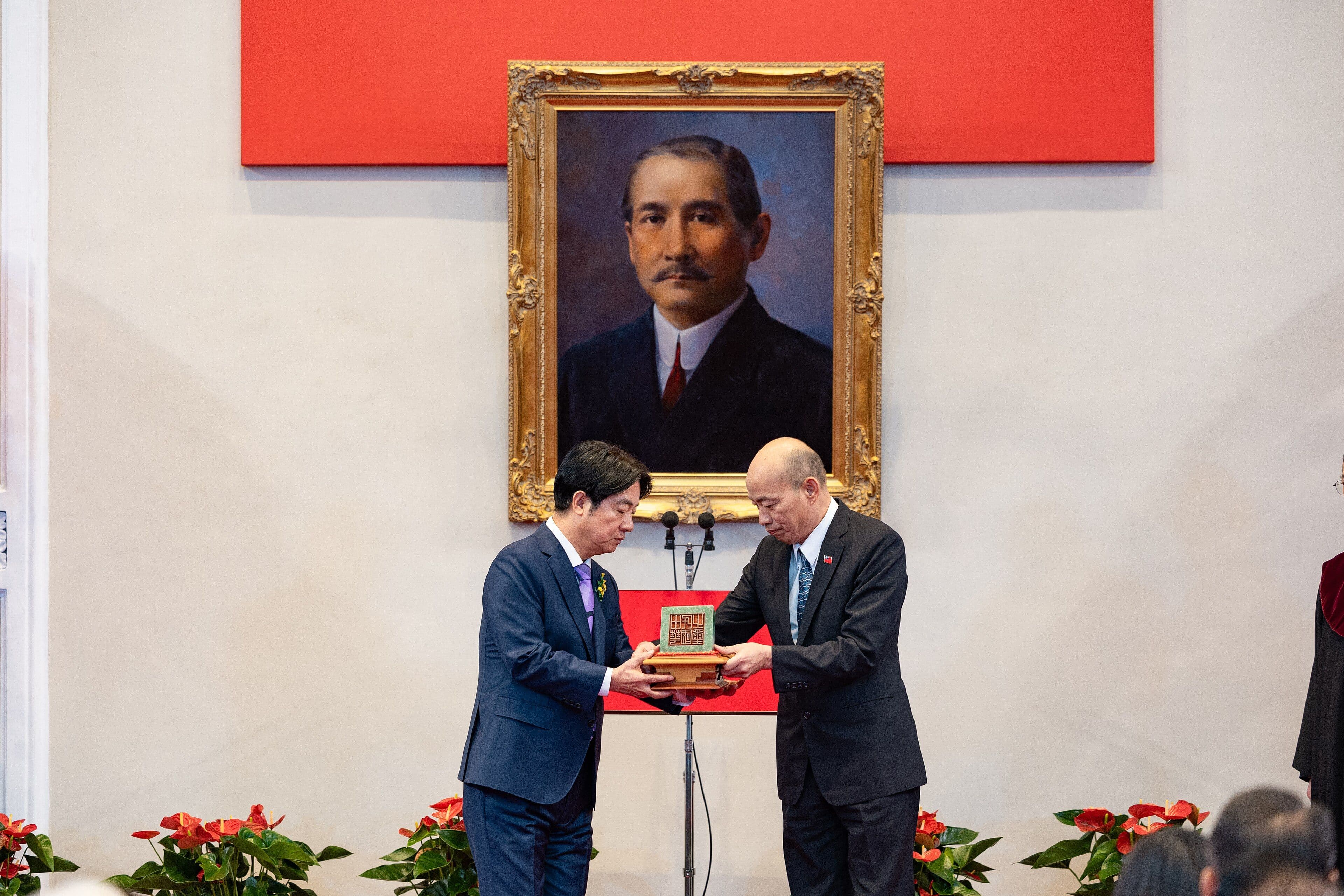
On 20 May 2024 Lai and Hsiao were sworn in, with Legislative Yuan Speaker Han Kuo-yu presenting the seals of office. In his inaugural address Lai said that "the Republic of China and the People's Republic of China are not subordinate to each other", called on China to cease its verbal and military intimidation of Taiwan, and proposed beginning with the resumption of reciprocal tourism and of mainland degree students studying in Taiwan.
On 23 and 24 May the PLA Eastern Theater Command deployed army, navy, air force and rocket force units around Taiwan for the "Joint Sword-2024A" exercise, practising joint sea-air combat-readiness patrols, the joint seizure of comprehensive battlefield control and joint precision strikes on key targets. A theater spokesman called it a stern punishment for the separatist acts of "Taiwan independence" forces and a serious warning against interference and provocation by external forces.
Gallery
Narrative Comparison
| Source | Narrative |
|---|---|
| Chinese mainland official position (Taiwan Affairs Office and Eastern Theater Command spokesmen) | The results of Taiwan's two elections show that the DPP does not represent mainstream opinion on the island. Taiwan is China's Taiwan; the election cannot change the basic landscape and direction of cross-Strait relations, still less stop the trend that the motherland will eventually and inevitably be reunified. The mainland will adhere to the 1992 Consensus embodying the one-China principle and resolutely oppose "Taiwan independence" separatist acts and external interference. After Lai took office, the "Joint Sword-2024A" exercise around Taiwan served as a stern punishment for the separatist acts of "Taiwan independence" forces and a serious warning against external interference and provocation. |
| Taiwan's position (Lai Ching-te's victory speech and inaugural address, CNA) | Between democracy and authoritarianism, Taiwan chose democracy, and its people successfully resisted interference by external forces because "we choose our own president". Maintaining peace and stability across the Strait is the president's important mission: in accordance with the ROC constitutional order, neither humble nor overbearing, the status quo will be maintained, with exchanges replacing containment and dialogue replacing confrontation on the basis of parity and dignity — but in the face of China's verbal and military intimidation there is also determination to protect Taiwan. The ROC and the PRC are not subordinate to each other; China should face the reality of the ROC's existence, and the two sides could begin with reciprocal tourism and degree students and pursue peace and common prosperity together. |
| US official response (Secretary of State Blinken's statement, 13 January 2024) | The United States congratulated Lai Ching-te on his victory and the people of Taiwan for once again demonstrating the strength of their robust democratic system and electoral process. Washington looked forward to working with Lai and Taiwan's leaders of all parties to advance shared interests and values and to further the longstanding unofficial relationship, consistent with the US one China policy. |
| Overseas research analysis (Richard C. Bush and Ryan Hass, Brookings Institution, 2024) | Richard C. Bush of the Brookings Institution argued that with no party holding a majority Taiwan's political system would be more fragmented than at any time since 2008, making governance complicated and requiring negotiation between the executive and legislature and among the parties. Ryan Hass cautioned against concluding that the risk of cross-Strait conflict had risen: Beijing would have preferred a different winner, but Lai won with only 40.05%, the lowest for a winning candidate since 2000, and his party lost control of the legislature, so he had no mandate to alter Taiwan's status and his party was not positioned to deliver such an outcome. |
Key Milestones
- Election day
Lai and Hsiao won with 40.05%; no party won a legislative majority; the Taiwan Affairs Office and the US Secretary of State responded.
- Lai sworn in
Lai and Hsiao took office; Lai's address said the ROC and PRC "are not subordinate to each other".
- Joint Sword-2024A exercise
The Eastern Theater Command held a two-day exercise around Taiwan, calling it punishment for "Taiwan independence" forces.
Last verified:
Cite this page
Chronicles of Modern China. (2026, November 2). Taiwan's 2024 Elections and Lai Ching-te's Inauguration. Retrieved November 2, 2026, from https://www.cmcarchive.org/events/taiwan-2024-election-lai-ching-te
“Taiwan's 2024 Elections and Lai Ching-te's Inauguration.” Chronicles of Modern China. Last modified November 2, 2026. Accessed November 2, 2026. https://www.cmcarchive.org/events/taiwan-2024-election-lai-ching-te.
Chronicles of Modern China. Taiwan's 2024 Elections and Lai Ching-te's Inauguration[EB/OL]. (2026-11-02)[2026-11-02]. https://www.cmcarchive.org/events/taiwan-2024-election-lai-ching-te.