Sunflower Movement (2014)
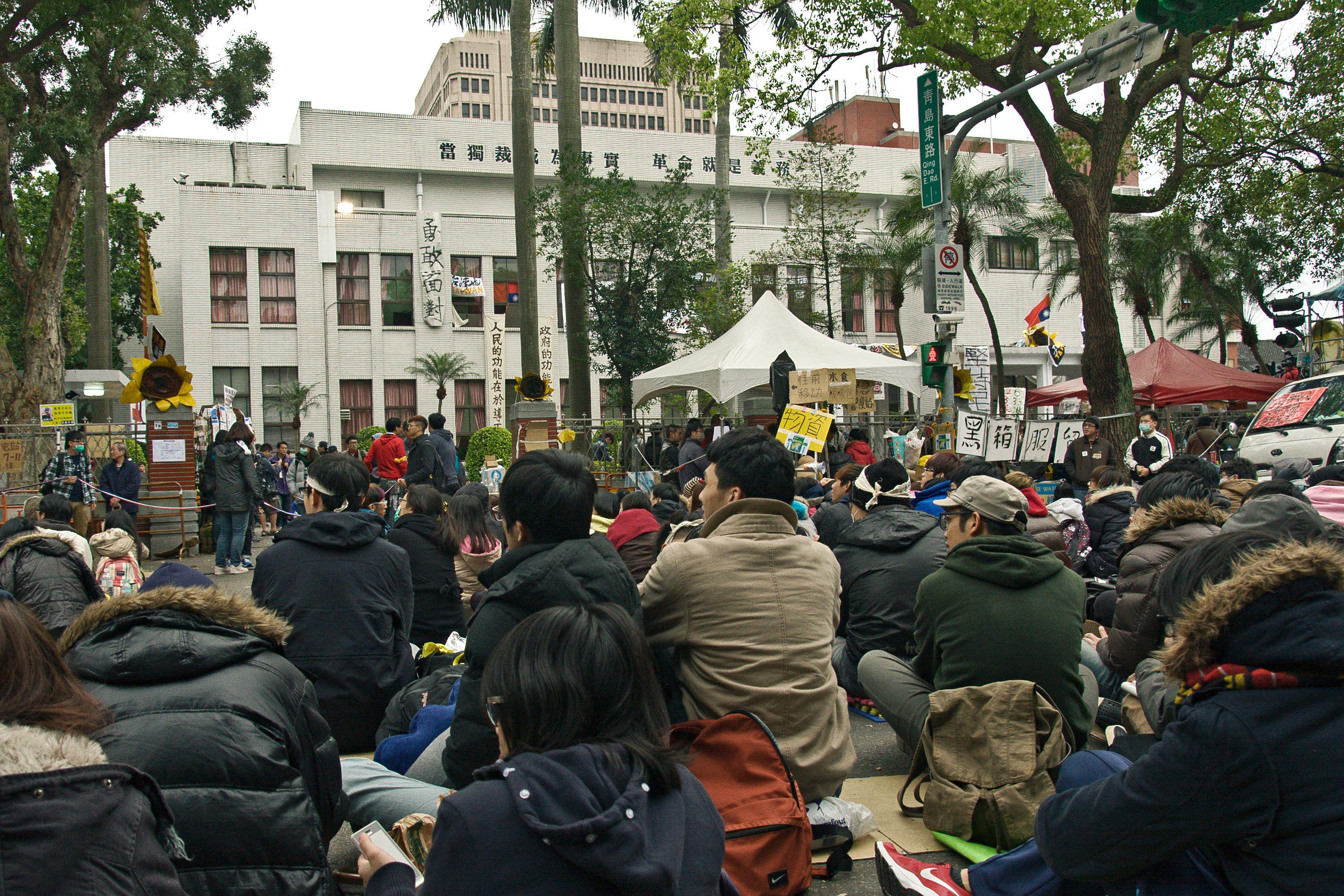
On 17 March 2014 KMT legislator Chang Ching-chung declared, in about thirty seconds, that a Legislative Yuan committee had finished reviewing the Cross-Strait Trade in Services Agreement and sent it to the plenary. The next evening students and civic groups opposed to the pact stormed the legislature and occupied its chamber for 24 days. On 23 March some protesters entered the Executive Yuan and were forcibly cleared by police early the next morning, with more than 500 injured; on 30 March an estimated 500,000 people rallied on Ketagalan Boulevard. President Ma Ying-jeou accepted a law on oversight of cross-strait agreements but refused to withdraw the pact; on 6 April Legislative Yuan President Wang Jin-pyng pledged no inter-party talks on it before the oversight law passed, and the students left on 10 April. Beijing’s Taiwan Affairs Office said compatriots did not want economic cooperation disrupted, and the US State Department called the agreement an issue for Taiwan to decide. Ratification of the agreement subsequently stalled.
The Services Agreement and the “Black Box” Controversy
On 21 June 2013 the two sides of the Taiwan Strait signed the Cross-Strait Trade in Services Agreement, one of a series of economic agreements concluded after the Economic Cooperation Framework Agreement (ECFA). According to the sociologist Ming-sho Ho, the public learned only a few days before the signing that Taiwan’s service sector was to be widely opened, and the details of the 64 service categories opened to mainland investment and personnel were announced after the agreement was finalised. The publisher Hao Mingyi was the first to oppose it, arguing that opening the printing industry while the mainland kept censoring Taiwanese books would devastate Taiwan’s publishing trade, and resigned as a presidential adviser.
On 25 June legislators of the Kuomintang (KMT) and the Democratic Progressive Party (DPP) agreed to review and vote on the agreement “article by article”. On 28 July a coalition of civic groups led by the lawyer Lai Chung-chiang formed the Democratic Front Against the Cross-Strait Trade in Services Agreement, and on 9 September students set up the Black Island Nation Youth Front. “Black box” became a common description of the negotiating process. Between July 2013 and March 2014 the Legislative Yuan held twenty public hearings.
“Thirty Seconds” and the Occupation of the Legislature
On the afternoon of 17 March 2014 KMT legislator Chang Ching-chung, the rotating convener of the Legislative Yuan’s Internal Administration Committee, was unable to reach the podium through a crowd of DPP legislators. Using a microphone he had brought, he announced that the committee review was complete and the agreement would go to the plenary, and adjourned the session within thirty seconds. Opponents saw this as a breach of the agreement to review the pact article by article.
At 9 p.m. on 18 March anti-agreement activists and students stormed the Legislative Yuan. About fifty climbed the walls while police were caught off guard and broke into the chamber; by 10 p.m. there were about 200, who erected barricades and formed a leadership core. News spread quickly online, and by midnight some 2,000 supporters had gathered on Qingdao East Road and Jinan Road outside, while the chairpersons of the DPP and the Taiwan Solidarity Union staged a sit-in in the courtyard. Ho notes that Legislative Yuan President Wang Jin-pyng at first appeared to agree to a police clearance but then took a more neutral position and did not allow police reinforcements; Wang was at the time in a legal battle with Ma Ying-jeou over Ma’s move to revoke his KMT membership.
The Executive Yuan Incident
At 7 p.m. on 23 March some protesters moved to the Executive Yuan, one block away, and launched a sit-in; thousands soon filled the square in front, and some broke into the building. According to President Ma, the protesters aimed to paralyse the Executive Yuan and occupied the building for nearly nine hours, a small number breaking doors and windows to enter offices and destroying public property; police evicted them in accordance with the law, causing minor injuries to members of the public and police. Ho records that from midnight on 24 March police used batons, shields and water cannon to disperse the crowd, that more than 500 protesters were injured, some with severe head injuries, and that 61 people were arrested and questioned; the government was criticised for “state violence”.
The student leaders in the chamber had kept their distance from the Executive Yuan action, describing it as independent. A year later student leader Chen Wei-ting said they had not expected so many people to break in, and that the prior understanding to distance themselves had been “a mistaken and overly naive decision”.
Ma’s Response and the Rally of 30 March
On 29 March Ma held an international news conference to respond to the students’ four demands. He praised the students holding a rational sit-in outside the Legislative Yuan but said it was “inappropriate to occupy the legislative chamber, bring legislative operations to a standstill, and destroy public property”. He pledged support for institutionalising oversight of cross-strait agreements and urged the parties to complete it during the current session, but rejected withdrawal of the agreement by the Executive Yuan, saying the issue had returned to an article-by-article review and vote. Citing the Chung-Hua Institution for Economic Research, he said the agreement could raise Taiwan’s services exports to the mainland by 37 percent and create up to 12,000 jobs, and that failure to pass it would damage Taiwan’s international credibility and its chances of joining regional trade agreements.
On 30 March protesters rallied on Ketagalan Boulevard in front of the Presidential Office; about 500,000 people were estimated to have taken part. Their four demands were to withdraw the agreement, to enact a law on oversight of cross-strait agreements, to pass that law before reviewing the agreement, and to convene a citizens’ constitutional conference. Before the closing speech the leaders decided to hold to their original demands.
Wang Jin-pyng’s Intervention and the Exit
On the morning of 6 April Wang Jin-pyng came to the occupied chamber and read a statement pledging not to convene inter-party negotiations on the agreement until the oversight law had been passed. The student leaders chose a cautious response—“not shouting slogans nor shaking hands with him”. On 7 April Ma issued a statement saying Wang’s position did not conflict with the government’s and affirming the students’ decision to withdraw; that evening the student leaders announced that the occupation would end three days later. On the evening of 10 April the protesters held a farewell rally and left the Legislative Yuan after 24 days.
Chen Wei-ting later reflected that decision-making in the chamber had not been democratic enough and that many felt the exit decision was rushed; after the 30 March rally, he said, public support had been like a pressure cooker, but “the exit decision would have been better if it had been more thorough.”
Reactions in Beijing and Washington
On 26 March Taiwan Affairs Office spokesman Ma Xiaoguang said Beijing had been following developments closely and that compatriots on both sides did not want the process of cross-strait economic cooperation disrupted. He called the agreement mutually beneficial, said concerns in Taiwan that mainland workers would pour in or that investment immigration could be bought were not borne out by the text, and said that most opinion on both sides believed “the reasons must be sought inside Taiwan”. On the timing of TAO Director Zhang Zhijun’s visit to Taiwan, he said the two sides were still communicating. At the same briefing he said that only by eliminating the toxin of “opposing the mainland on everything” could the DPP find a way forward.
On 24 March State Department deputy spokeswoman Marie Harf said the United States supported Taiwan’s vibrant democracy, that the services agreement was “an issue for Taiwan to decide”, and that it hoped the discussion could be conducted “peacefully and civilly”; she added that the United States welcomed steps taken by both sides of the Strait to reduce tensions and improve relations.
Consequences
After the movement the agreement’s review in the Legislative Yuan stalled. In August 2014 Ma acknowledged that the student movement had stalled ratification of the agreement and sparked heated debate over Taiwan’s economic autonomy. Zhang Zhijun visited Taiwan in June 2014, completing an exchange of visits with Mainland Affairs Council Minister Wang Yu-chi.
The American scholar Alan D. Romberg argued that the movement reflected broad anxiety in Taiwan society about deeper economic interaction with and dependence on the mainland, and for some a worry that a “certain inevitability regarding eventual unification was being created”; the DPP denied instigating the protests but gave them significant public support once they began. He suggested that Beijing’s subsequent emphasis on opposing Taiwan independence reflected concern that the movement was grounded in hostility toward the mainland. Ho argues that the movement originated from a tactical misstep by the ruling party, that a split within the KMT and opposition support allowed the students to seize the legislature, and that elite disunity helped them “manage a dignified exit”.
Gallery
Narrative Comparison
| Source | Narrative |
|---|---|
| President Ma’s news conference (29 March), meeting with Richard Bush (1 April) and statement (7 April), Office of the President | The Ma administration held that the agreement would stimulate Taiwan’s services sector, sustain economic vitality and prepare Taiwan for regional integration, and that failing to pass it would severely damage Taiwan’s international credibility. Ma praised the students’ rational sit-in outside the legislature but said it was “inappropriate to occupy the legislative chamber, bring legislative operations to a standstill, and destroy public property”, and described the Executive Yuan occupation as aimed at paralysing the government and lawfully cleared by police. He accepted a law institutionalising oversight of cross-strait agreements but refused to withdraw the pact, arguing that oversight legislation and article-by-article review could proceed together, and affirmed the students’ decision to leave. |
| TAO spokesman Ma Xiaoguang, press conference (26 March 2014) | The TAO said it was following events closely, stressed that cross-strait economic cooperation was meant to bring real benefits to Taiwan compatriots, called the agreement a good and mutually beneficial one, and said fears in Taiwan about mainland workers and investment immigration were unfounded. The spokesman said most opinion held that “the reasons must be sought inside Taiwan” and that no one on either side wanted to return to the tension and confrontation before 2008, while criticising the DPP for “opposing the mainland on everything”. |
| State Department deputy spokeswoman Marie Harf, daily press briefing (24 March 2014) | Washington treated the protests as an expression of Taiwan’s democracy, saying it supported “Taiwan’s vibrant democracy” while describing the agreement as “an issue for Taiwan to decide” and taking no position on it beyond hoping the discussion would be conducted “peacefully and civilly”. It reiterated its welcome for steps by both sides to reduce tensions, and said that to its knowledge it was offering no counsel to Ma’s government on handling the demonstrators. |
| Alan D. Romberg, China Leadership Monitor, no. 44 (2014) | Romberg traces the demonstrations to “long-simmering dissatisfaction among various student and other civic groups with the Ma administration”, reflecting broad anxiety in Taiwan about deeper economic interaction with and dependence on the mainland, and for some a fear that “a certain inevitability regarding eventual unification was being created”. The DPP denied instigating the protests but gave them significant public support. He reads Beijing’s strongly worded opposition to Taiwan independence afterwards as stemming from concern that the movement “was grounded in hostility toward the Mainland and aimed at Taiwan independence”. |
| Student leader Chen Wei-ting reflecting one year on (Newtalk, 18 March 2015) | Looking back a year later, student leader Chen Wei-ting admitted that the chamber students’ distancing from the Executive Yuan action was “a mistaken and overly naive decision”, and that decision-making inside the chamber had not been democratic enough, leaving many participants feeling the exit was rushed—“this is the most important point we must reflect on.” He described public pressure at the time as a pressure cooker and said: “Of course there should not be halos or stars monopolising decisions.” Fellow leader Lin Fei-fan likewise said that “more people should indeed have been given a chance to speak.” |
Key Milestones
- Services agreement signed
The two sides sign the Cross-Strait Trade in Services Agreement, opening 64 service categories.
- Parties agree to article-by-article review
KMT and DPP legislators agree to review and vote on the agreement article by article.
- Democratic Front formed
A coalition of civic groups led by lawyer Lai Chung-chiang is formed.
- The “thirty-second” review
Chang Ching-chung declares the committee review finished and sends the pact to the plenary.
- Students occupy the chamber
At 9 p.m. protesters storm the Legislative Yuan and occupy the chamber.
- Executive Yuan incident
Protesters enter the Executive Yuan; police clear it early on 24 March, injuring over 500.
- US State Department comments
Marie Harf calls the agreement an issue for Taiwan to decide and urges peaceful discussion.
- Taiwan Affairs Office responds
Ma Xiaoguang says compatriots on both sides do not want economic cooperation disrupted.
- Ma answers the four demands
Ma backs an oversight law but refuses to withdraw the agreement.
- Ketagalan Boulevard rally
An estimated 500,000 people rally in front of the Presidential Office.
- Wang Jin-pyng’s pledge
Wang pledges no inter-party talks on the pact before the oversight law passes.
- Students leave the legislature
Protesters hold a farewell rally and leave after 24 days.
Last verified:
Cite this page
Chronicles of Modern China. (2026, November 16). Sunflower Movement (2014). Retrieved November 16, 2026, from https://www.cmcarchive.org/events/sunflower-movement-2014
“Sunflower Movement (2014).” Chronicles of Modern China. Last modified November 16, 2026. Accessed November 16, 2026. https://www.cmcarchive.org/events/sunflower-movement-2014.
Chronicles of Modern China. Sunflower Movement (2014)[EB/OL]. (2026-11-16)[2026-11-16]. https://www.cmcarchive.org/events/sunflower-movement-2014.