Establishment of Sino-French Diplomatic Relations
On 27 January 1964 the People's Republic of China and the French Republic announced the establishment of diplomatic relations in a joint communiqué, making France the first major Western country to recognise the PRC. In October 1963 former French Prime Minister Edgar Faure, visiting privately with a handwritten letter from de Gaulle, agreed with Zhou Enlai and Chen Yi on a plan for direct recognition and a three-point "tacit understanding" on Taiwan. The Republic of China government broke relations with France on 10 February. The United States opposed the move and had urged Taipei not to break first.
Background
After the founding of the People's Republic of China, France continued to recognise the Republic of China government on Taiwan. During the 1954 Geneva Conference, French Prime Minister and Foreign Minister Pierre Mendès France met Zhou Enlai at the Chinese embassy in Switzerland on 19 June, the first time the two sides discussed establishing relations. According to Zhang Jinling of the Institute of European Studies, Chinese Academy of Social Sciences, Zhou told a French parliamentary delegation in November 1955 that China recognised one France and France should likewise recognise one China; in May 1957 former French Prime Minister Edgar Faure, visiting in a private capacity, was received by Mao Zedong. Charles de Gaulle became the first President of the Fifth Republic in January 1959. Beijing had regarded France's war in Algeria as an obstacle to relations; that obstacle was removed when France ended the Algerian War in 1962.
Faure's Visit and the "Main Points of Premier Zhou Enlai's Remarks"
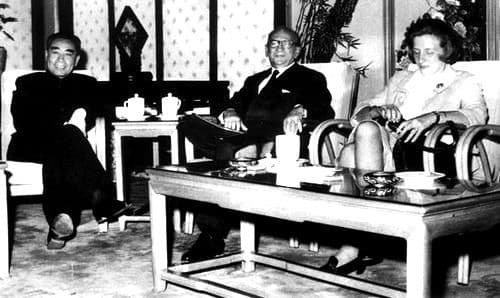
On 20 August 1963 Faure called on Ambassador Li Qingquan at the Chinese embassy in Switzerland and asked to visit China in a personal capacity; an invitation was issued in the name of the Chinese People's Institute of Foreign Affairs. De Gaulle wanted Faure to go as his representative and gave him a handwritten letter saying, "I fully trust everything you will say and hear"; China's Foreign Ministry describes the letter as "in fact written to the Chinese leaders". Faure arrived in Beijing on 22 October and held six rounds of talks with Zhou Enlai and Chen Yi in Beijing and Shanghai.
Taiwan was the crux of the talks. According to Zhang, Faure said it was difficult for France to cut all ties with Taiwan because de Gaulle had not forgotten standing with Chiang Kai-shek during the war; Zhou replied with a hypothetical foreign-backed regime opposed to de Gaulle, saying China would not on that account withhold recognition from the French government or "recognise both", and answered "impossible" to the idea of France keeping a low-ranking consular official on Taiwan. In early November (accounts give 2 or 3 November), the Chinese side set out a plan for direct recognition in a written document titled "Main Points of Premier Zhou Enlai's Remarks": France would send a note recognising the PRC government and proposing immediate relations and an exchange of ambassadors, China would reply welcoming it, and both notes would be published simultaneously. According to Ma Baofeng, a former counsellor in the Foreign Ministry's Protocol Department, the Chinese side also stated a "tacit understanding" on three points: France would recognise only the PRC government as the sole legal government representing the Chinese people; France would support the PRC's legitimate rights and status in the United Nations; and when Taipei withdrew its diplomatic mission from France, France would withdraw its own from Taiwan. Faure deleted wording in the first point that France would explicitly "no longer recognise" the authorities on Taiwan, substituting that this "automatically implies" the status no longer belonged to the government on Taiwan.
The Bern Negotiations and the Joint Communiqué
According to Ma, de Gaulle approved after hearing Faure's report on 29 November; from 12 December Jacques de Beaumarchais, head of the French Foreign Ministry's European Department, negotiated the communiqué's wording and timing with Li Qingquan in Switzerland. China's Foreign Ministry says the two sides finally agreed to announce relations first, with China issuing a statement on "one China" that France would tacitly accept. At 11:00 GMT on 27 January 1964 the two governments simultaneously released a joint communiqué: "The Government of the People's Republic of China and the Government of the French Republic have decided by common agreement to establish diplomatic relations. The two governments have agreed for this purpose to appoint ambassadors within three months." The next day the Chinese Foreign Ministry issued a statement saying that the Chinese government had reached the agreement as the sole legal government representing the entire Chinese people, that recognising a new government of a country "self-evidently means" no longer recognising the overthrown old ruling group, and reaffirming that Taiwan is Chinese territory.
On 31 January de Gaulle explained the decision at a press conference at the Élysée Palace. He spoke of "the inevitable difference of national policies" between the Soviet Union and China and said France "must be able to hear China directly"; at the same time he said the decision implied no approval whatsoever of the political system governing China, that France "simply recognises the world as it is", and that other governments still holding back would "sooner or later" follow its example.
Taiwan and the American Reaction
Declassified US records show that on 18 January Secretary of State Dean Rusk called in the Republic of China's ambassador, Tsiang Tingfu, telling him that Washington regarded de Gaulle's action as "almost intolerable", had lodged a strong protest with France, and advised Taipei to take no immediate retaliatory action and not to break with France first, so as to put Beijing "to maximum test". According to Ma, Chiang Kai-shek had written to de Gaulle on 24 December 1963; de Gaulle later sent Zinovy Pechkoff, his former ambassador in Chongqing, to Taipei to explain France's position to Chiang.
On 10 February the French chargé d'affaires in Taipei, Pierre Salade, told ROC Foreign Minister Shen Chang-huan orally that once Beijing's chargé arrived in Paris France would regard him as the representative of China, and the ROC mission in France would lose its raison d'être. Chiang told US Ambassador Jerauld Wright the same day that relations had been terminated by this French communication. The ROC Foreign Ministry records the break as 10 February 1964, with the mission closed on 12 February. The State Department afterwards expressed disappointment that Taipei's announcement had failed to put the onus for the break clearly on France. The first French ambassador to China, Lucien Paye, arrived in Beijing on 27 May, and the first Chinese ambassador to France, Huang Zhen, took up his post on 2 June.
Impact and Assessments
The historian Garret Martin notes that this was the first time since 1950 that a major power had recognised the PRC. China's Foreign Ministry says Western media called the event "a sudden diplomatic nuclear explosion". On 30 January Mao Zedong received a French parliamentary delegation and said China and France shared two fundamental points: opposing bullying by great powers, and exchanges in commerce and culture. According to Zhang, the first French technology exhibition opened in Beijing in September 1964; according to Ma, several African countries established relations with China that year, and Italy and Austria agreed with China to set up trade offices in each other's countries.
Gallery
Narrative Comparison
| Source | Narrative |
|---|---|
| PRC Foreign Ministry, "100 Stories of the CPC's External Relations" (2022); Zhang Jinling, World Affairs, 2024 no. 2 | Official Chinese accounts treat the establishment of relations as a major breakthrough for PRC diplomacy and a model of negotiation. A 2022 Foreign Ministry article calls the communiqué "the most concise and most uniquely worded" in the PRC's diplomatic history and describes China and France as "two countries pursuing independence in a bipolar world"; it stresses Zhou Enlai's position that there could "absolutely not" be "two Chinas", and says Mao and Zhou "upheld principle while showing flexibility", making the outcome "a masterpiece of negotiation and a first in diplomatic history". Zhang Jinling (2024) writes that it "broke through the barriers of the Cold War", making France the first major Western country to establish relations with the PRC. |
| FRUS 1964–1968, vol. XXX, docs. 5, 12, 13 (18 January – 12 February 1964) | The US government opposed the French decision publicly and privately. On 18 January Secretary Rusk told the ROC ambassador that Washington regarded de Gaulle's action as "almost intolerable", particularly given Chinese involvement in South Vietnam where US troops were taking almost daily casualties, and that de Gaulle's motives lay more in his "peculiar psychological make-up" than in serious analysis of French interests. US strategy was to have Taipei "stand fast" and not break first, forcing France to take responsibility and putting Beijing "to maximum test", making recognition "as difficult as possible for both Paris and Peiping". After Taipei announced the break on 10 February, the State Department expressed disappointment that it had not put the onus clearly on France. |
| ROC Foreign Ministry, Foreign Relations Yearbook 1999, Appendix 5; Chiang's remarks as recorded in US Embassy Taipei telegrams (FRUS 1964–1968, vol. XXX, docs. 11, 12) | The ROC government held firmly against "two Chinas" and broke relations once France made its position explicit. According to US records, Chiang Kai-shek said on 29 January that he "must have some way of reassuring his people that he will never agree to two-Chinas situation", and that had action been taken to recover the mainland three years earlier, French recognition would not have happened; after the French chargé's oral communication on 10 February he concluded that relations had ceased "by French action" and asked that President Johnson be told. The ROC Foreign Ministry records the break as 10 February 1964, with the mission closed on 12 February; unofficial ties were rebuilt only when France set up the "France-Asia Trade Promotion Association" in Taipei in 1978 and Taipei opened a representative office in Paris in 1980. |
| Martin, Journal of Cold War Studies 10(1), 2008 (abstract); Romano, Modern Asian Studies 51(1), 2017 (abstract) | Western scholars generally place recognition within de Gaulle's broader Cold War strategy. Using newly available archives, Garret Martin (2008) argues that while domestic political considerations helped spur de Gaulle, he was also determined to make France a world actor that could "forge a middle path" between the United States and the Soviet Union. Angela Romano (2017), drawing mainly on French archives, argues that successive French governments had since the mid-1950s used commercial diplomacy to open unofficial channels and quietly prepare recognition, driven by European competition for Beijing, concern about China's appeal to developing countries, an early reading of Sino-Soviet rivalry, and annoyance at Washington's Cold War outlook. |
| De Gaulle, press conference of 31 January 1964 (text from elysee.fr) | De Gaulle himself set out his reasons at the press conference of 31 January 1964: for fifteen years almost all of China had been gathered under one government that presented itself abroad as a sovereign and independent power, and "the weight of evidence and of reason growing day by day", France judged the time had come to put relations on a normal, diplomatic footing; no war or peace in Asia was imaginable without China, nor any neutrality arrangement for Southeast Asia. In the same remarks he paid tribute to the "valour, patriotism and nobility of soul" of Chiang Kai-shek, and stressed that recognition implied no approval whatsoever of China's political system: France "simply recognises the world as it is". |
Key Milestones
- Zhou and Mendès France first discuss relations
During the Geneva Conference, French Prime Minister and Foreign Minister Mendès France meets Zhou Enlai at the Chinese embassy in Switzerland; the two first discuss diplomatic relations.
- Faure asks to visit China
Faure calls on Ambassador Li Qingquan at the Chinese embassy in Switzerland and asks to visit China in a personal capacity.
- Faure arrives in Beijing
Faure arrives in Beijing with a handwritten letter from de Gaulle and holds six rounds of talks with Zhou Enlai and Chen Yi in Beijing and Shanghai.
- China presents the "Main Points of Premier Zhou's Remarks"
China gives Faure a written plan for direct recognition and states a "tacit understanding" on three points (some accounts date this 3 November).
- Joint communiqué on diplomatic relations
At 11:00 GMT the two governments simultaneously announce they have "decided by common agreement to establish diplomatic relations" and will appoint ambassadors within three months.
- Chinese Foreign Ministry statement
The statement says China reached the agreement as the sole legal government of the entire Chinese people and reaffirms that Taiwan is Chinese territory.
- De Gaulle's press conference
At the Élysée Palace de Gaulle explains the recognition, saying France "simply recognises the world as it is".
- Republic of China breaks relations with France
After the French chargé tells Taipei orally that its mission in France will lose its raison d'être, the ROC government announces the break the same day and closes its mission on 12 February.
- First ambassadors take up posts
France's first ambassador, Lucien Paye, having reached Beijing on 27 May, China's first ambassador to France, Huang Zhen, takes up his post on 2 June.
Last verified:
Cite this page
Chronicles of Modern China. (2026, October 24). Establishment of Sino-French Diplomatic Relations. Retrieved October 24, 2026, from https://www.cmcarchive.org/events/sino-french-diplomatic-relations-1964
“Establishment of Sino-French Diplomatic Relations.” Chronicles of Modern China. Last modified October 24, 2026. Accessed October 24, 2026. https://www.cmcarchive.org/events/sino-french-diplomatic-relations-1964.
Chronicles of Modern China. Establishment of Sino-French Diplomatic Relations[EB/OL]. (2026-10-24)[2026-10-24]. https://www.cmcarchive.org/events/sino-french-diplomatic-relations-1964.