Sichuan Earthquake
A magnitude 7.9 earthquake struck Sichuan province, killing nearly 70,000 people. The disaster exposed the "tofu construction" scandal involving poorly-built school buildings and prompted accountability campaigns by bereaved parents, which were subsequently suppressed by the authorities.
The Disaster
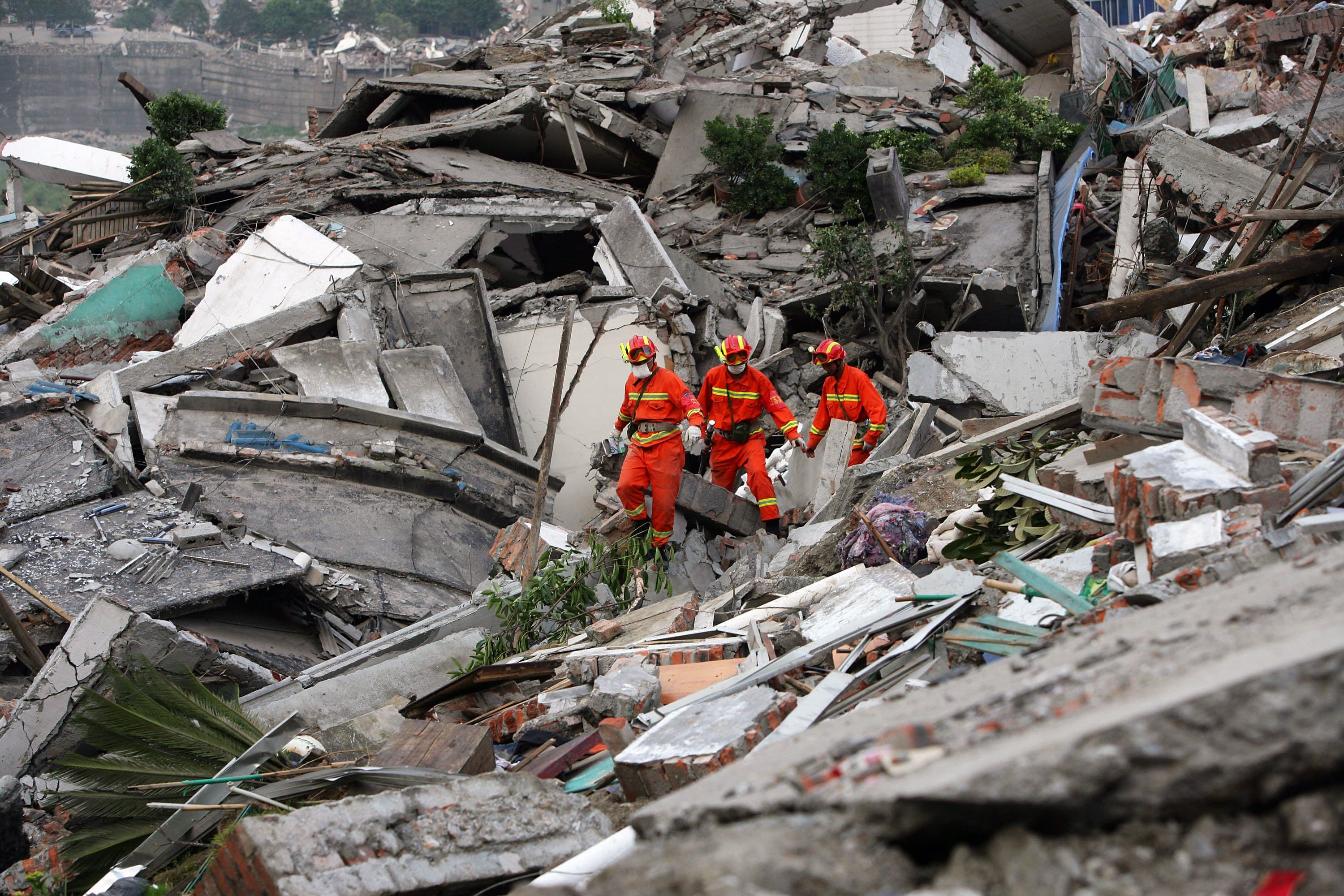
On May 12, 2008, a magnitude 7.9 earthquake struck Wenchuan County in Sichuan Province at 2:28 PM local time. It was the deadliest earthquake in China in over three decades. The official death toll reached 69,197, with 18,222 listed as missing and 374,000 injured. Entire towns were leveled. The earthquake's effects were felt as far as Beijing, Shanghai, and Vietnam. Aftershocks continued for months.
Response and Controversy
The Chinese government mounted a rapid, large-scale emergency response: Premier Wen Jiabao arrived at the disaster site within hours, and tens of thousands of PLA troops, police, and rescue workers were deployed. The government briefly allowed unprecedented openness in media coverage. However, significant controversy emerged over the collapse of thousands of school buildings while adjacent government and commercial structures survived. Parents of the estimated 10,000 student dead dubbed them "tofu-dregs schoolhouses" (豆腐渣工程), attributing the collapses to corrupt construction practices under official supervision.
Social Impact
Parents who organised to demand accountability for the school collapses were eventually suppressed; activist Tan Zuoren was imprisoned for investigating the deaths. The earthquake occurred just months before the Beijing Olympics, and the initial outpouring of national solidarity gave way to political tensions over accountability.
Narrative Comparison
| Source | Narrative |
|---|---|
| PRC Official Narrative | Following the Wenchuan earthquake, the Party Central Committee and the State Council immediately activated a Level-I emergency response. General Secretary Hu Jintao convened an emergency meeting of the Standing Committee of the Political Bureau to deploy relief operations, while Premier Wen Jiabao arrived at the disaster front line within hours to personally direct rescue efforts. The Party and government mobilised 140,000 PLA and People's Armed Police troops, together with large numbers of professional rescue teams and medical personnel, demonstrating the superiority of the socialist system in concentrating resources to accomplish major tasks. With regard to the collapse of certain school buildings, the relevant departments conducted lawful investigations and imposed penalties on those responsible for substandard construction; construction quality standards were comprehensively raised in post-disaster reconstruction. Three years later, reconstruction in the disaster areas was substantially completed and the living and production conditions of affected people were effectively restored. |
| Testimonies of Bereaved Parents | After pulling their children's bodies from the earthquake rubble, bereaved parents observed that school buildings reduced to rubble stood alongside government office buildings that remained intact, and began spontaneously compiling lists of deceased students and documenting discrepancies between actual death tolls at individual schools and official figures. Parents engaged lawyers to bring legal actions against responsible government officials and construction contractors, and organised joint letters demanding that authorities release the architectural drawings and construction inspection records of the collapsed school buildings. Their documentation indicated that school buildings constructed in the same batch had collapsed across multiple counties in a pattern that could not be attributed to isolated construction failures; some parents gathered specific evidence of kickbacks in tendering contracts. The accountability campaign was swiftly suppressed: parents who signed joint letters were called in for questioning by police, those who persisted in petitioning were pressured to sign agreements to cease their appeals, and Tan Zuoren, who had participated in documenting the deaths, was sentenced to five years' imprisonment in 2009. |
| Western Academic Analysis | Western scholarly and journalistic analysis of the Sichuan earthquake has concentrated on several dimensions. The first concerns the government's emergency response and image transformation: Premier Wen Jiabao's rapid personal appearance at the disaster site and his visible expressions of grief transformed the public image of Chinese leaders in crisis; compared with the handling of the 1976 Tangshan earthquake — where information was suppressed for decades — the relatively open media coverage of 2008 was widely interpreted as a significant shift in governance. The second concerns the systemic causes of the school building collapses: investigative journalists and independent researchers documented the collapse of large numbers of school buildings in the Wenchuan area while adjacent government structures generally remained intact — a pattern attributed to failures of oversight by local officials, corruption in construction contracts, and the prevalence of substandard construction at the county and township level. The third concerns the fate of civic accountability efforts: bereaved parents who spontaneously organised, signed joint petitions, and engaged lawyers to pursue accountability were subjected to systematic suppression — signatories were detained for questioning, advocacy lawyers were targeted, and Tan Zuoren, who had documented the names and numbers of students killed, was sentenced to five years' imprisonment in 2009. The fourth concerns the boundaries of media openness: the relative openness permitted in the immediate aftermath of the earthquake contracted rapidly once coverage of the lists of deceased students and school building quality was restricted, marking the limits of the government's tolerance in disaster reporting. |
Key Milestones
- Magnitude 7.9 Earthquake Strikes Wenchuan; Official Final Death Toll 69,197
At 14:28 on 12 May 2008, a magnitude 7.9 earthquake struck Wenchuan County in Sichuan Province, with a focal depth of approximately 19 kilometres. The earthquake caused the collapse of buildings across a wide area, with Dujiangyan, Beichuan, and Mianzhu among the worst-affected localities. Premier Wen Jiabao flew to the disaster area on the same day, and 140,000 PLA and People's Armed Police troops were immediately deployed in a large-scale search and rescue operation. The earthquake ultimately produced an official death toll of 69,197, with 18,222 listed as missing and more than 374,000 injured — the deadliest earthquake disaster in China since the 1976 Tangshan earthquake.
- Three Days of National Mourning Declared; Olympic Torch Relay Suspended
From 19 to 21 May 2008, China observed three days of national mourning: flags were flown at half-mast across the country, public entertainment activities were suspended, and major internet portal websites adopted black-and-white colour schemes. The ongoing domestic leg of the Beijing Olympic torch relay was also suspended. This was the first time in the history of the People's Republic that a national day of mourning had been declared for victims of a natural disaster, marking a significant shift in the government's approach to disaster commemoration.
- Tan Zuoren Sentenced to Five Years; Accountability Campaign Suppressed
On 12 August 2009, the Chengdu Intermediate People's Court sentenced citizen journalist Tan Zuoren to five years' imprisonment on charges of "inciting subversion of state power". Tan had spontaneously begun investigating and compiling lists of students killed at individual schools following the earthquake, and his documented death figures differed significantly from official figures. His defence lawyers were subsequently harassed by the authorities. Groups of bereaved parents who had continued to press for accountability were, around the same period, successively pressured into signing agreements to cease their appeals.
- On Third Anniversary, Post-Disaster Reconstruction Declared Substantially Complete
On 12 May 2011, the third anniversary of the Wenchuan earthquake, the Chinese government announced that the three-year post-disaster reconstruction programme had been substantially completed: approximately 1.5 million permanent housing units had been built, thousands of schools and hospitals had been rebuilt or repaired, and infrastructure had been restored to and in many cases improved beyond pre-earthquake levels. The reconstruction was advanced through direct central government funding and a paired-assistance mechanism whereby eastern provinces provided direct support to affected areas — a scale and pace of post-disaster reconstruction that was unusual by international standards.
Last verified: