Saudi–Iranian Rapprochement in Beijing
From 6 to 10 March 2023, Saudi and Iranian delegations held talks in Beijing hosted by China. On 10 March the three countries issued a joint statement announcing that Saudi Arabia and Iran, which had broken off relations in 2016, would resume diplomatic ties and reopen embassies within two months. Wang Yi, director of the CPC's Central Foreign Affairs Commission Office, presided over the opening and closing sessions and signed for China. The two foreign ministers met in Beijing in April, Iran reopened its embassy in Riyadh in June and ambassadors took up their posts in September; a trilateral joint committee set up to follow up on the agreement had met three times by the end of 2025.
The Rupture and Earlier Talks
On 2 January 2016 Saudi Arabia's interior ministry announced the execution of 47 people on terrorism charges, among them the Shia cleric Nimr al-Nimr. That night protesters in Tehran stormed the Saudi embassy. On 3 January Saudi Arabia announced that it was severing diplomatic relations with Iran and gave Iranian diplomats 48 hours to leave the kingdom.
In 2021–2022 Iraq and Oman hosted several rounds of talks between the two sides. On 7 December 2022 Chinese President Xi Jinping arrived in Riyadh to attend the first China-Arab States Summit and the China-GCC Summit and to pay a state visit to Saudi Arabia. On 14 February 2023 Xi held talks in Beijing with Iranian President Ebrahim Raisi, who was on a state visit, saying that China appreciated Iran's willingness to improve relations with its neighbours and supported countries in the region in resolving differences through dialogue. Ali Shamkhani, secretary of Iran's Supreme National Security Council, later said that Raisi's visit and his talks with Xi had paved the way for "fresh and very serious negotiations" between the Iranian and Saudi delegations.
The Beijing Talks and the Trilateral Statement
From 6 to 10 March 2023, delegations led by Musaad bin Mohammed Al-Aiban, Saudi Minister of State, cabinet member and National Security Adviser, and by Ali Shamkhani held talks in Beijing. According to China's foreign ministry spokesperson, Wang Yi, member of the CPC Politburo and director of the Office of the Central Foreign Affairs Commission, held talks with each side and presided over the opening and closing sessions.
On 10 March China, Saudi Arabia and Iran issued a joint statement. It said the talks were held in response to Xi Jinping's initiative of Chinese support for good-neighbourly relations between Saudi Arabia and Iran, and on the basis of an agreement between Xi and the two countries' leaderships that China would host and sponsor them; the two sides thanked Iraq and Oman for hosting rounds of dialogue in 2021–2022. The three countries announced that Saudi Arabia and Iran had agreed to resume diplomatic relations and reopen their embassies and missions within two months, affirming respect for state sovereignty and non-interference in internal affairs; their foreign ministers would meet to arrange the return of ambassadors, and the two countries would implement a 2001 security cooperation agreement and a 1998 general agreement on economy, trade, investment, technology, science, culture, sports and youth. The statement was signed by Wang Yi, Al-Aiban and Shamkhani.
After presiding over the closing session, Wang Yi told reporters that this was "a victory for dialogue and a victory for peace", adding that "the world is not only about the Ukraine issue" and that "the Middle East belongs to the people of the Middle East". In his closing speech Al-Aiban said the Saudi leadership's welcome for Xi's initiative stemmed from the kingdom's consistent commitment to good-neighbourliness and to resolving disagreements through dialogue and diplomacy. Iran's Tasnim News Agency quoted Shamkhani as calling the talks explicit, transparent, all-inclusive and constructive.
The same day John Kirby, the US National Security Council's coordinator for strategic communications, said Saudi Arabia had kept Washington informed of the talks but the United States was not directly involved; if the deal could be sustained and the war in Yemen could end, he said, "in the end we welcome that", but "it really does remain to be seen whether the Iranians are going to honor their side of the deal". Saudi Foreign Minister Prince Faisal bin Farhan later told Asharq Al-Awsat that the agreement reflected both sides' desire to "resolve disputes through communication and dialogue", but that "this does not mean that an agreement has been reached to resolve all pending disputes between them".
Restoring Relations
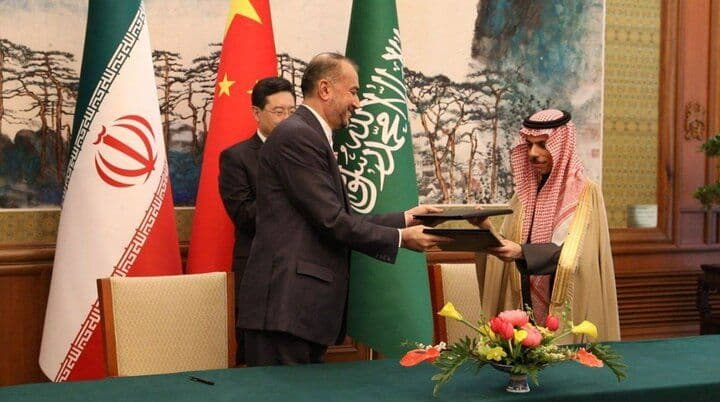
On 6 April 2023 Faisal and Iranian Foreign Minister Hossein Amir-Abdollahian met in Beijing, the first formal meeting between the two countries' top diplomats in more than seven years. Chinese State Councilor and Foreign Minister Qin Gang met the two ministers together and, after their meeting, witnessed their signing of a joint statement announcing the resumption of diplomatic relations with immediate effect.
On 6 June Iran held a ceremony reopening its embassy in Riyadh, followed by its consulate general in Jeddah and its office to the Organisation of Islamic Cooperation. On 5 September Iran's ambassador Alireza Enayati arrived in Riyadh, and hours later Saudi ambassador Abdullah Al Anazi arrived in Tehran. On 11 November Raisi travelled to Riyadh for an extraordinary meeting of OIC leaders on Gaza and was received by Crown Prince Mohammed bin Salman — the first visit by an Iranian president to Saudi Arabia in 11 years.
The Trilateral Joint Committee
To follow up on the Beijing Agreement, the three countries set up a trilateral joint committee. Its first meeting was held in Beijing on 15 December 2023, chaired by Chinese Deputy Foreign Minister Deng Li, with Saudi Vice Minister of Foreign Affairs Waleed El-Khereiji and Iranian Deputy Foreign Minister Ali Bagheri Kani leading their delegations; Saudi Arabia and Iran stressed their full commitment to implementing the agreement. At the second meeting, in Riyadh on 19 November 2024, the two reaffirmed their adherence to all its provisions. The third meeting, in Tehran on 9 December 2025, issued a joint press release calling for an immediate halt to Israel's aggression against Palestine, Lebanon and Syria and condemning the violation of Iran's sovereignty and territorial integrity.
Gallery
Narrative Comparison
| Source | Narrative |
|---|---|
| Chinese official position (Wang Yi's remarks to the press; foreign ministry spokesperson) | The Saudi-Iranian dialogue in Beijing achieved important results with the restoration of diplomatic relations — a victory for dialogue and for peace, and major good news for a turbulent world. It advanced on the basis of consensus among the leaders of China, Saudi Arabia and Iran, with President Xi Jinping's clear support from the outset, and was a successful practice of the Global Security Initiative; China, as a well-meaning and reliable mediator, faithfully fulfilled its duties as host. China has no selfish interests in the Middle East, respects the ownership of regional countries, opposes geopolitical competition there and has no intention of filling a so-called "vacuum" or forming exclusive blocs; the region's future should be in the hands of Middle Eastern countries. |
| Saudi official position (Al-Aiban's closing speech, Saudi Press Agency; Foreign Minister Faisal bin Farhan to Asharq Al-Awsat) | The Saudi leadership's welcome for President Xi Jinping's initiative to support good-neighbourly relations between Saudi Arabia and Iran stems from the kingdom's consistent commitment since its founding to good-neighbourliness, to strengthening regional and world security and stability, and to resolving disagreements through dialogue and diplomacy. The talks reviewed the causes of the two countries' disagreements and ways to handle them; the agreement's affirmation of respect for state sovereignty and non-interference in internal affairs is a basic pillar for developing relations between states and enhancing regional security. Foreign Minister Faisal bin Farhan said the deal reflected a shared desire to resolve disputes through communication and dialogue, but did not mean that all pending disputes had been resolved. |
| Iranian official position (Supreme National Security Council Secretary Ali Shamkhani, as reported by Tasnim News Agency) | Five rounds of preliminary negotiations hosted by Iraq and Oman contributed to the rapprochement, and President Raisi's February visit to Beijing and his talks with President Xi paved the way for fresh and very serious negotiations between the Iranian and Saudi delegations. The dialogue was explicit, transparent, all-inclusive and constructive; correcting misunderstandings and taking a future-oriented view of Tehran-Riyadh relations will promote regional stability and security and closer cooperation among the Persian Gulf states and the Islamic world in addressing existing challenges. China played a constructive role in supporting the expansion of ties among the countries. |
| US official response (John Kirby, National Security Council coordinator for strategic communications, 10 March 2023) | Saudi Arabia kept Washington informed about its talks with Iran, just as the US keeps Riyadh informed of its own engagements, but the United States was not directly involved. The White House believes internal and external pressure, including effective Saudi deterrence against attacks from Iran or its proxies, ultimately brought Iran to the table; the US supports any efforts to de-escalate regional tensions and has pursued this through its own combination of deterrence and diplomacy. If the deal can be sustained, the war in Yemen ends and Saudi Arabia no longer has to defend itself against attacks by the Iranian-backed Houthis, the US welcomes it — but it remains to be seen whether Iran will honour its side of the deal. |
| Overseas research analysis (Hamdullah Baycar, Sada, Carnegie Endowment, 2023) | Hamdullah Baycar, a doctoral candidate at the University of Exeter's Institute of Arab and Islamic Studies, argued that on closer inspection China's role was relatively insignificant and much more limited than media coverage indicated: the negotiations had been under way for a long time with the help of regional states, with Iraq and Oman both playing major roles, and the credit attributed to China was in effect a gift from Saudi Arabia and Iran. By involving China, both countries sought to signal to the United States that it could be replaced, though whether it actually would be remained debatable; Beijing did not appear willing, at least for now, to become more deeply involved in regional competition. |
Key Milestones
- Saudi Arabia cuts ties with Iran
After its execution of Shia cleric Nimr al-Nimr and the storming of its Tehran embassy by protesters, Saudi Arabia severed diplomatic relations with Iran.
- Xi Jinping arrives in Riyadh
Xi attended the first China-Arab States Summit and China-GCC Summit and paid a state visit to Saudi Arabia.
- Xi holds talks with Raisi
Iranian President Raisi made a state visit to China; Xi voiced support for regional countries resolving differences through dialogue.
- Agreement reached in Beijing
The Beijing talks ended with a trilateral statement announcing that Saudi Arabia and Iran would resume diplomatic relations and reopen embassies within two months.
- Foreign ministers meet in Beijing
Faisal bin Farhan and Amir-Abdollahian met in Beijing and signed a joint statement, the first formal meeting of the two countries' top diplomats in over seven years.
- Iran reopens its Riyadh embassy
Iran held a ceremony reopening its embassy in Riyadh.
- Ambassadors take up posts
Iranian ambassador Enayati arrived in Riyadh and Saudi ambassador Al Anazi in Tehran.
- Raisi visits Riyadh
Raisi attended an extraordinary OIC leaders' meeting and met the Saudi crown prince, the first visit by an Iranian president in 11 years.
- First trilateral committee meeting
The China-Saudi Arabia-Iran trilateral joint committee held its first meeting in Beijing to follow up on the Beijing Agreement.
- Second trilateral committee meeting
The second meeting was held in Riyadh; Saudi Arabia and Iran reaffirmed adherence to all provisions of the agreement.
- Third trilateral committee meeting
The third meeting was held in Tehran.
Last verified:
Cite this page
Chronicles of Modern China. (2026, November 2). Saudi–Iranian Rapprochement in Beijing. Retrieved November 2, 2026, from https://www.cmcarchive.org/events/saudi-iran-beijing-agreement-2023
“Saudi–Iranian Rapprochement in Beijing.” Chronicles of Modern China. Last modified November 2, 2026. Accessed November 2, 2026. https://www.cmcarchive.org/events/saudi-iran-beijing-agreement-2023.
Chronicles of Modern China. Saudi–Iranian Rapprochement in Beijing[EB/OL]. (2026-11-02)[2026-11-02]. https://www.cmcarchive.org/events/saudi-iran-beijing-agreement-2023.