Proclamation of the People's Republic of China
On October 1, 1949, Mao Zedong proclaimed the establishment of the People's Republic of China from Tiananmen Gate, ending the Chinese Civil War and beginning Communist Party rule.
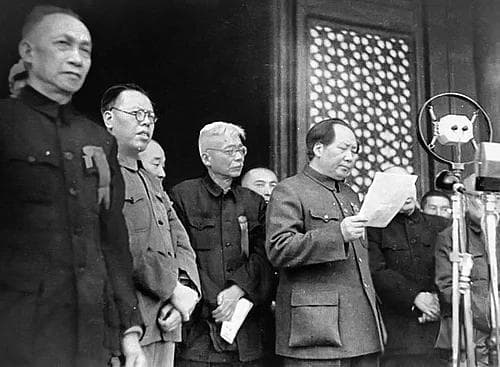
The Founding Ceremony
At 3 p.m. on 1 October 1949, Mao Zedong read the Proclamation of the Central People's Government of the People's Republic of China from atop Tiananmen Gate, formally declaring the establishment of the new state before an assembly of approximately 300,000 soldiers and civilians in Tiananmen Square. Zhu De then read out the order of the People's Liberation Army General Headquarters, placing the PLA under the unified command of the central government. Mao pressed a button to raise the first Five-Star Red Flag as the March of the Volunteers played, marking the formal birth of the new political order.
Building the State: The CPPCC and the Common Programme
The legal foundations of the new government had been laid at the First Plenary Session of the Chinese People's Political Consultative Conference, held from 21 to 30 September 1949. The conference adopted the Common Programme, which served as a provisional constitution, elected the Central People's Government Council, and determined the national flag, national anthem, capital (Beijing), and calendar system. Mao Zedong was elected Chairman of the Central People's Government; Zhu De, Liu Shaoqi, Soong Ching-ling, and others served as Vice-Chairmen. The Common Programme established a framework of multi-party cooperation under Communist Party leadership, retaining formal participation for several democratic parties as part of the united-front strategy that had characterised the Communist rise to power.
International Recognition and the Diplomatic Order
The Soviet Union recognised the People's Republic on 2 October 1949, followed quickly by the Eastern European people's democracies. Among Western nations, the United Kingdom extended recognition in January 1950, but the United States continued to recognise the Republic of China government on Taiwan and refused to recognise Beijing — a position that hardened after the outbreak of the Korean War in June 1950. The question of PRC representation at the United Nations was not resolved until 1971, when UN General Assembly Resolution 2758 transferred China's seat — including its permanent seat on the Security Council — from the Republic of China to the People's Republic.
Historical Significance and the Formation of the Cross-Strait Order
The establishment of the People's Republic of China brought the Chinese Civil War to a decisive, though not conclusive, end. The Republic of China government, having suffered military defeat on the mainland, withdrew to Taiwan in December 1949 and continued to assert its claim as the sole legitimate government of all China. The resulting division of the Chinese-speaking world into two rival states has persisted to the present day, making it one of the most enduring unresolved geopolitical questions in East Asia. For the Chinese Communist Party, 1 October 1949 represents the moment China "stood up" — the symbolic end of a century of humiliation; for Taiwan, it marks the continuation of civil war and the beginning of a contested claim to Chinese sovereign representation.
Narrative Comparison
| Source | Narrative |
|---|---|
| PRC Official Narrative | On 1 October 1949, the Chinese people stood up. On this day, the founding of the People's Republic of China brought a complete end to more than a century of humiliation and subjugation under imperialist aggression, and the Chinese people took their destiny into their own hands. Under the leadership of the Chinese Communist Party, the Chinese people fought for twenty-eight years to overthrow the three mountains of imperialism, feudalism, and bureaucratic capitalism, and established a people's democratic dictatorship — opening a new historical era for the great rejuvenation of the Chinese nation. At the founding ceremony, Chairman Mao Zedong solemnly announced to the world: the Chinese people have stood up. This is the greatest event in the history of the Chinese nation in modern times. |
| Republic of China / Taiwan Historical Assessment | The government of the Republic of China never surrendered to the Chinese Communist Party, nor did it abandon its commitment to the constitutional legitimacy of the Republic of China. What occurred in 1949 was a temporary military setback in a civil war, not the extinction of a state. The ROC government has continued to function under the constitution, exercising effective sovereignty over the Taiwan area and representing the unbroken continuation of the ROC constitutional order. The so-called "founding of the People's Republic of China" was a unilateral proclamation by the Chinese Communist Party after seizing power on the mainland by force — one that was neither the result of a free choice by all Chinese people nor brought an end to the legal existence of the Republic of China. The ROC government has always held as its mission the restoration of democratic constitutional governance for all Chinese people; the freedoms and rights guaranteed to the people under the ROC Constitution are today being realised and protected in Taiwan. |
| Western Academic Assessment | Western historians situate the founding of the People's Republic within a confluence of structural factors: the CCP's success in winning peasant support through land reform; the loss of urban middle-class confidence in the Nationalist government due to hyperinflation and corruption; Soviet material and diplomatic support for the Communists; and the way in which the Second Sino-Japanese War had fundamentally transformed China's political landscape. Scholars also note that the 'century of humiliation' narrative is itself a constructed historical discourse serving the CCP's legitimation needs rather than a neutral presentation of modern history. In terms of political form, what was established in 1949 was not a multi-party democracy but a party-state under single-party Communist rule. The cross-strait division that resulted from the civil war has also left the question of Chinese national identity among the most complex unresolved issues in international law and regional security. (Fairbank, 1992; Westad, 2003; Shambaugh, 2001) |
Key Milestones
- CPPCC First Plenary Session Opens
The Chinese People's Political Consultative Conference convened in Beijing, bringing together representatives of the Communist Party, democratic parties, and mass organisations to finalise preparations for the founding of the new state.
- Common Program Adopted
The CPPCC adopted the Common Program of the Chinese People's Political Consultative Conference, which served as the provisional constitution of the new state, defining the PRC as a "people's democratic dictatorship" led by the working class.
- Central People's Government Committee Established
The CPPCC elected Mao Zedong as Chairman of the Central People's Government, with Zhu De as Commander-in-Chief of the People's Liberation Army. The state apparatus of the new republic was formally constituted.
- Founding Ceremony at Tiananmen
Mao Zedong proclaimed the founding of the People's Republic of China from Tiananmen Gate before a crowd of 300,000. The Five-Star Red Flag was raised for the first time, and a 54-gun salute rang out — one shot for each of the 54 ethnic groups recognised at the time.
- Soviet Union First to Recognise the PRC
The Soviet Union became the first country to formally recognise the People's Republic of China, just one day after its founding. Eastern European socialist states followed within days. Western nations, led by the United States, refused recognition, deepening the Cold War divide.
- Republic of China Government Retreats to Taiwan
Chiang Kai-shek and the remnant Nationalist government completed their evacuation to Taiwan following the fall of Chengdu — the last major mainland city. The cross-strait division that persists to this day was thus established.
Sub-Events
Last verified: