The Marshall Mission and the Political Consultative Conference
In December 1945 the American envoy George C. Marshall arrived to mediate between the Nationalists and Communists. On 10 January 1946 the Conference of Three signed a cease-fire order and set up an Executive Headquarters in Beiping, and the Political Consultative Conference opened, reaching agreements on a coalition government, constitutional revision and army reorganisation within three weeks. The agreements were not implemented, fighting escalated in Manchuria, and relations broke down after the Nationalists convened the National Assembly in November. Marshall left China in January 1947; the parties still assign blame differently.
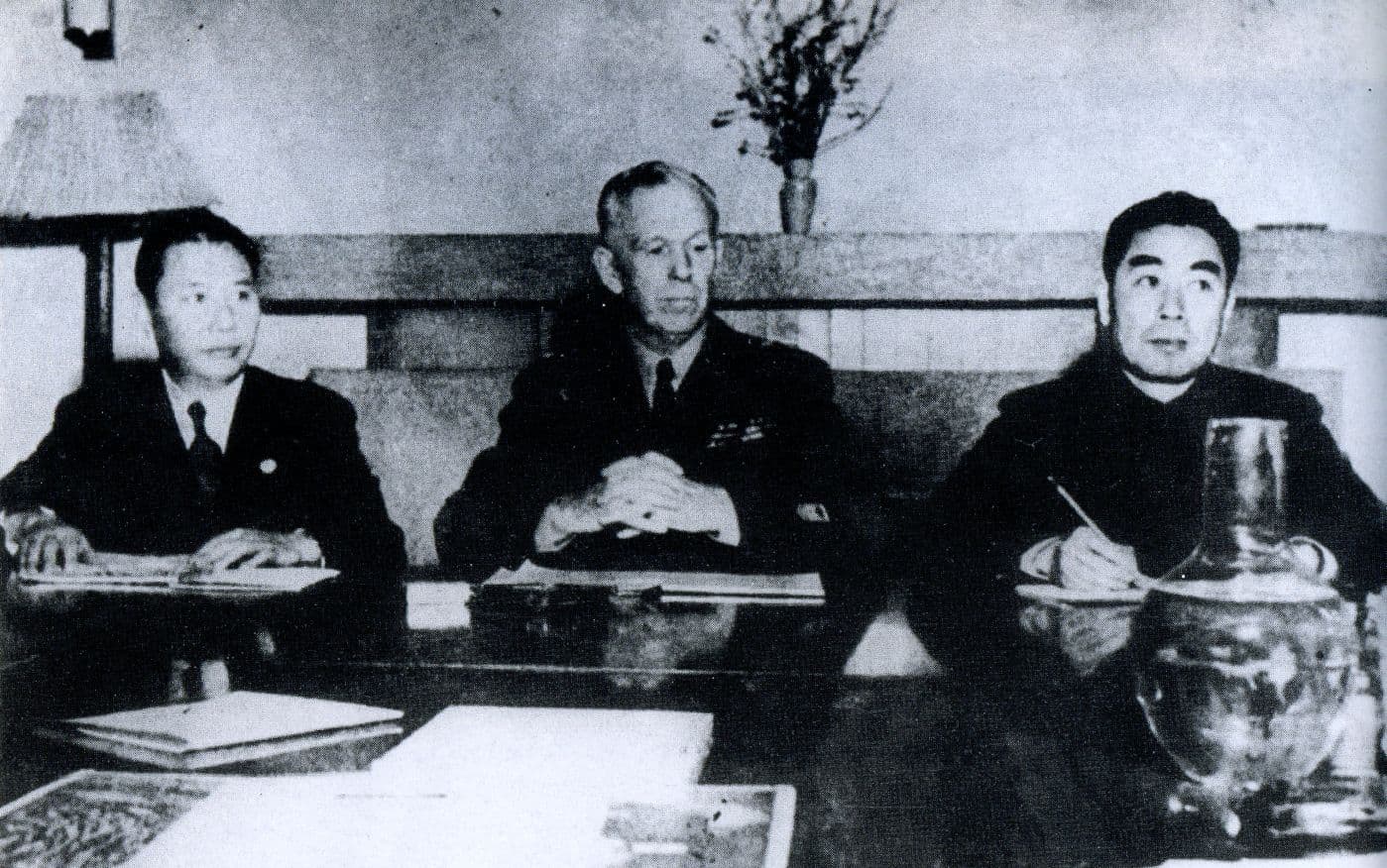
Marshall Comes to China
After the Chongqing negotiations produced the "Double Tenth Agreement" in October 1945, fighting between Nationalist and Communist forces continued. On 20 December 1945 General George C. Marshall, newly retired as U.S. Army Chief of Staff, arrived in China as President Truman's special envoy to mediate between the two sides. In his China policy statement of December 1946, Truman recalled that the United States believed "a united and democratic China is of the utmost importance to world peace" and that "a broadening of the base of the National Government to make it representative of the Chinese people" would further that goal; this statement had served as Marshall's directive.
The Cease-Fire Order and Executive Headquarters
On 10 January 1946 the Conference of Three — Marshall, Government representative Zhang Qun and Communist representative Zhou Enlai — met at Marshall's residence in Chongqing and signed the agreed cease-fire order, addressed to Chiang Kai-shek and to Mao Zedong. The order provided that "all hostilities will cease immediately" and established in Beiping an Executive Headquarters of three commissioners, representing the National Government, the Communists and the United States, to carry out the agreement. Truman noted that the Headquarters sent out truce teams, each with one American, one Government and one Communist officer, to trouble spots; U.S. Army personnel staffed the Headquarters and investigated clashes between the two sides.
The Political Consultative Conference
The same day the Political Consultative Conference opened in Chongqing, with representatives of the Nationalist Party, the Communist Party, the Democratic League, the Youth Party and independents. According to Truman, within three weeks the participants reached agreements providing for "an interim government of a coalition type with representation of all parties," for revision of the draft constitution along democratic lines before its adoption by a National Assembly, and for reduction of the Government and Communist armies and their eventual amalgamation into "a small modernized truly national army responsible to a civilian government." A study from National Taiwan University notes that under the influence of Marshall's mediation the Nationalists agreed to form a coalition government before the constitution was adopted.
Breakdown
Disputes soon followed. Truman said that by the time Marshall returned to China in April the truce was being disregarded; fighting escalated in Manchuria, where the Communists captured Changchun and the Government had not fully agreed to the presence of truce teams; and "the agreements made in January and February have not been implemented." On 15 November 1946 the Nationalists convened the National Assembly over Communist objections; according to the National Taiwan University study, relations between the two parties ruptured immediately, marking the end of Marshall's mission. In his December statement Truman said Marshall had remained at his post "even though active negotiations have been broken off by the Communist Party."
Marshall was recalled in January 1947 and, according to a study from National Chengchi University, left China on 8 January; before leaving he issued a long statement criticising both sides for lack of sincerity. In early February the United States withdrew its personnel from the Executive Headquarters. Marshall then became Secretary of State.
Differing Explanations for the Failure
The parties assign blame differently. An article on Chinese Social Sciences Net says that although the Nationalists agreed to the five PCC resolutions, "to maintain one-party rule" they "soon tore up the PCC resolutions" and convened the "constitution-making National Assembly." The Taiwanese scholar Wei Liang-tsai argues that Marshall, resentful of the recall of his friend Stilwell, was not impartial and misjudged Communist ambitions, and that his decision as Secretary of State to cut military and economic aid to the Nationalist government led to the Nationalist defeats of 1948 and 1949. The Eisenhower Presidential Library's archival description states that Nationalist and Communist officials "did not negotiate in good faith" and that the cease-fire attempts failed after several months.
Gallery
Narrative Comparison
| Source | Narrative |
|---|---|
| Chinese Social Sciences Net (2024) | Mainland official media blame the Nationalists: although they agreed to the five PCC resolutions, "to maintain one-party rule they soon tore up the PCC resolutions" and convened the "constitution-making National Assembly," "exposing the true face of Nationalist dictatorship"; the parties to the old PCC were "not in a truly equal relationship." |
| Wei Liang-tsai (Academia Sinica); studies from National Taiwan University and National Chengchi University | The Taiwanese scholar Wei Liang-tsai argues that Marshall "deeply resented China's leaders" over Stilwell's recall, which "seriously affected his impartiality," that he "misjudged the Communists' ambitions," and that his cutting off of aid as Secretary of State "led to the Nationalist defeats of 1948 and 1949." A National Taiwan University study notes more neutrally that relations ruptured once the Nationalists convened the National Assembly over Communist objections in November 1946. |
| Truman's China policy statement (December 1946); Eisenhower Presidential Library finding aid | Truman called the PCC agreements "statesman-like" but said "the agreements made in January and February have not been implemented" and that "active negotiations have been broken off by the Communist Party." The Eisenhower Library's archival description states that Nationalist and Communist officials "did not negotiate in good faith" and that the cease-fire attempts failed after several months. |
Key Milestones
- Marshall arrives in China
Marshall arrives as Truman's special envoy to mediate between the Nationalists and Communists.
- Cease-fire signed; PCC opens
The Conference of Three signs the cease-fire order and sets up the Executive Headquarters; the Political Consultative Conference opens the same day.
- National Assembly convened; talks rupture
The Nationalists convene the National Assembly over Communist objections, and relations rupture.
- Truman's China policy statement
Truman says the PCC agreements have not been implemented but Marshall remains at his post.
- Marshall leaves China
Recalled, Marshall leaves China after issuing a statement criticising both sides.
Last verified:
Cite this page
Chronicles of Modern China. (2026, November 3). The Marshall Mission and the Political Consultative Conference. Retrieved November 3, 2026, from https://www.cmcarchive.org/events/marshall-mission-1946
“The Marshall Mission and the Political Consultative Conference.” Chronicles of Modern China. Last modified November 3, 2026. Accessed November 3, 2026. https://www.cmcarchive.org/events/marshall-mission-1946.
Chronicles of Modern China. The Marshall Mission and the Political Consultative Conference[EB/OL]. (2026-11-03)[2026-11-03]. https://www.cmcarchive.org/events/marshall-mission-1946.